Custom Pocket Knife Sourcing: MOQ, Pricing Structure, and Landed-Cost Controls
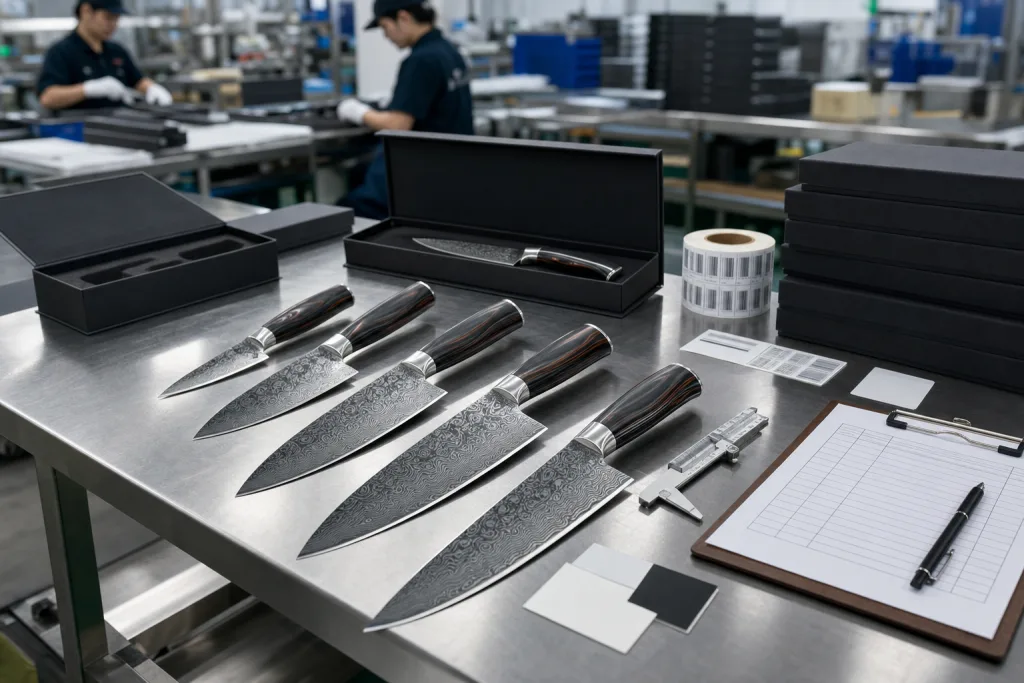
Custom Pocket Knife Sourcing: MOQ, Pricing Structure, and Landed-Cost Controls
**By Vincent Xi, Editorial Author** Author profile
Custom pocket knife programs are controlled less by brochure language and more by three commercial variables: **minimum order quantity (MOQ)**, **quote structure**, and **landed cost**. For importers, private-label brands, and retailers, unit price alone is a weak decision metric. Tooling amortization, steel and finish choices, packaging cube, inspection depth, freight mode, duties, and inventory carrying cost all change cost of goods sold.
This guide is for B2B buyers evaluating custom pocket knife OEM/ODM programs. It is structured around buyer actions:
1. Scope the program type before requesting quotes. 2. Separate pilot, production, and reorder MOQs. 3. Force multi-line pricing instead of a blended FOB number. 4. Build a landed-cost model from carton, freight, duty, and QC inputs. 5. Compare suppliers on engineering response and verification quality, not only price.
Where market statistics appear, they come from published secondary sources and are **industry context only**—not evidence of any one factory’s capacity, pricing, process window, or certification status. No Tangforge factory capability, product performance, client outcome, or certification claim is made in this article.
Market Context for Volume Scoping
China is frequently treated as a major hub for knife manufacturing scale and export logistics in secondary trade summaries. According to a B2B sourcing guide summarizing trade data, China exported **$1.66 billion** worth of knives in **2024**, representing **51.5% of global knife exports** (Lee Knives sourcing guide citing OEC World). The same guide reports total production of knives, scissors, and blades at **2.9 billion units** in that period, up **8% year-over-year**, based on IndexBox market overview material cited by that guide (Lee Knives sourcing guide).
Regional concentration matters for pocket-knife RFQs. The same secondary guide states that Yangjiang’s knife and hardware industry exceeded **55 billion RMB** in output value in **2024**, and that Yangjiang-made products are described as accounting for **eight out of every ten knives** China exports (Lee Knives sourcing guide citing China Daily). It also states Yangjiang accounts for roughly **70% of China’s total knife output** and about **85% of its knife exports**, with a dense local supply chain spanning stainless steel sourcing, heat treatment, handle fabrication, and export logistics (Lee Knives sourcing guide).
**Buyer takeaway:** these figures explain why capacity and variety are widely discussed in public sourcing literature. They do **not** prove that every supplier can run every steel grade, lock type, finish, or packaging configuration at the same MOQ. Verify process capability against your drawing package, sample plan, and acceptance criteria.
Define “Custom” Before You Ask for MOQ or Price
In B2B sourcing, “custom pocket knife” usually falls into one of three program types:
| Program type | What changes | Commercial implication | |---|---|---| | **Private-label / logo custom** | Brand marking, colorways, packaging, minor hardware | Lower tooling risk; faster first stock | | **Semi-custom OEM** | Blade profile, scales, lock geometry, clip, materials on a proven platform | Medium tooling and validation risk | | **Full custom / ODM** | New design, new tooling, new assembly process windows | Highest first-article risk and MOQ pressure |
Public manufacturer-education content on custom-knife production commonly separates concept design, steel preparation, heat treatment/tempering, grinding/finishing/assembly, and quality control as distinct stages (BiliKnife manufacturer overview). For commercial pocket knives, each stage that changes geometry, heat-treatment recipe, surface finish, or packaging can add setup time, scrap risk, and MOQ pressure. Treat that stage list as a process map for RFQ scoping—not as proof that any named factory runs every stage in-house.
Ethical and material-traceability requirements also appear more often in branded programs. Responsible-sourcing discussions for custom knives commonly focus on steel origin/traceability, handle materials (including wood and composites), labor practices, and documentation that supports brand claims (Shokunin USA ethical sourcing overview). If your brand markets recycled content, FSC-linked woods, conflict-mineral diligence, or social-compliance status, put documentary evidence requirements into the RFQ rather than accepting brochure language.
MOQ: What Actually Sets the Floor
MOQ is not a universal catalog number. It is the lowest order size at which a factory can cover setup, yield loss, and inventory risk for your specific bill of materials.
Drivers that raise or lower MOQ
- **Blade steel and heat-treatment batch size** — premium stainless or powder steels may require larger or more carefully controlled heat-treatment lots than commodity stainless. Ask for lot size, furnace type, and hardness verification method.
- **Handle materials** — G10, FRN, micarta, aluminum, titanium, wood, and stabilized organics have different machining, finishing, and scrap rates.
- **Lock and mechanism complexity** — liner lock, frame lock, button lock, and assisted-open systems change fixtures, assembly time, and function-test labor.
- **Surface finish** — stonewash, satin, DLC/PVD, anodizing, and laser marking create separate process queues and rework paths.
- **Tooling ownership** — new molds, dies, clips, and scale tooling often force higher first-run quantities so amortization is manageable.
- **Packaging and accessory kits** — retail boxes, sheaths, cards, multi-language inserts, and barcode work raise unit and batch costs.
- **Inspection depth** — AQL sampling is cheaper than 100% function checks; tighter cosmetic standards raise scrap and rework.
Secondary sourcing commentary on Chinese knife hubs notes that capacity can range from relatively small private-label runs to high-volume budget pocket knives in the same regional ecosystem (Lee Knives sourcing guide). Treat any published “500-piece” or “50,000-piece” illustration as **market context**, not a guaranteed quote for your SKU. Require the supplier to state MOQ against your exact BOM, finish, packaging, and inspection plan.
Use three MOQs in every negotiation
| MOQ type | What it covers | Buyer use | |---|---|---| | **Sample / pilot MOQ** | First-article or pre-production units for fit, finish, and function | Freeze golden samples before full production | | **Production MOQ** | First commercial run at quoted unit economics | Compare true launch cost | | **Reorder MOQ** | Ongoing replenishment after tooling is proven | Plan cash, safety stock, and replenishment |
If a supplier quotes one MOQ only, ask which of the three it is. Pilot and reorder economics often differ, and that difference should appear in the cost model before deposit decisions.
Technical acceptance items that should drive MOQ discussion
Write measurable criteria into the RFQ so MOQ is tied to process risk, not marketing grade language:
- Blade thickness and grind symmetry tolerances (buyer-specified on drawing)
- Pivot axial/radial play limits and lockup engagement criteria
- Hardness target range and verification method (e.g., lot coupon vs sample blade)
- Edge angle target and sharpening standard with photo boundary samples
- Scale fit gaps, clip retention, and detent consistency checks
- Cosmetic AQL classes with approved/rejected boundary samples
Do not treat “custom,” “premium,” or “collector grade” language as a specification. Retail category framing around custom/collector positioning describes product positioning more than factory process control (Knife Purveyor category framing).
Pricing Structure: How to Read the Quote
A usable quotation separates one-time program costs from recurring unit costs. If everything is rolled into a single “FOB price,” landed-cost control becomes guesswork.
One-time / program costs
- Design engineering / CAD conversion
- Soft tooling or hard tooling
- Prototype and pre-production samples
- Fixture and gauge development
- First-article inspection documentation
- Packaging structural design and print plates
- Compliance sample sets for destination-market testing
Recurring unit-cost buckets
- Blade steel blank and heat treatment
- Handle scales and hardware
- Pivot, washers/bearings, lockbar, detent, clip
- Grinding, finishing, sharpening
- Assembly and function testing
- Logo marking
- Individual packaging and master cartons
- Factory QC and packing labor
Example calculation (assumption to verify in supplier quote)
The following is an **illustrative example only**, not a market price survey and not a Tangforge offer:
- Tooling + sample package: **$2,400** one-time (example assumption; unit: USD; scope: first program only)
- Production MOQ: **1,000 pcs** (example assumption; unit: pieces; scope: first commercial run)
- Ex-works unit price: **$6.80/pc** (example assumption; unit: USD per piece; Incoterm must be confirmed)
- Tooling amortization if recovered over first run only: **$2,400 / 1,000 = $2.40/pc**
- Fully loaded first-run factory cost before logistics: **$6.80 + $2.40 = $9.20/pc**
If the same tooling is amortized over a planned annual volume of **5,000 pcs**, amortization falls to **$0.48/pc**. That is why pricing structure and demand planning must be discussed together. Label amortization math as a planning model until the supplier confirms tooling ownership, lifetime, and maintenance responsibility.
Quote red flags
- One blended price with no BOM or process assumptions
- No steel grade equivalent stated (or only marketing names)
- No hardness target / heat-treatment method
- No tolerance stack-up on blade thickness, pivot fit, and lock engagement
- Packaging “included” without dieline, material, or print count
- Lead time stated without production calendar, material lead time, or inspection hold points
- Any certification, test, or ethical claim without a current document, scope, and date
Landed-Cost Controls for Importers
Landed cost is the total cost to place sellable inventory in your warehouse or 3PL. Controllable levers usually include:
1. **Incoterms** — EXW, FOB, CIF, and DDP allocate freight, insurance, customs clearance, and risk differently. 2. **Freight mode** — air for launch samples and stockouts; ocean for replenishment. 3. **Carton density** — blade guards, inserts, and retail packaging can sharply change volumetric weight. 4. **Duty classification and origin documentation** — confirm HS code strategy and country-of-origin paperwork with your broker. 5. **Inspection timing** — pre-shipment inspection reduces expensive inbound rejection after ocean transit. 6. **Inventory policy** — over-ordering to “hit a lower unit price” can erase savings through carrying cost and markdown risk. 7. **Defect and warranty reserves** — budget for returns, reseating, and cosmetic rejects rather than assuming zero failure.
Example landed-cost skeleton (assumption model)
These are **example placeholders** for RFQ comparison, not published market rates and not supplier quotes:
| Cost element | Example assumption | Notes | |---|---:|---| | Ex-works / FOB unit price | $7.50 | Confirm Incoterm exactly | | Ocean freight allocation | $0.45 | Depends on carton cube and lane | | Insurance | $0.05 | Cargo value and coverage terms | | Duties / fees | $0.90 | Broker-confirmed classification | | Destination handling / 3PL inbound | $0.20 | Local terminal and receiving | | QC reserve / expected rework | $0.25 | Based on AQL history | | **Estimated landed unit cost** | **$9.35** | Planning figure only |
Require suppliers to quote packaging outer dimensions, net/gross weight, units per inner, and units per master carton. Without cube data, freight is not controllable.
Buyer Decision Table: Choose the Program Path First
| Decision factor | Logo / private-label on existing platform | Semi-custom OEM | Full custom ODM | |---|---|---|---| | Typical development risk | Lower | Medium | Higher | | Tooling exposure | Low to moderate | Moderate | High | | MOQ pressure | Often lower | Medium | Often higher | | Speed to first sellable stock | Faster | Moderate | Slowest | | Differentiation | Branding and finish | Form + materials | Highest product uniqueness | | Best when | Market entry with controlled spend | Recognizable but distinct SKU | IP-defining geometry or mechanism | | Main cost control lever | Packaging + finish + volume ladder | Shared platform parts + selective tooling | Phased prototypes + staged tooling release | | Main verification need | Color/logo consistency, function AQL | Lock geometry, heat treat, scale fit | Full FAIR, process capability, reliability testing |
Use this table in internal go/no-go meetings **before** tooling deposits. The risk rankings are procurement heuristics, not measured factory benchmarks.
Standards, Claims, and Documentation Discipline
Name standards only when they apply to your destination market and product claims. A standard’s requirement is not the same as a factory’s current practice, and a certificate is not current unless you have a valid document with scope and date.
Depending on market and claims, buyers may need to verify:
- Material declarations and restricted-substance compliance for coatings, handle resins, and packaging inks
- Mechanical function and safety expectations for folding knives in the destination jurisdiction
- Marking, origin, and labeling rules
- Any social-compliance or environmental claims used in retail storytelling
Ethical-sourcing literature for custom knives emphasizes responsible material choices and supplier diligence as brand-risk controls, not as automatic product quality guarantees (Shokunin USA ethical sourcing overview). If you require recycled steel content, sustainable wood chain-of-custody, or audited labor conditions, put those requirements in the RFQ and demand documentary evidence tied to the production lot.
This article does **not** assert that any supplier, including any Tangforge-related entity, holds a named certification, passes a named test method, or meets a named standard.
Practical RFQ Checklist
Send this with drawings and reference samples.
1) Product definition
- [ ] Intended use case (EDC utility, outdoor, promotional gift, retail premium, etc.)
- [ ] Open/closed dimensions and weight targets
- [ ] Blade steel grade (or approved equivalents) and hardness target range
- [ ] Blade grind, edge angle target, and finish standard with photos
- [ ] Lock type and function criteria (play, stick, lockup, detent feel)
- [ ] Handle material, texture, color tolerance, and scale fastening method
- [ ] Hardware finish and corrosion-resistance expectation
- [ ] Clip style, tip-up/tip-down, left/right options
- [ ] Logo method and artwork files (laser, etch, print, medallion)
2) Commercial structure
- [ ] Target annual volume and first-order quantity
- [ ] Requested pilot MOQ, production MOQ, and reorder MOQ
- [ ] Incoterm and destination port/warehouse
- [ ] Separate lines for tooling, samples, unit price tiers, packaging, and spare parts
- [ ] Payment terms tied to sample approval and inspection milestones
- [ ] Tooling ownership, storage, and maintenance responsibility
3) Quality and process control
- [ ] Critical-to-quality dimensions and gauges
- [ ] Cosmetic standard with boundary samples
- [ ] AQL plan by defect class, plus any 100% checks
- [ ] Heat-treatment verification method
- [ ] Corrosion, drop, cycle, or salt-spray tests only if required by your brand protocol
- [ ] Pre-shipment inspection rights and hold points
4) Packaging, compliance, and logistics
- [ ] Retail pack vs bulk pack
- [ ] Barcode, warning labels, and language requirements
- [ ] Carton markings and drop-test expectations
- [ ] Units per carton and palletization plan
- [ ] Document pack: packing list, invoice, material declarations, certificates if applicable
- [ ] Lead time broken into material, production, finishing, inspection, and shipping
5) IP and communication control
- [ ] NDA and drawing ownership terms
- [ ] Approved supplier communication channel and revision control
- [ ] Golden sample retention at buyer and factory
- [ ] Change-control rule: no material/process change without written approval
How to Compare Suppliers Without Over-Weighting Unit Price
A lower FOB number can still produce a higher landed cost if scrap, delays, or packaging density are worse. Score suppliers on a balanced card:
1. Engineering response quality to your drawing package 2. Transparency of cost breakdown 3. Sample-to-production consistency plan 4. Inspection documentation quality 5. Packaging and cube efficiency 6. Lead-time realism and capacity explanation 7. Willingness to separate tooling ownership and maintenance 8. Evidence quality for any compliance or ethical claim
Where possible, request a process flow chart for your exact SKU: blanking/stock removal, heat treat, grind, finish, assembly, function test, pack. Manufacturing process overviews for custom knives commonly highlight that heat treatment, grinding/finishing, assembly, and QC are separate risk points (BiliKnife manufacturer overview). Map cost and inspection to those points during quote review.
Methodology Note: How This Article’s Evidence Was Derived
This article synthesizes publicly available secondary sourcing and industry-education material relevant to custom knife manufacturing and B2B knife export hubs. Market-scale statistics and regional concentration figures are attributed to the Lee Knives B2B sourcing guide and the third-party references it cites for **2024** trade and production context (Lee Knives sourcing guide). Process-stage framing for custom knife manufacturing is informed by publicly available manufacturer-education content describing design-to-QC workflows (BiliKnife manufacturer overview). Ethical-material diligence themes are drawn from publicly available ethical-sourcing discussion for custom knives (Shokunin USA ethical sourcing overview). Retail category language around custom/collector positioning is referenced only to distinguish marketing categories from factory specifications (Knife Purveyor).
No factory audit, price survey, laboratory test, customer case study, or first-hand production observation was conducted for this article. Numerical price, amortization, and landed-cost figures shown above are explicitly labeled example calculations for RFQ planning and must be verified in supplier quotes and broker estimates.
Limitations and What Buyers Should Verify
- Export and production statistics describe national or regional industry scale; they do not validate any single supplier’s MOQ, lead time, or quality system.
- Published hub descriptions can become outdated; confirm current capacity and process capability during quotation and sample review.
- Example cost models are not quotes. Freight, duty, steel surcharges, and packaging costs move with lane, season, and material markets.
- Ethical or sustainability claims require lot-level or certificate-level evidence; marketing copy is insufficient.
- Destination-market knife regulations, age-restricted sales rules, and restricted-feature rules vary by country and locality; confirm with qualified counsel/compliance advisors before launch.
- Any standard, test method, or certification named in a supplier claim should be checked against a current document, scope, and date. This article does not assert certification status for any company.
- Process-stage descriptions from public manufacturer-education pages are general workflow maps, not audited process capability statements for a specific plant.
Closing Guidance for Procurement Teams
For custom pocket knife programs, treat MOQ as a process-cost threshold, pricing as a multi-line structure, and landed cost as a system of packaging, logistics, inspection, and inventory decisions. Start with a precise RFQ, force transparent cost buckets, run a pilot that freezes golden samples, and only then scale volume ladders.
Buyers who control documentation—drawings, acceptance criteria, tooling ownership, carton cube, and inspection rights—usually control margin. Buyers who negotiate only unit price often discover the real cost after the first ocean container arrives.
**Editorial note:** This article is prepared under the byline of Vincent Xi, Editorial Author for Tangforge. It is an evidence-bound sourcing guide based on cited public sources and standard procurement practice. It does not claim personal factory visits, proprietary test results, client outcomes, years of experience, or certifications beyond the referenced materials.