How to Draft a Pocket Knife Material and Performance Specification for Wholesale RFQs
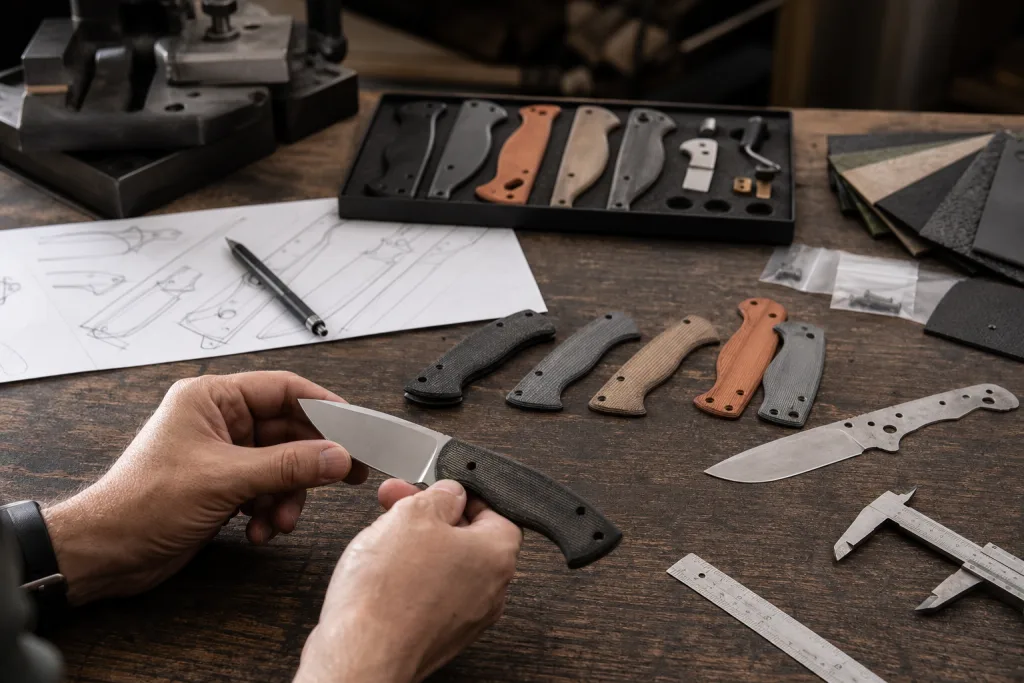
How to Draft a Pocket Knife Material and Performance Specification for Wholesale RFQs
A quote-ready pocket knife specification connects each controlled material, process, dimension, and performance requirement to evidence and an acceptance decision. Naming a blade steel, handle material, finish, or lock type is not enough. The RFQ must state how conformity will be verified, how production will be sampled, and what happens when a result falls outside the limit.
This article covers product-specification drafting for material selection and measurable performance. It does not recommend a supplier, distributor, branded product, universal material grade, or universal test threshold. All bracketed entries below are fields to complete, not recommended values.
Use the Supplied Sources Only for Purchasing Context
The supplied commercial sources provide sourcing context rather than technical acceptance values. One guide identifies pre-quote decisions such as customer, product type, market, steel, lock, finish, packaging, and inspection requirements (wholesale knife sourcing guide). A retail article discusses blade-assortment decisions (retail blade assortment article). A sourcing library organizes articles around steel, heat treatment, mechanisms, and end use (knife sourcing article library). A distributor-comparison article includes consistency and returns among wholesale purchasing considerations (wholesale distributor comparison article).
Those pages do not establish project-specific hardness ranges, dimensional tolerances, loads, cycle counts, corrosion exposures, or sampling rules. Insert technical values only when supported by the buyer’s controlled drawing, an identified test standard, an approved project method, or qualification data accepted for the program.
Start With a Performance Basis
Material selection should follow the intended use and the failure conditions the buyer needs to control. Begin with a concise performance basis:
> **Product:** Manual folding pocket knife for [defined cutting tasks]. **Operating conditions:** [temperature, moisture, contamination, abrasion, impact, or other exposure]. **Maintenance assumption:** [cleaning, lubrication, sharpening, and storage]. **Performance priorities:** [priority 1], [priority 2], and [priority 3]. **Excluded uses:** [conditions outside the specification].
For each priority, define an inspectable or testable result. Depending on the design, controlled failures may include:
- Cutting performance below the buyer-defined limit
- Edge damage beyond the permitted size, location, or frequency
- Corrosion beyond a specified rating or affected-area limit
- Blade play above the permitted movement
- Lock slip, disengagement, cracking, fracture, or permanent deformation under the specified protocol
- Handle cracking, warpage, delamination, or fit outside tolerance
- Coating wear, adhesion failure, coverage loss, or color variation beyond the specified limit
- Fastener loosening or removal torque outside the accepted range
- Use of an unapproved material, process, coating, lubricant, source, or component
Do not classify every attribute as critical by default. Assign the required defect classification or priority to each result and state which failures require rejection, sorting, rework, retest, or deviation review.
Build Each Requirement as a Complete Clause
Assign a unique clause ID to every controlled input or result. Use the same ID in the specification, drawing, bill of materials, test method, supplier response, and inspection report.
| Clause field | Required RFQ entry | |---|---| | Clause ID | Unique identifier and applicable revision | | Controlled input | Material, process, construction, geometry, finish, or assembly condition | | Required result | Range, minimum, maximum, tolerance, defect limit, or prohibited event | | Unit and precision | Reporting unit and required precision or rating category | | Verification | Document review, measurement method, external standard, or controlled internal method and revision | | Sample unit | Material record, coupon, blade, component, or completed knife | | Sampling | Lot definition, sample count, readings per unit, and selection method | | Acceptance | Per-unit requirement and permitted number of nonconforming units | | Failure response | Rejection, sorting, rework, expanded sampling, retest, or deviation review | | Record | Certificate, raw readings, photographs, test report, or inspection report |
A material clause is incomplete if it gives only a trade description. A performance clause is incomplete if it omits the protocol, sample rule, or acceptance limit.
Specify the Blade in Separate Control Blocks
Give blade material, heat treatment, finished hardness, geometry, finish, and cutting performance separate clause IDs so each requirement can be verified and revised independently.
Blade material
State the exact material designation, applicable standard and edition, product form or layered construction, controlled pre-processing condition, required identity evidence, and traceability from the material record to the blade batch and finished lot. Identify whether producer, source, or production route is controlled and whether alternatives are prohibited or require written approval.
Avoid stand-alone descriptions such as stainless steel, surgical steel, premium steel, or Damascus. If layered or patterned construction is required, identify its construction and controlled attributes rather than relying on appearance terminology.
> **Blade material — Clause [ID]:** Blade material shall be [designation] to [standard and edition], in [product form or construction]. Supplier shall provide [record type] containing [required fields]. Record identifier shall be traceable to blade batch [identifier] and production lot [identifier]. Substitution is [prohibited or subject to written approval under Clause ID].
A material record and an independent material test are different requirements. If independent verification is required, identify the sample source, analysis method, laboratory requirement, reported characteristics, sampling, and acceptance rule.
Heat treatment and finished hardness
If the buyer controls the heat-treatment route, specify the process condition, permitted source, batch traceability, and required record in a process clause. Put finished-hardness acceptance in a separate product clause.
The hardness clause should state the scale, accepted range, method and revision, surface preparation, measurement locations, excluded areas, blades sampled per lot, readings per blade, rule for evaluating multiple readings, treatment of test marks, and response to an out-of-range result. State whether testing uses production blades, witness samples, or coupons.
> **Finished hardness — Clause [ID]:** Finished blades shall measure [minimum–maximum] [scale] when tested by [method and revision]. Measure [number] readings at [locations] on each of [sample quantity] blades selected by [method] from each [lot definition]. Evaluate readings by [rule]. An out-of-limit result requires [disposition].
Do not use a nominal hardness value without an accepted range and lot-disposition rule.
Blade geometry
List each controlled dimension on the drawing and identify where it is measured. Depending on the design, this may include blade stock thickness, length, width, grind symmetry, primary-bevel dimensions, edge-angle range, thickness behind the edge, tip geometry, straightness, centering, and alignment.
For each characteristic, specify the datum, measurement location, blade condition, instrument or profile method, contact points, unit, reporting precision, sample quantity, and acceptance rule. Convert instructions such as even grind or centered blade into a dimension, permitted offset, profile comparison, or controlled visual boundary where practical.
Cutting performance
Replace sharp, durable, and long-lasting with results measured under a defined protocol. Identify the test medium and condition, blade conditioning, fixture or operator procedure, orientation, cutting direction, controlled force or stroke, number and length of cuts, measurement intervals, stopping threshold, sample quantity, and acceptance rules.
If initial and retained performance are both controlled, give each a separate result and limit. Define permitted edge damage independently. Report conclusions only as performance under the stated protocol rather than as broad product claims.
> **Cutting performance — Clause [ID]:** Test completed knives using [method ID and revision] with [test medium and condition]. Test [sample quantity] units per [lot definition]. Record [raw data] at [intervals]. Each unit shall meet [limit], and the lot shall be accepted when [lot rule]. Prohibited failures are [events].
Blade finish
Identify the finish process, appearance reference, coverage requirement, inspection conditions, and permitted visual defects. Use separate clauses for functional characteristics such as coating thickness, adhesion, wear, friction-related performance, corrosion response, and measured color or gloss.
An approved appearance sample should govern only its assigned attributes. It should not override written requirements for material identity, hardness, dimensions, or performance.
Specify Handle and Structural Materials by Grade and Construction
Create separate clauses for scales, liners, frame, backspacer, bolsters, and other controlled structural components. A material-family name alone does not define the grade, construction, or measurable output.
| Material family | Material and process fields | Measurable output fields | |---|---|---| | Molded polymer | Resin designation; reinforcement when controlled; color reference; process; texture; post-molding condition | Dimensions; warpage; flash; sink or void limits; fit; conditioning result | | Composite | Grade; construction; thickness; layer or weave description; finish; texture; color | Thickness tolerance; flatness; edge condition; delamination limit; fit; environmental result | | Metal | Exact alloy; temper or heat treatment; thickness; manufacturing process; surface treatment | Dimensions; flatness; finish; corrosion result; fit or deformation limit | | Natural material | Material identity; grading rules; conditioning; permitted color and grain boundaries | Limits for cracks, voids, repairs, warpage, edge defects, and visual variation |
When words cannot define a cosmetic boundary, identify approved images or physical samples by ID, date, and revision. State which attributes they govern and define inspection lighting, viewing distance, orientation, and magnification where needed.
> **Handle scale — Clause [ID]:** Material shall be [grade and construction] in [condition], with [finish, texture, and color reference]. Verify identity by [record or method]. Critical dimensions are shown on drawing [number and revision]. Inspect [sample quantity] units per [lot definition] for [fit, warpage, defect, or performance limits]. Unapproved substitutions are prohibited.
Draft Pivot, Lock, and Fastener Requirements as Assembly Clauses
Mechanism clauses should control component inputs and completed-assembly results. A mechanism name does not replace material, geometry, assembly, and performance requirements.
Pivot and opening action
Identify pivot construction and material, washer or bearing material, mating finishes, critical dimensions and clearances, lubricant and application condition, installation-torque range, thread-retention method, and permitted adjustment.
If opening behavior is accepted by measurement, define force or torque, knife orientation, fixture, measurement point, starting and ending positions, operating speed, conditioning state, pre-measurement operations, accepted range, and sample quantity. Define blade centering and play by measurement location, applied load, direction, instrument, and limit. State whether limits apply before cycling, after cycling, or at both stages.
Lock engagement, load, and cycling
Specify lock-component materials, thicknesses, contact geometry, engagement range, permitted travel, and heat treatment where applicable. For a lock load test, state fixture orientation, restraint points, load direction and application point, loading rate, maximum load or stopping condition, hold time, sample count, and whether the test is destructive.
Define prohibited slip, disengagement, cracking, or fracture; the method and limit for permanent deformation; and required post-load engagement, blade play, and operation. For cycling, state the operating path, speed, count, lubrication state, inspection intervals, pre-test and post-test measurements, permitted change, and failure conditions.
Distinguish qualification testing from routine production acceptance. Identify when each test is performed and which design status or production lot it represents.
Fasteners and pocket clip
For each controlled fastener or clip, specify material and finish, thread designation, engagement, head and tool interface, installation torque, retention material, removal-torque method when controlled, and any corrosion, load, or cycle protocol. Define limits for loosening, stripping, cracking, deformation, and coating damage. State whether torque is recorded during assembly, audited after assembly, measured after cycling, or checked at multiple stages.
Make Every Test Method Repeatable
Assign every test method an ID and revision. Include enough detail for the supplier, buyer, and designated inspector to run the same procedure and report comparable raw data.
| Test-method field | Required entry | |---|---| | Characteristic | Exact property, dimension, or failure event | | Sample | Coupon, blade, component, or completed knife | | Preparation | Cleaning, masking, surface preparation, sharpening, or assembly state | | Conditioning | Temperature, humidity, immersion, aging, lubrication, or pre-cycling | | Equipment | Instrument, fixture, range, resolution, and calibration status | | Setup | Datums, support points, measurement point, orientation, and restraint | | Procedure | Sequence, load, speed, duration, cycle count, and inspection intervals | | Data | Measurements, observations, photographs, and failure events | | Result | Formula, rounding rule, rating method, or comparison basis | | Acceptance | Per-unit limit, lot rule, prohibited failures, and decision rule | | Response | Rejection, sorting, rework, expanded sampling, retest, or review |
For corrosion, define exposure medium, concentration, preparation, temperature, duration, orientation, cleaning, drying, inspection timing, lighting, magnification, rating method, and maximum permitted result. Evaluate cosmetic staining, coating change, and base-material corrosion separately when required.
For cutting and edge tests, control the test medium, path, force or load method, number of cuts, intervals, damage definition, stopping threshold, and pass rule. For coatings, create separate results for thickness, adhesion, wear, coverage, color or gloss, edge condition, and corrosion response where applicable.
State whether load, cycle, corrosion, or coating tests apply to qualification, first article, production-lot acceptance, periodic verification, or change requalification. Qualification replaces production testing only when the approved control plan expressly allows it.
Define the Production Lot, Sampling, and Disposition
A measurable limit is not production-ready until the RFQ defines which units it represents and what follows a failure.
> **Production lot:** Units of item [number and revision] produced under purchase order [identifier] using [required common material batch, heat-treatment batch, coating batch, assembly period, or other identifiers]. Maximum lot size: [quantity]. Combining or splitting lots is permitted only under [rules].
Assign verification to pre-production document review, first article, production lot, periodic verification, or change requalification. For every stage, state the units selected, selection method, readings per unit, per-unit limit, permitted nonconforming units, destructive-sample allocation, retest conditions, and authority to approve sorting, rework, deviation, or release.
If an external sampling standard is used, identify the standard, edition, inspection level, lot-size basis, and acceptance parameters. Do not write inspect to AQL without the information needed to select and apply the plan.
Inspection reports should identify the purchase order, item number, revisions, lot and sample IDs, equipment IDs, method revisions, raw measurements, observed failures, calculated results, and final disposition. Require measured values for quantitative characteristics rather than pass-only entries.
Control Substitutions, Documents, and Revisions
Apply written change control to every controlled blade, handle, frame, pivot, lock, fastener, coating, adhesive, lubricant, heat-treatment process, component source, and test method.
A substitution request should identify the affected clause, current and proposed input, reason, supporting records, dimensional and appearance effects, expected performance effects, cost and schedule effects, review samples, repeated qualification tests, and first affected lot. The supplier should answer whether the original requirement can be met before presenting an alternative. Keep base and alternative quotations separate.
> **Substitution control — Clause [ID]:** No change to a controlled material, grade, construction, source, process, coating, lubricant, adhesive, component, or test method is effective without written approval referencing the affected clause and specification revision. Approval shall identify required requalification and the first affected production lot.
State document precedence for conflicts. A project-specific order may be: signed specification and revisions; controlled drawings; approved bill of materials; approved test methods; written deviations; and physical appearance samples for their assigned attributes. Assign revisions and issue dates to every controlled record and require quotation, purchase order, first-article report, material evidence, inspection report, and deviation record to cite them.
Require a Compliance Matrix
Require one supplier response for every clause: compliant, exception, or unanswered. Put a proposed alternative in a separate field so it does not replace the response to the specified requirement.
| RFQ clause | Required input or result | Supplier status | Evidence or method | Exception or substitution | Commercial effect | |---|---|---|---|---|---| | Blade material | Designation, standard, evidence, traceability | [status] | [record] | [details] | [effect] | | Hardness and geometry | Range, method, locations, tolerances, sampling | [status] | [method] | [details] | [effect] | | Cutting and corrosion | Protocols, samples, results, limits | [status] | [capability] | [details] | [effect] | | Handle and structure | Grades, construction, evidence, dimensions | [status] | [record] | [details] | [effect] | | Pivot, lock, and fasteners | Assembly, load, cycle, torque, retention | [status] | [method] | [details] | [effect] |
Use the matrix to compare declared materials, verification capability, exceptions, evidence, and requalification obligations—not unsupported claims about general supplier quality.
Copy-Ready Pocket Knife Specification Block
> **Performance basis:** Product shall be configured for [defined cutting tasks] under [operating and exposure conditions]. Controlled failures are [list]. > > **Blade material — Clause [ID]:** [designation, standard, product form, construction, identity evidence, and traceability]. Substitution status: [rule]. > > **Heat treatment and hardness — Clauses [IDs]:** [process, batch, record, range, scale, method, locations, sampling, and acceptance]. > > **Blade geometry and finish — Clauses [IDs]:** [dimensions, tolerances, datums, measurement methods, finish process, appearance boundaries, and defect limits]. > > **Cutting and corrosion — Clauses [IDs]:** [methods, sample quantities, measured results, prohibited failures, and lot rules]. > > **Handle and structure — Clauses [IDs]:** [grades, constructions, evidence, dimensions, fit, appearance boundaries, and performance results]. > > **Pivot, lock, fasteners, and clip — Clauses [IDs]:** [materials, geometry, assembly requirements, torque, test protocols, limits, and sampling]. > > **Lot and sampling — Clause [ID]:** [lot definition, selection method, quantities, readings, destructive samples, and acceptance]. > > **Failure response — Clause [ID]:** [rejection, authorized sorting, rework, retest, expanded sampling, or deviation process]. > > **Change control — Clause [ID]:** No controlled substitution or process change is permitted without [approval record], [requalification], and identification of [first affected lot].
Final RFQ Checklist
Before release, confirm that the RFQ:
- Defines intended use, exposure, maintenance assumptions, priorities, excluded uses, and controlled failures
- Names exact material grades, constructions, standards, evidence, and traceability requirements
- Separates heat-treatment controls from finished-hardness acceptance
- Gives every dimension, test, and appearance boundary a method, sample rule, limit, and disposition
- Defines cutting, corrosion, coating, load, and cycle protocols without relying on performance adjectives
- Controls pivot, lock, fastener, clip, lubricant, torque, retention, and post-test requirements where applicable
- Defines production lots, selection methods, readings, destructive samples, acceptance, retest, and reporting
- Distinguishes first-article, production, periodic, qualification, and change-requalification activities
- Requires clause-specific written approval for substitutions and identifies the first affected lot
- Controls document precedence, revisions, supplier exceptions, and base-versus-alternative quotations
The completed RFQ should leave no controlled material defined only by a marketing term and no required performance defined only by an adjective. Each material selection should lead to specified evidence, and each performance requirement should lead to a repeatable method, sampling rule, measured result, and explicit acceptance decision.