How to Evaluate a Knives Manufacturer: RFQs, Samples, and Inspection Checks for B2B Buyers
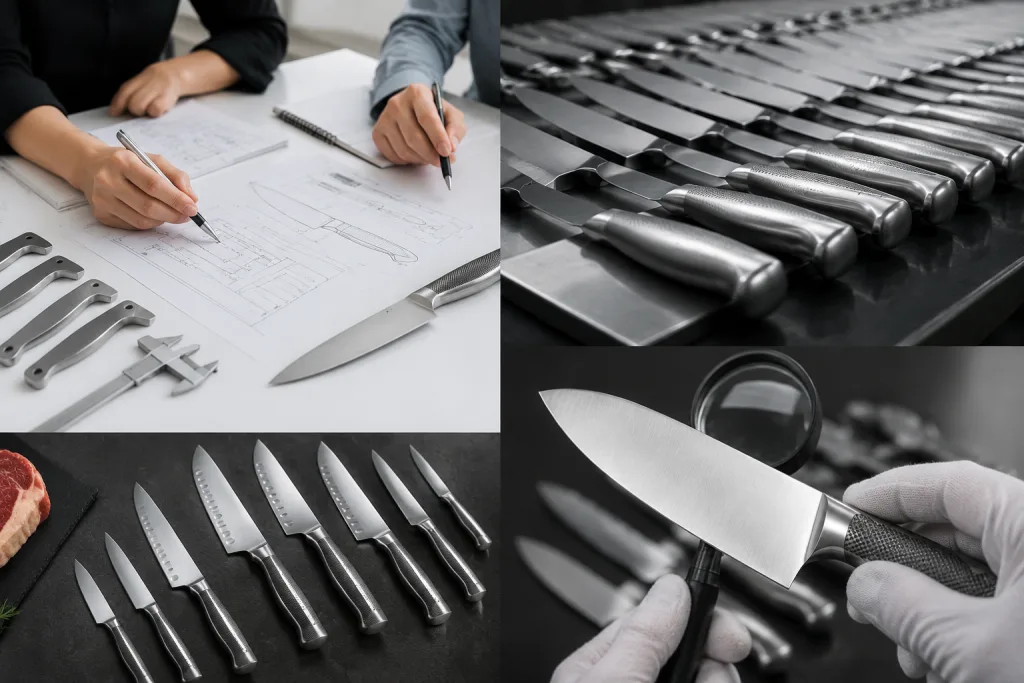
How to Evaluate a Knives Manufacturer: RFQs, Samples, and Inspection Checks for B2B Buyers
By Vincent Xi, Editorial Author, TANGFORGE
<script type="application/ld+json"> {"@context":"https://schema.org","@type":"BlogPosting","headline":"How to Evaluate a Knives Manufacturer: RFQs, Samples, and Inspection Checks for B2B Buyers","author":{"@type":"Person","name":"Vincent Xi","jobTitle":"Editorial Author","url":"https://tangforge.com/authors/vincent-xi/"},"publisher":{"@type":"Organization","name":"TANGFORGE","url":"https://tangforge.com/"},"mainEntityOfPage":{"@type":"WebPage","@id":"https://tangforge.com/"}} </script>
Evaluating a knives manufacturer should start with controlled evidence, not only quoted unit price. A buyer needs to know which company is quoting, which product specification is being priced, which sample controls production, and which documents will be reviewed before shipment.
This guide is for importers, distributors, private label brands, and retail buyers preparing RFQs for kitchen knives, knife sets, scissors, and related blade products. It focuses on buyer-controlled steps: supplier identity checks, RFQ detail, sample approval, inspection planning, and compliance-document review.
What the cited sources support
The cited LeeKnives China knife manufacturing guide, dated 2026-04-21, states that China exported USD 1.66 billion of knives in calendar year 2024, equal to 51.5 percent of global knife exports in calendar year 2024. The page attributes those export figures to OEC World https://leeknives.com/chinese-knife-manufacturers/.
The same LeeKnives page states that China's production of knives, scissors, and blades reached 2.9 billion units in calendar year 2024, up 8 percent year over year versus calendar year 2023. The page attributes those production figures to IndexBox 2025 https://leeknives.com/chinese-knife-manufacturers/.
For regional context, the cited LeeKnives page identifies Yangjiang, Guangdong as a knife manufacturing hub. It states that Yangjiang accounts for approximately 70 percent of China's total knife output and approximately 85 percent of China's knife exports, and that Yangjiang's knife and hardware industry exceeded RMB 55 billion in output value in calendar year 2024 https://leeknives.com/chinese-knife-manufacturers/.
These figures are useful sourcing context, but they are not supplier qualification evidence. They do not prove that any individual manufacturer has the right equipment, export role, compliance documents, quality system, production capacity, or product fit for a specific order.
Marketvalue's kitchenware sourcing hub covers buyer preparation topics such as product category, target quantity, reference samples, packaging notes, RFQ details, quotation requirements, quality control expectations, export preparation, and compliance-document review https://marketvalue.cn/insights/. That context supports a structured RFQ process for knife sourcing.
The TOP KNIVES buyer FAQ hub groups company identity, official contact, RFQ preparation, OEM/ODM sourcing, brand relationship verification, and search result verification as separate due diligence topics https://top-knives.com/news/. Those checks are most useful before deposit payment, tooling release, or mass production approval.
Sourcing Nova's wholesale kitchen knife page describes a general workflow in which a buyer sends a design or chooses a current design, reviews samples for quality assessment and changes, and then places a private label knife order https://sourcingnova.com/products/wholesale-kitchen-knives/. Treat that as a general sourcing workflow, not proof that a specific supplier can meet a particular buyer specification.
Evaluation sequence before final pricing
Use a simple sequence before comparing final unit prices:
- Confirm supplier identity, contracting entity, and official contact channel.
- Define the SKU and measurable product specification.
- Request sample terms and revision control.
- Confirm packaging, labeling, and export-document expectations.
- Define inspection points, defect categories, and release authority before production.
- Verify compliance documents for the exact material, market, and SKU.
Supplier identity and role checks
Ask each knives manufacturer or sourcing partner to identify the legal company name, registered address, export entity, official website domain, and official email contact. Keep these records with the RFQ, quotation, purchase order, sample approval record, and shipment file.
Also confirm the supplier role. The quoted party may be a factory, exporter, trading company, sourcing coordinator, brand owner, or mixed-role supplier. Each model can be workable, but the buyer should know which entity receives payment, which entity appears on commercial documents, and which party is responsible for corrective action if production differs from the approved sample.
Before sampling, ask:
- Is the quoting company the factory, exporter, trading company, sourcing coordinator, brand owner, or mixed-role supplier?
- Which legal entity receives payment and appears on export documents?
- Which facility performs blade blanking or forging, heat treatment, grinding, handle assembly, polishing, sharpening, and packing?
- Which contact channel is official for RFQ, sample approval, purchase order, and shipment release?
- Can the supplier document any claimed brand relationship, production role, or authorization?
RFQ details that make quotations comparable
A useful RFQ turns the buyer's product idea into measurable quotation lines. Instead of asking for a private label chef knife in general terms, specify the product type, material, dimensions, finish, packaging, order quantity, compliance expectations, and inspection requirements.
For an example RFQ line, a buyer might request an 8 inch blade-length chef knife, with blade length measured from heel to tip. This 8 inch blade-length figure is an example RFQ assumption for supplier quote verification, not a cited supplier capability claim.
Include these fields for each SKU:
- Product type: chef knife, santoku, paring knife, boning knife, slicer, utility knife, scissors, folding knife, or set.
- Dimensions: blade length, overall length, blade thickness, handle length, and target weight if relevant.
- Materials: steel grade, handle material, rivets or fasteners, bolster, coating, sheath, blade guard, and packaging-contact materials.
- Finish: satin, mirror polish, brushed finish, coating, logo method, etching, or no logo.
- Edge and geometry: edge angle target, bevel type, tip profile, spine finish, sharpening requirement, and tolerance range if required.
- Packaging: individual sleeve, blade guard, gift box, color box, blister, inner carton, master carton, barcode, warning label, and carton marks.
- Compliance: destination country or region, food-contact expectations for kitchenware, retailer requirements, and buyer-required testing.
- Commercial terms: sample quantity, order quantity, quote currency, Incoterms, lead time, payment terms, tooling charges, sample charges, and quote validity.
Sampling: define what approval means
The sample stage should be defined in writing before production begins:
- Prototype sample: confirms shape, handling direction, appearance, and early feasibility.
- Pre-production sample: confirms material, construction, dimensions, finish, logo, and packaging.
- Sealing sample: signed or otherwise approved as the production reference.
- Production sample: pulled from mass production for comparison against the approved reference.
A sample approval record should include SKU code, supplier name, sample date, revision number, material specification, blade length, overall length, blade thickness, handle material, logo method, packaging version, known deviations, and buyer approval status.
Do not approve only from photos when approval depends on material, hardness, edge quality, handle security, food-contact documentation, folding action, lock function, or carton strength. Photos can support appearance review, but they do not replace product-specific documents, measurements, and agreed inspection criteria.
Inspection plan before production starts
Knife inspection should be tied to the purchase order, approved sample, and RFQ specification. Define inspection timing, defect severity, sampling approach, and shipment-release authority before production starts.
A practical inspection plan can cover:
- Incoming material checks: steel grade documentation, handle material, rivets, coating, packaging materials, and buyer-specified components.
- In-process checks: blade dimensions, grinding consistency, polishing direction, handle fit, logo position, and packaging setup.
- Final product checks: visual defects, edge condition, handle security, folding action where relevant, blade guard fit, SKU consistency, and quantity by SKU.
- Packaging checks: retail pack, barcode, warning label, country-of-origin marking where required, carton marks, inner carton, master carton, and quantity per carton.
- Shipment release checks: final inspection report, packing list, commercial invoice, product photos if required, and buyer approval before shipment.
Define defect severity in advance. Wrong material, unsafe lock failure, cracked handle, incorrect destination-market label, or missing buyer-required warning may need different treatment from minor cosmetic variation, depending on the product and buyer policy. The buyer should state these classifications rather than assume the supplier uses the same definitions.
Compliance and standards: keep claims document-based
Marketvalue's hub notes that food-contact compliance documentation depends on product category, material, destination market, order requirements, and buyer-specific testing needs https://marketvalue.cn/insights/. For kitchen knives, buyers should verify documents for the exact blade material, handle material, coating, ink, adhesive, packaging, and destination market involved in the order.
Do not treat a prior test report as automatically valid for a new SKU. Check the report date, issuing body, product identity, material scope, factory or supplier name, test method, and destination-market relevance.
Standards should be named only when they apply to the product and market. A supplier's internal QC practice is not the same as a third-party certification. A certification claim should not be used in buyer-facing materials or purchase decisions unless a current document supports the exact scope being claimed.
Buyer checklist for supplier comparison
| Area | Buyer question | Evidence to request | |---|---|---| | Legal identity | Who is the contracting and payment entity? | Business license, registered address, export entity, official email | | Supplier role | Factory, exporter, trader, sourcing coordinator, brand owner, or mixed role? | Written role explanation and production-flow description | | Product fit | Which product category and SKU are being quoted? | Similar non-confidential product examples and process list | | RFQ completeness | Are dimensions, materials, finish, packaging, and quantity defined? | Quote matched line by line to the RFQ | | Sampling | Which sample stage is being supplied? | Sample approval record with revision number and date | | Packaging | Are retail pack, blade protection, labels, and cartons specified? | Dieline, carton specification, barcode and label review | | Compliance | Which documents apply to this material, SKU, and destination? | Current reports or a written testing plan | | Inspection | What will be checked before shipment? | Inspection checklist, defect classification, and release process | | Documents | What shipment documents will be provided? | Packing list, commercial invoice, inspection report, and agreed export documents |
Methodology, source context, and limitations
This article was prepared from the cited URLs and their described source contexts. The source contexts include the LeeKnives China knife manufacturing guide with export, production, and regional cluster figures https://leeknives.com/chinese-knife-manufacturers/, the Marketvalue kitchenware sourcing hub covering RFQ preparation, sourcing steps, quality control, export preparation, and compliance-document topics https://marketvalue.cn/insights/, the TOP KNIVES buyer FAQ hub organized around company identity, official contact, RFQ, OEM/ODM, and verification topics https://top-knives.com/news/, and the Sourcing Nova wholesale kitchen knife page describing a design-to-sample-to-order workflow https://sourcingnova.com/products/wholesale-kitchen-knives/.
The data points in this guide were derived by retaining figures and process descriptions attributed to the cited pages, then separating market-scale context from supplier-specific qualification steps. Exact numbers are presented with their stated unit, period or date context, scope, and source context where available. Example dimensions are labeled as buyer assumptions for supplier verification.
The cited market figures should be checked against current primary sources before contract, investment, or supplier qualification decisions. Supplier capabilities, production capacity, certifications, test reports, lead times, prices, legal identity, brand relationships, and quality outcomes should be verified directly with the supplier and, where appropriate, through independent inspection or testing.
Author note: Vincent Xi is listed by TANGFORGE as Editorial Author at https://tangforge.com/authors/vincent-xi/. This article does not rely on personal factory visits, audits, production tests, client outcomes, or first-hand sourcing claims.