How to Scope a Pocket Knife RFQ for Comparable Quotes, Capacity Evidence, and Schedule Control
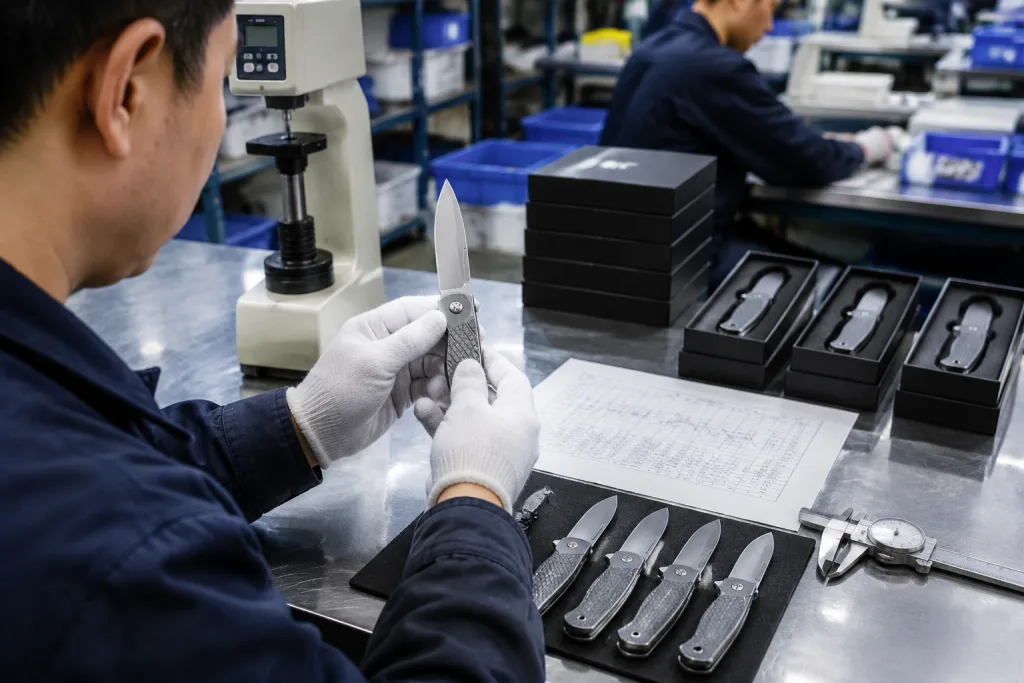
How to Scope a Pocket Knife RFQ for Comparable Quotes, Capacity Evidence, and Schedule Control
A pocket knife RFQ should make suppliers quote the same deliverable, explain the capacity basis behind their proposed production window, and disclose assumptions that could move the shipment date. The comparison should distinguish dated evidence and confirmed commitments from supplier statements, pending inputs, and buyer assumptions.
The cited wholesale sourcing guide covers product type, supplier role, minimum order quantity, landed-cost inputs, samples, inspection, packaging, compliance, and reorder planning (Vast State). For this RFQ, include only the fields needed to define quoted scope, compare cost, assess order-specific capacity, or identify schedule dependencies.
Evaluate each response through three questions:
1. **Scope comparability:** Did the supplier price the specified product and included work? 2. **Capacity support:** Did the supplier connect the order quantity and dates to an identified production route, output basis, and available window? 3. **Schedule control:** Are milestones, prerequisites, exclusions, and delay scenarios stated as dates or durations?
Do not rank quotes commercially until exceptions and open items are visible. An omitted requirement remains unresolved; it is not a zero-cost inclusion.
1. Issue one controlled pocket knife RFQ baseline
Send every bidder the same RFQ package. Give the package a revision number and release date, then require each quotation, clarification, sample submission, and purchase order to reference that revision.
Identify the buying route because it defines what the supplier must include and which activities may affect timing:
- Stock wholesale model
- Existing model with buyer branding
- Existing model with specified modifications
- Buyer design requiring development, tooling, or both
Require the supplier to select one route and itemize any development, tooling, fixtures, setup, artwork preparation, or sample work included in the quote.
Define the product and included work
Specify the fields needed to identify the quoted pocket knife and its proposed production route:
- Supplier model reference or buyer drawing number
- Open length, closed length, blade length, and applicable tolerances
- Blade material, thickness, finish, edge condition, and specified hardness requirement
- Handle material, color, texture, liners, fasteners, and visible components
- Opening method and locking mechanism
- Branding method, location, dimensions, colors, and artwork format
- Unit packaging, inserts, labels, barcodes, protective materials, and master cartons
- Sample stages, submission quantities, and buyer acceptance criteria
- Inspection points, acceptance criteria, and requested report format
- Buyer-requested documents that affect quoted work or timing
A cited knife-sourcing resource presents the knife, logo application, packaging, and shipping carton as separate sourcing elements (China Knives Wholesale). That separation can be used to structure the RFQ so bidders identify what is included. The citation does not establish that a particular supplier performs or controls every element.
Require one deviation schedule
Every substitution, exclusion, or exception should appear in a single table:
| Field | Required supplier response | |---|---| | RFQ reference | Specification section, drawing note, or packaging requirement affected | | Required baseline | Exact requirement not being offered | | Proposed alternative | Offered material, component, process, finish, or dimension | | Product effect | Effect on fit, function, appearance, packaging, or inspection criteria | | Price effect | Increase, decrease, or no change, with currency and basis | | Schedule effect | Calendar-day effect and affected milestone | | Evidence status | Supported, supplier-stated, or pending confirmation | | Buyer approval | Open, conditionally accepted, or accepted |
Until the buyer records approval, treat the proposed alternative as an exception to the RFQ baseline.
2. Require a structured quote return
Provide one quote template and require a response in every field. A valid response is a value, an explicit exclusion, or a clearly stated clarification request.
| Quote category | Mandatory response | |---|---| | Scope reference | RFQ, specification, drawing, and packaging revisions priced | | Product route | Stock, branded existing model, modified model, or buyer design | | Quantity | Quoted quantity and requested price tiers | | Unit price | Amount, currency, quantity basis, and included work | | Non-recurring cost | Tooling, fixtures, setup, artwork, or development, itemized | | Samples | Stage, quantity, price, production method, and submission timing | | Packaging | Included components and separately priced options | | Inspection | Included checks, acceptance criteria, report, and requested buyer access | | Delivery basis | Delivery rule, named place, and included logistics work | | Payment | Deposit, balance trigger, and other payment milestones | | Quote validity | Expiration date and inputs subject to reconfirmation | | Schedule trigger | Defined starting event and required documents or payments | | Schedule endpoint | Goods release, carrier handoff, or other proposed event | | Exceptions | Every exclusion, deviation, and unconfirmed assumption |
Require separate totals for:
- Recurring product cost
- Non-recurring charges
- Samples
- Packaging
- Inspection
- Logistics
This structure keeps unlike scopes from appearing comparable merely because each supplier provides a unit price or total.
3. Separate capacity statements from order-specific evidence
Factory size, general output figures, equipment lists, and photographs may provide capability context. They do not show, on their own, that capacity is available for the quoted pocket knife order during the requested window.
Ask each supplier for an order-specific capacity return covering:
1. Production stages included in the quoted route. 2. The stage expected to constrain accepted output for the quoted configuration. 3. The line, work center, or external process proposed for that stage. 4. Planned operating dates, working days, and shifts during the order window. 5. Order-specific accepted output per operating day. 6. Whether the output rate is measured, estimated, or derived from another configuration. 7. Capacity already allocated during the proposed window. 8. Capacity reserved or proposed for this order. 9. External-process slots and planned turnaround times. 10. Separate allowances for inspection, sorting, rework, maintenance, or disruption.
Use consistent capacity arithmetic
Define the same terms for every bidder:
- **Q:** Accepted units required for order release.
- **R:** Accepted units per operating day allocated to this order at the constraining stage.
- **D required:** Operating days required at that stage.
- **D available:** Operating days allocated to the order between the planned start and finish dates.
Apply this check:
**D required = Q ÷ R, rounded up to the next operating day**
Require the supplier to show how it calculated **R**. If the starting point is gross output, the response should state the assumed inspection yield, treatment of rework, shift pattern, and share of the resource allocated to the order. Do not apply those adjustments again if **R** is already an order-specific accepted-output rate.
Compare **D required** with **D available**. Record any difference as stated schedule headroom, but do not classify it as confirmed contingency unless the supplier shows where that time appears in the dated schedule.
Test downstream stages separately. A sufficient rate at blade processing does not demonstrate that assembly, branding, inspection, packaging, or an external process fits within the same production window.
Request dated evidence with a defined scope
Order-specific evidence may include:
- Process flow for the quoted configuration
- Dated line or work-center allocation plan
- An anonymized loading schedule for the proposed window
- Output calculation showing units, shifts, yield basis, and order allocation
- Equipment or work-center list limited to the proposed route
- External-processor schedule or written slot confirmation
- Milestone calendar tied to the requested handoff date
For each item, request its issue date, applicable product or process, and current status. Use four evidence labels consistently:
- **Supported:** Accompanied by dated information applicable to the quoted route and order window.
- **Supplier-stated:** Asserted in the response without order-window support.
- **Pending:** Dependent on a later allocation, material, subcontractor, or buyer decision.
- **Buyer-assumed:** Added by the buyer for comparison and not accepted by the supplier.
Equipment photographs may support process identification, but they remain capability context unless tied to a dated allocation and output calculation.
A cited sourcing article discusses product quality and shipping delay as buyer concerns (WholesaleSeeker). Use that citation only as context for requesting inspection and schedule information. It is not evidence of a bidder's quality performance, available capacity, or delivery reliability.
4. Replace a single lead-time figure with a dated schedule
A quoted duration is comparable only when its starting event, included activities, calendar basis, and endpoint are defined. Require planned dates and identify whether each duration uses calendar days or supplier working days.
| Milestone | Planned date | Responsible party | Prerequisite | Status | Included in quoted duration? | Schedule allowance | |---|---|---|---|---|---|---| | Purchase order and required payment received | | | | | | | | Technical files and artwork approved | | | | | | | | Tooling or fixtures completed | | | | | | | | Pre-production sample submitted | | | | | | | | Buyer sample decision due | | | | | | | | Production materials available | | | | | | | | Packaging materials available | | | | | | | | Constraining-stage slot begins | | | | | | | | Production starts | | | | | | | | In-process checkpoint completed | | | | | | | | Assembly completed | | | | | | | | Final inspection completed | | | | | | | | Corrective work completed if needed | | | | | | | | Packing completed | | | | | | | | Goods released | | | | | | | | Contracted delivery handoff reached | | | | | | |
Assign one status to each milestone:
- Confirmed
- Provisionally scheduled
- Pending buyer action
- Pending supplier confirmation
- Pending external-party confirmation
A planned date does not confirm that a production slot has been reserved. Require the supplier to state whether capacity is reserved, provisionally held until quote expiry, or subject to reconfirmation after order placement.
Show who controls each dependency
Classify each schedule interval by the party controlling its completion:
- **Supplier-controlled:** Engineering, procurement, tooling, production, internal inspection, correction, and packing.
- **Buyer-controlled:** Artwork approval, sample decision, change approval, and required payment.
- **External:** Subcontract processing, third-party inspection, freight booking, customs activity, or transport when included in the quoted schedule.
This classification does not change contractual responsibility. It identifies the dependency to test when comparing proposed dates.
Require quantified delay scenarios
For each relevant condition, ask the supplier to identify the affected milestone, estimated calendar-day effect, recovery action, and any price or product consequence:
- Artwork approval misses the required date.
- The first sample is rejected.
- A specified material or packaging component is unavailable.
- Tooling requires revision after the first sample.
- An external processor misses its planned return date.
- Inspection requires sorting, rework, or resubmission.
- The planned freight service is unavailable at goods release.
Keep the baseline schedule separate from delay scenarios. Do not add all delay estimates mechanically. Ask which activities can run in parallel and which would move the controlling sequence of milestones.
Convert open conditions into quote fields
| Open condition | Required supplier response | |---|---| | Material availability is unconfirmed | Confirmation deadline, affected milestone, and alternative if offered | | Packaging files are incomplete | Required buyer decision date and schedule effect | | Tooling feasibility is open | Review gate, evidence required, and added time if revision is needed | | Component or finish has a purchasing minimum | Minimum quantity, price effect, procurement duration, and excess treatment | | Process is external | Process owner, transfer time, planned slot, turnaround, and contingency status | | First-pass sample approval is assumed | Resubmission path, new decision date, and schedule effect | | Inspection correction is excluded | Exclusion statement and proposed correction allowance | | Capacity is not reserved | Reservation trigger, reconfirmation date, and possible schedule effect | | Freight is not booked | Booking responsibility, booking deadline, and quoted handoff point |
For each proposed recovery action, request:
- Trigger condition
- Decision deadline
- Responsible party
- Added or avoided calendar time
- Added cost
- Any change to the specified product or inspection criteria
- Approval status
Possible actions include reserving material, approving a documented alternative, ordering packaging earlier, planning a second sample route, or establishing a firm buyer decision deadline. Keep an action unapproved until its specification, price, and schedule effects are recorded.
Include one change-control rule: no change to the specification, included work, price, capacity basis, or milestone dates becomes part of the order until the revised requirement and approval status are documented.
5. Normalize quotes on one scope and delivery basis
Create one comparison sheet with a supplier column and a common row for every required cost. Normalize commercial values only after recording scope exceptions and schedule endpoints.
Include:
- Product unit price at the same quantity
- Tooling, fixtures, setup, artwork, and development
- Samples and sample shipment
- Branding or decoration
- Unit packaging and master cartons
- RFQ-required inspection, testing, and reporting
- Buyer-approved spares or overage
- Inland transport and export handling
- Freight on the selected comparison basis
- Buyer-calculated duties and taxes, if included in the comparison
- Payment amount and timing
- Quote-validity period
Assign one status to every cost row:
- Included in unit price
- Separately quoted
- Excluded
- Not applicable
- Open clarification
Do not enter zero for an excluded or unanswered requirement. If the buyer adds an internal allowance for comparison, label it **buyer-assumed**, state its basis, and keep it separate from the supplier's quoted total.
Evaluate minimum order quantity only where it changes the quoted quantity, price tier, material purchase, packaging purchase, capacity allocation, or reorder timing. The Vast State guide groups MOQ with landed cost, compliance, quality control, and reorder planning (Vast State); it does not provide order-specific values for the current RFQ.
6. Apply a gated quote-comparison decision
Gate 1: Scope completeness
Confirm that the quote references the correct RFQ revision and answers every mandatory field. Return missing requirements, undisclosed substitutions, and unclear inclusions for clarification.
Gate 2: Capacity support
Check the proposed production route, constraining stage, accepted-output basis, operating calendar, existing allocation, order allocation, and external-process slots. Keep supported fields separate from supplier statements and pending confirmations.
Gate 3: Schedule credibility
Confirm that tooling, samples, buyer approvals, materials, production, inspection, correction, packing, and the contracted handoff appear in the schedule. Compare bids using the same starting event and endpoint.
Gate 4: Commercial normalization
Convert quoted values to the same quantity, currency basis, and delivery basis. Keep supplier exclusions, pending amounts, and buyer allowances visible as separate fields.
Gate 5: Executable commitment
Rank only responses that define the deliverable, capacity basis, dated milestones, prerequisites, open risks, and commitment status. Base the decision on quoted scope and supported schedule information, not an unsupported unit price or lead-time statement.
Pocket knife RFQ release checklist
Controlled scope
- [ ] Buying route is identified.
- [ ] RFQ, specification, drawing, and packaging revisions are dated.
- [ ] Dimensions, materials, finish, mechanism, and branding are defined.
- [ ] Sample stages and acceptance criteria are stated.
- [ ] Packaging and carton requirements are included.
- [ ] Deviations require itemized disclosure and buyer approval.
Comparable quote return
- [ ] Every bidder receives the same response template.
- [ ] Recurring and non-recurring charges are separated.
- [ ] Packaging, inspection, and logistics are visible.
- [ ] Delivery rule, named place, currency, payment, and validity are requested.
- [ ] Schedule trigger and endpoint are defined.
- [ ] Blank responses are treated as unresolved.
Capacity evidence
- [ ] Production route and constraining stage are identified.
- [ ] Accepted output is defined and tied to this order.
- [ ] Operating dates, working days, shifts, and order allocation are shown.
- [ ] Existing allocation and external processes are addressed.
- [ ] Evidence has an issue date, applicable scope, and status.
- [ ] Required production days fit the allocated operating window.
- [ ] Inspection, rework, disruption, and downstream capacity are addressed separately.
Schedule control
- [ ] Milestones use planned dates and a stated calendar basis.
- [ ] Capacity-reservation status is disclosed.
- [ ] Buyer decision deadlines are shown.
- [ ] External dependencies have owners and confirmation status.
- [ ] Correction time is included or expressly excluded.
- [ ] Delay scenarios identify milestone and calendar-day effects.
- [ ] Recovery actions show price and product consequences.
- [ ] Changes require documented approval.
A controlled pocket knife RFQ makes quote differences visible before commercial ranking. The decision record should show which bidder priced the required scope, what evidence supports the proposed capacity window, which dates remain conditional, and how unresolved assumptions could affect the contracted handoff.