Knife Manufacturer Sourcing Guide: Packaging, Compliance Documents, Delivery, and Reorder Planning
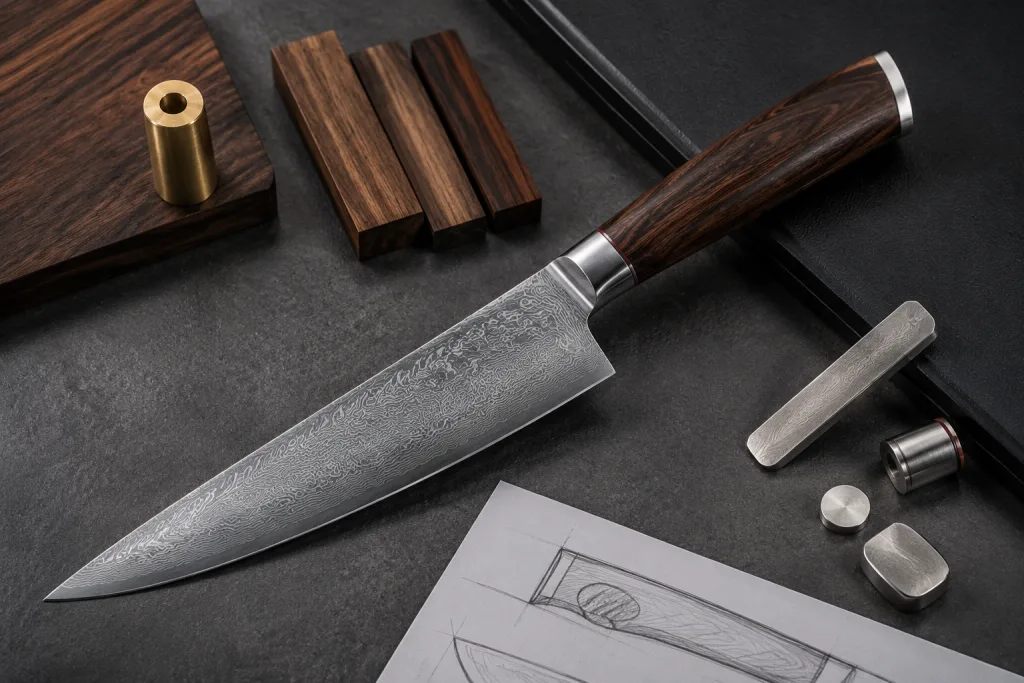
Knife Manufacturer Sourcing Guide: Packaging, Compliance Documents, Delivery, and Reorder Planning
**By Vincent Xi, Editorial Author** Author profile
Selecting a **knife manufacturer** is not only a steel, grind, and handle decision. For brands, distributors, and private-label buyers, commercial risk often appears later: carton damage, incomplete shipping marks, missing compliance paperwork, unclear Incoterms, or reorder drift after the first production run. This guide focuses on packaging, compliance documents, delivery planning, and reorder continuity—the operational chain that turns an approved sample into a repeatable B2B program.
This article is an editorial synthesis for procurement and product teams. It does not claim factory audits, client outcomes, certifications held by any named supplier, or first-hand production experience. Figures below are attributed to the cited public sources and should be verified against current supplier quotes, destination-market rules, and logistics quotes.
What B2B Buyers Actually Buy Beyond the Blade
Wholesale knife programs commonly fail in operational handoff points rather than only at metallurgy:
- Packaging that looks acceptable in a sample photo but collapses under stacked export cartons
- Unit packs that do not match retail, Amazon/FBA, or gift-set workflows
- Incomplete material declarations or labeling files when customs or marketplace onboarding begins
- Lead-time promises that omit tooling, packaging print, inspection, and booking windows
- Reorders that change edge geometry, handle fit, or print color because master specs were never locked
Public B2B knife-sourcing materials frame OEM/ODM work around customization pathways that explicitly include packaging and logo execution, not only blade construction, and list packaging and global shipping as commercial touchpoints for brand owners and wholesalers. (LeeKnives B2B knife manufacturing whitepaper)
Handle and finish choices still affect commercial continuity because they influence returns and reorders. One cited 2026 B2B handle-material guide reports that G10 and Micarta account for **over 40% of handle material usage in mid-to-premium outdoor knife segments** (scope: mid-to-premium outdoor segment as stated on that page; as-of context: 2026 guide publication) and links handle performance to return rates and repeat purchasing behavior. (Ruihalo handle materials guide) Packaging and documentation should be designed around those SKUs, not treated as an afterthought once blade steel is selected.
Packaging Specifications That Belong in a Knife Manufacturer RFQ
Treat packaging as a bill of materials, not a brochure line item. A practical packaging package for a knife manufacturer RFQ usually includes four layers:
1. **Primary pack** — blade guard/sheath, sleeve, blister, gift box, or pouch 2. **Secondary pack** — retail box, set tray, insert, barcode placement, multilingual insert 3. **Export pack** — inner carton, master carton, divider strength, desiccant if needed 4. **Identity system** — SKU code, colorway code, lot/batch mark, shipping mark layout
Primary and retail packaging decisions
Ask the manufacturer to confirm, in writing:
- Blade protection method (edge guard, sheath material, tip protection)
- Whether handles such as G10, Micarta, or wood require different insert tolerances
- Print method for logos (pad print, laser, foil, sticker) and approved artwork dimensions
- Whether packaging is sample-grade only or production-tooling ready
- Retail-facing claims policy: no unsupported “military grade,” hardness, or certification claims on cartons unless documented for that exact SKU
Public OEM/ODM pathway discussions specifically call out packaging customization alongside blade finishes and handle materials such as G10, Micarta, and wood. (LeeKnives B2B knife manufacturing whitepaper) That is useful as a **scope checklist**; it is not evidence that any one factory’s packaging line meets a buyer’s channel rules.
Export carton and handling rules
Define measurable packaging parameters before mass production:
| Packaging element | Buyer should lock before PO | Why it matters | | --- | --- | --- | | Unit pack type | Box / pouch / blister / set tray | Affects retail readiness and damage rate | | Blade protection | Guard, sheath, tip cap | Reduces edge damage and claims | | Carton drop/stack assumptions | Buyer-defined packing method + test request | Prevents crushed master cartons | | Units per inner / master | Exact count and orientation | Drives freight cube and pick/pack labor | | Shipping marks | SKU, qty, NW/GW, carton no., destination | Warehouse receiving accuracy | | Barcode/label placement | File + physical sample photo | Marketplace and DC compliance | | Moisture control | Desiccant / VCI only if needed | Climate and ocean transit risk | | Spare packaging % | Example assumption to verify in quote | Covers print waste and damaged outers |
**Example calculation (assumption to verify in the supplier quote, not a universal factory standard):** if one master carton holds **20 units/carton**, and a planned first order is **2,000 sellable units**, export cartons equal **100 master cartons** before spares. If the buyer requests **2% spare packaging materials** (scope: unit packs and master cartons for that PO only), that is **40 extra unit packs** and **2 extra master cartons**—confirm cost, storage, and whether spares ship with the order or are held for reorders.
Buyer-facing sourcing notes also stress connecting packaging decisions to freight cost and shipping plans before final sample approval and order release. (TOP KNIVES buyer FAQ and sourcing guides)
Compliance Documents Buyers Should Request Early
Compliance is destination- and channel-specific. Do not accept marketing language as a substitute for current documents. A knife manufacturer conversation should separate:
- **What a regulation or marketplace requires** in the destination market
- **What documents the supplier can provide for this exact SKU and production lot**
- **What remains the buyer’s responsibility** (label claims, importer of record duties, retailer portals)
Core document set for most B2B knife programs
Request a document matrix, not a single PDF dump:
1. **Commercial invoice and packing list** formats matching actual SKUs 2. **HS code proposal** for review by the buyer’s broker (not final legal advice) 3. **Material declarations** for blade steel family and handle materials 4. **Restricted substances statements** when required by destination or retailer 5. **Label/artwork proofs** with languages, warnings, and country-of-origin placement 6. **Test reports** only when relevant to the claim being made (edge retention, hardness, coating adhesion, food-contact components if applicable) 7. **Lot traceability method** (PO, batch, carton, and inspection linkage)
If a supplier names a standard or certification, ask for the **current certificate scope, legal entity name, expiry date, and product coverage**. Distinguish a standard’s general requirement from a factory’s claimed practice. Never treat a website badge as active certification, and do not imply certification without a current document for the exact entity and SKU scope.
For outdoor and tactical lines, handle material choice can change documentation needs (composite handles vs. wood, coatings, adhesives). Market context also matters for assortment planning: the same cited 2026 guide states the global outdoor survival knife market is projected to grow from **US$586 million in 2025** to **US$898 million by 2032**, a **6.4% CAGR** (units: U.S. dollars; scope: global outdoor survival knife market as stated on the cited page; as-of: figures presented in that 2026 guide). (Ruihalo handle materials guide) Growth does not relax compliance; it usually increases channel scrutiny and packaging complexity.
Practical compliance workflow
- Freeze the SKU bill of materials before requesting final tests
- Align packaging claims with approved test scope only
- Keep a “claims not allowed” list for cartons and inserts
- Store lot-linked PDFs with the shipment file, not only in chat threads
- Re-check documents on reorder if materials, coating, factory site, or label text change
Delivery Planning: Lead Time Is a Chain, Not a Single Date
Delivery problems usually start before production. Buyer education resources emphasize freight and shipping planning as part of the sourcing path, including the need to connect freight cost, sample approval, packaging, production timing, and shipping plans before final order release. (TOP KNIVES buyer FAQ and sourcing guides)
Break the schedule into gated stages:
1. **Technical freeze** — drawings, steel, hardness target range, handle material, finish 2. **Packaging freeze** — dielines, inserts, shipping marks, barcode files 3. **Pre-production sample / golden sample** — approved against measurable criteria 4. **Mass production window** — capacity, material lead time, print lead time 5. **Inspection window** — AQL plan, rework buffer, photo evidence protocol 6. **Booking and handover** — cargo ready date, cut-off, Incoterms, insurance
Delivery questions that reduce ambiguity
- What is included in the quoted lead time: materials only, or packaging print and inspection?
- When does the clock start: deposit, artwork approval, or sample sign-off?
- Who books freight under the chosen Incoterm, and who pays detention/demurrage risk?
- Are partial shipments allowed if one SKU fails inspection?
- What is the cargo-ready definition: production finished, or cartons labeled and palletized?
Public B2B knife-sourcing materials repeatedly surface long lead times and quality inconsistency as core buyer pain points, alongside MOQ barriers. (LeeKnives B2B knife manufacturing whitepaper) Use that as a planning prompt: ask for historical range estimates by process stage, then validate with the current order’s critical path. Do not treat any website lead-time claim as a committed schedule for your SKU.
**Example planning assumption to verify in the quote (not a measured factory average):** if packaging print needs **10 calendar days**, inspection and rework buffer **5 calendar days**, and ocean booking needs **7 calendar days** after cargo-ready notice, a production-complete date is not a customer-delivery date. Buyers should request a stage-gated timeline with owner names for artwork, inspection, and logistics.
Reorder Planning and SKU Continuity
A first order can succeed while the program still fails on reorder. Continuity depends on locked masters:
- Approved sample with revision ID
- Material callouts (steel family, handle grade/color code, fastener type)
- Hardness target range and measurement method
- Edge angle/process notes if commercially critical
- Packaging dieline revision and color standard
- Carton count and orientation
- Acceptable change-control process for substitute materials
Reorder triggers buyers should pre-define
- Safety stock in destination warehouse
- Seasonal demand spikes
- Marketplace advertising calendar
- Packaging reprint minimums
- Tooling wear checkpoints for custom handles or molds
Demand signals can help size the program, but public lead boards are not forecasts. A kitchen-knives buyer directory page, for example, shows **93 kitchen knives buy leads** listed in that listing view (unit: listed buy leads; scope: kitchen knives category on that directory page; as-of: snapshot at page access). That figure is a directory snapshot, not validated demand for any brand or destination. (Tradewheel kitchen knives buyers directory)
Continuity controls
| Control | First order | Reorder | | --- | --- | --- | | Golden sample | Physically retained by buyer and supplier | Compare lot photos and measurements | | Spec sheet revision | v1 locked after approval | No silent revision without ECO | | Packaging print | Signed proof | Reprint only from current proof | | Material substitution | Not allowed without written approval | Same rule, plus re-label check | | QC checklist | Same AQL/critical defects list | Trend defects across lots | | Document pack | Lot-linked invoice/packing/test files | Reissue if SKU or site changes |
For outdoor assortments where composite handles are prominent in mid-to-premium mixes, color and texture continuity on G10/Micarta can be as commercially important as blade finish because customers notice grip and appearance immediately. The cited handle-material landscape places these composites at **over 40%** usage in that mid-to-premium outdoor segment context (same source, scope, and as-of context as above). (Ruihalo handle materials guide)
Buyer Decision Table: Packaging, Compliance, Delivery, Reorder
| Decision area | Strong manufacturer response | Weak response | Buyer action | | --- | --- | --- | --- | | Packaging engineering | Dielines, insert drawings, carton count, shipping mark template | “Standard export carton” only | Require packaging BOM + sample photos of open/closed pack | | Branding control | Artwork proof cycle with revision IDs | Chat screenshots only | Use formal proof approval gate | | Compliance readiness | Document matrix by SKU/lot and market | Generic certificate images | Verify entity name, scope, date; reject expired/unscoped files | | Delivery planning | Stage-gated timeline including packaging and booking | Single multi-week claim with no stage owners | Map critical path and Incoterms responsibilities | | Freight linkage | Cube, GW/NW estimate, carton plan before PO | Freight ignored until production ends | Estimate landed cost before sample finalization | | Reorder control | ECO process, retained golden sample, lot traceability | “Same as last time” verbal assurance | Lock masters and require change logs | | QC boundary | Written critical/major/minor defects for knives and packs | Visual check only | Define edge, handle fit, print, rust, carton crush criteria | | Commercial fit | Clear MOQ by SKU and by packaging variant | One MOQ for all variants | Separate blade MOQ from print/pack MOQ |
Practical RFQ Checklist for a Knife Manufacturer
Use this checklist when requesting quotes so packaging, compliance, delivery, and reorder terms are priced and scheduled together.
Product and quality
- [ ] Knife type, intended channel, and target price band
- [ ] Blade steel family options requested for quote comparison
- [ ] Hardness target range and measurement points
- [ ] Handle material/color codes (for example G10, Micarta, wood)
- [ ] Finish, edge, and assembly acceptance criteria
- [ ] Golden sample policy and retention responsibility
Packaging
- [ ] Primary pack type and blade protection method
- [ ] Retail box/insert requirements and languages
- [ ] Logo process and approved file formats
- [ ] Units per inner and master carton
- [ ] Carton material request and shipping mark layout
- [ ] Barcode/label placement diagram
- [ ] Spare packaging percentage (example assumption to verify)
- [ ] Photo set required: unit, open box, master carton, pallet if applicable
Compliance and documents
- [ ] Destination markets and channels
- [ ] Required commercial docs and packing list format
- [ ] Material declarations needed for blade/handle/coatings
- [ ] Any retailer/marketplace document portal requirements
- [ ] Claims allowed vs. prohibited on packaging
- [ ] Lot traceability fields on carton and invoice
- [ ] Current certificates only if relevant—with scope, legal entity, and expiry check
Delivery and logistics
- [ ] Requested Incoterm and destination
- [ ] Stage-gated lead time from deposit to cargo-ready
- [ ] Inspection window and rework buffer
- [ ] Partial shipment rules
- [ ] Carton cube and GW/NW estimate method
- [ ] Booking responsibility and cargo-ready definition
- [ ] Packaging and freight plan reviewed before final sample approval (TOP KNIVES buyer FAQ and sourcing guides)
Reorder and commercial terms
- [ ] First-order qty vs. 12-month forecast range
- [ ] MOQ by SKU and by packaging print variant
- [ ] Price validity window and material escalation clause
- [ ] Change-control / ECO process
- [ ] Reorder lead time with packaging reprint already tooled
- [ ] Defect claim window and evidence requirements
- [ ] Archive of approved specs after shipment
RFQ preparation is repeatedly treated as a primary buyer entry point in knife-sourcing FAQ structures, alongside company identity and official contact verification. (TOP KNIVES buyer FAQ and sourcing guides) A complete RFQ reduces “quote incomparability,” where one supplier prices naked knives and another prices retail-ready goods.
Evidence Basis, Methodology, and Limitations
Source contexts used
1. **B2B knife manufacturing / OEM packaging pathway context** from a public whitepaper landing page discussing MOQs, steel selection framing, OEM/ODM customization (including packaging and handle materials), and common sourcing pain points such as inconsistent quality and long lead times. (LeeKnives) 2. **Handle-material and market-context source** for 2025–2032 outdoor survival knife market values (US$586 million in 2025; US$898 million by 2032), **6.4% CAGR**, and the mid-to-premium outdoor handle-material share figure for G10/Micarta (**over 40%**). (Ruihalo) 3. **Buyer-process source** for RFQ preparation pathways and the operational link between sample approval, packaging, production timing, freight cost, and shipping plans. (TOP KNIVES) 4. **Demand-directory snapshot** showing **93** kitchen knives buy leads listed on a public buyers directory page. (Tradewheel)
Methodology / how the data was derived
This article aggregates publicly available B2B knife-sourcing pages relevant to packaging, RFQ structure, and assortment planning. Market, CAGR, handle-share, and directory-lead figures are taken as presented on the cited pages for buyer planning context only. Operational recommendations (document matrix, stage-gated delivery, reorder ECO controls, packaging BOM fields) are synthesized as procurement practice prompts from those source themes and standard RFQ structure, not as audited factory performance data, Tangforge production metrics, or client outcomes.
Limitations / what to verify
- Market size, CAGR, and handle-share figures are secondary-reported on commercial content pages; re-validate with primary research or your own category data before investment decisions.
- Directory lead counts change over time and do not equal qualified demand.
- No certification, test result, factory capacity, MOQ, price, lead time, or customer outcome should be inferred for any manufacturer from this article.
- Destination labeling, restricted substances, food-contact, and dangerous-goods rules (where applicable to certain knives/shipments) must be confirmed with qualified compliance advisors and the importer of record.
- Every exact operational number used as an example (carton counts, spare packaging %, planning buffers) is an **assumption to verify in the supplier quote**.
- Author basis is limited to the public editorial author profile for Vincent Xi; no additional experiential, factory-visit, or client-work claims are made. (Vincent Xi author page)
Closing Procurement Notes
A capable **knife manufacturer** conversation should make packaging dielines, compliance document ownership, cargo-ready definitions, and reorder change control as explicit as steel and handle selection. Buyers who lock those items in the RFQ usually compare suppliers more fairly, reduce landed-cost surprises, and protect brand continuity after the first container.
Use the decision table and RFQ checklist above to structure supplier calls. Require written stage gates before deposit where possible, retain golden samples, and treat every packaging or material change as a controlled revision—not a casual substitution.