Knife Price Factors for B2B Buyers: Technical Specs and RFQ Checklist
Knife Price Factors for B2B Buyers: Technical Specs and RFQ Checklist
**By Vincent Xi, Editorial Author**
B2B knife pricing is rarely a single line item for “blade + handle.” For importers, private-label brands, and retail buyers, unit cost is the sum of material grade, process route, dimensional tolerance, surface finish, packaging, inspection depth, and order structure. This guide maps those **knife price factors** to technical specification levers and a practical RFQ checklist so OEM and ODM quotes can be compared on equal terms.
The goal is not a universal price list—factory quotes move with steel markets, tooling amortization, and capacity—but a specification framework that shows which choices move cost most and which documents to request before awarding a program.
Market Context: Why Scale and Cluster Density Matter to Buyers
China is a major manufacturing base for commercial knife programs, as reflected in published trade totals. A 2026 B2B sourcing guide states that China exported **USD 1.66 billion** worth of knives in **2024**, equal to **51.5% of global knife exports** (Lee Knives sourcing guide, citing OEC World). The same guide reports that China’s combined production of knives, scissors, and blades reached **2.9 billion units**, up **8% year-over-year** (IndexBox, 2025, as summarized there).
Regional concentration also shapes landed-cost planning and supplier shortlisting. The guide notes that Yangjiang’s knife and hardware industry exceeded **55 billion RMB** in output value in **2024**, that Yangjiang-made products account for roughly **eight of every ten knives China exports**, and that the city represents about **70% of China’s knife output** and **85% of its knife exports** (Lee Knives sourcing guide, citing China Daily and local industry context). Those figures describe market scale and geographic density only. They do not establish that any single factory can hold a stated Rockwell range, edge geometry, food-contact documentation package, or lead time.
**Source context 1:** Export volume and regional concentration statistics are taken from a secondary industry guide that attributes primary figures to OEC World, IndexBox (2025), and China Daily (2025).
**Buyer implication:** Use cluster data for market research and shortlist geography, not as a substitute for factory-level capability checks, process-control evidence, or quote normalization.
Material Specification Drivers of Knife Cost
Blade steel grade and form
Steel is usually the first material cost driver, but “stainless kitchen knife” is not a complete RFQ term. Cost changes with alloy family (for example common martensitic stainless versus higher-alloy powder steels), billet or strip thickness, and whether the blank is stamped, laser-cut, water-jet cut, or forged. Higher-alloy steels can raise raw-material cost and also increase grinding time, abrasive consumption, and heat-treatment complexity.
Write steel requirements as measurable purchase data: exact designation (or approved equivalents), form (strip/plate), thickness with tolerance, hardness after temper (HRC range), and required mill/test certificate scope. Avoid marketing adjectives such as “premium steel” without a grade and acceptance method.
Ethical and material-origin requirements can add another commercial layer. Industry commentary on custom-knife sourcing notes that responsible programs may specify recycled steel content, chain-of-custody documentation for wood handles, or verified origins for natural materials (Shokunin USA ethical sourcing overview). Those requirements can support brand policy, but they should be written as measurable purchase specs—grade, certificate type, substitution rules, and lot traceability—rather than marketing claims.
Handle materials, bolsters, and hardware
Handle systems often swing total cost as much as the blade. Polymer injection-molded handles amortize well at volume when molds already exist. Stabilized wood, layered composites, G10/Micarta-class laminates, or metal scales add machining, finishing, and scrap risk. Full-tang construction generally uses more steel and more grinding labor than partial-tang or molded-handle constructions. Fasteners, liners, pivot systems (for folders), and bolster fitment add both material and assembly time.
Specify handle material grade/color/texture, moisture-stability expectations if wood is used, fastener/pivot materials, and fit tolerances (for example flushness of scales to tang, gap limits, and torque or retention method if relevant).
Coatings and surface systems
Satin machine finish, bead blast, mirror polish, stonewash, PVD/DLC-type coatings, or food-safe electropolishing change cycle time and reject rate. Coatings may also require adhesion tests, corrosion tests, and packaging that prevents scuffing during export. Separate “visual finish” from “functional surface requirement,” because the same appearance can be produced by different process routes with different cost structures. Request limit samples and a cosmetic AQL rather than relying on catalog photos.
Process Route and Tolerance: Where Labor and Scrap Appear
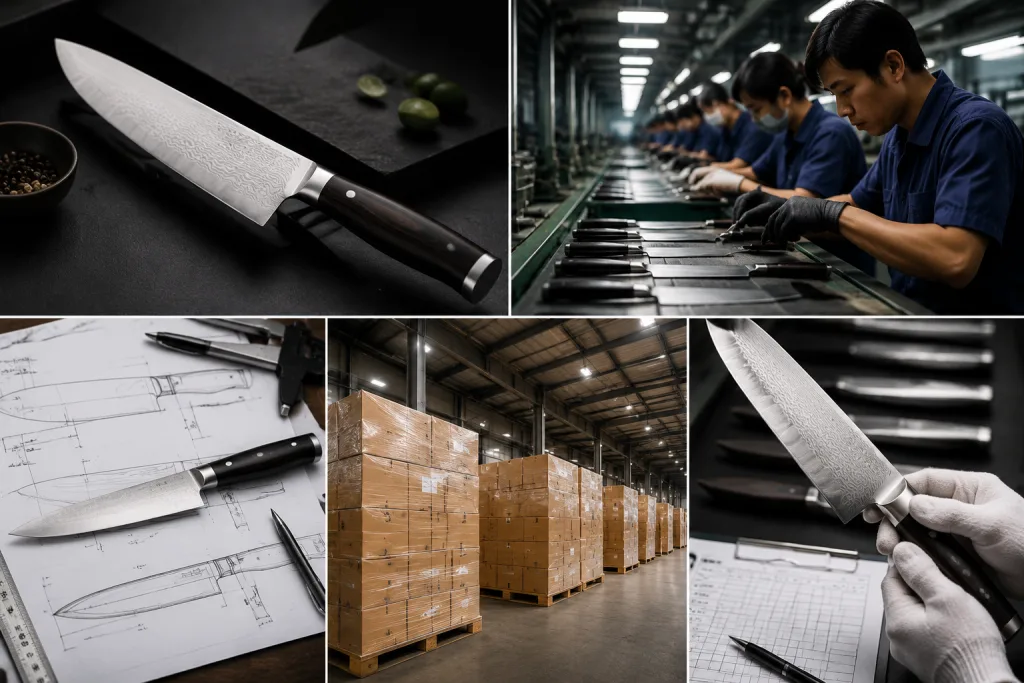
Custom and production knife manufacturing typically moves through design, steel preparation, forging or stock removal, heat treatment and tempering, grinding/finishing, assembly, and quality control (BiliKnife manufacturing overview). Each stage can be a price factor:
1. **Blanking method** — Progressive die stamping favors high volume and stable geometry; CNC or laser cutting favors lower tooling but higher unit process cost at scale. 2. **Heat treatment** — Hardness target, quench method, temper cycles, and distortion control affect metallurgical performance and scrap. A narrow Rockwell window usually costs more to hold than a broad commercial window. 3. **Grind geometry** — Flat, hollow, convex, or multi-bevel grinds change machine time and skilled labor. Thin edge apexes and tight distal taper can increase rework risk. 4. **Assembly and fit** — Handle-to-tang flushness, pivot smoothness, lock engagement, and centering (folders) are labor- and fixture-sensitive. 5. **Inspection depth** — Dimensional sampling is cheaper than 100% hardness checks, salt-spray sampling, edge-retention protocols, or food-contact migration testing.
**Source context 2:** Process-stage language is drawn from a manufacturer-oriented overview of custom knife production steps (design through QC), used here only to map cost centers—not to imply that every supplier uses the same equipment, subcontracting model, or holds the same certifications.
Example calculation (assumptions to verify in supplier quote)
The following is an **example calculation only**, not a market quote and not based on a specific factory offer. Assume a private-label chef knife RFQ at **5,000 units**, EXW, with two steel/process options:
- Option A base steel + commercial heat treat: **USD 4.80/unit** materials and conversion (**example assumption to verify in supplier quote**).
- Option B higher-alloy steel + tighter hardness band + finer grit finish: **+USD 1.10** steel, **+USD 0.45** heat treat/process control, **+USD 0.35** finishing labor = **+USD 1.90/unit** (**example assumption to verify in supplier quote**).
- Packaging upgrade from bulk poly bag to gift box + sleeve: **+USD 0.70/unit** (**example assumption to verify in supplier quote**).
Implied delta: **USD 2.60/unit**, or **USD 13,000** across **5,000 pieces**, before freight, duties, tooling amortization, inspection rejects, or scrap allowances. Replace every figure with supplier-quoted values, scrap allowances, and Incoterms before any award decision.
Volume, Tooling, and Program Structure
MOQ and amortization
Low MOQs can look attractive but often hide higher unit process cost, manual handling, or incomplete tooling. Large runs reduce unit price only if dies, molds, fixtures, and packaging plates are amortized correctly. Ask suppliers to separate:
- one-time NRE/tooling,
- per-unit conversion cost,
- packaging plate/mold fees,
- sample and pre-production fees.
Also request tooling ownership, expected tool life (strokes or cycles if known), storage terms, and whether amortization is embedded in unit price or billed separately.
OEM vs ODM vs fully custom
- **Catalog/OEM with logo only** usually has the lowest development cost when geometry and tooling already exist.
- **ODM modifications** (blade length change, handle color, sheath redesign) add engineering time and new inspection criteria.
- **Fully custom** geometry, lock systems, or forged construction increases design risk, prototype cycles, and first-article rejection probability.
Regional cluster statistics can inform where capacity is concentrated, but buyers still need to verify actual equipment lists, whether heat treatment is in-house or subcontracted, and export documentation experience rather than assume cluster averages apply to a specific factory (Lee Knives sourcing guide).
Compliance, QC, Packaging, and After-Sales Cost Layers
Price comparisons fail when one quote includes only visual inspection and another includes documented QC. Common add-on cost layers include:
- incoming steel certificates and heat-treatment records,
- hardness sampling plan (every lot vs every piece—define AQL and critical/major/minor defect classes),
- edge angle measurement method and sharpness method (state instrument or protocol),
- corrosion testing for marine or high-humidity retail channels,
- food-contact or restricted-substance declarations where applicable to the destination market,
- drop tests for retail packaging,
- barcode/label compliance and multi-language inserts,
- spare parts, warranty handling, and replacement blade policies.
Ethical-sourcing documentation, when required by the brand, should be priced as a compliance deliverable: supplier code of conduct acknowledgments, material origin statements, and audit rights (Shokunin USA ethical sourcing overview). Do not treat a marketing claim of “ethical materials” as equivalent to a current certificate or test report.
Name standards only when they are part of the purchase order. A standard’s requirement is not the same as a factory’s routine practice, and any certification status must be verified with current documents rather than website language. Do not imply certification from process descriptions alone.
Buyer Decision Table: Spec Choices vs Typical Price Impact
| Specification choice | Usually lower-cost direction | Usually higher-cost direction | What to verify in the quote | | --- | --- | --- | --- | | Blade steel | Common commercial martensitic stainless strip | Higher-alloy / specialty steels; thicker stock | Alloy designation, thickness tolerance, mill cert scope/date | | Blanking route | Existing progressive die at volume | New tooling or CNC/laser for low volume | Tooling ownership, life expectancy, unit amortization | | Heat treatment | Broad commercial hardness window | Tight Rockwell band with documented process control | Hardness range (HRC), sample size, temper records | | Grind/finish | Machine satin or bead blast | Hand-rubbed high grit, mirror, complex geometry | Grit sequence, cosmetic AQL, rework allowance | | Handle system | Molded polymer / existing mold | Stabilized wood, premium laminates, full custom scales | Moisture stability, fastener type, fit tolerance | | Construction | Partial tang / molded over-shank | Full tang with contoured scales | Tang profile drawing, balance target if specified | | Coating | None or simple blast | PVD/DLC-class or multi-step polish + coat | Adhesion/corrosion test method and lot frequency | | Packaging | Bulk export pack | Retail gift box, inserts, UPC, multi-language | Drop-test method, barcode proof, carton markings | | QC depth | Visual + basic dimensions | Hardness + corrosion + functional tests | AQL tables, instruments used, retention of records | | Order structure | Stable repeat SKU, large MOQ | Multi-SKU pilot, frequent revisions | NRE fees, revision control, sample approval gates |
Use the table during quote comparison: if two suppliers quote the same “8-inch chef knife,” force both to populate the same cells. Price gaps often narrow once steel form, hardness window, finish grit, and packaging are normalized. The table describes relative cost direction only; it is not a price list.
Practical RFQ Checklist for Knife Sourcing
Attach this checklist to RFQs. Incomplete RFQs produce non-comparable prices.
1) Product definition
- Knife category (kitchen, outdoor fixed, folding EDC, multi-tool, etc.)
- Overall length, blade length, blade height, thickness at spine and behind edge (**mm**, with tolerance)
- Edge angle target (degrees per side or inclusive) and grind type
- Tip style, bolster/ricasso requirements, serration pattern if any
- Open/closed dimensions and lock type for folders
- Weight target (**g**) and balance preference only if commercially relevant and measurable
2) Materials and metallurgy
- Exact steel designation and acceptable equivalents
- Steel form (strip/plate), thickness, and hardness after temper (**HRC range**)
- Handle material grade/color/texture; filler or liner materials
- Fasteners, pins, rivets, pivot, and stop-pin materials
- Coating/finish specification and cosmetic standards (photos of limit samples)
3) Process and capacity
- Forged vs stock removal; heat treatment in-house or subcontracted
- Expected monthly capacity and lead time for samples, pilot, and mass production
- Tooling list: dies, molds, fixtures; ownership and storage terms
- Change-control process for drawings and BOM revisions
4) Quality and compliance deliverables
- Incoming material certificates required (scope and retention)
- In-process and final inspection plan (AQL, critical dimensions)
- Functional tests (centering, lock strength method if folding, sharpness method)
- Corrosion or food-contact documentation only if required by destination market
- Retention period for QC records and traceability lot coding
5) Commercial terms that change unit price
- MOQ by SKU and mixed-carton rules
- Incoterms, payment terms, and validity window of the quote
- Packaging BOM and retail vs bulk options priced separately
- Sample fees, NRE, and amortization schedule
- Warranty, defective-rate handling, and spare-parts policy
- Restricted substances / ethical material requirements as separate line items
6) Evidence package before PO
- First-article samples with measured dimensions and hardness readings
- Process flow chart and control plan
- Packaging dieline proofs
- Current certificates only when claimed (do not accept expired or generic PDFs)
How This Guidance Was Compiled
**Methodology / how the data was derived:** This article synthesizes (a) publicly reported trade and regional production figures as summarized in a China knife manufacturing sourcing guide, (b) manufacturing process stages described in a custom-knife manufacturer overview, and (c) material-responsibility themes from an ethical-sourcing article. Export and production numbers are attributed to the secondary guide’s cited primary references (OEC World; IndexBox, 2025; China Daily, 2025). Process stages are used only to identify cost centers commonly priced in OEM programs. Example unit-cost math is labeled as an assumption set for RFQ comparison, not as a supplier offer. No factory audit, mill certificate, or first-article dataset from a named supplier is claimed here.
**Limitations / what to verify:** Trade totals and regional output shares describe market scale, not the capability or pricing of any single factory. They do not establish steel quality, food-contact compliance, labor conditions, or lead times for a specific RFQ. Handle woods, recycled-steel claims, and “premium” finishes require lot-level evidence. Hardness, corrosion performance, and edge retention depend on process control and test method; a catalog photo is not a test report. Always re-verify MOQ, tooling ownership, Incoterms, scrap allowances, and current certificates in the supplier’s formal quotation and first-article package. Do not treat any figure in this article as a standing price.
Putting Knife Price Factors to Work in Supplier Comparisons
When two quotes differ by a wide margin, the gap is often specification mismatch rather than pure factory margin. Normalize steel designation and thickness, hardness window, grind and finish, handle system, packaging BOM, inspection plan, and tooling amortization. Then compare total program cost: unit price + NRE + expected scrap/rework + logistics + compliance documentation burden.
For multi-SKU programs, price a pilot run and a steady-state reorder separately. Pilot units absorb engineering and learning costs; reorder pricing should reflect stable fixtures and approved limit samples. Keep a controlled drawing pack and a signed cosmetic standard so future lots are judged against the same acceptance criteria the original quote assumed.
Buyers reviewing dense manufacturing regions can use supply-chain density for shortlisting, but cluster statistics—such as Yangjiang’s reported share of China’s knife output and exports in **2024** reporting summarized above—should inform market research, not replace factory-level due diligence (Lee Knives sourcing guide). Map each cost driver to a measurable specification, request the evidence package, and only then rank suppliers.
Key takeaways for RFQ-ready teams
- Treat **knife price factors** as a bill of materials plus a process control plan, not a single SKU label.
- Force comparable quotes with fixed steel, HRC range, finish, packaging, and AQL.
- Separate one-time tooling from unit conversion cost.
- Label any internal cost model as an assumption until supplier numbers replace it.
- Verify claims with current documents; do not infer certification from process descriptions alone.
Used this way, technical specifications become a negotiation language: clearer inputs, fewer surprise change orders, and more defensible award decisions across OEM and private-label knife programs.