Knife Wholesale Supplier Prequalification: Material and Performance Evidence
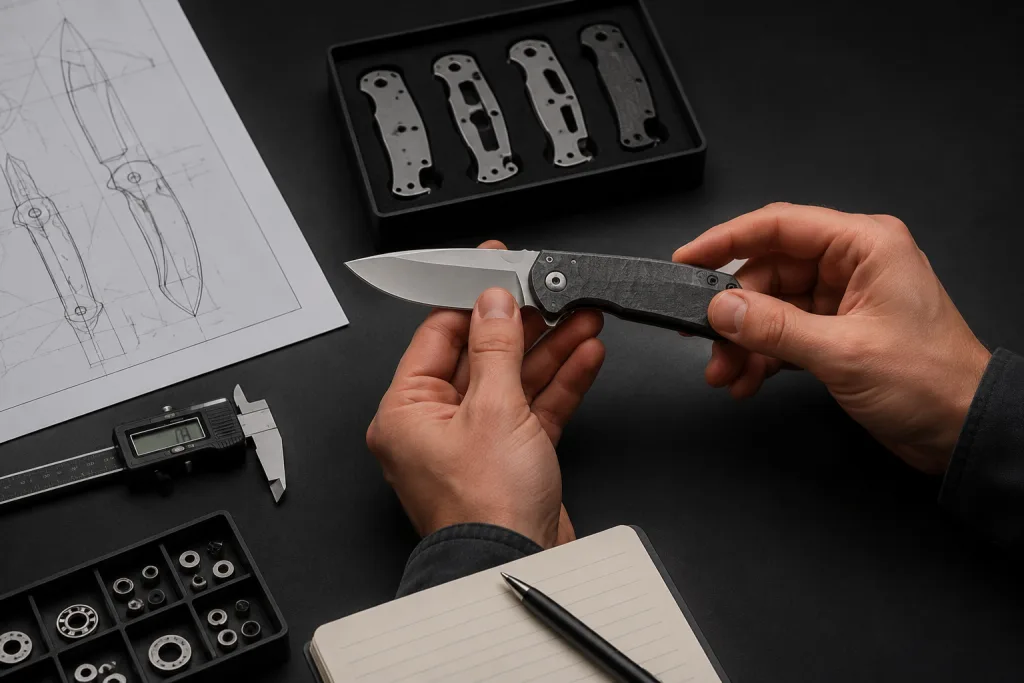
By Vincent Xi, Editorial Author
Editorial basis: Vincent Xi's author profile identifies him as an Editorial Author. It does not provide a basis for first-hand factory, testing, customer, or certification claims; none are made here.
Knife wholesale supplier prequalification is not a search for a universally superior blade material. It is a decision about whether a candidate supplier can connect a quoted knife SKU to controlled material identity, a defined finished configuration, dated measurements, and production records.
Approval boundary: Qualify only the named SKU, drawing revision, material condition, geometry, finish, construction, and packaging configuration supported by linked evidence. Do not transfer approval to a different material, revision, process route, or production lot without documented review.
Assign the Disposition Before Comparing Price
| Buyer disposition | Evidence condition | Buyer action |
|---|---|---|
| Hold | The quote, controlled drawing, material record, sample identity, measurement report, or lot reference cannot be matched to the same configuration. | Request the missing or corrected record and leave the configuration unqualified. |
| Controlled pilot | Sample measurements have been reviewed, but production-equivalent lot linkage or written change control remains incomplete. | Limit the release to the documented pilot configuration and record the evidence required before reorder review. |
| Regular-order review | The quote, material identity, controlled drawing, production-equivalent sample, measurement record, lot linkage, and change-control commitment align. | Complete commercial review while retaining the technical evidence and reapproval triggers in the approval file. |
Commercial terms become comparable only after candidate quotes describe the same controlled technical configuration. A lower quote for an unspecified material condition or an unlinked sample is not equivalent evidence.
Make Material Selection Traceable
Start with the named SKU's intended use, exposure conditions, cleaning and storage expectations, geometry, finish, construction, and unacceptable failure condition. Convert those inputs into an auditable chain:
buyer-defined failure condition -> controlled material or configuration variable -> measurement or test method -> acceptance criterion -> identified sample or lot -> dated result -> disposition
| Control area | Buyer-defined requirement | Capability evidence to request | Hold condition |
|---|---|---|---|
| Material identity | Exact material designation, material condition, permitted alternatives, and required heat, batch, or lot reference. | A material record linked to the quote line, named SKU, controlled drawing revision, and evaluated sample. | A generic steel description, unmatched record, or undocumented alternative. |
| Heat treatment and surface condition | Required reporting fields, test location or coupon route, finish condition, and treatment-change notification. | A dated process or inspection record showing the method, actual observations, instrument status, applicable batch, and exception disposition. | A result without batch linkage or a changed treatment route that has not been reviewed. |
| Finished geometry | Drawing-controlled thickness location, profile, grind, edge geometry, and visual acceptance criteria. | Individual readings linked to the drawing revision, measurement location, sample identity, method, and inspection date. | A nominal target without actual measurements or a report taken at an undefined location. |
| Finished-product performance | A SKU-specific corrosion, cutting, edge-retention, impact, or functional check selected for the intended use and failure condition. | Test setup, sample condition, raw observations, endpoint, acceptance decision, and sample-to-lot traceability. | An untraceable demonstration, an undefined endpoint, or results from a different configuration. |
| Configuration and change control | Controlled construction, finish, packaging protection, substitution rules, notification triggers, and reapproval conditions. | A production-equivalent sample record, lot map, written change-control commitment, and nonconformance process. | An unreviewed change to material, source, treatment, geometry, finish, construction, or packaging. |
Request actual readings and observations rather than target-only statements. Each record should identify the supplier, named SKU, controlled revision, sample condition, applicable material or production lot, method, acceptance criterion, actual result, report date, and disposition of any exception.
Put Measurable Assumptions in the RFQ
The figures below are illustrative buyer-created RFQ assumptions, not external benchmarks, supplier results, or universal knife requirements. For each example, the source is the buyer's controlled RFQ for the named SKU, the as-of context is that RFQ's issue date, and every target, tolerance, sample quantity, method, and acceptance rule must be verified in the supplier's dated quote and inspection record before approval.
| Measurement field | Illustrative assumption, scope, source, and as-of context | Evidence required from the supplier |
|---|---|---|
| Hardness | Example assumption to verify: 58-60 HRC on the Rockwell C scale at a buyer-defined location, measured on 3 sacrificial coupons linked to the named SKU and defined heat-treatment batch. Source: buyer-controlled RFQ; effective as of its issue date. | Method, test location, individual readings, coupon-to-batch link, instrument status, inspection date, and disposition. |
| Blade-spine thickness | Example assumption to verify: 2.50 mm +/- 0.10 mm at the drawing-defined spine location, measured on 5 finished blades from the named SKU and defined production lot. Source: buyer-controlled RFQ; effective as of its issue date. | Gauge or instrument, measurement location, individual readings, drawing revision, sample identities, lot reference, and inspection date. |
| Edge geometry | Example assumption to verify: 18 degrees +/- 2 degrees per side after final sharpening, measured on 3 finished blades from the named SKU and defined production lot. Source: buyer-controlled RFQ; effective as of its issue date. | Inspection fixture or method, sample condition, individual readings, drawing or acceptance reference, lot reference, and inspection date. |
| Corrosion exposure | Example assumption to verify: 24 hours under a buyer-defined exposure method, applied to 2 production-equivalent samples from the named SKU and defined production lot. Source: buyer-controlled RFQ; effective as of its issue date. | Exposure conditions, start and end records, sample condition, endpoint, observations, acceptance decision, lot reference, and disposition. |
Set the final limits only after defining intended use, failure cost, test setup, sample condition, and acceptance endpoint. A hardness range does not replace the separate evidence needed for material identity, finished geometry, surface condition, corrosion response, or functional performance.
Practical RFQ Checklist for Supplier Quotes
Attach this checklist to the controlled RFQ and require the supplier to mark each item as included, unavailable, or requiring clarification. Every included item should identify the corresponding document name, revision, issue date, SKU, and applicable lot or batch. An unchecked item or unsupported statement remains an open requirement rather than evidence of compliance.
Quoted configuration
- [ ] The quote identifies the supplier's legal name, quote revision, issue date, validity date, named SKU, buyer drawing number, and drawing revision.
- [ ] The quote states the exact blade material designation and material condition rather than a generic material family.
- [ ] The quote identifies the heat-treatment route, finish, grind, edge condition, construction, included components, and packaging protection applicable to the named SKU.
- [ ] Any permitted material, component, or process alternative is listed explicitly; unlisted substitutions are prohibited without written buyer review.
- [ ] Price, currency, minimum order quantity, order multiple, tooling or setup charges, delivery term, payment term, sample cost, production lead time, and quote validity are stated for the same configuration.
Material and process records
- [ ] A material record is linked to the quoted SKU, controlled drawing revision, sample identity, and applicable material heat, batch, or lot.
- [ ] The material record identifies the reported designation, condition, issuing organization, issue date, and the records needed to trace it to finished production.
- [ ] Heat-treatment and surface-process records identify the applicable batch, process route, inspection method, actual observations, report date, and exception disposition.
- [ ] Any cited standard is identified by exact title and revision, with a statement explaining whether it defines a test method, product requirement, or supplier practice.
- [ ] Any certification claim is supported by a current document identifying the issuing body, covered facility or product, scope, and validity period; otherwise, the claim is marked unverified.
Sample and measurement return
- [ ] Each sample is identified as prototype, pre-production, or production-equivalent and is linked to the named SKU, drawing revision, material lot, and production lot where applicable.
- [ ] Dimensional reports state the instrument or gauge, controlled measurement location, sample condition, individual readings, acceptance criterion, inspection date, and disposition.
- [ ] Hardness reports state the method, scale, test location or coupon route, individual readings, instrument status, applicable heat-treatment batch, inspection date, and disposition.
- [ ] Edge-geometry reports state whether measurements apply per side or inclusively, along with the fixture or method, sample condition, individual readings, and inspection date.
- [ ] Corrosion or functional-performance reports define the setup, exposure or loading conditions, sample preparation, endpoint, raw observations, acceptance decision, and sample-to-lot linkage.
- [ ] Nonconforming or inconclusive results remain in the return package with the approved disposition and authorization record.
Production and change controls
- [ ] The supplier describes how material lots, process batches, production lots, samples, inspection reports, and shipment records remain linked.
- [ ] The supplier agrees to notify the buyer before changing material source, material condition, heat-treatment route, geometry, finish, construction, critical subcontractor, inspection method, or packaging protection.
- [ ] The response identifies which changes require a new sample, repeated measurement, pilot release, or buyer reapproval before shipment.
- [ ] The supplier states how nonconforming output is segregated, reviewed, documented, and prevented from being shipped without an authorized disposition.
- [ ] The supplier confirms which records will accompany a shipment and which records will be retained for later receiving, complaint, or reorder review.
Buyer closeout
- [ ] Technical reviewers have matched the quote, drawing, material record, samples, reports, and lot references to one controlled configuration.
- [ ] Open clarifications, deviations, and missing records have named owners and written dispositions.
- [ ] Commercial comparison uses only quotes that cover an equivalent technical and packaging configuration.
- [ ] The purchase release identifies the approved SKU, drawing revision, configuration, evidence package, pilot or regular-order status, and reapproval triggers.
A supplier's completed checklist is an index to evidence, not evidence by itself. The buyer should retain the referenced documents and record a hold, controlled-pilot, or regular-order-review disposition for the exact quoted configuration.
Review Evidence as a Single Configuration
Read the approval file horizontally across the quoted configuration. The material designation and condition should match the quote, drawing, material record, sample label, measurement report, and applicable lot reference. Record whether the evaluated item is a prototype, pre-production sample, or production-equivalent sample.
Check that:
- Measurement locations and sample conditions match the controlled drawing or acceptance plan.
- Reports show individual readings or raw observations, not only a target or summary statement.
- Material and production lots link to the evaluated samples and finished inspection records.
- Out-of-specification results remain visible with their disposition and authorization.
- Material substitutions and process changes require notice and buyer review before release.
- The retained approval sample and report can be used for later receiving comparison.
A polished sample without material, revision, and lot linkage is sample evidence only. It does not establish repeatable production capability for the quoted configuration.
Handle Standards and Certification Claims Carefully
When a supplier cites a standard, request its exact title, revision, method, specimen condition, and relationship to the buyer's acceptance criterion. Separate the standard's stated requirements from the supplier's own inspection practice.
A reference to a standard is not proof of certification. Treat certification as unverified unless a current document identifies the relevant product, facility, issuing body, validity period, and scope.
Source Context and Evidence Limits
| Cited source | Context retained for this article | Evidence limit |
|---|---|---|
| China Knives Wholesale sourcing articles | Category-level knife sourcing context supplied with the article package. | No material specification, performance limit, price, or candidate capability claim is derived from this page. |
| SZCO stocking article | Retail stocking context supplied with the article package. | It is not technical evidence for a candidate supplier's material, process, measurements, or lot controls. |
| WholesaleSeeker distributor guide | Distributor-selection context supplied with the article package. | It is not used to establish current commercial terms, technical capability, or an RFQ acceptance requirement. |
| TOP KNIVES wholesale page | Wholesale and regional-distribution context supplied with the article package. | It is not proof of material identity, production control, measured performance, or change control. |
| Vincent Xi author profile | Source for the visible author name, profile URL, and Editorial Author role. | It does not support factory observation, product testing, customer outcomes, credentials, or certification claims. |
Methodology: This prequalification framework was derived by mapping a buyer-defined failure condition to a controlled material or configuration variable, then to a stated measurement method, acceptance criterion, identified sample or lot, dated result, and release disposition. No quantitative benchmark was extracted from the contextual source pages. The numerical fields are explicitly labeled buyer-created assumptions for supplier verification.
Limitations and what to verify: The cited pages do not establish a candidate supplier's material chemistry, material condition, heat-treatment route, tolerances, equipment, capacity, quality results, pricing, minimum order quantity, lead time, inventory, certification, customer outcomes, or destination-law compliance. Before release, verify the current SKU-specific quote, controlled drawing, material record, production-equivalent sample, actual measurements, test conditions, instrument status, raw observations, lot linkage, exception handling, change-control terms, and signed commercial conditions.
Close the Approval File
The final file should connect the supplier name, named SKU, controlled drawing revision, material record, sample identity, measured results, lot or batch reference, exceptions, quote revision, and reapproval triggers. Move the configuration to regular-order review only when the quoted material maps to the evaluated product, the buyer-set limits have dated supporting records, and lot and change-control commitments are documented.