Knives Bulk Order Guide: Technical Specifications and RFQ Checklist for B2B Buyers
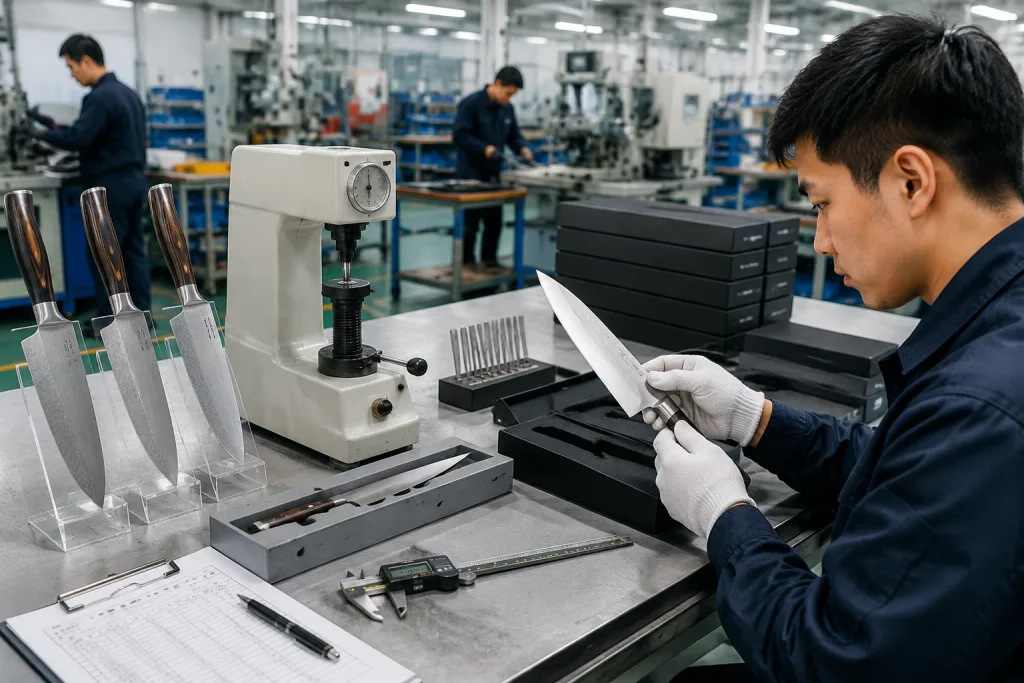
Knives Bulk Order Guide: Technical Specifications and RFQ Checklist for B2B Buyers
**By Vincent Xi** Editorial Author | https://tangforge.com/authors/vincent-xi/
A knives bulk order succeeds or fails on specification clarity. Importers, private-label brands, distributors, and retail buyers who treat bulk knife procurement as a catalog purchase often discover late-stage issues in steel grade substitution, heat-treatment drift, handle fit, packaging compliance, or inspection sampling. This guide focuses on measurable technical specifications and a practical RFQ checklist so purchasing, product, and quality teams can compare suppliers against the same written requirements.
The content below is editorial research for B2B sourcing decisions. Market-scale figures and process descriptions are attributed to the cited third-party pages only. This article does not present factory claims, pricing, certifications, capacity, labor practices, or customer outcomes as verified for any single supplier, including Tangforge or any other named manufacturer.
Who this guide is for
Use this article when you need to:
- Convert a product concept or retail assortment into a quoteable engineering package
- Align purchasing, product, and QC on one RFQ packet before supplier outreach
- Compare multiple factories on steel, hardness, geometry, packaging, and inspection depth rather than unit price alone
- Reduce rework risk between sample approval and mass production
Market and manufacturing context for bulk knife sourcing
Bulk knife programs are commonly sourced from high-volume manufacturing regions with deep blade-and-hardware clusters. A published B2B sourcing guide states that in **2024** China exported **$1.66 billion** worth of knives, equal to **51.5%** of global knife exports, based on OEC World bilateral product data as summarized by that guide (Lee Knives sourcing guide). The same guide reports total Chinese production of knives, scissors, and blades at **2.9 billion units**, up **8%** year over year, referencing IndexBox **2025** market overview material (Lee Knives sourcing guide).
Within China, Yangjiang is frequently described as a dominant knife production hub. The same sourcing overview reports that Yangjiang’s knife and hardware industry exceeded **55 billion RMB** in output value in **2024** and that Yangjiang-made products accounted for **eight out of every ten knives** China exports, citing China Daily **2025** coverage (Lee Knives sourcing guide). It also attributes approximately **70%** of China’s total knife output and **85%** of China’s knife exports to Yangjiang (Lee Knives sourcing guide). These figures describe national and regional scale only. They are not capacity, quality-system, steel-authenticity, or compliance evidence for any individual factory.
**Buyer takeaway:** published trade context indicates large available scale; product risk still concentrates in incomplete specifications. A supplier able to quote private-label kitchen SKUs or high-volume folding SKUs may still produce inconsistent hardness, edge geometry, or packaging if the RFQ leaves those variables open. Quote feasibility must be confirmed in the supplier’s formal response and sample inspection, not inferred from national export totals (Lee Knives sourcing guide).
Technical specifications to lock before a knives bulk order RFQ
Define product architecture first. Kitchen, folding EDC, outdoor/tactical, hunting, and multi-tool programs do not share the same failure modes.
| Program type | Dominant risk areas to specify | Typical RFQ attachments | | --- | --- | --- | | Fixed-blade kitchen | Edge retention, corrosion resistance, handle hygiene, food-contact packaging | Steel grade, hardness method, handle material docs, unit/master pack rules | | Folding EDC / outdoor | Pivot torque, lock engagement, detent consistency, clip strength, assembly stack-up | Function-test method, lock criteria, clip position, torque notes | | Hunting / fixed outdoor | Tip strength policy, sheath interface, corrosion protection for export oiling | Geometry drawing, finish standard, sheath BOM if included | | Multi-tool | Component fit, tool deployment force, fastener retention | Exploded BOM, critical stack dimensions, sampling plan |
Blade steel and heat treatment
Specify steel by commercial grade or mill designation, not marketing labels alone. Common bulk categories discussed in sourcing practice include stainless kitchen steels, mid-range stainless for EDC, and higher-alloy options for premium programs. Those category labels are decision groupings only; they are not a substitute for a named grade on the RFQ. The RFQ should require:
- Exact steel grade and any buyer-approved alternate grades, if permitted
- Target hardness range with unit and method—for example Rockwell hardness on the C scale (HRC)—plus measurement location on the blade and sampling frequency
- Heat-treatment process controls the supplier must document (austenitize/temper notes only if the buyer requires process disclosure)
- Corrosion or edge-retention expectations framed as named test methods and accept/reject limits, not slogans
Custom and OEM process descriptions commonly sequence steel preparation, forging or stock removal, heat treatment and tempering, grinding/finishing, assembly, then quality control and testing (BiliKnife process overview). Treat that sequence as a process map for verification questions, not proof that a quoted factory performs every step in-house or under a single quality system.
Geometry, finish, and functional dimensions
Provide a drawing or fully dimensioned CAD package under revision control. Minimum fields typically include:
- Overall length and blade length, with units
- Blade thickness at spine and ricasso
- Edge angle or grind type; tip geometry
- Tang style and hole positions
- Assembly stack-up and critical clearances for folders
- Surface finish as a measurable condition (for example grit range for satin, bead-blast condition, mirror polish, or coated finish with coating type and thickness expectation where relevant)
Handle materials and fittings
Handle choice affects cost, durability, hygiene, and material-responsibility documentation. Ethical-sourcing discussions for custom knives commonly highlight steel, wood, and other natural or composite materials, and stress responsible material selection and production methods (Shokunin USA ethical sourcing article). For bulk RFQs, convert that into document requirements:
- Material SDS or composition sheets
- Wood species and treatment, or polymer grade/color standard
- Pin/screw alloy and torque or retention method
- Restricted-substance requirements for each destination market
Do not treat “ethical,” “premium,” or “natural” wording as proof of compliance. Require records that map material lots to finished SKUs.
Marking, packaging, and logistics interfaces
Bulk programs fail at the carton as often as at the blade. Specify logo method, placement, and depth/contrast; barcode/SKU rules; unit packaging; master carton count; drop-test or transit expectations if required by the buyer’s network; and destination labeling language. Also define Incoterms, sample approval gates, and rework/reject disposition before production starts.
Buyer decision table for knives bulk order programs
Use the table below as a pre-RFQ alignment tool. Values are decision variables, not universal market prices, lead times, or guaranteed factory capabilities.
| Decision variable | Lower-complexity bulk path | Higher-control bulk path | What the RFQ must force into writing | | --- | --- | --- | --- | | Program type | Existing factory model with logo/pack changes | New geometry or full private-label development | Drawing revision, sample stage, tooling ownership | | Steel definition | One named stainless grade with stated hardness band | Named grade plus approved alternates and certs by heat/lot | Mill certs, hardness method, reject limits | | MOQ posture | Larger standard runs to stabilize unit cost | Smaller pilot lots, then scale | Pilot quantity, mass-production quantity, price-break logic | | Handle system | Standard polymer or common wood/composite options | Controlled species/composite stack and hardware | Material grade, moisture/finish rules, fastener torque | | QC depth | AQL sampling on dimensions, hardness, function | Tighter AQL plus process checks on critical CTQs | CTQ list, sampling plan, measurement tools | | Compliance posture | Destination-market baseline only | Ethical material and labor documentation requests | Restricted substances, origin docs, audit scope | | Lead-time risk | Stock-adjacent components | Custom heat treat, coatings, complex packaging | Capacity calendar, holiday blackouts, air/sea split |
Practical RFQ checklist for a knives bulk order
Copy this checklist into the RFQ packet. Incomplete RFQs create quote incomparability.
1. **Commercial identity:** legal buyer entity, destination markets, estimated annual volume, first-order quantity, reorder forecast, and target ship window. 2. **Product identity:** SKU list, category (kitchen, folding, fixed outdoor, multi-tool), left/right or ambidextrous requirements, and reference-sample policy. 3. **Engineering package:** 2D drawings and/or 3D files, revision control, critical-to-quality (CTQ) dimensions, and geometric tolerances with units. 4. **Steel and heat treatment:** exact grade, hardness range with unit (for example HRC), measurement method and location, temper documentation if required, and whether freehand or fixture grinding is allowed on the edge. 5. **Edge and finish:** grind type, edge-angle target or range, burr acceptance, finish type, coating type if any, and corrosion-protection oil policy for export packing. 6. **Handle and hardware:** material grade/species, color standard, texture, pin/screw specification, clip type/position, and lock type for folders. 7. **Function tests:** open/close force or detent method for folders, lock engagement criteria, tip strength or flex policy only if the buyer has a defined test method, and food-contact use case for kitchen SKUs. 8. **Marking:** logo artwork, placement coordinates, method (laser, etch, stamp), depth/contrast acceptance, and serial or batch coding if required. 9. **Packaging:** unit pack, inserts, master carton count, carton strength, labels, barcodes, languages, and any retail hangtag rules. 10. **Inspection plan:** AQL levels, sampling points (incoming steel, in-process hardness, final function), measurement equipment list, and whether third-party inspection is buyer-appointed. 11. **Documentation:** material certificates, process travelers, packing-list format, certificate-of-origin needs, and any restricted-substance declarations requested by the buyer’s compliance team. 12. **Commercial terms:** Incoterms, payment terms for samples vs mass production, tooling ownership, mold/die amortization if applicable, warranty/defect claims window, and defective-goods remediation path. 13. **Ethical and material-responsibility questions:** ask whether steel, wood, or other handle materials are documented for responsible sourcing practices; do not accept vague claims without records (Shokunin USA ethical sourcing article). 14. **Capacity and risk:** monthly capacity for the quoted SKU family, subcontracted process steps (especially heat treatment and coating), and blackout dates around major trade or holiday periods. Regional trade-fair calendars such as Yangjiang’s annual hardware knives and scissors fair are planning context only; they are not a substitute for a factory capacity letter or current production schedule (Lee Knives sourcing guide).
RFQ packet minimum contents
| Attachment | Purpose | Buyer-side owner | | --- | --- | --- | | Controlled drawings / CAD | Freeze geometry and CTQs | Product / engineering | | Spec sheet (steel, hardness, finish, handle) | Make quotes comparable | Purchasing + QC | | Packaging standard | Prevent carton and label failures | Operations / retail | | Inspection plan with AQL and methods | Define accept/reject rules | Quality | | Commercial term sheet | Align Incoterms, tooling, claims window | Purchasing / legal |
Process map buyers should verify, not assume
Professional custom and OEM manufacturing narratives commonly describe a path from design to steel preparation, forging or stock removal, heat treatment and tempering, grinding and finishing, assembly, then quality control and testing (BiliKnife process overview). For a knives bulk order, convert that narrative into verification questions:
- Which steps are performed in-house versus subcontracted?
- Where is hardness measured in the process flow, with what instrument and on what sample size?
- Are edge angles checked with a defined gauge or optical method?
- How are nonconforming blades segregated and dispositioned?
- What is the sample size for final function testing on folders?
A government-backed testing body and concentrated local supply chain are often cited as infrastructure advantages in major hubs such as Yangjiang (Lee Knives sourcing guide). Infrastructure proximity can support faster iteration, but it does not automatically mean a specific quote includes third-party test reports. Require the reports you need by name, method, lot linkage, and as-of date.
Quality, standards language, and compliance wording that keeps RFQs clean
Name standards only when they map to a real acceptance requirement. Distinguish a standard’s requirement from a company’s internal practice. For example, a buyer may require Rockwell C hardness results as an acceptance method without claiming the product is “certified” to a broader management system. Food-contact markets may require buyer-defined compliance evidence for materials and coatings; that is a destination-market documentation requirement the supplier must support with records, not a marketing badge.
Avoid RFQ language that confuses quality systems with product acceptance. “ISO-capable factory,” “export quality,” or “premium steel” are not measurable. Replace them with:
- hardness window, method, location, and measurement frequency
- dimensional CTQs and gauges
- packaging drop or compression criteria if used by the buyer
- lot traceability from steel heat number to finished carton
- written disposition rules for cosmetic vs functional defects
Ethical sourcing claims should follow the same discipline. Responsible material selection can support brand policy and reduce supply-chain risk only when materials and methods are documented rather than asserted (Shokunin USA ethical sourcing article).
Sample-to-mass production controls
A practical bulk path usually includes three gates:
1. **Engineering sample / first article:** confirm geometry, hardness, finish, and function against the drawing package. 2. **Pre-production sample:** confirm production tooling, packaging, and markings under near-mass conditions. 3. **Mass-production release:** freeze the bill of materials, inspection plan, and packing standard.
At each gate, record measured values with units and methods. **Example calculation for internal planning only, to verify in the supplier quote:** if a pilot lot is **500 pieces** and the buyer’s internal scrap/rework allowance assumption is **2%**, the planning yield is **490 shippable pieces** before final QC disposition. The **2%** figure is an assumption for worksheet planning, not a market constant or factory guarantee, and must be replaced by the supplier’s agreed process controls and the buyer’s AQL plan.
For multi-SKU assortment orders, freeze a master CTQ matrix. Kitchen blades may prioritize corrosion resistance and handle hygiene; folding SKUs may prioritize lock engagement and pivot consistency. Do not collapse different failure modes into one vague “quality” line item.
Methodology and source context
**How the data was derived:** Market-scale figures in this article are taken from a published B2B sourcing guide that aggregates public trade and industry reporting for Chinese knife exports and Yangjiang industrial output, including references attributed there to OEC World, IndexBox 2025, and China Daily 2025 (Lee Knives sourcing guide). Process-step language is drawn from a manufacturing overview describing design through quality control in custom knife production (BiliKnife process overview). Ethical-material considerations are summarized from a sourcing discussion focused on responsible material choices for custom knives (Shokunin USA ethical sourcing article). RFQ checklist items and decision tables are editorial synthesis for buyer process control; they are not measurements of any named factory’s capability.
**Limitations / what to verify:** Export values, unit production totals, and regional share percentages are historical published figures as reported by the cited secondary guide and may be revised in later datasets. They describe market scale, not quote validity. Factory capability, steel authenticity, heat-treatment control, subcontracting scope, labor practices, restricted-substance status, and any certification status must be verified against current supplier documents, sample inspection, and destination-market legal requirements. Any numeric commercial assumptions in an internal cost model—such as pilot quantity, scrap allowance, hardness target, or carton fill—should be labeled as example calculations or buyer requirements and confirmed in the supplier quote and inspection records.
Conclusion
A knives bulk order is a specification project before it is a price project. Published trade context shows large export and production scale in major manufacturing hubs, including multi-billion-dollar export value and multi-billion-unit production totals for recent reporting years (Lee Knives sourcing guide). That scale helps buyers locate capacity, but only a complete RFQ—steel, hardness method, geometry, handles, packaging, inspection, documentation, and commercial terms—makes supplier quotes comparable.
Use the decision table to align internal stakeholders, then issue the checklist as a mandatory attachment. Require process transparency for heat treatment and finishing steps (BiliKnife process overview), and request material-responsibility evidence where brand or compliance policy requires it (Shokunin USA ethical sourcing article). Verify every critical number in the supplier’s formal quotation and inspection records before approving mass production.