OEM Pocket Knife Factory Guide: Technical Specs and RFQ Checklist
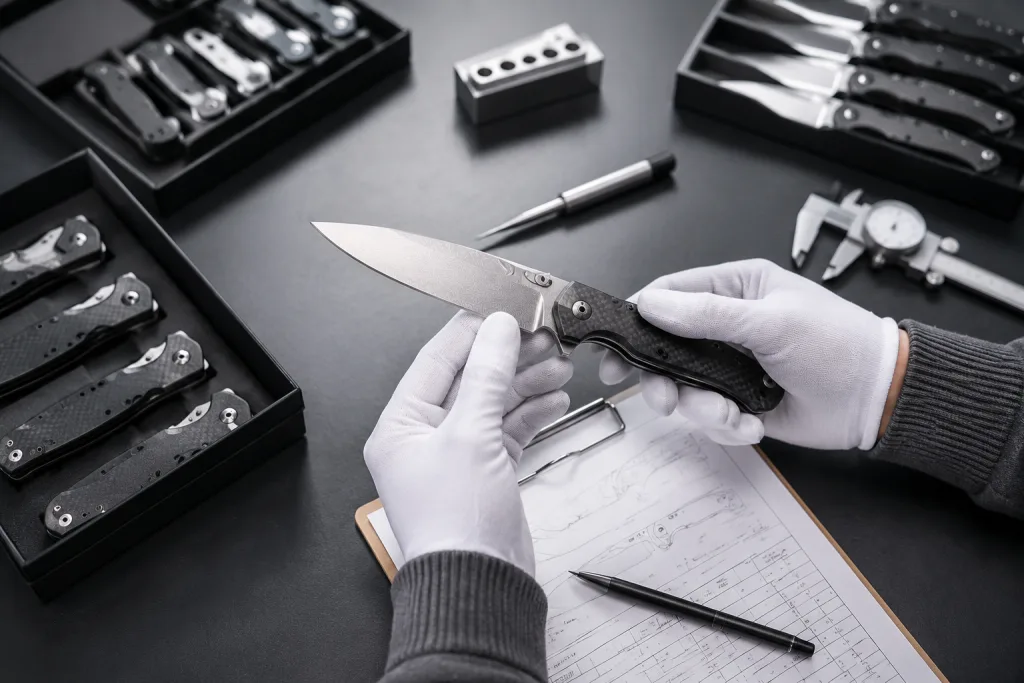
OEM Pocket Knife Factory Guide: Technical Specs and RFQ Checklist
**By Vincent Xi, Editorial Author**
Buying from an **oem pocket knife factory** is a specification project first and a price negotiation second. Private-label brands, importers, and retailers that treat the RFQ as a complete technical package reduce sample churn, protect margin, and avoid lock, steel, and finish mismatches that only appear after tooling is paid.
This guide is written for B2B buyers who need a practical specification framework and an RFQ checklist. It synthesizes publicly reported industry context with common OEM process stages. It does **not** claim factory audits, customer programs, tooling ownership outcomes, scrap rates, or first-hand production runs for any single supplier.
What to lock before you send an RFQ
Define the product as a system, not a unit price:
1. **Blade package** — steel grade, hardness band, thickness, grind, edge, finish 2. **Mechanism package** — opener, lock type, pivot stack, play and lockup limits 3. **Handle and hardware package** — scales, liners, clip, fasteners, backspacer 4. **Identity and pack-out package** — logo method, unit pack, master carton, labels 5. **Acceptance package** — AQL, functional tests, sample retention, rework rules
If any of these are left to factory defaults, the quote is not comparable and the pilot run will absorb the ambiguity.
Market context for OEM pocket knife sourcing
China remains a high-density manufacturing base for knives sold into export programs. According to a B2B sourcing overview citing OEC World, China exported **$1.66 billion** worth of knives in **2024**, equal to **51.5% of global knife exports** (Lee Knives sourcing guide). The same guide cites IndexBox (2025) for total production of knives, scissors, and blades at **2.9 billion units**, **up 8% year-over-year** (Lee Knives sourcing guide).
Regional concentration matters for pocket-knife OEM programs because folding knives depend on local supply of stainless blanks, heat treatment, die-cast or CNC handle parts, clips, fasteners, and packaging. The same source reports that Yangjiang’s knife and hardware industry exceeded **55 billion RMB** in output value in **2024**, with Yangjiang-made products accounting for **eight out of every ten knives China exports**. It also states Yangjiang accounts for approximately **70% of China’s total knife output** and **85% of its knife exports** (Lee Knives sourcing guide).
Those figures are **industry-level** indicators of capacity density and export orientation. They help explain where multi-SKU OEM ecosystems cluster. They are **not** evidence that any named factory can hold hardness windows, lock geometry, scrap rate, MOQ, or ship dates.
Evidence and methodology note
**Source contexts used:** (1) a China knife manufacturing hub overview with 2024–2025 export and production figures (Lee Knives); (2) an ethical materials discussion for custom knives covering steel, wood, and natural handle materials (Shokunin USA); (3) a custom-knife manufacturing process outline covering design, stock removal/forging, heat treatment, grinding, assembly, and QC (BiliKnife).
**How the data was derived for this article:** Numeric market figures are restated exactly as reported in the cited secondary guide and attributed to the primary references named there (OEC World; IndexBox 2025; China Daily 2025 as named by that guide). Process and materials points are treated as **general OEM workflow language**, not as verified capability of any named factory. Dimensional, hardness, cycle-count, and force targets below are labeled as **buyer specification examples** to confirm in samples and the supplier quote.
**Limitations / what to verify:** Export totals and regional shares do not prove any factory’s MOQ, scrap rate, hardness window, lock life, packaging performance, or compliance package. Destination markets may restrict blade length, assisted opening, or lock style. Before purchase-order release, re-check current mill certificates, heat-treat records, AQL plan, packaging drop tests, and legal import rules for each SKU and market. Secondary sourcing guides can lag primary customs or statistical releases; treat cited market figures as directional context, not as a live capacity commitment.
Core technical specifications buyers must define
An OEM pocket knife RFQ should define the product as a system: blade steel + heat treatment + grind + lock + pivot + handle stack + hardware + finish + marking + packaging. Incomplete RFQs force factories to fill gaps with defaults that may not match brand positioning.
Blade steel and heat treatment
Specify both **steel grade** and **target hardness band**, plus whether the factory may substitute. Common commercial categories buyers request (examples for RFQ language, not a performance ranking and not a claim about any factory’s available inventory):
- Budget stainless programs: 3Cr13 / 5Cr15MoV / 8Cr13MoV class steels
- Mid stainless programs: 440C, 9Cr18MoV, AUS-8 class
- Tool-steel / higher-wear programs: D2 / equivalent semi-stainless
- Premium stainless programs: VG-10, S35VN, or other powder steels **only when the factory can document heat-treat capability and material source**
**Example calculation / assumption to verify in the supplier quote:** If a brand targets a mid-tier EDC folder, a common specification window is **blade hardness 58–60 HRC** after tempering for 8Cr13MoV-class stainless. Treat this as an **example target**, not a universal standard and not a guaranteed factory outcome. Confirm actual Rockwell method (surface location, sample size, acceptance band) and request hardness logs from the pilot run.
Also specify:
- Blade stock thickness (**example assumption to verify:** **2.5–3.5 mm** blank for a compact EDC design; confirm against drawing and quote)
- Grind type (hollow, flat, saber) and edge angle target
- Primary bevel finish (stonewash, satin, bead blast, mirror)
- Corrosion test method if outdoor use is claimed (buyer-defined salt spray hours or comparative wipe test; method and acceptance must be written into the RFQ)
Geometry, openers, and locks
Pocket knife function failures are usually geometric, not cosmetic. Define:
- Overall length closed / open
- Blade length to tip (and legal max for target markets)
- Blade shape (drop point, tanto, sheepsfoot, reverse tanto)
- Opener (thumb stud, hole, flipper, nail nick)
- Deployment: manual only vs. assisted (assisted often has extra legal and logistics constraints)
- Lock type: liner lock, frame lock, lockback, button lock, compression-style—**name the mechanism and detent expectation**
- Pivot system: screw or barrel, washers (phosphor bronze / Teflon) vs. bearings, threadlocker policy
- Stop pin / stop face design and overtravel limits
Ask for a **lockup photograph standard** (percentage of lockbar engagement on liner/frame locks) and a re-open force range after break-in of a defined cycle count. If the factory cannot describe how it measures lock stick, detent, or blade centering, the RFQ is incomplete. Do not accept brochure lock names without measurement method, acceptance band, and sample evidence.
Handle, clip, and hardware stack
Handle choice drives weight, cost, and QC difficulty:
- G10 / FRN / GRN for volume EDC
- Aluminum or titanium for mid/high programs
- Micarta, wood, bone, or other natural materials where brand story requires them
Ethical-sourcing guidance for custom knives commonly emphasizes responsible steel choices (including recycled content where claimed), sustainably sourced wood, and careful handling of natural materials such as bone or Micarta precursors (Shokunin USA ethical sourcing overview). If a brand markets “recycled steel,” “FSC wood,” or “conflict-free materials,” require **claim-level documentation** in the RFQ rather than brochure language. Absence of documents means the claim should not appear in product copy.
Also specify:
- Handle thickness and contouring
- Liner material and thickness (if separate liners)
- Pocket clip: deep carry / standard, tip-up / tip-down, reversible or fixed, screw torque
- Fastener standard (Torx size, black oxide vs. stainless)
- Backspacer material and color matching tolerance
Marking, packaging, and private-label details
OEM programs fail at the last mile when artwork and packaging are vague. Specify:
- Logo method: laser, etch, stamp, medallion
- Logo location and max size
- Blade steel marking yes/no
- Individual unit packaging (poly bag, box, sheath)
- Master carton count, drop-test expectation, barcode / UPC placement
- Insert cards, serials, or batch codes
Manufacturing process stages that affect the RFQ
Professional custom and OEM knife production is typically described as a sequence from design through QC: idea and drawings, steel preparation (forging and/or stock removal), heat treatment and tempering, grinding and finishing, assembly, then quality control and testing (BiliKnife manufacturing process overview). For pocket knives, map each stage to a **control document**:
1. **Design freeze** — 2D/3D drawings, exploded BOM, tolerance stack for pivot and lock. 2. **Blanking / stock removal** — laser/waterjet/CNC profile, grain direction if relevant, heat number tracking. 3. **Heat treatment** — furnace type, quench media, temper cycles, hardness sampling plan. 4. **Grind and finish** — fixture method, surface roughness target, edge geometry. 5. **Handle fabrication** — CNC/mold tooling ownership, color lot control, insert fit. 6. **Assembly** — pivot preload method, threadlocker, clip install sequence. 7. **QC and functional test** — centering, lock engagement, open/close cycles, blade play, cosmetics AQL.
OEM and ODM services, small-batch runs, and after-sales maintenance are commonly listed as manufacturer service types in custom-knife supplier discussions (BiliKnife OEM/ODM section). Separate **service menu language** from **contractual capability**: ask who owns tooling, who pays for rework, and what happens if hardness falls outside band. A published process outline is not a factory audit result.
Buyer decision table: match specs to evidence
Use the table below during supplier shortlisting. It is a decision aid, not a certification scheme and not an endorsement of any supplier.
| Decision area | What to specify in the RFQ | Factory evidence to request | Buyer risk if missing | | --- | --- | --- | --- | | Steel identity | Exact grade + allowed substitutes | Mill cert / heat number on pilot blades | Silent substitution, corrosion or edge-life drift | | Hardness | HRC target band + test location | Hardness log for sample lot | Soft edges or brittle tips | | Lock geometry | Lock type, engagement photo standard, play limits | Functional video + go/no-go gauges | Lock stick, walkout, unsafe unlock | | Deployment | Manual/assisted, detent force range | Cycle test plan (**example assumption to verify in quote:** 500 open/close cycles) | Retail returns after break-in | | Handle materials | Grade, color code, ethical claims if any | Material COC; sustainability docs only if claimed | Color mismatch, claim exposure | | Finish | Stonewash/satin/etc. + cosmetic AQL | Approved limit samples | Subjective reject storms | | Marking | Logo file, size, process | First-article logo proof | Branding rework | | Packaging | Unit + master pack + barcode | Pack-out photo + carton drop result if required | Retail receiving failures | | Compliance | Destination rules for length/lock/assist | Written confirmation + restricted-feature checklist | Customs holds or marketplace delisting | | Capacity | Monthly volume by SKU | Line plan / tooling list (no marketing volume claims) | Missed launch windows |
Practical RFQ checklist for an OEM pocket knife factory
Copy this checklist into the RFQ packet. Require answers in writing, not only on a call.
A. Commercial and program basics
- [ ] Product name / internal SKU
- [ ] Target markets and any blade-length or lock restrictions
- [ ] Forecast first PO quantity and 12-month volume band
- [ ] Requested sample stages: prototype → pilot → mass production
- [ ] Tooling ownership, amortization, and storage terms
- [ ] Payment terms, Incoterms, and lead time from deposit and from sample approval
- [ ] Spare parts policy (clips, screws, springs)
B. Blade and heat-treat package
- [ ] Steel grade (and banned substitutes)
- [ ] Hardness target and tolerance (**example to verify:** 58–60 HRC)
- [ ] Blade length, thickness, grind, edge angle
- [ ] Finish standard and approved limit sample process
- [ ] Corrosion or outdoor-use test expectation, if any
- [ ] Heat-number traceability requirement
C. Mechanism and assembly package
- [ ] Opener type and lock type
- [ ] Pivot hardware, washers/bearings, lubricant
- [ ] Blade centering, lateral play, and tip-to-handle gap limits
- [ ] Lock engagement criteria and re-open force after defined cycles
- [ ] Clip configuration and torque
- [ ] Fastener standard and anti-loosening method
D. Handle, materials ethics, and cosmetics
- [ ] Handle material, color, texture
- [ ] Any recycled steel / sustainable wood / natural-material claims and required proof (ethical sourcing considerations)
- [ ] Cosmetic AQL and major/minor defect definitions
- [ ] Logo process and placement drawings
E. QC, packaging, and shipment
- [ ] Incoming material checks vs. in-process vs. final inspection
- [ ] Functional test plan and sample retention period
- [ ] Unit packaging, carton count, labeling, barcodes
- [ ] Moisture protection for long ocean freight
- [ ] Photo report standard for mass-production lots
- [ ] Non-conformance handling: rework, scrap, partial shipment rules
F. Documents to attach to the RFQ
- [ ] Dimensioned drawings or STEP/3D files
- [ ] BOM with critical tolerances marked
- [ ] Logo vector files
- [ ] Packaging dieline
- [ ] Reference competitor sample photos (if legal to share) labeled as **visual intent only**
How to read quotes without over-trusting unit price
A low unit price often shifts cost into tooling amortization, packaging downgrades, steel substitution rights, or vague hardness language. When comparing OEM pocket knife factory quotes, normalize line by line:
1. **Steel and hardness** — same grade language and same HRC band. 2. **Included operations** — heat treat, stonewash, laser logo, clip install, oiling, bagging. 3. **Sample policy** — free, paid, or credited; number of revision rounds. 4. **AQL and rework** — who pays when pilot fails. 5. **Lead time definition** — from deposit, artwork freeze, or material arrival. 6. **Legal features** — assisted openers and certain locks may change shipping lanes and retailer acceptance.
Yangjiang and other Chinese hubs are frequently described as offering vertically integrated stainless sourcing, heat treatment, handle fabrication, and export logistics at scale (Lee Knives hub overview). Integration can shorten the BOM chain, but buyers still need factory-specific process control. A dense supply cluster improves optionality; it does not automatically improve detent consistency, hardness control, or packaging compliance.
Materials and brand claims: keep language auditable
If marketing will mention responsible materials, align the RFQ with claim strength:
- “Stainless steel blade” is a material statement.
- “Recycled steel content” is a **chain-of-custody** statement and needs supplier documentation.
- “Sustainably sourced wood scales” needs species, source region, and any certification **only if currently held and documentable**.
- Natural materials introduce lot variation; define color and grain acceptance with physical limit samples (ethical materials discussion).
Do not imply ISO, CE, or other certifications in product copy unless the supplier provides a **current** certificate covering the relevant scope. Standards language should distinguish **what a standard requires** from **what a factory practices**. If no certificate is on file, omit the claim rather than paraphrase a brochure.
Sample approval workflow that protects the launch
A disciplined sample path reduces mass-production disputes:
1. **Drawing approval** — freeze dimensions before metal is cut. 2. **Soft prototype** — fit/finish and ergonomics only. 3. **Heat-treated pilot** — hardness, edge, lock, clip, logo. 4. **Packaging pilot** — real carton, labels, inserts. 5. **Golden sample** — sealed reference retained by buyer and factory. 6. **Pre-shipment inspection** — against the golden sample and written AQL.
For each stage, record steel heat numbers, HRC readings, and lock photos. Custom manufacturing writeups commonly place QC after grinding, finishing, and assembly (BiliKnife process overview); pocket-knife buyers should insist that **functional** checks are not skipped for cosmetic speed. QC sequence language in a general process article is not proof of any factory’s inspection depth.
Putting the RFQ to work
An **oem pocket knife factory** partnership succeeds when the brand’s technical package is unambiguous: steel, hardness, grind, lock geometry, handle stack, marking, packaging, and acceptance tests. Use the market context above only as a map of where capacity is dense—especially export-oriented Chinese hubs with large 2024 knife export share and high Yangjiang concentration (Lee Knives). Convert that map into supplier evidence with the decision table and checklist.
Before release of tooling funds, re-verify: current material certificates, hardness method, legal fit for destination markets, sample retention, and written ownership of molds, fixtures, and logo artwork. Those controls matter more than brochure volume claims.
---
**Author note:** Published under the editorial byline of Vincent Xi, Editorial Author (author profile). This article is a sourcing specification guide based on cited secondary industry and process sources. It does not present personal factory-visit narratives, client results, awards, certifications, or unverifiable performance claims.