Pocket Knife Bulk Order Guide: Technical Specs and RFQ Checklist for B2B Buyers
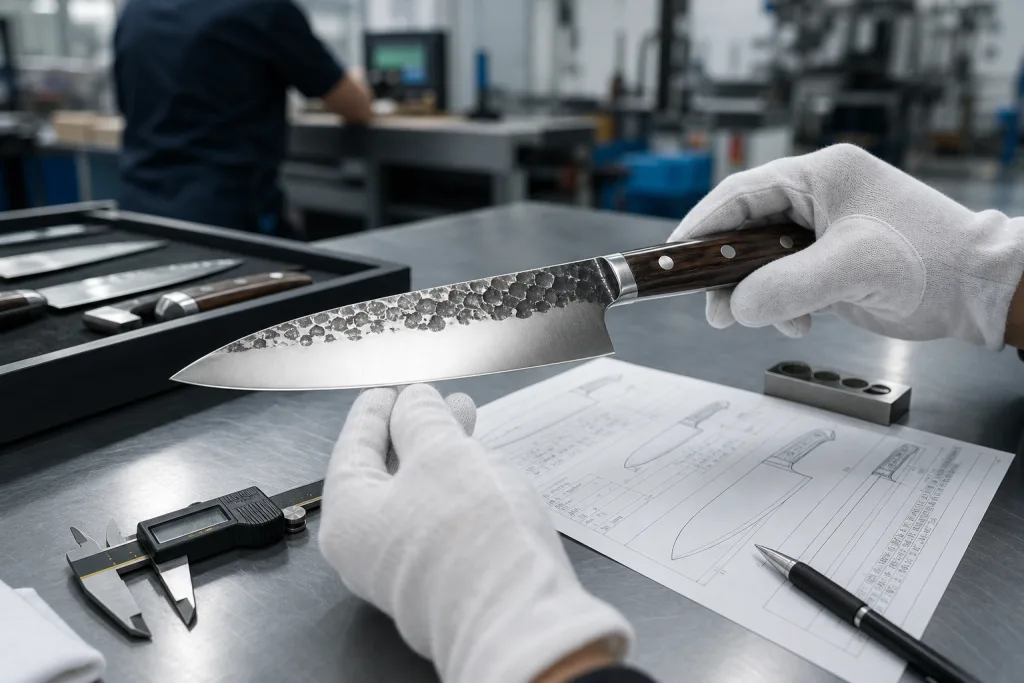
Pocket Knife Bulk Order Guide: Technical Specs and RFQ Checklist for B2B Buyers
**Byline:** Vincent Xi, Editorial Author **Author profile:** https://tangforge.com/authors/vincent-xi/ **Publisher:** TANGFORGE (tangforge.com)
A pocket knife bulk order is controlled by specification quality, not by a style photo and a target price. Importers, private-label brands, distributors, and retail buyers who send RFQs as “style + quantity + target price” often receive inconsistent samples, weak lock geometry, steel substitution, or packaging that fails destination-market rules. This guide gives technical buyers a repeatable way to define blade steel, heat-treatment targets, opening and locking systems, dimensional tolerances, inspection criteria, and commercial terms before samples and tooling begin.
This article is editorial guidance for RFQ preparation. It does not claim factory ownership, certifications, production capacity, customer results, or first-person manufacturing experience for TANGFORGE or the author.
Why bulk pocket-knife sourcing needs tighter specs
China is a major manufacturing base for commercial knives. According to a B2B sourcing overview that aggregates trade and industry statistics, China exported **USD 1.66 billion** worth of knives in **2024**, equal to **51.5% of global knife exports**, and total production of knives, scissors, and blades reached **2.9 billion units**, up **8% year-over-year** (Lee Knives sourcing guide). The same overview reports that Yangjiang’s knife and hardware industry exceeded **55 billion RMB** in output value in **2024**, with Yangjiang-made products accounting for **eight out of every ten knives China exports**, and roughly **70% of China’s knife output** and **85% of its knife exports** (Lee Knives sourcing guide).
Those figures describe market scale only. They do not validate quality, capacity, or process control at any single supplier. High export volume means buyers can find many MOQ options, finish levels, and OEM configurations—and that RFQ ambiguity invites substitution of steel grade, heat treatment, pivot hardware, handle material, and packaging. Bulk pocket-knife programs are especially sensitive because small dimensional drift affects lockup, blade centering, clip fit, and hand feel across thousands of units.
Start with order profile: how deep should your RFQ go?
Match specification depth to program risk before drafting drawings and packaging dielines.
| Buyer profile | Typical quantity band (example planning ranges; verify with supplier) | Spec depth required | Highest-risk failure modes | RFQ priority | |---|---|---|---|---| | Promotional / giveaway program | Often low unit price, higher volume | Medium: fixed design, controlled branding, simple lock or slipjoint | Weak detent, logo misplacement, packaging count errors | Artwork control, AQL cosmetics, ship-date certainty | | Retail private label EDC | Mid volume, repeat reorders | High: steel, hardness, lock geometry, clip, packaging compliance | Steel substitution, soft heat treatment, lock wear after use | Material certificates, hardness plan, pre-production sample freeze | | Outdoor / utility branded line | Mid to high volume | High: corrosion, edge retention expectations, drop durability | Rust at pivot, tip breakage, clip failure | Environmental checks, hardware finish, warranty policy language | | Premium collector-adjacent commercial run | Lower volume, higher ASP | Very high: finish matching, tighter tolerances, controlled materials | Finish inconsistency, centering, hardware rattle | Master sample, photo standards, low AQL on critical defects | | Multi-SKU assortment launch | Mixed quantities across SKUs | High program management | SKU mix-ups, shared-part contamination, uneven QC | SKU matrix, common-parts list, carton labeling rules |
The quantity bands above are planning examples only. Actual MOQ, lead time, and cost break points must come from the supplier quote for the exact design and packaging configuration.
Technical specifications to lock before requesting quotes
Define the product as a controlled bill of materials, not a photo. Separate **functional design**, **materials**, **process targets**, **finish**, **marking**, and **packaging**.
1) Product architecture and use case
State channel and duty level in measurable terms:
- Everyday carry / gift / promotional / outdoor utility / light work
- One-hand vs two-hand opening
- Right-hand, left-hand, or ambidextrous clip orientation
- Target overall length, closed length, blade length, and weight range
- Whether the knife must ship with a pocket clip, lanyard hole, or both
Do not rely on marketing names alone. “Tactical,” “EDC,” or “premium” are not measurable. Convert them into geometry, steel, hardness, and QC thresholds.
2) Blade geometry and dimensional controls
Ask suppliers to quote against drawings or controlled reference samples. Include:
- Blade shape (drop point, clip point, tanto, sheepsfoot, etc.)
- Grind type (flat, hollow, saber, scandi-style)
- Edge angle target and whether the factory edge is a working edge or shipping edge only
- Blade thickness at spine and behind edge
- Tip thickness and tip-strength expectation
- Blade length measured from tip to handle face, not overall open length
- Centering tolerance when closed
- Blade play limits: vertical and lateral, open and closed
For bulk orders, require a measurement method. Example calculation/assumption to verify in the supplier quote: if a buyer specifies closed length **110 mm ± 1.0 mm** and blade thickness **2.5 mm ± 0.10 mm**, the quote should confirm which fixture or caliper method is used, the measurement point on the part, and whether sampling is AQL-based or 100% for critical dimensions.
3) Opening and locking systems
Mechanism choice drives cost, safety risk, and QC burden.
Common commercial categories include:
- Slipjoint / non-locking traditional folders
- Liner lock
- Frame lock
- Lockback
- Button lock / axis-style / other assisted or spring-assisted systems where legal
For each system, specify:
- Deployment method: nail nick, thumb stud, flipper tab, hole, dual studs
- Detent strength target range (qualitative if no force gauge is available; quantitative if possible)
- Lock engagement depth and face contact condition
- Lockbar travel and overtravel stop if used
- Spring life expectation for assisted designs
- Disassembly policy: user-serviceable screws vs permanent assembly
Legal status of assisted-opening or automatic mechanisms varies by destination market. The RFQ should require manufacture only to the buyer’s stated market restrictions; do not treat a catalog mechanism as globally shippable.
4) Hardware and wear points
Bulk failures often appear first at pivots, clips, and stop pins—not at the grind line. Specify:
- Pivot type: screw, barrel, or peened construction
- Washer system: phosphor bronze, steel, Teflon/PTFE, ball bearings, or none
- Screw drive standard and finish
- Stop pin material and diameter
- Pocket clip material, retention force expectation, tip-up/tip-down, left/right convertibility
- Corrosion protection for hardware after salt exposure or humidity storage
Materials, heat treatment, and handle systems
Blade steel selection without marketing inflation
Request the exact commercial grade and, where relevant, the melt or supply standard the factory will use. Common bulk-program steels include 3Cr13 / 5Cr15MoV-class stainless families, 8Cr13MoV / 9Cr18MoV-class options, and higher-alloy stainless or tool steels for elevated programs. The core RFQ rule is substitution control: “equivalent steel” is not acceptable unless the buyer pre-approves chemistry and hardness windows.
A manufacturing-process overview of custom and OEM knife work commonly separates steel preparation, heat treatment/tempering, grinding/finishing, assembly, and quality control as distinct stages (Biliknife manufacturer overview). Use that stage model in the RFQ so heat treatment is not buried inside a vague “premium finish” line item.
Ask for:
- Named steel grade
- Hardness target and tolerance, e.g., example assumption to verify in the supplier quote: **HRC 56–58** measured on a defined blade zone after final grind
- Heat-treatment process owner: in-house vs outsourced
- Whether hardness is checked lot-by-lot or only on pilot samples
- Corrosion-resistance expectation for the intended use environment
Handle materials and construction
Handle choice affects weight, cost, chemical resistance, and drop durability:
- Stainless or carbon-steel liners with G10, FRN, micarta, wood, or aluminum scales
- Full stainless frame-lock construction
- Injection-molded polymer shells
- Contouring, jimping, and texture depth
- Fastener count and whether scales are pinned, screwed, or bonded
If wood or other natural materials are used, ethical and traceability questions become relevant. An ethical-sourcing discussion for custom knives notes that responsible programs consider steel, wood, and other natural materials, plus production methods and supplier practices (Shokunin USA ethical sourcing article). For bulk commercial programs, convert that principle into documents: material declarations, restricted-substance compliance, and evidence that handle materials match the approved sample lot.
Finish, marking, and brand control
Specify separately:
- Blade finish: stonewash, satin, bead blast, black oxide, PVD/DLC if used
- Handle finish and color standard (Pantone or physical master)
- Logo method: laser, etching, stamping, inlay, printed insert
- Logo location and maximum depth/height
- Serial or batch coding if required
- Whether cosmetic standards allow minor stonewash variation or require photographic A/B limits
Quality control, compliance, and sample gates
A bulk pocket-knife RFQ should force the supplier to describe inspection, not merely promise “strict QC.”
Inspection gates that reduce shipment risk
Use staged approvals:
1. **Design freeze** — drawings, BOM, mechanism photos or animation, packaging dieline 2. **Engineering sample / prototype** — function only 3. **Pre-production sample** — materials and process intended for mass production 4. **Pilot run** — small mass-production lot under production tooling 5. **Mass production with AQL** — critical and major defect classes defined in writing
Suggested critical checks for pocket knives:
- Blade hardness on a defined sample plan
- Lock engagement and accidental closure under controlled force
- Blade centering and side-to-side play
- Deployment consistency across a sample set
- Clip retention and screw torque
- Edge sharpness and burr condition
- Corrosion checks on hardware and blade if stainless claims are made
- Packaging accuracy: barcodes, warnings, country of origin, unit count
If the buyer uses an acceptance-sampling framework, state the plan explicitly (for example, buyer-defined AQL by defect class under an ISO 2859-1 style lot-sampling approach). That is a buyer inspection practice, not evidence that any supplier is certified to a standard.
Standards and claims discipline
Name standards only when they actually apply to the buyer’s market and product claim. Distinguish a standard’s requirement from a supplier’s internal practice. Never treat a website badge, historical certificate, or verbal assurance as current certification. If restricted substances, food-contact claims, or child-safety packaging rules are relevant, require current documents tied to the exact SKU and production lot—not generic factory brochures.
Yangjiang’s ecosystem includes specialized industry infrastructure such as a government-backed knives/scissors quality supervision and inspection center and a major hardware knives trade fair, as noted in market sourcing coverage (Lee Knives sourcing guide). Buyers can use that context when asking where third-party tests may be performed, but local proximity to a testing center is not itself proof that a given order was tested.
Practical RFQ checklist for a pocket knife bulk order
Use the checklist below as the body of the RFQ package. Require written answers, not catalog screenshots alone.
A. Commercial and program controls
- [ ] Legal buyer entity, ship-to markets, and restricted destination list
- [ ] Annual forecast vs first-order quantity
- [ ] Target ex-works or FOB point, Incoterm preference, and preferred payment terms
- [ ] Need for exclusivity on design, tooling ownership, and mold/die custody
- [ ] Sample fee policy, sample lead time, and mass-production lead time after deposit
- [ ] Whether reorders must match a sealed master sample
B. Product definition
- [ ] 2D drawings or controlled CAD with revision number
- [ ] Open/closed length, blade length, thickness, weight targets and tolerances
- [ ] Blade steel grade and hardness window
- [ ] Heat-treatment process description and test location on blade
- [ ] Opening system and lock type, with function criteria
- [ ] Washer/bearing system and lubricant policy
- [ ] Handle material, liner material, texture, color standard
- [ ] Pocket clip configuration and convertibility
- [ ] Finish standards with photo masters or physical standards
- [ ] Logo files, method, location, and depth/height limits
C. Compliance and documentation
- [ ] Required markings: brand, model, origin, warnings
- [ ] Restricted-substance requirements for destination market
- [ ] Any age-grading, retail packaging, or retail barcode rules
- [ ] Certificate list requested for this SKU only, with issue dates
- [ ] Ethical/material declaration needs for wood or other natural components if used (ethical sourcing considerations)
D. Quality plan
- [ ] Critical/major/minor defect definitions
- [ ] AQL levels by defect class
- [ ] Measurement tools and hardness tester method
- [ ] Function test method for lock and deployment
- [ ] Corrosion or humidity check if claimed
- [ ] Pilot-run quantity and approval authority
- [ ] Rework/scrap rules and nonconforming material control
E. Packaging and logistics
- [ ] Unit pack: polybag, box, sheath, hang card, manual
- [ ] Inner carton and master carton counts
- [ ] Drop-test or transit-protection requirements
- [ ] Label content and language
- [ ] Spare parts kit policy for screws/clips if needed
- [ ] Inspection window before shipment and who pays for third-party inspection
F. Quote comparison fields to force apples-to-apples pricing
- [ ] Unit price by quantity break
- [ ] Tooling / mold / fixture fees and ownership
- [ ] Sample cost and whether deductible
- [ ] Material brand/grade actually used
- [ ] Included QC steps
- [ ] Lead time in calendar days after deposit and after sample approval
- [ ] Payment milestones tied to sample gates
- [ ] Warranty language and defective-rate remedy
How to compare supplier answers without over-trusting catalogs
Rank responses by **spec completeness**, not only unit price. A lower price that omits hardness control, washer type, or AQL definitions is not cheaper; it is incomplete.
Evaluate these signals:
- Does the supplier restate your tolerances, or only restate marketing adjectives?
- Are materials named exactly, with substitution forbidden without written approval?
- Is heat treatment a measured output, not a slogan?
- Are packaging and compliance treated as part of the product?
- Is there a clear path from prototype to pre-production to pilot to mass production?
- Are ethical or material claims backed by lot-level documentation where claimed (Shokunin USA ethical sourcing article)?
A process-oriented manufacturer discussion typically emphasizes design-to-QC stages such as design, steel preparation, heat treatment, grinding/finishing, assembly, and testing (Biliknife manufacturer overview). Buyers can mirror those stages in the RFQ so no critical step remains unowned.
Methodology note: how this guide was derived
This article synthesizes publicly described market statistics and sourcing-structure points from published B2B knife-sourcing material, plus commonly used OEM specification categories for folding knives. Market figures for **2024** China knife exports (**USD 1.66 billion**, **51.5%** global share), **2.9 billion units** production of knives/scissors/blades (**+8%** year-over-year), and Yangjiang industry scale (**55 billion RMB** output value; high share of national output/exports) are taken from the cited sourcing overview and the secondary sources it attributes (Lee Knives sourcing guide). Process-stage language is aligned to publicly described custom/OEM manufacturing sequences (Biliknife manufacturer overview). Ethical-sourcing considerations for materials and supplier practices are drawn from the cited ethical-sourcing discussion (Shokunin USA ethical sourcing article).
Dimensional examples (**110 mm ± 1.0 mm** closed length; **2.5 mm ± 0.10 mm** blade thickness) and hardness windows (**HRC 56–58**) are labeled planning assumptions for RFQ structure only. No factory audit, laboratory test campaign, customer case study, or first-person production claim is used as evidence in this article.
Limitations and what buyers should verify
- Trade and production statistics describe national or regional industry scale as reported by the cited secondary overview; they do not validate any single factory’s capability, capacity, or quality system.
- Hardness windows, tolerances, MOQs, and lead times in this article that are labeled as examples are planning assumptions only and must be confirmed in the supplier quote and sample report.
- Mechanism legality, labeling, and restricted-substance rules depend on destination market and product configuration; obtain current legal and compliance review for the exact SKU.
- Ethical-sourcing claims require document-level verification for the materials actually used in the production lot.
- Any standard, inspection body, or certificate is relevant only with a current document tied to the product and date of manufacture.
- Cosmetic masters, lock feel, and detent strength are partly subjective unless the RFQ defines measurement methods and acceptance photos.
- Naming a sampling framework such as an ISO 2859-1 style AQL plan describes buyer inspection practice only; it does not imply supplier certification.
Closing: use the RFQ to buy a controlled product, not a photograph
A pocket knife bulk order is a controlled manufacturing program. Buyers who freeze geometry, materials, heat treatment, mechanism function, QC gates, and packaging before price negotiation reduce the risk of expensive sample loops and nonconforming mass production. Use the decision table to match specification depth to program risk, then send the checklist as a mandatory response template so every supplier quote can be compared on the same technical basis.
**Editorial author:** Vincent Xi, Editorial Author — https://tangforge.com/authors/vincent-xi/