Pocket Knife Price Factors for B2B Buyers: MOQ, Pricing Structure, and Landed-Cost Controls
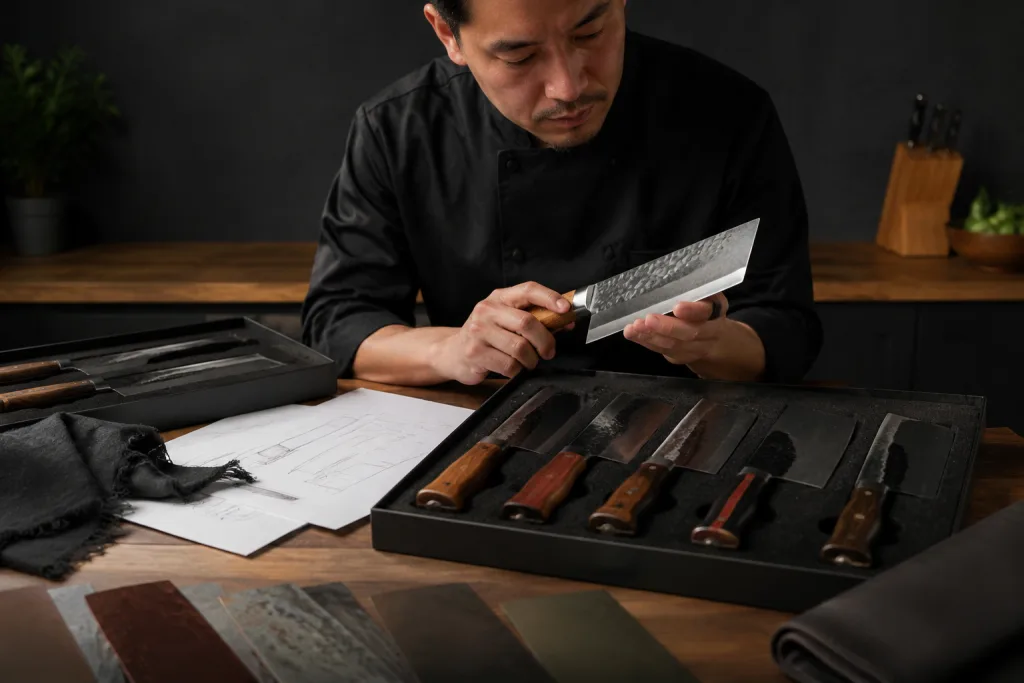
Pocket Knife Price Factors for B2B Buyers: MOQ, Pricing Structure, and Landed-Cost Controls
**By Vincent Xi** Editorial Author, TANGFORGE
For importers, private-label brands, and retail buyers, pocket knife pricing is rarely a single line item. Unit cost is shaped by minimum order quantity (MOQ), steel and handle choices, lock and finish complexity, tooling amortization, inspection intensity, and the freight-duty path that converts an ex-factory quote into a true landed cost. This article maps those pocket knife price factors into a practical B2B framework so RFQs can be compared on equal terms and cost control can begin before a purchase order is issued.
Buyer takeaway: four cost layers to model before award
| Layer | What moves price | Buyer control point | |---|---|---| | Spec / BOM | Steel, handle, lock, finish, hardware, packaging | Freeze drawings and named materials before mass production | | Volume economics | Setup, tooling recovery, batch efficiency, QC sampling | Request volume tiers and separate NRE from unit price | | Quote structure | Incoterm, validity, payment, sample fees, QC plan | Demand line-item quotes; reject incomplete offers | | Landed cost | Freight mode, duties, inspection, carton density, inventory risk | Convert all offers to the same Incoterm and model warehouse cost |
Industry scale explains why capacity exists; it does not set a SKU price. Buyers still need a clear pricing model, a disciplined RFQ, and a landed-cost checklist.
Industry scale context (not a SKU quote)
Publicly reported trade and production figures place China as a major commercial knife supply base. In 2024, China exported **USD 1.66 billion** worth of knives, accounting for **51.5% of global knife exports**, according to OEC World data summarized in a B2B sourcing guide (leeknives.com). Separate market reporting cited in the same guide notes total production of knives, scissors, and blades at **2.9 billion units**, up **8%** year-over-year (IndexBox overview referenced via leeknives.com). Within China, Yangjiang is repeatedly described as the dominant cluster: local knife and hardware industry output exceeded **55 billion RMB** in 2024, with Yangjiang-made products accounting for **eight out of every ten knives** China exports (China Daily, 2025, via leeknives.com). The same source states Yangjiang accounts for approximately **70%** of China’s total knife output and **85%** of its knife exports, and notes that regional capacity can span programs from roughly **500** private-label pieces to **50,000**-unit budget pocket knife runs (leeknives.com).
Those figures describe industry scale and cluster capacity context only. They are not a guaranteed quote, MOQ, lead time, factory capability statement, or certification for any one SKU or supplier.
What drives pocket knife unit pricing in OEM and ODM programs
Pocket knife price is a bill of materials plus process cost, not only “steel grade.” The major cost buckets buyers should separate in RFQs usually are:
1. **Blade steel and heat treatment** — commodity stainless grades, mid-tier cutlery stainless, and premium or powder steels differ in raw material cost, grind difficulty, and heat-treat cycle control. Public process overviews list heat treatment and tempering as core stages in professional knife manufacturing workflows (biliknife.com). 2. **Handle and hardware stack** — ABS, FRN, wood, G10, Micarta, aluminum, or titanium change both material cost and machining/finish time. Pivot systems, washers or bearings, screws, pocket clips, and liners often move unit cost as much as the handle slab itself. 3. **Mechanism and assembly complexity** — slip joints, liner locks, frame locks, and multi-component assisted or specialty locks differ in part count, fit-up labor, and scrap risk. Assembly and finishing are described as discrete stages after grinding in the same process overview (biliknife.com). 4. **Surface finish and cosmetics** — bead blast, stonewash, satin, polished flats, two-tone grinds, DLC/PVD, or engraved marks add cycle time and reject risk. 5. **Branding, packaging, and documentation** — logo methods, insert cards, clamshells, gift boxes, barcodes, and retail-ready packing raise both unit cost and QC scope. 6. **Quality plan intensity** — 100% function checks, sample hardness verification, corrosion sampling, and dimensional gauges cost more than visual AQL-only inspection.
Material ethics and origin choices can also affect cost and lead time when buyers specify recycled steel, certified wood, or tighter supplier documentation (shokuninusa.com). Write those requirements as commercial specifications; do not treat them as free upgrades.
No absolute dollar price is implied by material or process category alone. Named grade, hardness target, lock geometry, packaging BOM, and QC plan must appear in the written quote.
MOQ and how volume tiers reshape unit cost
MOQ is one of the strongest pocket knife price factors because factories recover setup, tooling, programming, fixture, plating, and packaging changeover costs across the batch.
Typical MOQ effects buyers should model:
- **Tooling and mold amortization** — handle molds, clip dies, and custom packaging tools are often quoted separately or amortized into unit price. A low MOQ forces faster amortization and a higher unit price.
- **Steel and hardware purchasing lots** — suppliers buy bar, sheet, screws, and bearings in practical lot sizes. Below those lots, material premiums or remelt/handling waste can appear.
- **Process batch efficiency** — heat treatment loads, coating racks, and polishing fixtures generally run more efficiently at higher volume.
- **QC sampling economics** — inspection cost per unit falls as batch size rises, unless the buyer requires 100% functional testing.
Public sourcing guidance notes that Chinese manufacturing capacity can support both smaller private-label runs and high-volume budget pocket knife programs, including illustrative thresholds such as **500** pieces for some private-label work and **50,000** units for budget pocket knives in the Yangjiang ecosystem (leeknives.com). Those numbers describe market capacity context reported by the cited guide, not a universal factory MOQ. Actual MOQ depends on SKU complexity, steel, lock type, packaging, and supplier policy.
Example calculation (assumption to verify in the supplier quote)
Suppose a simplified ex-factory quote structure for discussion only:
- Shared setup/tooling recovery: **USD 1,800** per SKU revision
- Variable manufacturing cost: **USD 4.20** per unit at efficient volume
- Packaging and branding: **USD 0.55** per unit
Then:
- At **600** units: tooling recovery = 1,800 / 600 = **USD 3.00**/unit → illustrative unit = 4.20 + 0.55 + 3.00 = **USD 7.75**
- At **3,000** units: tooling recovery = 1,800 / 3,000 = **USD 0.60**/unit → illustrative unit = 4.20 + 0.55 + 0.60 = **USD 5.35**
This is an **example calculation/assumption**. Real quotes may split tooling as a separate NRE line, use progressive volume tiers, or change variable cost with yield, overtime, or coating batch size. Always verify against the supplier’s written quotation and Incoterms.
Pricing structure: what should appear on a B2B quote
A usable pocket knife pricing structure is more than “FOB unit price.” Ask suppliers to break out:
| Quote line | Why it matters | |---|---| | Unit ex-factory / FOB / EXW price by volume tier | Core commercial comparison | | Tooling, molds, fixtures, logo dies | One-time vs amortized cost | | Sample / pilot run fee | Design validation cost | | Steel grade and handle material as named specs | Prevents silent substitutions | | Finish, lock type, clip style | High-variance cost drivers | | Packaging configuration | Retail vs bulk shipper differences | | QC plan and AQL / 100% checks | Cost of quality | | Lead time and capacity window | Inventory and air-freight risk | | Payment terms | Working-capital cost | | Validity date and currency | Quote comparison hygiene |
Public manufacturer-oriented process guidance describes OEM/ODM projects and small-batch or limited-run work as distinct service modes (biliknife.com). Price structures should reflect that difference: development-heavy ODM work usually carries higher NRE and sampling cost than a straight OEM build from frozen drawings. That is a commercial-structure distinction, not a claim about any specific factory’s catalog or certification.
Common commercial structures
- **EXW**: lowest factory-gate number; buyer controls export logistics and assumes more coordination risk.
- **FOB**: common B2B baseline for ocean programs; still not landed cost.
- **Tiered unit pricing**: e.g., 500 / 1,000 / 3,000 / 5,000+ brackets. Confirm whether tiers are cumulative or per release.
- **Separate NRE + unit price**: cleaner for multi-year programs because tooling ownership and reorders are clearer.
- **Cost-plus for special materials**: sometimes used for premium steels, exotic scales, or custom coatings with volatile input pricing.
Do not treat a low FOB number as the decision metric if packaging, inspection, or rework terms are weaker.
Landed-cost controls beyond ex-factory price
Landed cost is the full cash outlay to place sellable goods in the buyer’s warehouse or 3PL. For pocket knives, controls usually fall into five groups.
1) Product design freezes that protect yield
Late changes to blade geometry, lock engagement, clip hole pattern, or logo placement create scrap, rework, and schedule slip. Freeze drawings, tolerance callouts, hardness targets, and approved samples before mass production.
2) Inspection strategy
A stronger QC plan can raise unit cost while lowering total landed cost by reducing returns, chargebacks, and emergency air freight. Process descriptions for custom and professional knife production commonly include quality control and testing after finishing and assembly (biliknife.com). Buyers should specify:
- function checks (open/close, lockup, pivot smoothness),
- critical dimensions,
- edge geometry sampling,
- hardness sampling method and frequency,
- corrosion or coating adhesion sampling when relevant,
- packaging accuracy and barcode verification.
3) Logistics mode and carton engineering
Carton density, master-carton weight, and drop-test packaging affect freight class and damage rate. Ocean FCL is usually cheapest per unit at volume; LCL and air raise cost quickly on heavy stainless goods.
4) Duties, compliance, and documentation
Classify goods correctly, confirm marking requirements for destination markets, and budget broker fees, exams, and any anti-dumping or special measures if applicable in the destination. Do not assume preferential duty treatment without current documentation.
5) Inventory and cash conversion
Lower MOQ may improve cash flow even when unit price is higher. Higher MOQ may reduce unit price but increase storage, obsolescence, and markdown risk if demand is uncertain. Landed-cost control is therefore a portfolio decision, not only a freight decision.
Example landed-cost skeleton (assumption to verify)
For a **3,000-unit** pocket knife PO, a buyer might model:
- Ex-factory goods: **USD 5.35** × 3,000 = **USD 16,050** (from earlier illustrative unit)
- International freight + insurance: **USD 1,200** example assumption
- Duties/taxes/brokerage: **USD 1,650** example assumption
- Destination inland + handling: **USD 450** example assumption
- Third-party inspection: **USD 350** example assumption
Illustrative landed total = **USD 19,700** → **USD 6.57**/unit. All non-goods lines above are **example assumptions to verify** with freight forwarders, customs brokers, and inspection firms for the actual route, HS code, and Incoterm.
Buyer decision table: matching specs to cost levers
Use this table when comparing pocket knife programs or deciding where to spend budget.
| Decision area | Lower-cost direction | Higher-cost direction | Primary price effect | What to verify in RFQ | |---|---|---|---|---| | Blade steel | Commodity stainless | Premium / powder steel | Material + grind + heat treat | Named grade, hardness target, mill/test docs if required | | Handle | Molded polymer | G10 / Micarta / metal | Material + machining | Texture, thickness, color tolerance | | Lock type | Simple liner / slip joint | Complex multi-part lock | Parts + assembly + scrap | Function test method, lockup criteria | | Finish | Bead blast / basic stonewash | Hand satin, DLC/PVD, two-tone | Cycle time + reject rate | Finish standard sample, rework policy | | Hardware | Standard steel clip/screws | Titanium / custom clip | BOM + machining | Clip force, screw grade, anti-loosen method | | Branding | Laser on blade or clip | Multi-color packaging + inserts | Packaging labor | Artwork freeze date, barcode ownership | | MOQ | Higher repeatable volume | Low pilot / multi-SKU launch | Tooling recovery + setup | Tier breaks, reorder MOQ, NRE ownership | | QC plan | AQL visual + sample function | 100% function + lab sampling | Inspection labor | Defect definitions, acceptance criteria | | Logistics | Ocean FCL, dense cartons | Air / LCL / fragile retail packs | Freight + damage | Carton specs, Incoterms, insurance | | Compliance docs | Standard commercial invoice pack | Extended material/ethics dossier | Admin + sourcing constraints | Required declarations by market (ethical sourcing considerations) |
This table is a decision aid, not a price list. Absolute dollars depend on factory capability, steel markets, and the frozen specification. No supplier capability, award, or certification is implied.
Practical RFQ checklist for comparable pocket knife quotes
Send every shortlisted supplier the same package. Incomplete RFQs create non-comparable pricing.
Commercial terms
- Target annual volume and first PO quantity
- Requested volume tiers and whether prices are EXW, FOB, or another Incoterm
- Currency, quote validity, payment terms, and sample lead time
- Tooling ownership, storage, and maintenance responsibility
- Reorder MOQ after the first production run
Technical package
- 2D drawings with critical tolerances and pivot/lock geometry
- 3D files if available
- Named steel grade and hardness range
- Handle material, liner material, and clip specification
- Lock type and function criteria
- Blade finish and handle finish standards (approved photos or physical samples)
- Edge angle target or factory standard to be declared
- Open/close force expectations if commercially important
- Logo method and artwork files
- Packaging BOM: polybag, box, manual, UPC/EAN, master carton marks
Quality and compliance package
- AQL or 100% inspection requirement
- Required tests: hardness sampling, salt spray/coating checks if needed, drop/pack tests if retail packaging is fragile
- Restricted substance or material declarations required by destination market
- Any ethical-sourcing or material-origin documentation needed for brand claims (shokuninusa.com)
- Nonconformance handling: rework, scrap, sort, and reship responsibility
Landed-cost data request
- Net weight and gross weight per unit and per carton
- Carton dimensions and units per carton
- Production lead time and weekly/monthly capacity for the SKU
- Port of loading and ready-to-ship definition
- Optional third-party inspection window before shipment
Quote comparison rules
- Reject quotes that omit steel grade, lock type, packaging, or Incoterm
- Convert all offers to the same Incoterm before ranking
- Separate NRE from unit price so reorder economics are visible
- Score total landed cost and quality plan, not FOB alone
Source context, method, and limitations
Source contexts used
1. A B2B sourcing overview of Chinese knife manufacturing hubs, export scale, Yangjiang concentration, and capacity ranges for private-label and volume pocket knife programs (https://leeknives.com/chinese-knife-manufacturers/), itself summarizing OEC World export figures, IndexBox production reporting, and China Daily industry output statements. 2. A manufacturer-oriented overview of custom knife process stages—design, steel preparation, heat treatment, grinding/finishing/assembly, quality control—and OEM/ODM service modes (https://biliknife.com/blogs/news/top-custom-knives-manufacturers-and-suppliers-in-united-states). 3. An ethical-sourcing discussion covering responsible material choices and supplier considerations that can affect specification and documentation cost (https://www.shokuninusa.com/da-es/blogs/news/ethical-sourcing-custom-knives).
Methodology / how the data was derived
Industry scale figures in this article are taken from the cited secondary sourcing guide and the third-party references it attributes (OEC World, IndexBox, China Daily). Process-stage and OEM/ODM-mode notes are limited to publicly described knife manufacturing stages in the second source. Ethical-sourcing cost and documentation points are limited to issues raised in the third source. Numerical unit-price and landed-cost walkthroughs are **illustrative arithmetic examples**, explicitly labeled as assumptions for buyers to replace with supplier quotes, freight offers, duty calculations, and inspection proposals. No factory audit, lab test, current certificate, or TANGFORGE production claim is used as evidence.
Limitations / what to verify
- Export and production statistics describe country or cluster scale in 2024 and related reporting windows; they do not determine the price of a specific pocket knife SKU in later periods.
- Yangjiang share and capacity examples are industry-context figures from the cited guide, not a promise of availability, MOQ, lead time, or certification from any named factory.
- Process overviews describe common manufacturing stages; they do not prove that every supplier uses the same equipment, tolerances, or QC depth.
- No factory audit, lab test, duty ruling, or current certificate is implied by this article.
- Steel prices, coating capacity, ocean rates, and duty treatment change; always re-validate before award.
- Standards, restricted-substance rules, and marking laws are market-specific. Name a standard only when it is required by the destination or by the purchase contract, and distinguish a standard’s text from a supplier’s claimed practice. Do not assume certification without a current document.
- Ethical or sustainability claims require verifiable chain-of-custody evidence if used in marketing.
Closing guidance for buyers
Pocket knife price factors become manageable when buyers separate **design cost drivers**, **MOQ economics**, **pricing structure**, and **landed-cost controls**. Start with a frozen specification, demand line-item pricing, model at least two volume tiers, and compare total cost to the warehouse—not only the factory gate. Use the decision table to choose where premium spend actually improves sell-through or reduces returns, and use the RFQ checklist to keep supplier offers comparable.
For editorial correspondence on this topic framework, see the author profile: Vincent Xi, Editorial Author.