Pocket Knife Production Planning: Material Selection, Tests, and Lead-Time Control
<script type="application/ld+json"> { "@context": "https://schema.org", "@type": "BlogPosting", "headline": "Pocket Knife Production Planning: Material Selection, Tests, and Lead-Time Control", "author": { "@type": "Person", "name": "Vincent Xi", "jobTitle": "Editorial Author", "url": "https://tangforge.com/authors/vincent-xi/" } } </script>
Pocket Knife Production Planning: Material Selection, Tests, and Lead-Time Control
**By Vincent Xi, Editorial Author** Author profile
Pocket knife production planning should connect the requested ship date to a defined bill of materials, written acceptance criteria, and dated buyer approval gates. A single quoted lead time does not show which dependency controls the order, whether that dependency is blade stock, hardware, finish, packaging, or an unresolved approval.
For a private-label or wholesale pocket knife RFQ, the practical objective is to establish what must be confirmed before bulk production and shipment release. Material selection belongs at the start of the plan: an unapproved material, thickness, finish, or component substitution may require revised procurement, sampling, validation, and release dates.
Define Materials Before Requesting a Production Date
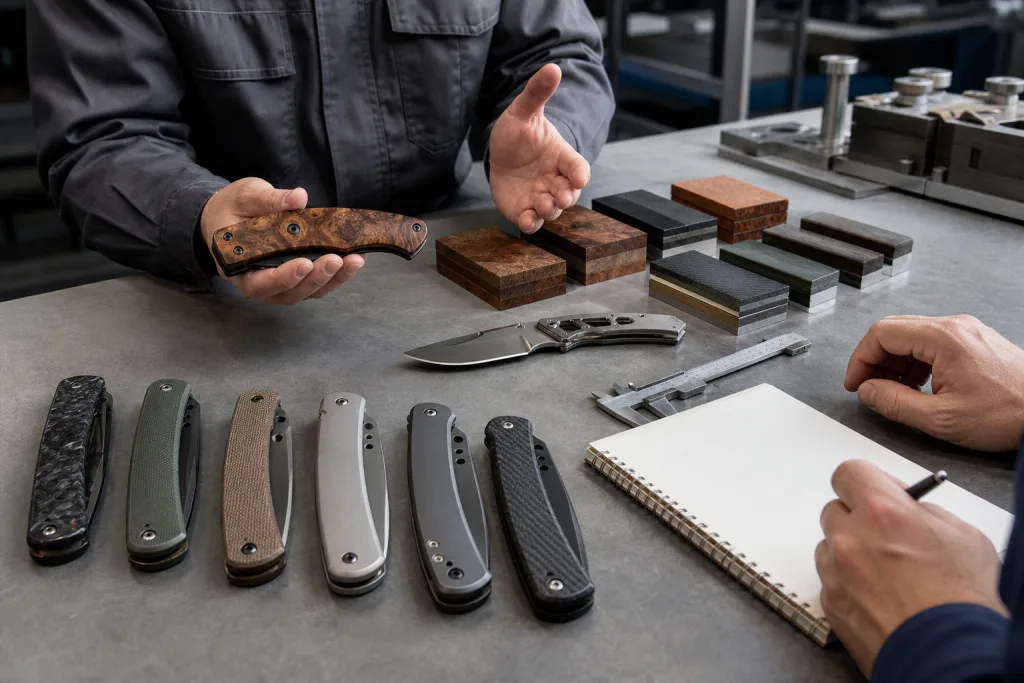
A request for a stainless blade and durable handle does not define the material inputs needed for an order-specific production plan. The RFQ should identify the requested blade material designation, stock thickness, handle construction, liners, pivot system, washers or bearings, screws, finish, marking, and packaging configuration.
Ask the supplier to identify every listed input as available, allocated, subject to procurement, or pending specification. The quotation should present unresolved inputs as schedule assumptions rather than approved specifications.
The Vast State wholesale sourcing guide is retained as wholesale buyer-sourcing context. The China Knives Wholesale sourcing index is retained as knife-sourcing research context. Neither citation establishes a particular supplier's material availability, production capacity, test result, or delivery date.
Before requesting milestone dates, define these inputs:
- Exact material designations and the written substitution policy.
- Dimensions, thicknesses, finishes, colors, and packaging requirements.
- Critical performance characteristics, test methods, and acceptance rules.
- Evidence required for sample approval and bulk-production release.
Build the Schedule Around Release Gates
Use dated release gates instead of one undifferentiated lead-time statement:
| Release gate | Buyer needs to confirm | Supplier evidence to request | |---|---|---| | Specification freeze | Drawing revision, bill of materials, tolerances, finish, packaging, test requirements, and change authority | Controlled specification and quotation assumptions | | Material confirmation | Status of blade stock, handle material, hardware, finish inputs, and packaging materials | Material-status statement and identified procurement dependencies | | Production-intent sample | Whether the sample uses the intended materials and stated process route | Sample deviation list, dimensional results, functional results, and cosmetic comparison | | Sample approval | Requirements reviewed and the person authorized to release bulk production | Dated approval record and approved reference-sample identification | | Bulk-production release | Whether unresolved deviations, substitutions, or failed checks remain | Change record, corrective-action disposition, and confirmed production start | | Final inspection and shipment release | Inspection status, pack-out status, shipping documents, and release authority | Final inspection record, pack-out confirmation, and shipment-release record |
A quoted delivery date should name the event that starts the lead-time clock, such as purchase-order acceptance, payment receipt, artwork approval, material confirmation, sample approval, or another defined event.
**Example calculation and assumptions to verify in the supplier quote:** For **1 pocket knife SKU at 1 drawing revision**, assume **3 business days** from specification freeze to material-status confirmation, **10 calendar days** from material confirmation to a production-intent sample, **2 business days** for buyer review after sample receipt, and **1 business day** for packaging-proof approval before pack-out. These intervals are illustrative planning assumptions, not supplier lead-time data or commitments. Replace each interval with dated milestones for the quoted order.
Material and Performance Decision Table
Use this table to connect material decisions to schedule control and measurable release evidence.
| Production decision | Schedule-control question | Measurable performance or conformity check | Evidence before release | Buyer action if unresolved | |---|---|---|---|---| | Blade material and stock thickness | Is the requested designation and thickness available for both sample and bulk production? | Material identity, blade dimensions, agreed hardness range, and any buyer-defined edge or corrosion protocol | Material declaration or agreed traceability record, dimensional report, and required test results | Do not approve an unnamed equivalent. Request the proposed substitution, retest requirement, and date impact in writing. | | Heat-treatment route | When will heat treatment occur, and when can representative test pieces be evaluated? | Hardness at agreed locations, agreed sample selection, and any buyer-defined deformation or toughness check | Results tied to the identified production lot or sample lot | Hold bulk release until the method, acceptance range, and failed-result disposition are defined. | | Handle material | Is the specified scale, sheet, metal stock, or molded component available in the approved color and thickness? | Dimensions, fit, surface condition, cosmetic boundary, and any buyer-defined environmental evaluation | Approved sample plus written dimensional and cosmetic criteria | Treat material or color changes as formal change requests. | | Pivot, washers, bearings, screws, and liners | Are components standard items or custom parts with separate manufacturing, coating, or procurement time? | Critical dimensions, assembly torque where specified, opening and closing behavior, and buyer-defined corrosion requirements | Component specification and functional sample results | Quote custom-hardware timing separately from general assembly timing. | | Lock and spring components | Are material and process requirements defined for the selected mechanism? | Lock engagement, blade play, operating force, repeated-cycle method where required, and failure criteria | Functional inspection record from production-intent samples | Require a written test method and acceptance threshold before authorizing bulk assembly. | | Blade and hardware finish | Does the finish require outside processing, color matching, masking, or a limit sample? | Appearance under defined lighting, coating thickness where relevant, adhesion method where required, and buyer-defined corrosion protocol | Approved finish sample and written cosmetic boundary | Add finish approval, rework, and any external-process dependency to the critical path. | | Packaging | Are labels, inserts, boxes, barcodes, inner packs, and cartons approved and available? | Fit, product protection, barcode verification, pack quantity, and carton dimensions | Packaging proof or sample followed by pack-out approval | Do not assume packaging can be completed after knife assembly without affecting shipment timing. |
Convert Product Intent Into Acceptance Criteria
Terms such as smooth action, strong lock, sharp edge, durable finish, and premium feel should be translated into a characteristic, method, and acceptance rule before they are used as release criteria.
- **Characteristic:** The controlled item, such as blade hardness, centering, opening force, lock engagement, edge performance, or coating appearance.
- **Method:** The evaluation procedure, including equipment, sample condition, measurement location, exposure conditions, and sample-selection approach.
- **Acceptance rule:** The permitted range or defect boundary, plus the disposition for a failed result.
An edge-performance requirement can define the cutting medium, edge preparation, operating procedure, endpoint, and required result. A corrosion requirement can define the exposure environment, duration, temperature where relevant, cleaning procedure, and allowable result. A mechanism requirement can define how blade play, force, lock engagement, and cycling are evaluated.
A hardness result is evidence only for the stated hardness measurement. Define separate test methods and acceptance rules for each additional property required by the buyer. When an applicable standard is included in the RFQ, distinguish that standard's stated requirements from the supplier's own process. Request current, order-specific documentation before relying on any certification or conformity claim.
Control Changes That Affect the Ship Date
After sample approval, record changes to the steel source, heat-treatment route, handle material, hardware coating, finish, adhesive, packaging board, carton configuration, or another controlled specification. A change request should state:
- Original and proposed specifications.
- Reason for the change and affected order quantity.
- Performance, compliance, cosmetic, and schedule risks.
- Retesting, resampling, sorting, rework, or replacement requirements.
- Cost impact, milestone impact, and shipment-date impact.
- Person authorized to approve the change.
The production plan should identify its current critical path using confirmed milestone dates. Packaging approval can become shipment-critical when assembly is complete but pack-out inputs remain unresolved. A material change can require a revised sample or test sequence before bulk production is released. Record these effects as dated plan changes.
RFQ Checklist for Material-Led Production Planning
Product and material definition
- [ ] Provide the pocket knife drawing, dimensions, tolerances, mechanism description, bill-of-material revision, and packaging requirements.
- [ ] Name the requested blade material designation and stock thickness.
- [ ] Define handle, liner, spacer, pivot, washer or bearing, screw, clip, and spring materials.
- [ ] State whether substitutions are prohibited or require written buyer approval.
- [ ] Define finishes, coatings, marking, colors, and acceptable cosmetic boundaries.
- [ ] Ask which materials are available, allocated, or subject to procurement for this order.
- [ ] Ask whether production-intent samples and bulk units will use the same material source and process route.
Measurable performance and evidence
- [ ] Define critical dimensions and inspection methods.
- [ ] State required hardness, edge, corrosion, mechanism, lock, cycle, force, torque, or coating evaluations.
- [ ] Give an acceptance threshold and failed-result disposition for each required evaluation.
- [ ] State the required reports, photos, samples, or traceability records.
- [ ] Identify whether destructive-test units are separate from the approved appearance and assembly reference unit.
Timeline and approval control
- [ ] Request dated milestones for specification freeze, material confirmation, sample completion, buyer approval, bulk production, inspection, pack-out, and shipment release.
- [ ] Define the event that starts quoted lead time.
- [ ] State the buyer's intended review period for samples, artwork, and change requests.
- [ ] Ask which dependency currently controls the requested ship date.
- [ ] Require written notice before a material, process, finish, or packaging substitution.
- [ ] Ask how a rejected sample or failed material lot changes the dated plan.
Source Context, Methodology, and Limitations
**Source contexts:** The Vast State wholesale sourcing guide is retained as wholesale sourcing context. The China Knives Wholesale sourcing index is retained as knife-sourcing research context. The SZCO wholesale supply article is retained as assortment-planning context. These citations are contextual references only. They are not evidence that a named or unnamed supplier has a material in stock, can meet a stated date, or has completed a particular test.
**Methodology:** This framework derives a proposed production schedule from the order-specific bill of materials, material-status confirmation, sample deviations, defined acceptance criteria, buyer approvals, change records, inspection results, and pack-out release. The critical path is the dependency sequence with the latest confirmed completion date in the supplier's dated production plan.
**What to verify:** Verify the current material source, stock thickness, procurement status, sample route, bulk-production route, test method, acceptance threshold, inspection sampling approach, external-process dependency, capacity availability, packaging readiness, trade term, and shipment-date effect in the supplier's dated quotation and production plan. Generic sourcing information and prior schedules are not evidence for the current order.