Pocket Knife Sample Approval Process: Technical Specs and RFQ Checklist for B2B Buyers
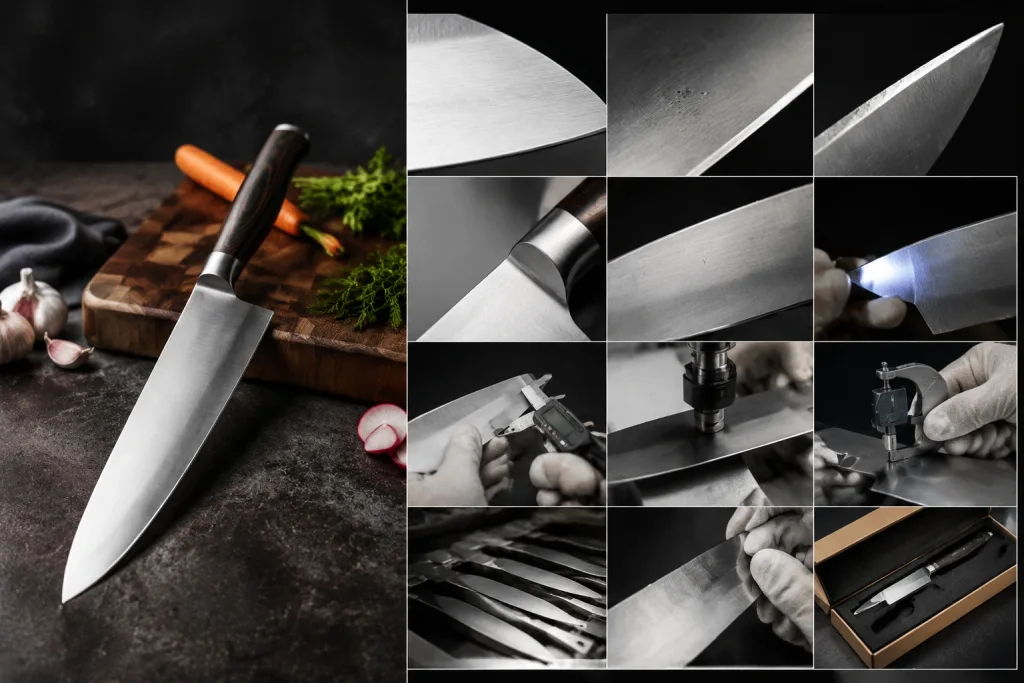
Pocket Knife Sample Approval Process: Technical Specs and RFQ Checklist for B2B Buyers
**Byline:** Vincent Xi, Editorial Author **Author profile:** https://tangforge.com/authors/vincent-xi/
```html <script type="application/ld+json"> { "@context": "https://schema.org", "@type": "Article", "headline": "Pocket Knife Sample Approval Process: Technical Specs and RFQ Checklist for B2B Buyers", "author": { "@type": "Person", "name": "Vincent Xi", "jobTitle": "Editorial Author", "url": "https://tangforge.com/authors/vincent-xi/" }, "publisher": { "@type": "Organization", "name": "TANGFORGE", "url": "https://tangforge.com" } } </script> ```
Sample approval is the control gate between a pocket-knife RFQ and production release. For private-label brands, importers, and OEM buyers, this stage is where blade geometry, lock function, heat-treat targets, handle fit, finish, and packaging claims either become enforceable specifications or remain open to supplier interpretation.
This article is an editorial process guide for B2B buyers. It focuses on technical specifications and RFQ discipline for folding pocket knives. It does not claim factory audits, proprietary test results, customer outcomes, certifications, production capacity, or product performance for any named manufacturer, including TANGFORGE.
Why sample approval matters in pocket knife OEM programs
Pocket knives combine cutting-edge geometry with mechanical assemblies: pivot systems, lock interfaces, stop pins, clip hardware, and multi-material handles. A drawing that looks complete on paper can still fail in hand evaluation if blade centering, detent strength, lock-up, or edge consistency are not measured against agreed tolerances and recorded methods.
China is a large knife manufacturing base by published trade volume. A B2B Chinese knife manufacturing guide reports that China exported **USD 1.66 billion** of knives in calendar year **2024**, equal to **51.5%** of global knife exports as stated in that guide; that production of knives, scissors, and blades reached **2.9 billion units** in the same reporting frame, up **8%** year-over-year; and that Yangjiang accounts for roughly **70%** of China’s knife output and about **85%** of its knife exports, with local industry output value exceeding **RMB 55 billion** in **2024** (Lee Knives sourcing guide).
Those figures describe export and cluster scale only. They do not establish SKU-level quality, process capability, or compliance for any pocket-knife program. High volume raises the commercial value of formal sample approval: small dimensional, finish, or heat-treat drifts can multiply across large lots if acceptance criteria are not frozen before release.
Technical specifications to lock before requesting samples
A sample request without locked specifications is a prototype conversation, not an approval process. Before requesting pre-production or golden samples, document the following as measurable requirements rather than marketing language.
Blade and steel requirements
Define steel grade by commercial designation (for example, a named stainless or tool-steel grade), not only by marketing family names. Specify stock thickness, blade length, cutting-edge length, grind style, edge-angle target range, finish (stonewash, satin, bead blast, coated), and logo or etch method.
If hardness is critical, state the Rockwell C target range, the measurement location on the blade (for example, a defined distance from the spine or edge), and the instrument class expected for sample reporting. Treat hardness as a process output to verify on samples, not as an assumed property of a steel name. Any numeric hardness window not confirmed by the supplier should be labeled as an example target to verify in the quote and controlled drawing.
Mechanism and hardware requirements
For folding pocket knives, specify lock type, intended lock-up behavior, pivot construction, washer or bearing type, stop-pin arrangement, and clip style/position. Include opening method (thumb stud, flipper, nail nick, assisted, or other) and any one-hand operation expectation as a function check with a defined cycle count and pass/fail definition—not as a vague “smooth action” claim.
Example function language to adapt with the supplier (verify in quote; not a published factory standard): no lock stick on open/close after a stated cycle count; no measurable lateral blade play above an agreed feel/gauge threshold; clip retention force and screw seating checked against a written hardware torque note.
Handle, materials, and ethics-sensitive inputs
List handle material, liner or frame material, fastener type, color/finish, and texture. Where brands market recycled steel, certified wood, or other responsible materials, ethical-sourcing discussions emphasize documenting origin and production-method claims rather than relying on general sustainability language (Shokunin USA ethical sourcing article). If a claim will appear on packaging or product pages, the sample package should include the evidence path the supplier will use to support that claim for the exact SKU.
Compliance and destination-market notes
Sample approval should include destination-market constraints: blade-length limits, locking-knife rules, packaging language, and any restricted materials. Distinguish a legal or standards requirement from a buyer’s private specification. Name a standard only when it is relevant to the destination market, and separate that standard’s requirement from any supplier’s own practice. Do not treat a supplier’s claim of compliance as certification unless current documentation is reviewed for the exact SKU, lot, and market.
Step-by-step pocket knife sample approval process
Public process descriptions of custom and OEM knife manufacturing commonly sequence design freeze, steel preparation, heat treatment, grinding/finishing, assembly, and quality control before release (BiliKnife process overview). For B2B sample control, translate that sequence into buyer-side approval gates. The stages below are an editorial framework derived from those publicly described process blocks; they are not evidence of any specific factory’s work instruction set.
Gate 1: Design freeze and RFQ package
Issue a controlled RFQ package: 2D drawings, 3D files if available, bill of materials, tolerance notes, finish references, packaging dieline, and acceptance criteria. Assign revision numbers. Require the supplier to confirm manufacturability issues in writing before cutting metal.
Gate 2: Engineering or prototype sample
Use the first physical sample to validate geometry, assembly method, and basic function. Measure overall length, closed length, blade length, thickness, weight, and critical interface dimensions. Photograph open and closed states under consistent lighting. Record failures with dimension callouts and instrument identity, not only adjectives.
Gate 3: Pre-production sample (PPS)
The PPS should use intended production materials, heat-treat route, finishes, hardware, clip, packaging, and marking methods. Judge this sample against production readiness, not against an idealized hand-finished concept piece.
Gate 4: Functional and dimensional inspection
At minimum, inspect and record:
- Blade centering and grind symmetry (left/right gap method agreed in writing)
- Edge geometry consistency along the belly and tip
- Lock engagement and unlock reliability over a stated cycle count
- Pivot smoothness and lateral play against an agreed threshold
- Clip retention and hardware seating consistency
- Handle gap, liner exposure, and fastener seating
- Coating or finish coverage at edges, pivots, and recesses
Where process literature highlights heat treatment, grinding, finishing, assembly, and QC as distinct stages, map sample records to those stages so a failed attribute can be assigned to a process owner for corrective action (BiliKnife process overview).
Gate 5: Golden sample and production release
Approve a golden sample only after deviations are closed or formally waived. Seal or uniquely identify the approved sample. Tie the approval form to drawing revision, material callouts, packaging revision, inspection plan (including any AQL example to confirm in the supplier quote), and the first production lot quantity. Without that linkage, later lots can drift while still matching an outdated sample.
Buyer decision table: approve, conditional approve, or reject
| Decision | Typical condition | Buyer action | Production implication | |---|---|---|---| | Approve | All critical dimensions, lock function, finish, markings, and packaging match the controlled revision | Sign golden-sample form; freeze BOM and process notes | Release tooling/production under the approved revision | | Conditional approve | Non-critical cosmetic variance only; no safety or function risk | Document waiver, photo evidence, and rework rule for mass production | Allow production only with written cosmetic standard | | Reject and resubmit | Lock failure, out-of-tolerance geometry/hardness (if specified), wrong steel/hardware, unsafe edge, wrong packaging claim | Issue nonconformance report with measured values and methods | No PO release until corrected PPS is approved | | Reject and redesign | Design is not manufacturable at target cost/tolerance | Update drawings and RFQ; restart prototype gate | Treat as new project revision, not a simple rework |
Use the table as a decision-log template. Every row should reference drawing revision, sample ID, inspector, date, instruments used, and residual risk notes.
Practical RFQ checklist for pocket knife sample approval
Copy this checklist into the RFQ and require the supplier to complete each line before quoting sample lead time.
1. **Product identity:** model name/code; open/closed length targets; weight target; handedness; target use category (EDC utility, outdoor, or other buyer-defined category). 2. **Drawings and revisions:** 2D drawings with tolerances; 3D file format; revision history; critical-to-quality callouts. 3. **Blade specs:** steel grade; stock thickness; grind; edge-angle range; tip geometry; finish; logo method; hardness target range and test location if hardness is a release criterion. 4. **Mechanism specs:** lock type; pivot system; washers/bearings; stop pin; opening method; expected lock-up description; clip type/position; function-cycle count for sample check. 5. **Handle and hardware:** materials; texture/color; fasteners; liners/frame; backspacer; any inlay or overmold details. 6. **Materials evidence:** if recycled steel, special alloys, wood, bone, or other natural materials are claimed, list documents required to support the claim for the exact SKU (Shokunin USA ethical sourcing article). 7. **Sample stages requested:** prototype; PPS; golden sample; quantity per stage; which stage is production-intent. 8. **Inspection method:** dimensional checklist; function-cycle count; hardness method if applicable; visual standard (photos or physical limit samples); instrument list. 9. **Packaging and marking:** unit pack; barcode/label fields; insert cards; warnings; destination language; master-carton marks. 10. **Quality plan:** AQL level example to confirm in quote; sorting rules; rework authorization; serial/lot coding. 11. **Compliance notes:** destination markets; restricted materials; age-restricted sale statements if applicable; documentation expected with shipment. Distinguish regulatory requirements from private buyer specs. 12. **Commercial sample terms:** sample fee/credit policy as stated by supplier; lead time; Incoterms for sample shipment; ownership of molds/jigs; IP and NDA references. 13. **Change control:** process for engineering change notices after golden-sample approval. 14. **Acceptance form fields:** sample ID; measured values; pass/fail; photos; residual risks; sign-off names and dates.
Any exact commercial or technical number not provided by the supplier—such as sample fee, hardness capability window, cycle-test count, tolerance stack, MOQ, lead time, or AQL cost impact—should be treated as an assumption or example value to verify in the supplier quote rather than as a published fact.
How to write measurable acceptance criteria
Weak criteria create endless sample loops. Prefer measurable language:
- Instead of “smooth action,” specify no blade stick, no lock stick, and no lateral blade play above a stated feel/gauge threshold agreed with the supplier, after a stated cycle count.
- Instead of “good centering,” specify left/right gap comparison method and maximum visual or measured bias.
- Instead of “sharp,” specify edge-angle target range and a simple comparative cut protocol (for example, paper or rope) used only as a sample check, with method and media recorded. Label any cut-count expectation as an example protocol to verify, not as a universal standard.
- Instead of “premium finish,” attach finish reference photos and define allowable scratch length, clouding, and coating holidays by zone (primary face vs. hidden pocket area).
Custom-knife manufacturing overviews typically separate steel preparation, heat treatment/tempering, grinding/finishing, assembly, and QC testing (BiliKnife process overview). Align each acceptance criterion to one of those stages so corrective action is assignable.
Common sample failures and documentation habits
Frequent failure themes in folding-knife sample programs include:
- Blade bias or uneven grinds after finishing
- Lock-face wear or incomplete engagement after cycling
- Detent that is too light or excessively stiff
- Clip that scratches handles or loses retention
- Hardware that rounds, loosens, or sits proud
- Logo etch depth or placement outside the artwork box
- Packaging that does not match retail claims or barcode data
Document each failure with sample ID, measured value, method, photo, and required corrective action. Keep rejected samples when possible; verbal descriptions alone are hard to enforce later. These failure themes are process-control risks for buyers to plan against; they are not attributed to any specific factory dataset.
Sourcing context buyers should not confuse with sample quality
Cluster scale can support tooling depth and component variety, especially in major Chinese knife hubs discussed in B2B guides (Lee Knives sourcing guide). That context is useful for supplier shortlisting and capacity planning. It does not replace sample metrology, process control, or destination-market compliance review.
If a supplier references a local testing center, industry fair, or quality supervision body, treat those as potential documentation sources to request. Do not interpret a regional industry claim as product certification for a specific pocket-knife SKU.
Methodology note: how this guide was derived
This article synthesizes three source contexts:
1. Published trade and cluster statistics reported in a B2B Chinese knife manufacturing guide, including **2024** export value (**USD 1.66 billion**), global export share (**51.5%**), unit production (**2.9 billion** knives/scissors/blades, **+8%** year-over-year as reported), and Yangjiang output/export share figures (**~70%** of China’s knife output; **~85%** of China’s knife exports; industry output value exceeding **RMB 55 billion** in **2024**) (Lee Knives sourcing guide). 2. Publicly described custom/OEM manufacturing stages such as design, steel preparation, heat treatment, grinding/finishing, assembly, and quality control (BiliKnife process overview). 3. Materials-responsibility considerations commonly raised in ethical knife-sourcing discussions, especially documentation of origin and production-method claims (Shokunin USA ethical sourcing article).
The RFQ checklist and decision table are practical editorial frameworks derived from those process stages. They are not a factory standard, not an industry certification checklist, and not based on proprietary TANGFORGE production data, lab tests, or client programs.
Limitations and what buyers should verify
- Trade figures and cluster percentages are as reported in the cited secondary guide for **2024** (and any related market commentary on that page). Verify current values against primary trade databases before using them in investment or sourcing memos.
- Manufacturing stage descriptions are general process context from public OEM overviews, not evidence that any specific factory uses a particular heat-treat recipe, inspection instrument, cycle-test protocol, or AQL plan.
- Ethical-material claims require SKU-level documentation; recycled content, wood origin, and labor statements should be verified with supplier records rather than assumed from category marketing (Shokunin USA ethical sourcing article).
- Hardness ranges, cycle-test counts, tolerances, sample fees, MOQs, lead times, and packaging compliance must be confirmed in the supplier’s quotation and controlled drawings. Example numeric criteria in this article are placeholders to adapt, not published capability claims.
- No certification, customer case study, factory visit, first-hand production result, award, or client outcome is asserted in this article.
Editorial author note
This publication package is written by **Vincent Xi**, Editorial Author for TANGFORGE. Author profile: https://tangforge.com/authors/vincent-xi/. The content is process-oriented B2B editorial guidance for pocket knife sample approval and RFQ preparation. It does not present personal manufacturing experience, client engagements, lab tests, factory visits, or proprietary factory claims.
Closing recommendation for RFQ-ready teams
Treat the pocket knife sample approval process as a document-controlled project: freeze the design, request production-intent samples, measure against written criteria, and release production only from an identified golden sample. Use the RFQ checklist to force material, mechanism, packaging, and inspection decisions upstream. Use the decision table to keep approve/reject outcomes auditable. In high-volume supply markets, process discipline—not catalogue photography—is what converts a promising prototype into a repeatable commercial SKU.