Pocket Knife Supplier Guide: Technical Specs and RFQ Checklist for B2B Buyers
Pocket Knife Supplier Guide: Technical Specs and RFQ Checklist for B2B Buyers
**By Vincent Xi, Editorial Author** Author profile
Selecting a **pocket knife supplier** is a technical procurement task. Importers, private-label brands, distributors, and outdoor retailers need comparable answers on steel grade, hardness, lock function, dimensional tolerances, packaging, and inspection depth before any purchase order. This guide converts those requirements into specification language, a decision table, and a copy-ready RFQ checklist so factories can be ranked on the same evidence basis.
**What this guide helps you do**
1. Freeze a product definition before price requests 2. Map manufacturing stages to measurable QC checks 3. Match order profile (promo, private label, specialty) to documentation depth 4. Issue a written RFQ that forces comparable commercial and technical replies 5. Normalize quotes without relying on brochure language
1. Why pocket knife sourcing is an RFQ problem, not a catalog browse
A folding pocket knife is a multi-part assembly: blade, handle scales, liners or frame, pivot, stop pin, lock interface, clip, and fasteners. Small deviations in heat treatment, grind geometry, or pivot fit change edge retention, corrosion behavior, lock reliability, and field feel. Consumer phrases such as “sharp,” “premium,” or “tactical” are not contract language.
China remains a major volume sourcing geography for cutlery. Secondary industry reporting compiled in a public B2B sourcing guide states that China exported **USD 1.66 billion** worth of knives in **2024**, equal to **51.5% of global knife exports** in that reporting frame, and that total production of knives, scissors, and blades reached **2.9 billion units**, up **8%** year-over-year (Lee Knives sourcing guide citing OEC World and IndexBox). Within China, Yangjiang is repeatedly described as the dominant cluster: local knife and hardware industry output value exceeded **55 billion RMB** in **2024**, with Yangjiang-made products accounting for **eight out of every ten knives China exports**, and roughly **70% of China’s knife output** and **85% of its knife exports** in the same secondary cluster descriptions (Lee Knives sourcing guide citing China Daily and cluster descriptions).
Those figures explain capacity density and cluster concentration. They do not define your SKU, MOQ, hardness window, or acceptance plan. Buyers still need drawings, measurable acceptance criteria, and factory-written commitments.
2. Product definition: specs every pocket knife supplier must quote against
Issue price and lead-time requests only after the product definition is locked. Ambiguous RFQs produce non-comparable quotes and sample drift.
2.1 Blade steel and heat-treatment targets
State the exact steel designation (for example, 8Cr13MoV, 9Cr18MoV, 14C28N, D2, or another grade required by your brand). Do not accept “stainless” alone. Require the supplier to confirm in writing:
- Nominal chemistry or mill-certificate availability by heat/lot
- Hardness target on the Rockwell C scale (**HRC**), with a numeric range and unit stated as HRC
- Example assumption to verify in the supplier quote and sample plan: **57–59 HRC** for a mid-range stainless EDC blade (not a universal industry rule)
- High-level heat-treatment description (austenitize / quench / temper sequence as applicable to the grade)
- Intended-use framing for corrosion and edge expectations (EDC, outdoor, promotional)
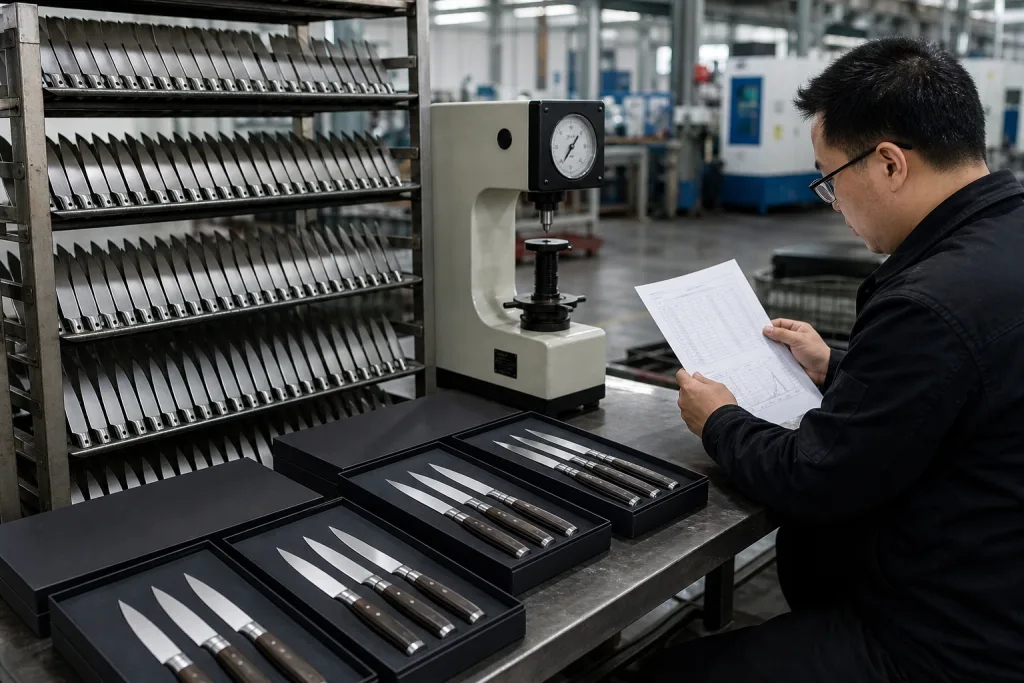
- Hardness measurement location on the blade (for example, mid-blade face away from edge and tang), instrument type if known, and pieces tested per lot
Hardness is an acceptance point only when method, location, range, sampling frequency, and disposition for out-of-range pieces are written into the quote or quality plan.
2.2 Blade geometry and dimensional tolerances
Specify in **millimeters (mm)** where possible:
- Overall length (OAL), closed length, blade length, cutting-edge length
- Blade thickness at the spine and stock thickness before grind
- Grind type (flat, hollow, saber, scandi-style if relevant)
- Edge angle or finished edge-thickness target
- Tip profile (drop point, clip point, tanto, sheepfoot, etc.)
- Finish (stonewash, satin, bead blast, black oxide, or other process the factory can document)
Provide a 2D drawing with tolerances and a revision number. If drawings are not ready, require the factory’s standard drawing format, revision-control method, and written approval workflow before tooling or mass production.
2.3 Lock, pivot, and mechanical function
Commercial failures often start at lock-up and pivot consistency. Define:
- Lock type: liner lock, frame lock, lockback, button lock, slipjoint (non-locking), or other
- Blade-play limits: up/down and side-to-side at a defined fully open position
- Example assumption to verify in the supplier quote: no perceptible lateral play under light finger pressure at the tip (replace with a measured limit if your QC process can measure it)
- Deployment method: thumb stud, flipper, nail nick, assisted, automatic
- Note: automatic and some assisted designs may be restricted by destination-market law; confirm import and sale legality separately from this technical RFQ
- Pivot construction: screw or peened; user-adjustable or not
- Detent target: qualitative description, or measured force if your QC process can measure it
- Clip type, clip material, and mounting (tip-up/tip-down, left/right)
2.4 Handle materials and corrosion interfaces
List handle materials (G10, FRN, aluminum, stainless steel, wood, Micarta, etc.), liner materials, and fastener materials. For wood or natural materials, long supply chains raise provenance and moisture-stability questions; ethical-sourcing discussions for custom knives commonly flag steel origin, wood provenance, and labor practices as buyer due-diligence topics (Shokunin USA ethical sourcing overview).
Also specify:
- Color, texture, and logo method (laser, pad print, inlay, medallion)
- Corrosion protection on screws and clips
- Weight target in **grams (g)**
- IP / trademark clearance for any logo artwork you supply
2.5 Packaging, labeling, and unit of sale
Unit ex-works price is incomplete without packaging rules. Define:
- Individual unit packaging (poly bag, clamshell, gift box, sleeve)
- UPC/EAN, SKU, country-of-origin mark, and any destination warning labels
- Master-carton quantity, carton strength, and drop-test expectations if required
- Barcode placement and packing-list format
3. Manufacturing stages buyers should map to QC
Public custom-knife manufacturing descriptions commonly sequence design freeze, steel preparation, stock removal or forging, heat treatment and tempering, grinding/finishing, assembly, then quality control and testing (BILIKNIFE manufacturing process overview). For pocket-knife programs, map acceptance tests to those stages:
| Stage | Buyer-side checkpoint | | --- | --- | | 1. Incoming steel / hardware | Certificates, visual defects, thickness checks (mm) | | 2. Heat treatment | HRC sampling, quench/temper records | | 3. Grind and finish | Symmetry, thickness at chosen stations (mm), surface defects | | 4. Assembly | Pivot torque if applicable, lock engagement, clip fit | | 5. Functional QC | Open/close cycles, lock-up position, blade centering | | 6. Final audit | Cosmetic standard + packaging audit under an agreed AQL |
If a supplier claims access to a regional inspection center or third-party lab (Yangjiang cluster descriptions reference a national knives/scissors quality supervision and inspection center in secondary sourcing material), treat that as a capability claim to verify with **current** documents, scope, and sample applicability—not as automatic certification of your SKU (Lee Knives hub overview).
4. Buyer decision table: match order profile to supplier requirements
Use this table to force trade-offs into the RFQ. Values in the “example assumption” column are planning placeholders only; replace them with your brand standard before award. They are not market averages or factory commitments.
| Buyer decision factor | Low-complexity promo EDC | Mid-tier private label | Higher-spec outdoor / specialty | | --- | --- | --- | --- | | Typical order size (example assumption to verify) | 1,000–5,000 pcs | 500–10,000 pcs | 200–3,000 pcs first run | | Steel control | Named stainless grade + HRC range | Named grade + mill cert + HRC map | Named premium grade + cert + retained samples | | Lock / function QC | Visual + open/close sample | Dimensional + lock-up + centering AQL | Functional cycle test + written failure criteria | | Customization | Logo only | Custom scales / clip / packaging | Full OEM/ODM drawing control | | Sample stages | 1 pre-production sample | Engineering sample + golden sample | Multiple revision samples + sealed golden sample | | Documentation pack | Spec sheet + packing list | Spec + material certs + QC report | Full first-article pack as agreed in writing | | Ethical / material diligence | Basic country of origin | CoO + restricted-substances questions | Supplier code of conduct + material provenance questions (ethical sourcing themes) | | Lead-time risk focus | Carton readiness | Heat-treat capacity + logo process | Steel availability + custom tooling |
Secondary sourcing guides note that Yangjiang manufacturers span kitchen, folding EDC, outdoor/tactical, hunting, and multi-tools, with illustrative capacity comments ranging from hundreds of private-label pieces to tens of thousands of budget pocket knives (Lee Knives). Treat those ranges as market context only. Your MOQ, monthly capacity, and lead time must come from the quoted factory’s written response for the current drawing revision.
5. Practical RFQ checklist for a pocket knife supplier
Copy this checklist into the RFQ package. Require written answers against the current drawing revision.
A. Commercial and capacity
- [ ] Legal factory name, address, and export entity name
- [ ] Years producing folding knives (self-declared; verify with references if needed)
- [ ] Quoted MOQ and price breaks by quantity (pcs)
- [ ] Sample cost, sample lead time, and whether sample cost is refundable against bulk
- [ ] Production lead time after sample approval
- [ ] Monthly capacity for your SKU family (pcs/month, self-declared then verify)
- [ ] Payment terms and Incoterms
- [ ] Tooling / mold ownership and amortization schedule if custom dies or molds are needed
B. Product engineering definition
- [ ] Full 2D/3D drawings or supplier drawing submitted for approval (revision controlled)
- [ ] Blade steel grade and acceptable equivalents
- [ ] HRC target, measurement location, measurement method, and sampling frequency
- [ ] Blade length, thickness (mm), grind, and finish
- [ ] Lock type and lock-engagement acceptance criteria
- [ ] Handle material, color, texture, logo method
- [ ] Pivot, stop pin, washer or bearing type
- [ ] Pocket-clip configuration
- [ ] Closed length, OAL (mm), weight target (g)
- [ ] Bill of materials with fastener materials
C. Quality system and inspection
- [ ] In-process QC checkpoints and final AQL (state levels for critical / major / minor as agreed with the buyer)
- [ ] Hardness testing frequency and disposition for out-of-range results
- [ ] Functional tests: centering, play, lock-up, open/close cycles
- [ ] Cosmetic standards with photo limit samples
- [ ] Nonconforming-product process and rework rules
- [ ] Golden-sample sealing and retention period
- [ ] Third-party inspection acceptance (buyer-appointed inspector)
D. Compliance, labeling, and destination rules
- [ ] Country-of-origin marking method
- [ ] Restricted-substances documentation if required by your market (buyer-defined)
- [ ] Warning labels / age grading if required
- [ ] Automatic / assisted knife legality confirmation for destination markets
- [ ] Packaging drop and carton-mark requirements
- [ ] Trademark / logo authorization letter from your brand
E. Ethics and supply-chain questions
- [ ] Material-origin statements for steel and handle materials
- [ ] Labor and workplace policy summary (request current documents; do not assume certification)
- [ ] Subcontractor use: which processes are outsourced (heat treat, coating, packaging)
- [ ] Conflict or restricted-material questions if your brand policy requires them (ethical sourcing considerations)
F. Commercial risk controls
- [ ] Spare-parts policy (clips, screws)
- [ ] Warranty / defect-claim window and evidence required
- [ ] Change control: no material or process change without written approval
- [ ] Intellectual property: who owns custom designs and tooling
6. How to evaluate quotes after RFQ returns
Do not rank suppliers on unit price alone. Normalize every quote to the same Incoterm, packaging set, steel grade, hardness method, and inspection depth. For each shortlisted factory, request:
1. A filled specification matrix matching your drawing revision 2. Photos or video of hardness testing and lock function on the actual sample 3. A process flow showing which steps are in-house versus subcontracted 4. A packing photo of master cartons if prior export packing is claimed 5. Written confirmation that the approved golden sample overrides brochure photos
OEM and ODM service menus, small-batch options, and after-sales support are commonly listed by professional custom-knife manufacturers as differentiators; require those services to be itemized with fees and timelines rather than accepted as vague promises (OEM/ODM service framing in custom knife manufacturing overviews).
**Suggested award sequence**
1. Drawing freeze and RFQ issue 2. Quote normalization matrix 3. Paid engineering / pre-production sample 4. Sealed golden sample 5. Pilot lot under agreed AQL 6. Bulk PO with change-control language
Methodology: how the data and checklist were derived
This article is an editorial synthesis for B2B buyers. Market-scale numbers for China’s knife exports (**USD 1.66 billion**, **51.5%** global share in **2024**), production volume (**2.9 billion units**, **+8%** YoY), and Yangjiang cluster concentration (**55 billion RMB** output value in **2024**, **eight of ten** exported Chinese knives, about **70%** of national knife output / **85%** of national knife exports) are taken from secondary reporting compiled in a public B2B sourcing guide that cites OEC World, IndexBox (2025), and China Daily (2025) (source context). Process-stage language for design, heat treatment, finishing, assembly, and QC is aligned to publicly described custom-knife manufacturing sequences (source context). Ethical and material diligence prompts reflect commonly published ethical-sourcing themes for custom knives, including steel, wood, and supplier-selection questions (source context).
The RFQ checklist is a buyer-side control document derived from those technical and commercial risk points. It is not a factory audit report and does not represent a site visit, production trial, or laboratory test by the author. Author role context: Vincent Xi, Editorial Author (profile).
Limitations and what buyers must still verify
- Export and production statistics are secondary-reported annual figures; confirm current trade data, currency definitions, and HS-code coverage with primary statistical sources before using them in board-level forecasts.
- Cluster claims (Yangjiang share of output/exports, local inspection infrastructure) describe regional industry structure, not the capability, MOQ, or quality system of any single named factory.
- No steel grade, HRC window, AQL plan, certification, MOQ, capacity figure, lead time, or customer outcome in this article is a Tangforge product claim or a supplier commitment unless restated in a signed quotation and purchase order.
- Example values (such as **57–59 HRC**, order-size bands in pcs, or “no perceptible play”) are planning assumptions to verify in the supplier quote and sample plan.
- Standards and certificates (quality system, material, coating, or lab reports) must be validated with **current** documents, certificate numbers, and scope. Naming a standard is not proof of conformity, and this article does not assert any certification.
- Destination-market knife laws (blade length, locking mechanisms, assisted/automatic status, carry rules) are legal compliance issues outside this technical RFQ guide.
- Ethical-sourcing claims require evidence trails; marketing language alone is insufficient (ethical sourcing discussion).
Closing guidance for the next sourcing step
A reliable **pocket knife supplier** relationship starts when the RFQ forces comparable answers on steel, hardness (HRC), lock function, tolerances (mm), packaging, inspection, and change control. Use the decision table to set QC depth for the SKU class, then issue the checklist with drawings and a sealed-sample requirement. Compare factories on documented process control and written acceptance criteria—not brochure photography.
For editorial context on this guide’s author role, see the public profile for Vincent Xi, Editorial Author: https://tangforge.com/authors/vincent-xi/.