Pocket Knife Supplier Prequalification: Material Traceability and Performance Evidence
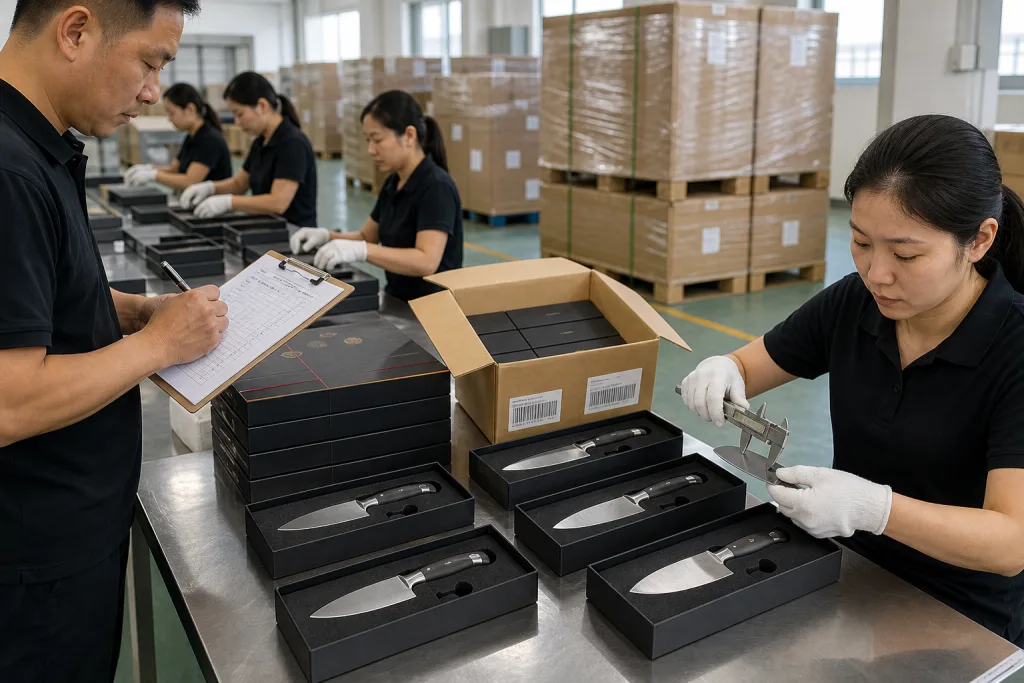
Pocket Knife Supplier Prequalification: Material Traceability and Performance Evidence
Pocket knife supplier prequalification should answer a specific buyer question: can the proposed manufacturing site prove that a controlled knife model uses the specified materials and meets defined, measurable performance requirements?
Qualify the complete manufacturing condition—not the supplier name alone. That condition includes the model, product revision, site, process route, subcontracted operations, material requirements, production-lot definition, and test plan. The evidence should connect each requirement to the applicable material lot, production batch, sample ID, test method, raw result, and disposition.
Catalog descriptions, quoted steel names, presentation samples, and reports for other products are not model-specific qualification evidence unless the buyer's approved plan explicitly permits their use.
Evidence Boundary
The supplied sources include a wholesale knife sourcing guide, a retail assortment article, a knife-sourcing article index, and a wholesale distributor guide. These links are retained as commercial sourcing context only. They are not used here to establish material-property values, hardness ranges, cutting thresholds, corrosion ratings, lock-load limits, test standards, or the capability of any supplier or product.
This protocol does not recommend a blade grade, handle material, lock type, coating, manufacturer, or distributor. It also does not prescribe universal acceptance values. The buyer must define application-specific requirements, methods, limits, and decision rules in a controlled specification or an explicitly referenced standard.
1. Fix the Qualification Scope Before Requesting Samples
Issue a controlled qualification basis with the RFQ or sample request. Require the supplier to acknowledge the current revision and declare all exceptions.
| Control field | Required entry | |---|---| | Qualification identity | Buyer project number, model number, and qualification revision | | Product definition | Controlled drawing, bill of materials, finish specification, and test-plan revisions | | Manufacturing scope | Supplier legal entity, manufacturing site, process route, and subcontracted operations | | Intended conditions | Buyer-defined cutting task, operating conditions, exposure conditions, and duty cycle addressed by testing | | Material requirements | Exact designation, governing specification and edition, product form, ordered condition, finish or coating, and substitution rules | | Production identity | Supplier definitions and identifiers for material, heat treatment, machining, finishing, assembly, and final-inspection lots | | Sampling basis | Lot population, sample quantity, selector, selection method, sample IDs, and test allocation | | Decision rules | Numerical limits or observable pass/fail conditions, treatment of measurement uncertainty, and retest rules | | Change boundary | Materials, components, processes, tooling, subcontractors, and sites that require written review before change |
Treat the prequalification submission as incomplete if it does not identify the proposed site, controlled product revision, process route, or production-lot definition.
2. Link Material Selection to Measurable Evidence
For each material decision, define four elements separately:
1. The application requirement. 2. The purchasing specification. 3. The supplier evidence. 4. The finished-product confirmation.
Do not substitute one evidence type for another unless the qualification plan allows it. A material source record, for example, addresses material identity within the buyer's defined evidence rules. It does not replace finished-blade hardness, geometry, cutting, lock, or corrosion results.
| Decision area | Purchasing requirement | Supplier evidence to request | Finished-product confirmation | |---|---|---|---| | Blade material identity | Exact grade, governing specification and edition, product form, ordered condition, thickness, and substitution rule | Source material record with heat, melt, or lot ID; purchase-to-receipt mapping; incoming-lot record; and production-batch link | Buyer-required material-verification result, if applicable, linked to the sample and material lot | | Heat-treated blade condition | Hardness range, test method, scale, locations, surface condition, sample quantity, and decision rule | Approved process revision, heat-treatment batch record, equipment ID, deviations, and blade-to-batch mapping | Individual hardness readings from identified finished blades | | Blade and edge geometry | Drawing datums, nominal dimensions, tolerances, grind requirements, edge condition, centering requirement, and measurement method | Controlled drawing, inspection plan, gauge list, and completed dimensional record | Raw measurements for every selected sample and characteristic | | Cutting performance | Test medium, conditioning, motion, speed, load, stroke, endpoint, result metric, and required edge configuration | Declared sharpening and finishing route plus the controlled test procedure | Results from identified samples tested in the specified configuration | | Lock and mechanism | Design revision, engagement requirement, allowable movement, operating-force limits, load conditions, and cycle criteria | Component specifications, assembly instructions, critical process checks, fixture information, and inspection records | Required engagement, blade-play, force, load, permanent-set, and cycle results | | Corrosion and finish performance | Base material, finish or coating system, preparation, exposure method, and separate cosmetic and functional limits | Material and finish records, process revision, batch ID, and inspection criteria | Post-exposure appearance, dimensions, operation, and other required measurements | | Handle and structural components | Exact material, condition, construction, dimensions, finish, and tolerances | Source or incoming records, component-lot IDs, and component-to-assembly mapping | Required dimensional, assembly, finish, load, or functional results |
Evaluate each result against its own controlled requirement. Do not infer finished-knife performance from a material designation, and do not infer material identity from a performance result.
Control Material Substitutions
Require a proposed substitution to include:
- The affected requirement and component IDs.
- The specified and proposed material designations and conditions.
- Differences relevant to the controlled requirements.
- Affected drawings, processes, tests, and production lots.
- The proposed verification plan and sample quantity.
- Buyer approval status and any limits on scope, duration, or revision.
Until the deviation is approved, treat the specified material as the qualification basis.
3. Separate Site Capability from Lot Conformity
Capability evidence and lot-conformity evidence answer different questions.
- **Capability evidence:** Has the proposed site defined the controls needed to make and test the specified model?
- **Lot-conformity evidence:** Were the submitted units produced and tested under those controls, and can the results be traced to the identified lot?
Keep the two evidence packages separate so generic procedures or example reports are not mistaken for model- and lot-specific results.
Capability Evidence
Request records identifying:
- The proposed manufacturing site and declared subcontractors.
- The process flow from material receipt through final release.
- Applicable work-instruction and inspection-plan revisions.
- Material-identification and internal-traceability controls.
- The heat-treatment, dimensional, force, cycle, and exposure-test capabilities required by the buyer's plan.
- Applicable equipment IDs, operating ranges, and calibration or verification status.
- Controls for nonconforming material, deviations, retests, and corrective actions.
- Change-notification controls covering materials, components, processes, tooling, subcontractors, and sites.
- Record formats that preserve model, lot, batch, and sample identity.
Generic procedures and example reports may support the capability review. They do not release a qualification sample or production lot.
Lot-Conformity Evidence
For the submitted lot, require:
- Model, drawing revision, bill-of-materials revision, and lot quantity.
- Material source record and heat, melt, or lot ID.
- Mapping from received material to internal work orders and process batches.
- Heat-treatment, finishing, and assembly batch IDs, where applicable.
- Selected sample IDs and the documented selection method.
- Test-method and work-instruction revisions.
- Equipment IDs and test dates.
- Individual readings, observations, and required photographs.
- Pass/fail decisions against the controlled limits.
- Deviations, nonconformances, retests, and dispositions.
- Release authorization tied to the identified lot.
Use an evidence index to connect records to requirements rather than accepting documents based on filenames or general descriptions.
| Evidence ID | Requirement ID | Document and revision | Model and revision | Material lot | Process batch | Sample IDs | Method revision | Raw-result location | Disposition | |---|---|---|---|---|---|---|---|---|---| | Buyer assigned | Buyer assigned | Supplier entry | Supplier entry | Supplier entry | Supplier entry | Supplier entry | Supplier entry | File and page reference | Accept, hold, or reject |
4. Define Reproducible Performance Tests
Put the test methods and acceptance criteria in the RFQ or referenced test plan before qualification samples are produced. Require individual results in addition to any summary. Define the treatment of averages, rounding, invalid readings, measurement uncertainty, and retesting wherever those factors can affect the decision.
Hardness Evidence
The hardness instruction should specify:
- Referenced method and edition.
- Reporting scale and required equipment information.
- Measurement locations defined by drawing coordinates or another unambiguous reference.
- Required surface condition and preparation.
- Number of blades and readings per blade.
- Sample-selection responsibility.
- Individual-reading, per-blade, and lot-level decision rules.
- Invalid-reading criteria and retest authorization.
- Required equipment ID, test date, operator or laboratory record, sample ID, and heat-treatment batch ID.
Do not accept an average alone when the controlled requirement applies to every reading or every blade. If a retest is authorized, retain the original result, reason for retesting, newly selected sample IDs, new results, and both dispositions.
Blade and Edge Geometry
Create an inspection row for each controlled characteristic. Each row should identify:
- Drawing characteristic number and revision.
- Datum or measurement reference.
- Nominal value, upper and lower limits, and units.
- Instrument or measurement method and required resolution.
- Number of units and readings.
- Individual measured values and sample IDs.
- Acceptance decision and inspector record.
Define descriptive requirements as measurable conditions. If centering is controlled, state whether acceptance is visual or based on measured left-and-right clearance. If edge angle, edge width, grind symmetry, or blade play is controlled, specify the measurement method and reference points.
Cutting Performance
The cutting protocol should identify:
- Response variable, such as force, completed cuts, cut depth, material removed, or cycles to a defined endpoint.
- Test-medium specification, lot, dimensions, and required conditioning.
- Blade cleaning, lubrication, sharpening status, edge geometry, and pretest inspection.
- Fixture, blade orientation, motion, stroke length, speed, applied load or force, and cycle definition.
- Stopping condition and failure criteria.
- Number of knives, replicates per knife, and test order.
- Raw-data format and required post-test edge assessment.
Report the tested knife's model, revision, material lot, heat-treatment batch, geometry results, and sample ID with the cutting result. Treat a different edge configuration as a separate qualification condition unless an approved comparison plan defines how the results can be transferred.
Lock and Mechanism Performance
Replace terms such as smooth action or solid lockup with defined measurements or observable pass/fail conditions. As applicable to the controlled design, specify:
- Lock-engagement characteristic, datum, measurement method, and allowable range.
- Side-to-side and vertical blade-play directions, preload, measurement point, displacement method, and limits.
- Opening and closing force, gauge contact point, direction, operating speed, and limits.
- Lock-load fixture, blade position, load direction, application point, loading rate, maximum load, and hold time.
- Permitted permanent set and prohibited release, fracture, disengagement, or damage conditions.
- Cycle count, cycling rate, lubrication condition, inspection intervals, and failure criteria.
- Preconditioning and post-test functional checks.
- Fixture ID, required safety controls, raw force or displacement data, and sample IDs.
Where required by the test plan, distinguish the initial condition, peak result, hold-period behavior, permanent change after unloading, and final functional disposition.
Corrosion and Finish Performance
Reference a named standard and edition or issue a controlled internal method. Define:
- Whether each sample is a material coupon, finished component, or assembled knife.
- The requirement addressed by each sample type.
- Surface preparation, cleaning, masking, and pretest condition.
- Exposure medium, concentration or composition, temperature, duration, orientation, and cycle sequence.
- Rinsing, cleaning, drying, and stabilization before inspection.
- Inspection timing, lighting, magnification, and rating method.
- Separate limits for staining, corrosion, coating damage, color change, dimensional change, operating-force change, and impaired function, as applicable.
- Required photographs, measurement locations, sample IDs, and lot links.
Do not use a coupon result as evidence for an assembled-knife requirement, or the reverse, unless the approved plan explicitly defines that relationship.
5. Control Qualification Samples and Production Lots
Define what each stage can approve. Evidence from an early stage should not be presented as approval for a later production condition.
| Stage | Required evidence | Permitted decision | |---|---|---| | Capability review | Site, process route, procedures, equipment, traceability, test methods, and change controls | Supplier may submit controlled samples | | Engineering-sample review | Construction revision, declared materials, dimensions, initial hardness and functional data, and recorded deviations | Design and test methods may proceed to pilot-lot evaluation | | Pilot-lot qualification | Units made through the declared production route, selected under the agreed plan, with material and process-batch links | Defined model, revision, site, and process route establish the qualification baseline | | Production-lot release | Lot-specific records, selected samples, required test results, and deviation status | Identified lot may be accepted, held, or rejected under the purchase requirements | | Change review or reorder verification | Change declaration, affected-requirement analysis, and required repeat evidence | Existing approval may be retained, restricted, or reopened for defined requirements |
For each sampling plan, define:
- Production-lot population and boundaries.
- Who selects the units and where selection occurs.
- Selection method and sample-identification sequence.
- Quantities allocated to dimensional, hardness, cutting, lock, cycle, and exposure testing.
- Whether each test is nondestructive, damaging, or destructive for disposition purposes.
- Handling, sealing, storage, and retained-sample requirements.
- Rules for missing, damaged, replaced, or additional samples.
If acceptance sampling is used, identify the controlled procedure or referenced standard and edition, lot size, inspection level, sample size, defect classes, acceptance limits, and switching or resampling rules. An undefined AQL request is not a complete sampling instruction.
6. Apply Evidence-Based Approval Rules
Evaluate each technical submission against four questions:
- **Relevance:** Does the record identify the applicable model, revision, material, process, requirement, and test?
- **Currency:** Does it apply to the site, process route, equipment status, and production period under review?
- **Traceability:** Can every tested unit be linked to its material and production records?
- **Reproducibility:** Are the method, equipment, conditions, sample quantity, raw data, calculations, and decision rules documented?
Follow the controlled hold or rejection rule when a mandatory condition occurs, including:
- Material designation or condition differs from the requirement without an approved deviation.
- Model, drawing, material-lot, process-batch, or sample IDs are missing or inconsistent.
- A result comes from another model, revision, site, lot, or production period without an approved transfer rationale.
- Only a summary is supplied when individual readings are required.
- A mandatory test fails its defined limit.
- A retest falls outside the approved rule or does not preserve the original result.
- A required process or subcontracted operation is undeclared.
- A material, component, process, tooling, subcontractor, or site change has not received the required review.
A corrective-action response should identify the failed requirement, containment scope, affected lots, cause analysis, corrective action, verification evidence, and approval status. Preserve the original failure and subsequent verification as separate records.
7. Issue a Material-and-Performance RFQ Package
Include the following controlled items in the pocket knife supplier prequalification request:
- [ ] Qualification ID, model number, and revision.
- [ ] Controlled drawings, bill of materials, finish requirements, and test-plan revisions.
- [ ] Intended cutting task and qualification conditions.
- [ ] Exact blade grade, governing specification and edition, product form, condition, thickness, finish, and coating.
- [ ] Controlled handle, liner, pivot, washer, spring, lock, fastener, and other structural materials.
- [ ] Prohibited substitutions and deviation-approval process.
- [ ] Required material source records, heat or lot IDs, and internal traceability links.
- [ ] Buyer-required material-verification method, sample plan, reporting fields, and dispute process, if applicable.
- [ ] Hardness method, scale, range, locations, surface condition, sample quantity, and decision rule.
- [ ] Heat-treatment batch records, process revision, equipment ID, and deviation reporting.
- [ ] Geometry characteristics, datums, tolerances, methods, instruments, and raw-data fields.
- [ ] Cutting medium, conditioning, motion, speed, load, cycle, result metric, endpoint, and edge configuration.
- [ ] Lock engagement, blade play, operating force, load, permanent set, cycle, and failure criteria.
- [ ] Exposure method, sample type, conditions, inspections, and cosmetic, dimensional, and functional limits.
- [ ] Capability, engineering-sample, pilot-lot, and production-lot approval boundaries.
- [ ] Lot definition, sample selector, selection method, quantity, identification, and test allocation.
- [ ] Acceptance-sampling procedure and defect definitions, if used.
- [ ] Required raw data, calculations, photographs, dates, equipment IDs, batch IDs, and sample IDs.
- [ ] Invalid-result, retest, resampling, and measurement-decision rules.
- [ ] Record-retention, retained-sample, and lot-release requirements.
- [ ] Change-notification and requalification triggers.
8. Record the Prequalification Decision
Base the final decision on mandatory material and performance evidence, not a general impression of supplier quality. The approval record should identify:
1. The exact model, revision, manufacturing site, and process route reviewed. 2. Every applicable material and performance requirement. 3. The evidence accepted for each requirement. 4. Open exceptions, deviations, failures, and corrective actions. 5. Any restriction to defined materials, lots, processes, or production conditions. 6. Changes that require notification, review, or requalification. 7. Approval authority, date, and record revision.
Advance suppliers to commercial comparison only after they satisfy the same mandatory evidence gates. Price and order terms do not resolve missing material identity, broken lot traceability, an unapproved substitution, or a failed performance requirement.