Pocket Knife Wholesale Product Specification Drafting for Regulatory, Labeling, and Traceability
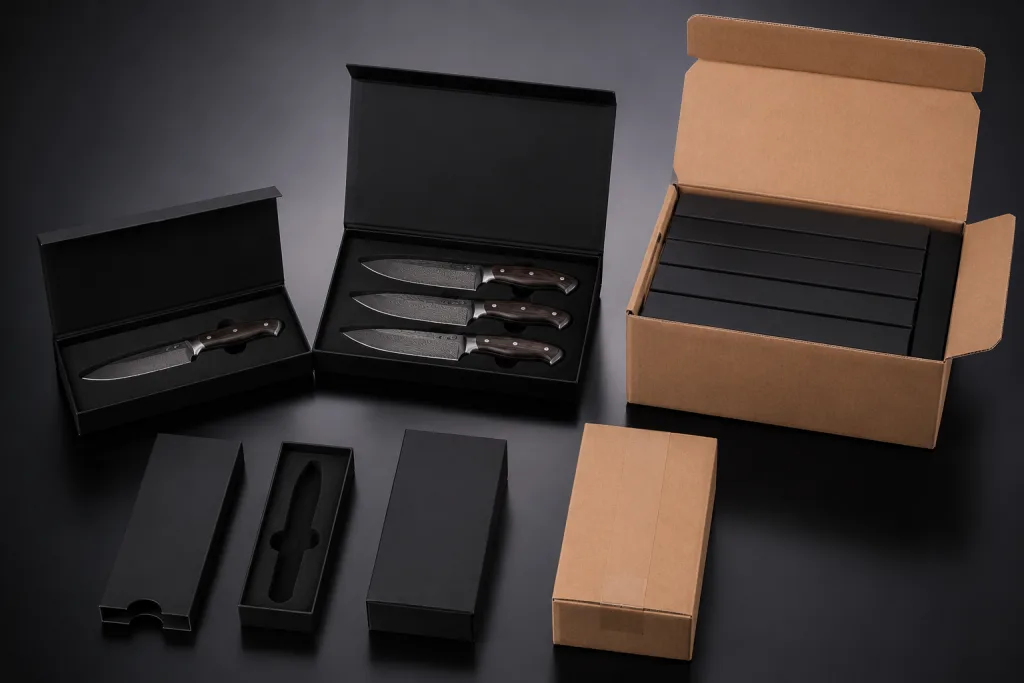
Pocket Knife Wholesale Product Specification Drafting for Regulatory, Labeling, and Traceability
A pocket knife wholesale product specification should convert buyer-approved regulatory, labeling, and traceability decisions into requirements a supplier can quote, manufacture, inspect, and document. General instructions such as “compliant for our market” are not sufficient because they do not identify the applicable market version, controlled characteristic, verification method, evidence, or approval gate.
This article addresses one buyer task: drafting the controlled product specification. It does not determine which laws apply, classify a knife under a particular rule, prescribe warnings, or provide legal advice. Those decisions should come from the buyer’s authorized legal or compliance reviewer for each destination, sales channel, and customer class.
For broader sourcing context, the supplied references are retained here: Vast State and China Knives Wholesale. Neither reference is used in this specification as authority for a legal threshold, permitted mechanism, mandatory label statement, test method, certification, or record-retention period. Each such requirement needs a source and applicability decision approved by the buyer.
Start With a Market-Requirements Register
Draft the specification from a controlled requirements register, not from a supplier catalog description. The register should record the buyer’s approved decisions for every destination and sales configuration included in the RFQ.
Use one row for each requirement or applicability decision:
| Field | Required entry | |---|---| | Requirement ID | Unique identifier, such as REG-[market]-001 | | Market version | Destination, sales channel, customer class, and exclusions | | Requirement source | Authority or customer requirement, section, edition, effective date, and source location supplied by the reviewer | | Applicability status | Applies, does not apply, conditional, or unresolved | | Decision basis | Reviewer’s rationale or reference to the approval record | | Controlled object | Knife configuration, product marking, package, insert, carton, traceability record, or evidence file | | Specification translation | Measurable product, data, document, or process requirement | | Verification method | Drawing review, measurement, functional inspection, artwork review, code verification, record lookup, or another defined method | | Approver | Buyer role authorized to accept the decision | | Status | Draft, approved, superseded, or blocked |
Keep unresolved decisions visible. Do not replace a missing decision with supplier practice, a previous-market label, an assumed convention, or an unverified product claim.
If one physical design is intended for several markets, assign a code to each approved market version. Record whether the versions differ in mechanism, dimensions, product marking, label content, insert, carton marking, traceability, or evidence. Use a single shared version only when the buyer’s review has approved the same controlled requirements for every destination within its stated scope.
Establish the Controlled Document Set
Separate legal and applicability decisions from engineering requirements, artwork, inspection instructions, and production records. Link the documents through identifiers and revisions.
| Controlled document | Function | |---|---| | Market-requirements register | Records sources, applicability decisions, market versions, and approvers | | Product specification | Defines the permitted configuration and measurable acceptance criteria | | Marking and artwork data matrix | Controls exact content, language, encoded data, surfaces, and artwork revisions | | Traceability schedule | Defines code ownership, syntax, locations, record links, and approved retention inputs | | Evidence and release matrix | Links each requirement to its evidence and release gate | | Deviation and change log | Records proposed departures, affected scope, approvals, and implementation limits |
Give every document an identifier, revision, owner, status, and approval date. The quotation, sample record, purchase order, inspection checklist, artwork approval, and shipment file should identify the controlling revisions.
The specification should also define conflict handling. When a drawing, approved sample, artwork file, purchase order, or inspection checklist disagrees with another controlled document, require the conflict to be recorded and resolved by the buyer’s designated approver before the affected release gate. Do not leave document precedence to supplier interpretation.
Write Atomic, Verifiable Requirements
Use one controlled subject and one acceptance decision per clause. A practical structure is:
> [Requirement ID] For market version [ID], [controlled subject] shall [required value or condition] when evaluated under [conditions] using [method]. Accept when [criterion]. Record the result in [evidence record] before [release gate].
Define drafting terms within the specification:
- **Shall** indicates a mandatory requirement.
- **Shall not** indicates a prohibited condition.
- **May** indicates an expressly permitted option.
- **Target** indicates a non-binding aim only when binding acceptance limits are defined elsewhere.
Replace terms such as “standard,” “normal,” “high quality,” “export grade,” “legal size,” “durable,” “clear,” or “compliant” with an approved value, limit, method, data string, document revision, or acceptance rule.
Define the Approved Pocket Knife Configuration
Create a configuration block for every sellable SKU and market version. Use buyer-controlled identifiers in addition to any supplier model reference.
| Configuration field | Specification entry | |---|---| | Identity | Buyer item number, supplier model reference, product name, variant, and market-version code | | Opening configuration | Approved opening method and prohibited alternatives | | Lock or retention feature | Approved type, required operating condition, and prohibited substitutions | | Blade configuration | Profile, number of blades, sharpened-edge arrangement, point configuration, and other buyer-controlled features | | Controlled dimensions | Feature IDs, units, nominal values, limits or tolerances, and measurement-method IDs | | Included items | Approved accessories, carrying components, inserts, and replacement parts | | Product markings | Marking IDs, methods, surfaces, locations, and artwork references | | Visual references | Controlled drawing, approved configuration images, and sample approval record | | Substitution limits | Materials, components, mechanisms, finishes, or processes that require prior approval before change |
A product-family name, catalog photograph, or statement that an item is visually similar should not be the sole definition of the approved configuration. Drawings, requirement fields, artwork, inspection records, and approved samples should use the same SKU and market-version identifiers.
Where substitution is prohibited, use a direct clause:
> Only configuration [ID and revision] is approved for market version [ID]. The supplier shall not substitute or modify [controlled features] without an approved change or deviation covering the affected SKUs, market versions, lots, documents, and implementation date.
Any market-specific prohibition included in this section should come from the buyer’s approved requirements register. The specification controls that decision; it does not create the underlying legal conclusion.
Specify Measurements Completely
A number alone does not define a controlled measurement. For every dimension used to identify or accept a market-specific configuration, state what is measured, how it is measured, and how the result is judged.
| Measurement field | Required entry | |---|---| | Feature ID | Unique reference linked to the drawing | | Characteristic | Exact dimension or feature being measured | | Units | Declared unit system | | Nominal and limits | Nominal value with upper and lower limits, or explicit minimum and maximum | | Reference points | Starting point, ending point, datum, axis, or surface | | Product state | Open, closed, locked, unlocked, or another defined condition | | Measurement path | Straight line, perpendicular projection, contour, arc, or another approved path | | Instrument | Instrument type and required resolution | | Method | Drawing detail, work instruction, fixture, and setup conditions | | Sampling | Buyer-approved sample size or sampling-plan reference | | Acceptance rule | Unit-level and lot-level decision criteria | | Record | Required report and photograph references |
Use a controlled clause rather than a bare entry such as blade length: 75 mm:
> DIM-[ID] Measure [feature] from [starting reference] to [ending reference] with the knife in [state], following [path], using [instrument and resolution], in accordance with drawing [ID and revision]. The acceptable range is [lower limit] to [upper limit] [unit]. Record each result in [report ID].
When a measurement supports a market-specific decision, link its method and limits to the applicable requirement-register ID. Do not allow the supplier or inspector to select reference points, measurement paths, limits, instruments, or sampling rules by assumption.
If an approved requirement includes a mechanism or safety-related function, define the complete test setup: initial state, actuation method, applied force or load where applicable, fixture, number of operations, observation points, failure conditions, sample size, and record format. Avoid an undefined request for a generic “function test.”
Control Market Versions and Supplier Substitutions
Use a version matrix when several market versions share a base product:
| Controlled attribute | Base configuration | Market version A | Market version B | Approval reference | |---|---|---|---|---| | Opening configuration | [value] | [value] | [value] | [requirement ID] | | Controlled dimension | [value] | [value] | [value] | [requirement ID] | | Product marking | [artwork ID] | [artwork ID] | [artwork ID] | [approval ID] | | Retail label | [artwork ID] | [artwork ID] | [artwork ID] | [approval ID] | | Insert or instructions | [document ID] | [document ID] | [document ID] | [approval ID] | | Traceability rule | [schedule ID] | [schedule ID] | [schedule ID] | [approval ID] | | Evidence set | [matrix ID] | [matrix ID] | [matrix ID] | [approval ID] |
Require the supplier’s quotation and response to identify the version being offered. Record proposed alternatives in the deviation log rather than leaving them in an email, quotation footnote, sample annotation, or unapproved drawing.
Each deviation should identify:
- the affected requirement, SKU, and market version;
- the specified and proposed values;
- the reason for the deviation;
- affected drawings, artwork, evidence, inspections, and traceability records;
- affected samples, production lots, and shipments;
- proposed start and end dates;
- verification required before acceptance; and
- buyer approver and approval status.
Convert Labeling Requirements Into Controlled Data
Draft product marking and packaging content as structured data before approving graphic layout. Keep each controlled surface separate:
1. knife or product; 2. retail package; 3. insert or instruction sheet; 4. inner carton; and 5. master carton.
Assign each surface an identifier, then control every content element independently.
| Label-data field | Required specification entry | |---|---| | Element ID | Unique identifier linked to a requirements-register row | | Surface | Product, retail package, insert, inner carton, or master carton | | Content type | Product identity, responsible-party data, origin statement, warning, instruction, barcode, lot code, or other approved content | | Exact content | Released wording or released data source; no supplier paraphrasing | | Language | Required language and approved translation identifier | | Applicability | Market version, SKU, channel, and any condition controlling use | | Placement | Panel, orientation, reference edge, coordinates, and placement tolerance | | Graphic criteria | Buyer-approved type size, line weight, contrast, color, symbol dimensions, or legibility method | | Application method | Printing, engraving, etching, adhesive label, or another approved method | | Encoded data | Symbology, data owner, exact value or generation rule, and human-readable value | | Verification | Content comparison, dimensional check, scanner check, or another approved method and acceptance target | | Artwork control | File ID, revision, approval date, and approving role |
Use conditional language where applicability varies: “when required for market version [ID] under requirement [ID].” Do not copy warnings, origin statements, responsible-party fields, material symbols, disposal marks, certification symbols, or translations from another product or market version without an approved requirement.
For machine-readable codes, control the symbology and encoded data separately from the graphic layout. If the buyer requires a particular verification method or grade, specify the method, verifier or equipment requirement, sample basis, acceptance target, and report. A successful scan on an unspecified device should not replace a defined verification requirement.
Artwork Approval Sequence
Include the approval sequence in the specification:
1. The buyer releases the approved data matrix, wording, translations, and encoded-data source. 2. The supplier places those inputs into the identified artwork template. 3. The supplier returns a proof with a file identifier and revision. 4. The buyer checks every element against the data matrix, including market version, item number, language, placement, and encoded data. 5. The supplier provides a production-representative marked and packaged sample when required by the release matrix. 6. The specified code or legibility verification is completed. 7. The buyer issues written approval for the named artwork revision and scope. 8. The supplier locks that revision for the approved production scope.
The purchase order, packaging specification, sample approval, production file, and inspection checklist should reference the same released artwork revisions. Approval of appearance alone does not approve wording, translations, encoded data, market applicability, or later file revisions.
Define Traceability as a Code-to-Record Link
A requirement for “lot coding” is incomplete unless the specification states what the code identifies and which records it must retrieve. The buyer should select the identification level and retention inputs through its approved market and risk review.
| Traceability field | Required specification entry | |---|---| | Identification level | Product, retail-package lot, serialized unit, carton, shipment, or approved combination | | Code owner | Party authorized to create, assign, release, and retire codes | | Uniqueness scope | Scope within which duplicate codes are prohibited | | Syntax | Character positions, permitted values, separators, date or lot elements, and example | | Location | Controlled application location at each packaging level | | Application method | Printing, engraving, label, or another approved process | | Readability method | Visual or machine-readable verification and acceptance rule | | Record key | Field used to retrieve the linked traceability record | | Required linkage | Buyer-defined production, component, artwork, inspection, packaging, and shipment fields | | Mixed-lot rule | Whether mixing is permitted and how contained lots are declared | | Rework or repacking rule | Method for preserving the original relationship and recording any new package or code | | Retention input | Buyer-approved period, start event, record holder, and storage form | | Retrieval test | Query input, required output, recipient, response target, and acceptance rule |
The buyer may select linked fields such as:
- buyer item number and market version;
- supplier model and production work order;
- production date and production location or line;
- required component or material batch identifiers;
- product-marking and artwork revisions;
- inspection and release-record identifiers;
- package, carton, and shipment relationships; and
- rework, repacking, or approved-deviation references.
Require an example code and a populated example record before the applicable approval gate. Start the review with the code shown on the sample or package and confirm that it retrieves every field required by the traceability schedule.
For master cartons, specify only the data controlled by the buyer’s approved receiving and traceability process. This may include the purchase-order reference, buyer item number, market version, quantity, carton sequence, and contained-lot declaration when those fields are required. Keep weights, dimensions, routing data, and other logistics marks outside this specification unless the carton specification expressly controls them.
Match Evidence to the Requirement and Scope
Avoid requests for an unspecified “compliance certificate.” Create one evidence-matrix row for each record required to support a defined specification clause.
| Evidence field | Required entry | |---|---| | Evidence ID | Unique controlled identifier | | Supported requirement | Requirement-register and specification-clause IDs | | Evidence type | Drawing, artwork proof, measurement report, test report, declaration, photograph, trace record, inspection report, or other named record | | Covered object | Exact SKU, market version, material, component, artwork revision, production lot, or shipment | | Issuing party | Required issuer or reviewer where specified by the approved requirement | | Method or basis | Test method, inspection instruction, document basis, or review procedure | | Date and version | Issue date, revision, and any buyer-defined validity criterion | | Required content | Results, fields, photographs, signatures, or attachments needed for review | | Acceptance rule | Objective acceptance or escalation conditions | | Reviewer | Buyer role authorized to decide acceptance | | Release gate | Stage at which accepted evidence is required |
Apply each record only to its stated scope:
- A drawing review addresses the identified design revision, not an unidentified production lot.
- A sample result addresses the tested sample and stated method unless the acceptance plan defines a broader use.
- An artwork proof addresses the named file revision, not later edits or production print quality unless those checks are included.
- A photograph records the visible condition shown; it does not establish an unstated dimension, material, test result, or legal conclusion.
- A traceability example demonstrates the submitted code-to-record lookup; continuing production controls require their own defined records and checks.
- A report or declaration should be reviewed only for the SKUs, materials, components, revisions, markets, lots, or shipments identified in the evidence matrix.
Record missing identifiers or revision mismatches instead of assuming coverage. Route documents requiring legal interpretation to the buyer-designated reviewer rather than assigning that judgment to the supplier or inspector.
Connect Evidence to Release Gates
Use explicit release gates so each approval has a defined object and scope.
| Gate | Required controlled outputs | |---|---| | G0 — Requirements release | Approved market versions, sources, applicability decisions, unresolved-item log, and named approvers | | G1 — Quotation acceptance | Supplier acknowledgment, version-specific quotation, configuration description, evidence plan, and deviation log | | G2 — Product sample approval | Controlled drawing, measured sample, required functional results, product-marking proof, example code, and sample trace record | | G3 — Artwork approval | Released data matrix, approved translations, artwork files, packaged sample when required, and specified code-verification results | | G4 — Production authorization | Released specification, approved sample record, accepted evidence, approved deviations, inspection plan, and production artwork revisions | | G5 — Shipment release | Lot-specific inspection record, required final evidence, production-code list or range, carton-to-lot relationship, and shipment-to-lot record |
Define the buyer role authorized to release each gate and whether the decision may be approved, conditionally approved, or rejected. A conditional release should identify the open item, responsible party, deadline, affected quantities or lots, permitted activity, and any later gate that remains blocked.
Put Change Control in the Specification
List the regulatory-configuration, labeling, traceability, and evidence attributes that require prior written approval before change. Depending on the buyer-approved scope, these may include:
- opening method, lock, blade configuration, or controlled dimensions;
- a material, component, finish, or process named in the approved specification or evidence;
- product-marking content, method, or location;
- label wording, translation, barcode data, placement, or artwork revision;
- lot-code syntax, location, application method, or linked-record structure;
- production location when it affects an approved record or evidence scope; and
- an inspection, test, or traceability method used at a release gate.
Each change request should state:
- current and proposed values;
- reason for the change;
- affected requirement IDs, SKUs, and market versions;
- affected drawings, artwork, evidence, inspection instructions, and trace records;
- affected samples, work orders, lots, and shipments;
- proposed implementation and segregation dates;
- requested revalidation, resampling, or document review; and
- buyer approval status.
An updated sample, quotation note, attachment, or production file should not change a controlled requirement unless the buyer incorporates it into an approved specification revision or a time-bounded deviation.
Align the Specification, Sample, Inspection, and Purchase Order
Keep four records synchronized:
1. **Released product specification:** Defines the approved configuration, measurable requirements, labeling references, traceability controls, evidence, and change rules. 2. **Approved sample record:** Identifies the physical sample by SKU, market version, configuration revision, artwork revision, code example, date, and approval scope. 3. **Inspection checklist:** Identifies applicable clauses, methods, instruments, sample basis, acceptance criteria, required records, and escalation path. 4. **Purchase order:** States quantity by SKU and market version, controlling revisions, inspection requirements, accepted deviations, and release conditions.
The sample demonstrates physical execution only within its recorded scope. It should not replace written tolerances, exact label data, translation approvals, traceability fields, retention inputs, evidence scope, or change-control clauses.
Product Specification Clause Set
Complete clauses such as these with buyer-approved values:
> **Market scope:** SKU [ID], revision [revision], is specified only for market version [ID], covering [destination, channel, and customer class]. Applicability decisions are recorded in market-requirements register [ID and revision].
> **Configuration:** The supplier shall manufacture only configuration [drawing and revision]. Features [list] shall not be substituted or modified without an approved change or deviation.
> **Dimension:** Characteristic [feature ID] shall be within [limits and unit] when measured from [references] with the knife in [state] using method [ID and revision]. Record results under inspection requirement [ID].
> **Marking and labeling:** Product and packaging content shall match data matrix [ID and revision] and artwork files [IDs and revisions] for market version [ID]. Unapproved text, symbols, marks, translations, or encoded data shall not be added.
> **Traceability:** Code [field ID] shall follow syntax [rule], appear at [locations], and retrieve the fields listed in traceability schedule [ID and revision]. Repacking or rework shall preserve or document the original lot relationship according to [rule ID].
> **Evidence:** Evidence item [ID] shall cover [object and scope], use [method or basis], include [required fields], and be submitted before gate [ID]. Acceptance is limited to the scope recorded in the evidence matrix.
> **Release:** Production or shipment shall not proceed past gate [ID] until the required records are accepted by [buyer role] or a written conditional release defines the permitted scope.
Pocket Knife Wholesale Product Specification Checklist
Buyer-controlled inputs
- [ ] Every destination, channel, customer class, and exclusion is assigned to a market version.
- [ ] Each regulatory or labeling decision has a requirement ID, approved source, applicability status, and approver.
- [ ] Unresolved decisions remain visible and are linked to blocked release gates.
- [ ] Approved opening, lock, blade, accessory, and substitution conditions are stated.
- [ ] Controlled dimensions include limits, reference points, product state, measurement path, instrument, sampling basis, and acceptance rule.
- [ ] Product, retail-package, insert, inner-carton, and master-carton requirements are separated.
- [ ] Exact content and approved translations are supplied only for versions that require them.
- [ ] Machine-readable-code ownership, data, symbology, placement, and verification are defined.
- [ ] Every artwork file has an identifier, revision, approval scope, and approving role.
- [ ] Traceability requirements define code syntax, uniqueness, locations, linked records, repacking rules, retrieval tests, and approved retention inputs.
- [ ] Each evidence item identifies the requirement and exact object, revision, lot, or shipment it supports.
- [ ] Controlled attributes requiring prior change approval are listed.
- [ ] Release gates identify required records and authorized approvers.
Required supplier response
- [ ] Each specification clause is marked accepted, exception, or clarification required.
- [ ] The quotation identifies the SKU, market version, specification revision, artwork revision, and quantity.
- [ ] Every proposed exception or substitution appears in the deviation log.
- [ ] The dimensioned drawing uses the approved feature IDs and measurement definitions.
- [ ] Marking and packaging proofs follow the specified artwork approval sequence.
- [ ] The supplier provides an example code and populated traceability record.
- [ ] Each evidence file identifies its applicable SKU, market version, material, component, revision, lot, or shipment.
- [ ] Production remains blocked until the required configuration, sample, artwork, and evidence gates are released.
- [ ] Shipment release includes the specified inspection record and shipment-to-lot relationship.
Release One Controlled RFQ Package
The final RFQ package should contain:
- one product specification for each controlled SKU or explicitly defined product family;
- one market-requirements and version register;
- one product-marking and packaging-artwork data matrix;
- one traceability schedule;
- one evidence and release-gate matrix; and
- one supplier deviation and change log.
Require every quotation, sample approval, purchase order, inspection record, artwork file, and shipment record to cite the applicable document identifiers and revisions. This gives the buyer a controlled basis for deciding whether the quoted and delivered pocket knife matches the approved market-specific configuration, labeling data, traceability relationships, and release evidence without converting supplier assertions or commercial sourcing material into unsupported regulatory conclusions.