Pocket Knife Wholesale Sample Approval: Golden-Sample Cost Control
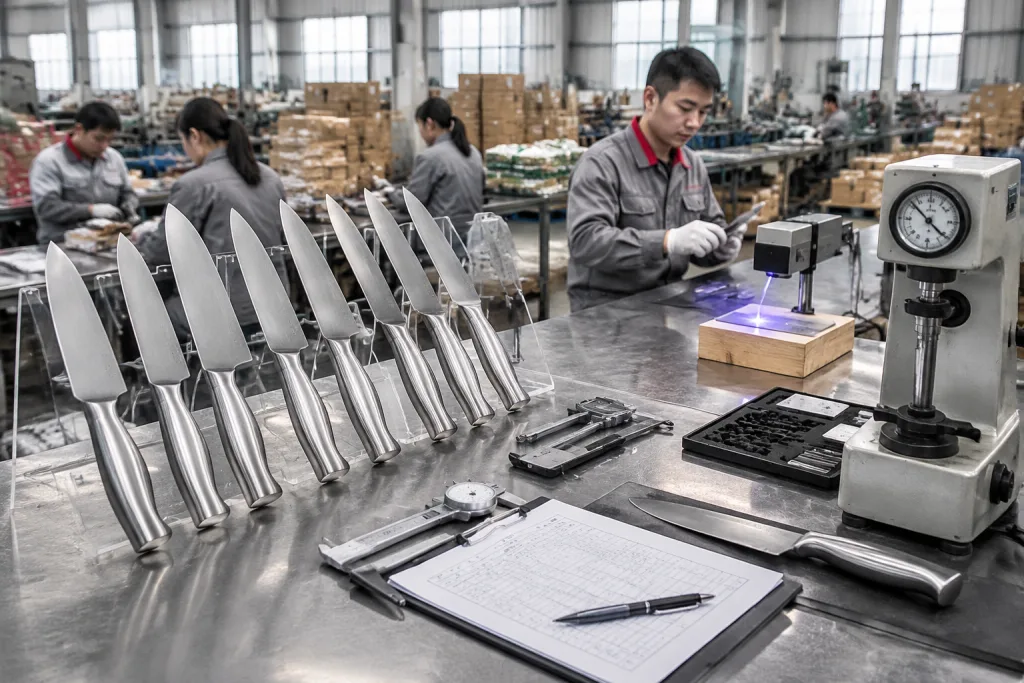
Pocket Knife Wholesale Sample Approval: Golden-Sample Cost Control
A pocket knife wholesale quotation is comparable only when it prices the same approved configuration as the competing quotations. The sample record must therefore connect the physical unit to its specification revision, packaging scope, quantity tier, trade term, and itemized cost basis.
Use one comparison rule:
> Compare quotations only when they reference the same sample revision, product specification, packaging revision, quantity tier, and trade term with named place.
Broader knife-sourcing resources discuss samples alongside specifications, packaging, quality control, total cost, and reorder planning (Vast State). Other sourcing material separates product, logo, packaging, and carton considerations (China Knives Wholesale). The process below converts those topics into a buyer-controlled sample-to-quote workflow. It does not establish what a supplier includes by default. Confirm every inclusion, exclusion, charge, credit, and production method in the supplier’s written quotation and sample record.
Give Every Sample a Commercial Status
Do not record a sample as merely approved or rejected. Assign a stage that shows what the unit can support commercially.
| Sample stage | Buyer evaluation | Quotation status | Production authority | |---|---|---|---| | Feasibility sample | Proposed construction, dimensions, mechanism, and general material approach | Preliminary; assumptions and substitutions remain open | None | | Pre-production sample | Intended product, finish, branding, and packaging configuration | Revised quotation tied to the sample revision | Conditional only if open items are recorded | | Golden-sample candidate | Complete configuration assessed against buyer-defined acceptance criteria | Proposed final quotation basis | None until formally approved | | Approved golden sample | Configuration identified in the signed approval record | Final quotation must reference the same basis | Supports production authorization under the purchase order |
A sample is not a complete production reference if it contains an undeclared substitute, omitted packaging, temporary branding, or sample-only workmanship. Record each known difference as a deviation and require the supplier to state:
- What differs from the requested production specification
- Why the difference exists
- Whether the intended production material or method changes unit price, setup charges, tooling, minimum quantity, or timing
- Whether a replacement sample is required
- Which quotation revision records the commercial effect
Do not assume that a deviation has no cost effect because the sample appears acceptable.
Freeze the Sample-to-Quote Control Key
Use the same control key on the sample label, approval form, quotation comparison sheet, and purchase order:
Product code / specification revision / sample ID / packaging revision / quantity tier / trade term and named place
If any element changes, treat the quotation as a different comparison basis. Preserve the original quotation and create a new revision or option column.
Product configuration
Record the fields needed to distinguish the quoted pocket knife configuration:
- Open length, closed length, blade length, and buyer-defined dimensional tolerances
- Blade material designation stated in the quotation or specification
- Blade finish, grind description, edge condition, and coating, when specified
- Handle material, color reference, texture, liners, bolsters, scales, and fasteners
- Opening method, lock construction, washer or bearing description, and clip configuration
- Buyer-defined checks for centering, blade play, retention, lock operation, assembly, and cosmetic condition
Do not infer material grade, heat treatment, hardness, coating process, tolerance, or performance from appearance. If an attribute affects approval or price, place it in the written specification and define any evidence the supplier must provide.
Branding and packaging
Keep branding and packaging separate from the knife configuration so that missing or provisional elements remain commercially visible:
- Artwork revision and file reference
- Logo location, dimensions, orientation, and application method
- Individual packaging components and specified materials
- Insert, protective material, and pack-out sequence
- Responsibility for barcode and label content
- Units per master carton
- Carton dimensions, protective packing, and marking requirements
Approval of the knife does not approve packaging that was absent, incomplete, or represented only by a mock-up. Give knife, branding, packaging, and carton scope separate approval fields and quotation lines.
Commercial basis
Record the basis used to price both the sample and the production order:
- Sample type, quantity, and destination
- Sample freight basis
- Production quantity tier
- Trade term and named place
- Buyer-supplied artwork, packaging, or components
- Inspection or testing expressly included in the quotation
- Quote validity period
- Included sample-revision rounds
- Charges for additional revisions
- Written conditions for any sample or development credit
Classify each requirement as **fixed**, **supplier-proposed**, **optional**, or **open**. Give every optional alternative its own option code, sample ID, specification revision, and quotation column.
Normalize Sample and Production Cost Drivers
Require every supplier to complete the same cost schedule. A blank field is not zero. Mark it **included**, **excluded**, **not applicable**, or **open**.
| Cost line | Required detail | Comparison treatment | |---|---|---| | Sample units | Sample type, quantity, configuration, and sample ID | Keep separate from production goods | | Sample modification | Work performed and included revision limit | Add confirmed non-creditable charges | | Design or engineering | Deliverable, included rounds, and whether the charge recurs | Separate one-time and recurring amounts | | Tooling, molds, dies, or fixtures | Purpose, charge, ownership terms, and change trigger | Keep outside recurring unit price unless expressly included | | Blade material and processing | Quoted designation, finish, and coating basis | Compare only against the same written specification | | Handle and hardware | Quoted material and configuration | Compare only against the same written specification | | Branding setup | Quoted artwork preparation, programming, plate, screen, or fixture | Separate from per-unit application cost | | Branding application | Per-unit or lot charge and included locations | Add to recurring cost if excluded from unit price | | Packaging development | Structural sample, print proof, insert, or pack-out work | Add confirmed omitted work before ranking quotations | | Packaging production | Per-unit packaging and pack-out charge | Confirm whether included in unit price | | Inspection or testing | Defined activity, timing, stated quantity or sampling basis, and payer | Include only confirmed scope and cost | | Sample freight | Courier and other stated transport charges | Add buyer-paid amounts | | Production freight and import costs | Supplier amount or documented buyer comparison input | Use the same basis across suppliers | | Production unit price | Sample revision, quantity tier, packaging revision, and trade term | Keep open if the basis is undefined | | Credits | Eligible charge, qualifying threshold, timing, and application method | Treat as conditional until written conditions are met |
Do not state that a material, process, or feature necessarily raises or lowers cost. Ask whether the supplier’s quotation changes when the requirement changes, and record the written response.
Calculate Comparable First-Order Cost
Use the same calculation for every supplier and configuration:
Production goods total = quoted unit price × order quantity
Gross evaluated first-order cost = production goods total + non-creditable sample and development charges + tooling or fixtures + branding setup + packaging development or setup + comparison allowances for inspection, freight, and import costs
Gross evaluated cost per unit = gross evaluated first-order cost ÷ order quantity
A comparison allowance must be either a supplier-confirmed amount or the same documented buyer assumption applied to every supplier. Label buyer assumptions separately from supplier-quoted amounts.
Show conditional credits outside the gross total:
Conditional net cost = gross evaluated first-order cost − credits earned under the stated conditions
Do not subtract a possible credit unless the written quotation identifies:
- The eligible charge
- The qualifying order quantity or value
- When the credit is earned
- How it will be applied
- Any stated expiry or order-specific condition
If a required amount or condition is unknown, mark the quotation **commercially open**. Do not place an unsupported estimate in a supplier-quoted field.
Compare matching quantity tiers. If suppliers quote different tiers, request common tiers or display each tier in a separate comparison column. Do not normalize different order quantities by silently treating them as the same commercial basis.
Link Every Sample Decision to a Re-Quote Decision
After each sample round, record both the approval result and its commercial consequence.
| Finding or requested change | Approval status | Quotation action | Required record | |---|---|---|---| | Sample matches the frozen specification and buyer-defined criteria | Approve as golden sample | Confirm the final quotation reference | Signed approval, sample ID, specification revision, photographs, and quotation revision | | Cosmetic result is within a written acceptance boundary | Approve within that boundary | Obtain written confirmation of the existing price basis | Boundary reference and dated decision | | Substitute material or finish was used | Production basis remains open | Require production-method and price confirmation | Deviation record and replacement-sample decision | | Blade or handle material changes | Revise | Request an itemized price delta or written no-change confirmation | New specification revision and quotation response | | Grind, coating, finish, mechanism, or hardware changes | Revise | Review the affected quotation lines | Change record, sample decision, and quotation response | | Logo method, size, artwork, or location changes | Branding approval remains open | Review setup and application charges | Artwork revision and branding sample reference | | Packaging is omitted or represented by a mock-up | Packaging approval remains open | Keep packaging cost open | Packaging sample or proof, pack-out specification, carton data, and price basis | | Sample includes hand fitting or polishing not identified as the production method | Production approval on hold | Require production-method and price confirmation | Supplier statement and replacement-sample decision | | Functional or assembly issue is found | Reject or conditionally revise | Review the proposed correction and any quoted cost effect | Issue record, supplier response, and new sample result | | Quotation assumptions or exclusions are unclear | Commercial approval on hold | Require a normalized quotation revision | Revised inclusions, exclusions, assumptions, and validity date | | Lower-cost alternative is proposed | Evaluate as a separate option | Obtain a standalone quotation | Option code, separate sample, specification, and price |
A technical revision does not establish a price increase or decrease by itself. It triggers commercial review. Record the supplier’s price response, including a stated no-change response; silence is not confirmation.
Approve the Golden-Sample Control Pack
The controlled reference is the approved physical unit plus its linked records. The control pack should contain:
- Golden-sample ID
- Product and option codes
- Product specification revision
- Packaging revision
- Approval date
- Final quotation reference
- Production quantity tier and trade term
- Approved blade, handle, hardware, finish, mechanism, branding, and packaging descriptions
- Artwork revision and logo-placement dimensions
- Packaging proof or sample reference
- Pack-out sequence and carton configuration
- Photographs of both sides, blade finish, centering view, lock area, clip, branding, packaging, and identifying label
- Buyer-defined measurements and recorded results
- Intentionally accepted deviations
- Any open items under conditional approval
- Buyer and supplier approval names or roles
- Location and identification of retained physical references
- Replacement and revision instructions
If buyer and supplier retain matching units, apply the same golden-sample ID and revision while identifying the holder or copy number. If another party will use the reference for inspection, state whether it will receive the physical unit, photographs, written specifications, acceptance criteria, or a defined combination.
Do not use the physical sample as an unstated tolerance. The sample records the approved reference result; written dimensions, criteria, and acceptance boundaries define acceptable variation.
A concise approval statement can read:
> Golden sample GS-[ID], dated [date], is approved with product specification [revision], packaging revision [revision], and deviation record [reference]. Final quotation [reference] applies to this configuration at quantity tier [tier] under [trade term and named place]. Any proposed deviation requires written buyer review and a documented sample or re-quote decision before use for the order.
Connect the Golden Sample to Change Control
Reference the approved control key in the purchase order and define the response required for a proposed change.
| Proposed change | Minimum control response | |---|---| | Administrative correction with no configuration or price-basis effect | Document revision and written confirmation | | Blade or handle material designation, thickness, or color change | Commercial review and sample decision | | Material source change when source is part of the approved specification | Commercial review and sample decision | | Heat-treatment, coating, grinding, or finishing-route change | Written review, sample decision, and quotation confirmation | | Lock, spring, washer, bearing, fastener, or clip change | Functional review, sample decision, and quotation confirmation | | Logo artwork, location, dimensions, or application-method change | New branding approval and price confirmation | | Packaging material, dimensions, printing, or pack-out change | Packaging approval, carton-data review, and price confirmation | | Tooling, fixture, or production-location change that may alter the approved output | Written review and sample decision | | Inspection instruction or acceptance-criteria change | Revised controlled document and commercial review |
Each change notice should identify:
- Golden-sample ID and affected specification revision
- Affected purchase order or planned order
- Description and reason for the proposed change
- Proposed effective date
- Affected sample, tooling, packaging, or inspection records
- Supplier-stated price and timing effect
- Requested buyer decision
Classify the outcome as **document-only**, **sample-required**, **re-quote-required**, **sample-and-re-quote-required**, or **not approved**.
For a repeat order, compare the new quotation with the same controlled configuration or document every approved revision. Broader wholesale sourcing guidance includes repeatability and reorder planning among buyer considerations (Vast State); the fields above are a proposed buyer control procedure.
Final Quote-Comparison Sheet
Use one row per supplier and a separate row for each alternative configuration.
| Comparison field | Supplier entry | |---|---| | Supplier quotation reference and date | | | Product and option code | | | Specification revision | | | Sample ID and approval stage | | | Packaging revision | | | Quantity tier | | | Trade term and named place | | | Production unit price | | | Production goods total | | | Non-creditable sample units | | | Non-creditable modification, design, or engineering | | | Tooling, dies, molds, or fixtures | | | Branding setup | | | Recurring branding application | | | Packaging development and setup | | | Recurring packaging cost excluded from unit price | | | Inspection or testing | | | Buyer-paid freight and import-cost input | | | Gross evaluated first-order cost | | | Gross evaluated cost per unit | | | Conditional credits | | | Conditional net cost | | | Open assumptions or exclusions | | | Sample revisions included | | | Additional revision charge | | | Quote validity | | | Golden-sample replacement cost, if quoted | | | Commercial status: comparable or open | |
Wholesale commentary cautions against relying only on the cheapest bulk offer (SZCO). For this approval process, the comparison target is narrower: the normalized first-order cost of the same documented and approved pocket knife configuration.
Do not rank a quotation as complete while its sample revision, packaging scope, quantity tier, trade term, or material-cost exclusions remain open.
Production Award Gate
Before awarding production, confirm that:
- [ ] Each compared quotation uses the same product and packaging revisions.
- [ ] Each compared quotation uses the same quantity tier, trade term, and named place.
- [ ] The final quotation identifies the approved sample or golden-sample candidate.
- [ ] Knife, branding, packaging, and carton scopes are approved or explicitly open or excluded.
- [ ] Sample, development, tooling, branding, packaging, inspection, freight, and import-cost inputs are separated.
- [ ] Buyer assumptions are distinguished from supplier-quoted amounts.
- [ ] Conditional credits remain separate from gross evaluated cost.
- [ ] Substitutes, mock-ups, omitted components, and sample-only workmanship are documented and resolved.
- [ ] Accepted deviations are included in the golden-sample control pack.
- [ ] Retained reference units are identified by holder or copy number.
- [ ] The purchase order references the golden-sample ID, specification revision, packaging revision, final quotation, and accepted deviations.
- [ ] Change notices have defined document, sample, and re-quote outcomes.
- [ ] Production inspection instructions use the same controlled specification and acceptance criteria.
The award file should answer four questions without relying on memory or informal messages:
1. Which exact sample and specification revision was approved? 2. Which quoted and buyer-paid costs apply to that configuration? 3. Which deviations were expressly accepted? 4. Which future changes require documentation, another sample, a revised quotation, or both?
When the RFQ, normalized quotation, golden-sample control pack, and purchase order carry the same control key, the buyer can compare the cost of the approved configuration without mixing sample stages, quantity tiers, packaging scopes, or conditional credits.