Private Label Kitchen Knives: MOQ, Pricing Structure, and Landed-Cost Controls
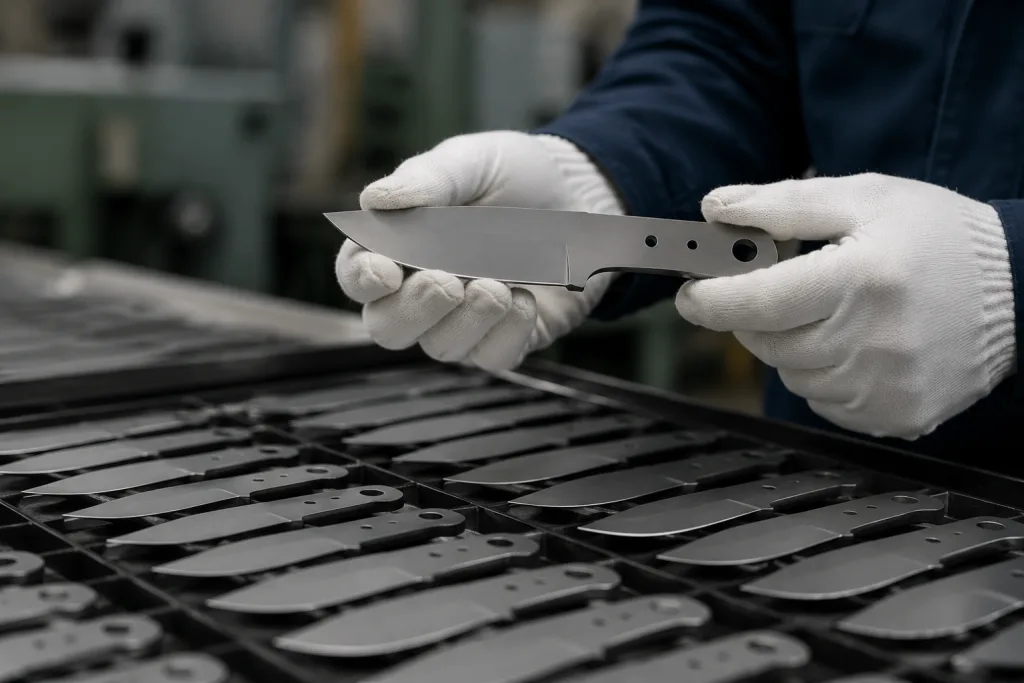
Private Label Kitchen Knives: MOQ, Pricing Structure, and Landed-Cost Controls
**Byline:** Vincent Xi, Editorial Author **Author profile:** https://tangforge.com/authors/vincent-xi/ **Publisher:** TANGFORGE (tangforge.com)
Private label kitchen knife programs often stall for three reasons: MOQ is quoted without a clear SKU map, unit price is treated as the full commercial cost, and landed cost is estimated after samples are already approved. For importers, distributors, retailers, and brand owners, the task is not simply to “find a knife factory.” It is to lock quantity tiers, pricing structure, packaging assumptions, compliance documentation, and freight timing before a purchase order is released.
This article is an editorial buyer framework for private label kitchen knives. It focuses on MOQ, pricing structure, and landed-cost controls. It does not present factory claims, unpublished price lists, or personal production experience. Market scale figures below are attributed to published secondary sources cited inline. Any cost arithmetic is labeled as an example calculation for quote verification, not a market guarantee.
Buyer decision sequence at a glance
Use this order when comparing private label kitchen knife offers:
1. Define channel, destination markets, and first-order sell-through risk. 2. Map SKUs: open stock vs. sets, handle family, packaging versions. 3. Request MOQ by SKU, color, logo process, and packaging version. 4. Normalize every quote into the same cost stack and Incoterm. 5. Model carton cube, freight mode, and duty before final sample approval. 6. Write acceptance criteria, inspection hold points, and document owners into the PO.
If any of those six steps is missing, unit price alone is not a reliable buying signal.
Why China remains central to private label kitchen knife sourcing
China is a major global knife manufacturing and export base. According to a B2B sourcing overview citing trade data, China exported **USD 1.66 billion** worth of knives in **2024**, equal to **51.5% of global knife exports** (Lee Knives / OEC World citation). The same overview reports that total production of knives, scissors, and blades reached **2.9 billion units**, up **8% year over year**, with the production figure attributed to IndexBox material published for the 2024 market overview (Lee Knives / IndexBox citation).
Within China, Yangjiang is repeatedly described as the dominant knife cluster. The same sourcing guide states that Yangjiang’s knife and hardware industry exceeded **CNY 55 billion in output value in 2024**, that Yangjiang-made products accounted for **eight out of every ten knives China exports**, and that Yangjiang represents roughly **70% of China’s knife output** and **85% of its knife exports** (Lee Knives / China Daily and local-industry summary). Those secondary figures explain why private label kitchen knife RFQs often route through Yangjiang capacity: export volume and production concentration are reported as high in that cluster.
For buyers, cluster concentration matters commercially because MOQ, lead time, and packaging options often depend on whether a supplier can access local steel finishing, heat treatment, handle fabrication, sharpening, and export packaging within one region. A separate kitchenware buyer resource hub frames private label projects around RFQ preparation, OEM/ODM path choice, packaging, and food-contact compliance planning rather than product photography alone (Marketvalue kitchenware insights). That is the correct commercial lens for private label kitchen knives.
What MOQ really means in a private label kitchen knives program
MOQ is not one number. For private label kitchen knives, MOQ is usually a stack of constraints:
1. **Blade/model MOQ** — minimum production run per blade pattern, thickness, and edge geometry. 2. **Handle/material MOQ** — minimum for handle material, color, rivets, or overmold tooling. 3. **Logo/process MOQ** — laser, etching, stamping, or printed mark setup thresholds. 4. **Packaging MOQ** — color box, sleeve, blister, sheath, insert card, barcode label, and master carton. 5. **Assortment MOQ** — set composition rules when a multi-piece set mixes chef, utility, paring, and bread knives.
Buyers who ask only “What is your MOQ?” usually receive an incomplete answer. A better question is: “What is the MOQ by SKU, by handle color, by packaging version, and by logo process, and which of those can be mixed in one production batch?”
Practical MOQ planning ranges for RFQ comparison
Use planning ranges only as RFQ discussion anchors. Confirm every threshold in writing against the actual factory quote. These ranges are not universal factory rules.
| Buyer objective | Typical RFQ structure | What usually raises MOQ | Landed-cost risk if ignored | | --- | --- | --- | --- | | Fast first private label launch | 1–3 core SKUs, shared handle family, simple logo, shared carton system | Extra handle colors, unique gift boxes | Packaging overbuy and slow sell-through | | Retail shelf assortment | Multi-SKU set plus open stock | Different blade lengths and set inserts | Mixed-SKU cartons that inflate freight cube | | Premium material story | Narrow SKU count, tighter steel/handle control | Higher-spec steel, forged look, special finishing | Sample-to-bulk deviation and rework cost | | Market test before scale | Smaller first run, locked packaging template | Full custom tooling plus multi-language packaging | Tooling amortization on too few units |
**Example calculation (assumption to verify in supplier quote):** if a supplier quotes a packaging MOQ of **1,000 color boxes per SKU** and the buyer only needs **400 retail units** for a market test, the buyer either overbuys packaging or redesigns packaging to a lower-MOQ format. The unit product price can look attractive while packaging waste destroys contribution margin. Treat packaging MOQ as a quote field, not a side note.
Kitchenware sourcing checklists commonly emphasize defining product categories and target quantities before supplier outreach (Marketvalue sourcing checklist framing). For knives, that means separating open-stock SKUs from sets and stating whether the first order is a test run or a replenishment program.
MOQ questions that produce comparable answers
- Can multiple handle colors share one blade production batch?
- Is packaging MOQ independent of knife MOQ?
- Can logo setup be amortized, or is it a fixed fee?
- What is the lowest viable first-order quantity if packaging is simplified?
- Which SKUs can share master-carton architecture without mixed-SKU customs risk?
Pricing structure: separate unit price from program cost
Private label kitchen knife pricing should be broken into commercial layers. A single FOB number is not enough for landed-cost control.
Core pricing layers to request in every quote
- **Blade and handle unit price** by steel grade or equivalent designation, hardness target range, finish, and handle construction.
- **Tooling / mold / stamp charges** if the design is not a standard blank.
- **Logo process cost** and whether it is amortized or charged as a setup fee.
- **Sample cost and sample lead time**, including whether sample cost is refundable against bulk.
- **Packaging price** by retail pack, inner pack, and export carton.
- **QC and inspection scope** — in-line checks, final random inspection, and any third-party inspection booking.
- **Incoterm and payment terms** — EXW, FOB, CIF, or DDP changes the risk and cash profile.
- **Document pack** — commercial invoice, packing list, material declarations, and market-specific food-contact support where required.
OEM and ODM are not interchangeable. An OEM path usually starts from a buyer-controlled design or locked specification. An ODM path often starts from an existing model with logo, packaging, and limited adjustments. Buyer resource pages on kitchenware sourcing explicitly recommend comparing OEM, ODM, and wholesale paths before deciding how much customization is necessary (Marketvalue OEM vs ODM framing). Over-customizing a first order is one of the most common ways private label knife programs inflate MOQ and delay shipment.
Example cost stack for quote comparison
The following is an **example calculation / assumption set for verification**, not a published market price and not a Tangforge quotation:
- Assumed EXW unit price: **USD 4.80 per chef knife**
- Assumed packaging: **USD 0.55 per retail unit**
- Assumed logo setup amortized: **USD 0.12 per unit at 3,000 units**
- Assumed inland + export handling allocated: **USD 0.20 per unit**
- Assumed ocean freight + destination charges allocated: **USD 0.70 per unit**
- Assumed duty/tax placeholder: buyer-market specific and must be calculated with the correct HS code and local rate
**Illustrative merchandise cost before duty/tax:** 4.80 + 0.55 + 0.12 + 0.20 + 0.70 = **USD 6.37 per unit**. Any real program should replace each line with supplier, forwarder, and customs inputs. If duty is omitted, the “landed” number is not landed.
Wholesale private label process pages often describe a sequence of design or model selection, sampling, then first private label order (Sourcing Nova wholesale kitchen knives process). From a cost-control standpoint, the critical commercial step is not the sequence itself; it is forcing the quote to itemize what changes between sample and bulk, especially packaging and logo process.
Quote-normalization rules
Before ranking suppliers, convert every offer to the same structure:
1. Same Incoterm. 2. Same SKU list and packaging version. 3. Separate lines for knife, packaging, logo setup, tooling, and samples. 4. Same validity window and material-assumption notes. 5. Same carton data request for freight modeling.
Without normalization, the lowest headline unit price is often the least complete offer.
Landed-cost controls to lock before sample approval
Landed cost is where private label kitchen knife programs quietly lose margin. Unit price can be stable while carton cube, packaging weight, inspection failures, and shipping mode destroy the plan.
Controls that belong in the pre-PO checklist
1. **Cartonization before final sample sign-off** Confirm units per inner, inners per carton, carton dimensions (length × width × height), gross weight, and stacking limits. Knife programs with sheaths, magnetic strips, or gift boxes can change cube dramatically.
2. **Freight mode decision tied to launch date** Air freight can rescue a late launch and erase contribution margin at the same time. A knife buyer FAQ/sourcing library includes freight-planning guidance that connects shipping cost to sample approval, packaging, production timing, and order release (TOP KNIVES freight planning note). The buyer takeaway is practical: do not approve final packaging until freight assumptions are modeled.
3. **Assortment and mixed-SKU rules** Mixed cartons may help cash flow and retail replenishment, but they can raise pick/pack cost and complicate customs descriptions if not planned.
4. **Quality cost allowance** Budget for pre-shipment inspection, possible rework, and replacement production for edge chips, hardness out-of-range, handle fit gaps, and packaging defects. A low unit price with undefined AQL and no inspection plan is not a controlled landed cost.
5. **Compliance documentation as a cost and timeline item** Food-contact support for destination markets depends on material, coating, handle composition, and market rules. Buyer resources on kitchenware compliance note that documentation needs are product- and market-specific (Marketvalue food-contact basics framing). Treat test reports and declarations as schedule-critical documents, not afterthoughts. A standard’s existence is not evidence that a specific lot was tested to that standard.
6. **Currency, payment, and deposit timing** Deposit percentage, balance trigger, and banking fees affect working capital. A program that looks cheap on EXW can still strain cash if deposit, tooling, and long ocean transit stack together.
Buyer decision table: MOQ vs. customization vs. landed-cost control
| Decision lever | Lower-risk first order | Higher-risk first order | Control action | | --- | --- | --- | --- | | SKU count | 1–3 hero SKUs | Full 8–12 SKU wall | Freeze assortment until sell-through data exists | | Customization depth | Logo + packaging on proven model | New blade geometry + new handle tooling | Separate tooling PO from bulk goods PO | | Packaging | Shared structure, label/version changes | Fully custom gift architecture | Approve dieline and carton cube with freight quote | | Steel/handle story | Standard grade with clear spec sheet | Marketing claims without measurable spec | Require measurable hardness, finish, and tolerance fields | | Shipping plan | Ocean with buffer stock | Air for entire first order | Model margin under ocean and under air before PO | | QC plan | Defined AQL + inspection hold point | Visual check only at warehouse receipt | Book inspection before balance payment where terms allow |
How to write an RFQ that forces comparable knife quotes
A weak RFQ produces non-comparable quotations: one supplier quotes bare knife EXW, another quotes FOB with color box, and a third omits logo setup. Knife buyer FAQ structures commonly push buyers to prepare clearer RFQs before manufacturing conversations begin (TOP KNIVES RFQ preparation section).
Practical RFQ checklist for private label kitchen knives
Use this checklist as a copy-ready RFQ spine:
1. **Program identity**
- Brand/private label or retail white label
- Destination markets
- Target retail channel (e-commerce, supermarket, specialty retail, foodservice)
2. **SKU map**
- Knife types: chef, santoku, utility, paring, bread, boning, steak, shears
- Blade length and thickness targets
- Set composition if applicable
- Forecast first order quantity and 12-month planning quantity
3. **Technical specification**
- Steel designation or acceptable equivalents
- Hardness target range and measurement method
- Edge angle / sharpening expectation
- Surface finish (satin, blasted, polished, coated)
- Handle material, color, tang type, fastener method
- Balance and weight targets if commercially relevant
- Corrosion, dishwasher, or use-condition claims only if supported by lot-specific evidence later
4. **Branding**
- Logo process preference
- Logo position and size
- Artwork files available or not
- Whether blade mark, handle mark, or both are required
5. **Packaging and labeling**
- Retail pack format
- Safety requirements for blade protection
- Barcode / label language
- Insert card or instruction sheet
- Master carton marks and palletization preference
6. **Commercial terms**
- Requested Incoterm
- Port of loading preference if known
- Payment terms request
- Sample policy
- Tooling ownership and amortization rules
- Lead time for sample and bulk
7. **Quality and acceptance**
- Critical defects list (edge chips, handle gaps, rust, logo misplacement, packaging damage)
- Inspection standard / AQL request
- Whether third-party inspection is required
- Retention sample policy
8. **Compliance pack**
- Destination market list
- Food-contact documentation expectations by material
- Restricted substance questions relevant to coatings, handles, and adhesives
- Document lead time and who pays for testing
9. **Landed-cost inputs to request with the quote**
- Export carton dimensions and gross weight
- Units per carton
- HS code suggestion from supplier plus buyer confirmation
- Production ready date after deposit and after packaging approval
10. **Quote comparison format**
- Ask every supplier to price the same Incoterm
- Require separate lines for knife, packaging, logo setup, tooling, and samples
- Require validity date of quote and raw-material assumption notes
This level of RFQ detail is consistent with importer checklists that stress reference samples, packaging notes, quotation detail, quality control, and export preparation before order confirmation (Marketvalue importer checklist themes).
Process map: from model selection to landed-cost lock
A controlled private label kitchen knives workflow usually looks like this:
1. **Category and channel definition** — what must be on shelf or site for launch. 2. **Spec and packaging brief** — measurable product fields plus carton assumptions. 3. **Comparable RFQ release** — same brief to shortlisted suppliers. 4. **Quote normalization** — convert every offer into the same cost stack. 5. **Sample evaluation** — check against written tolerances, not against memory. 6. **Freight and duty model** — using actual carton data, not estimates from another SKU. 7. **Pilot order quantity decision** — choose MOQ that matches sell-through risk. 8. **PO with hold points** — packaging approval, inspection, and document release gates. 9. **Inbound QC and claim window management** — preserve evidence for any shortage or defect claim.
Private label process marketing pages often compress this into design, samples, and first order (Sourcing Nova process outline). Commercially, the missing middle is quote normalization and freight modeling. That middle section is where MOQ and landed-cost control are won or lost.
Standards, claims, and documentation boundaries
Name standards and regulations only when they are relevant to the destination market and material set. A standard’s existence is not proof that a specific lot was produced or tested to that standard. Likewise, a supplier’s historical work for other brands is not transferable evidence for the buyer’s PO unless the current order has its own specification, inspection record, and document pack.
For food-contact kitchen knives, buyers should separate:
- **Market legal requirements** applicable to the finished product and materials in the destination market.
- **Supplier practice** such as internal inspection routines.
- **Lot-specific evidence** such as test reports, declarations, and inspection records tied to the shipment.
Do not treat marketing language about “world-class materials” or “same factory as famous brands” as a substitute for measurable acceptance criteria. Where third-party sites make brand-association claims, treat those as unverified marketing statements unless independently documented for the current order (example of brand-association marketing language on a wholesale page). The buyer’s control document is the signed specification plus inspection result, not a website claim.
Evidence basis, methodology, and limitations
Source contexts used
1. **China knife industry scale and Yangjiang concentration** drawn from a B2B Chinese knife manufacturers guide that cites OEC World, IndexBox, and China Daily figures for 2024 export value, global share, production volume, Yangjiang output value, and export concentration (https://leeknives.com/chinese-knife-manufacturers/). 2. **Importer/private label process framing** drawn from kitchenware sourcing resource pages covering RFQ preparation, OEM/ODM path choice, packaging, and food-contact basics (https://marketvalue.cn/insights/). 3. **RFQ and freight-planning emphasis** drawn from a knife buyer FAQ and sourcing-guide library that highlights RFQ preparation and shipping planning before final order release (https://top-knives.com/news/). 4. **Private label process sequence reference** drawn from a wholesale kitchen knives page describing design/model selection, sampling, and first private label order flow (https://sourcingnova.com/products/wholesale-kitchen-knives/).
Methodology note
This article synthesizes publicly available B2B sourcing pages into a buyer-side decision framework for MOQ, pricing structure, and landed-cost control. Market statistics are repeated with the units, years, and attribution present in the cited secondary source. Commercial tables and cost stacks are analytical templates for RFQ comparison. They are not factory quotations, not Tangforge price lists, and not predictions of achievable margins.
Limitations / what to verify
- Export value, production volume, and Yangjiang share figures are secondary citations; verify against the underlying statistical publishers before using them in investor materials or customs arguments.
- No universal MOQ applies across all knife factories, steels, handle systems, or packaging formats.
- Duty, anti-dumping exposure if any, VAT/GST, and local marking rules are market-specific and must be confirmed with qualified trade counsel or a licensed broker.
- Food-contact documentation requirements vary by material and destination market; request lot-relevant documents rather than assuming a general certificate covers every SKU.
- Supplier marketing claims about capacity, brand relationships, or R&D headcount are not adopted here as verified facts for any specific vendor.
- This editorial package does not certify products, factories, or compliance outcomes.
Author note
This article is written for TANGFORGE under the byline of **Vincent Xi, Editorial Author**. Author profile: https://tangforge.com/authors/vincent-xi/. No first-person operational experience, factory visit narrative, customer outcome, or personal testing claim is made.
Closing buyer checklist
Before approving a private label kitchen knives PO, confirm all five controls:
1. MOQ is defined by SKU, color, logo process, and packaging version. 2. Quote lines separate product, packaging, tooling, samples, and logistics responsibility. 3. Carton data and freight mode are modeled before final sample approval. 4. Acceptance criteria and inspection hold points are written into the order. 5. Destination-market document requirements are assigned owners and dates.
Buyers who control those five items can compare private label kitchen knives offers on total program economics rather than on the most attractive unit price alone.
<script type="application/ld+json"> { "@context": "https://schema.org", "@type": "Article", "headline": "Private Label Kitchen Knives: MOQ, Pricing Structure, and Landed-Cost Controls", "author": { "@type": "Person", "name": "Vincent Xi", "jobTitle": "Editorial Author", "url": "https://tangforge.com/authors/vincent-xi/" }, "publisher": { "@type": "Organization", "name": "TANGFORGE", "url": "https://tangforge.com" }, "mainEntityOfPage": "https://tangforge.com", "about": [ "private label kitchen knives", "MOQ", "pricing structure", "landed cost" ] } </script>