Private Label Knife Sourcing: MOQ, Quote Structure, and Landed-Cost Controls
Private Label Knife Sourcing: MOQ, Quote Structure, and Landed-Cost Controls
By Vincent Xi, Editorial Author
<script type="application/ld+json"> {"@context":"https://schema.org","@type":"BlogPosting","headline":"Private Label Knife Sourcing: MOQ, Quote Structure, and Landed-Cost Controls","author":{"@type":"Person","name":"Vincent Xi","jobTitle":"Editorial Author","url":"https://tangforge.com/authors/vincent-xi/"},"publisher":{"@type":"Organization","name":"TANGFORGE","url":"https://tangforge.com/"}} </script>
Private label knife sourcing is easier to compare when every supplier quotes the same scope: knife specification, logo method, packaging, carton data, inspection reference, shipping term, and document list. If those items are left open, two quotes with the same unit price may cover different finished products.
This guide uses the supplied sources as sourcing context. It does not verify any supplier's current MOQ, price, certification, production capacity, factory relationship, or delivery performance. Buyers should confirm supplier-specific claims in the quotation, sample approval record, compliance files, inspection plan, packing specification, and shipping estimate before placing an order.
Buyer Decision Summary
The cited WOOKTOOL article compares bulk supply, private label, and OEM sourcing for hand tools, noting that each path can affect sample work, MOQ, packaging, lead time, and quality-control planning https://www.wooktools.com/blog/private-label-oem-or-bulk-hand-tools/. For knife buyers, use that article as a sourcing-structure reference, not as evidence that any specific knife supplier can meet a blade, handle, packaging, or compliance requirement.
| Buying path | Best fit | Quote fields to request | Main verification risk | | --- | --- | --- | --- | | Bulk standard knife | Buyer accepts an existing model with little or no brand customization | Model reference, unit price, carton quantity, carton dimensions, Incoterm, named port or place, and available stock or production lead time | Standard product may not match the buyer's retail presentation, packaging, or channel rules | | Private label knife | Buyer uses an existing base model with buyer branding | Base knife price, logo method, logo fee if any, packaging cost, barcode label, carton mark, sample fee, MOQ, and lead time | Artwork, barcode, or carton-mark errors may only appear during sample review or pre-shipment inspection | | Modified private label knife | Buyer changes material, finish, blade thickness, handle color, sheath, set mix, or packaging | Change list, sample rounds, updated unit price, updated MOQ, updated carton data, and approval record | Early quotes may become unreliable when the specification changes after pricing | | OEM knife development | Buyer requires a new design or proprietary specification | Drawing control, development charges, tooling terms, sample approval process, defect definitions, and production ramp plan | Responsibility for drawings, tooling, failed samples, or later specification changes may be unclear unless written into the purchase agreement |
The cited Sourcing Nova kitchen knife page describes a private label flow in which the buyer sends a design or chooses an existing design, receives samples for quality assessment and changes, and then places a private label order https://sourcingnova.com/products/wholesale-kitchen-knives/. Treat that as a workflow example from the cited page. The buyer's control point is the approved sample: it should define blade dimensions, handle fit, finish, logo position, packaging, and carton marks in writing.
Market Context to Use Carefully
The supplied Chinese knife manufacturing guide reports that China exported **USD 1.66 billion of knives in calendar year 2024**, equal to **51.5 percent of global knife exports in calendar year 2024**, citing OEC World through the supplied page https://leeknives.com/chinese-knife-manufacturers/.
The same supplied guide reports that production of knives, scissors, and blades reached **2.9 billion units in calendar year 2024**, up **8 percent year over year in calendar year 2024**, citing IndexBox through the supplied page https://leeknives.com/chinese-knife-manufacturers/.
For regional context, the supplied guide states that Yangjiang's knife and hardware industry exceeded **RMB 55 billion in output value in calendar year 2024**, citing China Daily through the supplied page https://leeknives.com/chinese-knife-manufacturers/. The same supplied guide also reports that Yangjiang accounts for about **70 percent of China's total knife output** and **85 percent of China's knife exports** https://leeknives.com/chinese-knife-manufacturers/.
These figures explain why supplier-search coverage, regional concentration, and verification discipline matter in knife sourcing. They do not prove that a specific factory can meet a buyer's steel grade, heat treatment, packaging, import rule, retailer protocol, inspection requirement, or delivery date.
Demand-side channel requirements also affect the sourcing brief. The cited WOOKTOOL article references FRED data sourced from the U.S. Census Bureau showing U.S. retail e-commerce sales of **USD 326.74 billion in Q1 2026**, representing **16.9 percent of total U.S. retail sales on a seasonally adjusted basis in Q1 2026** https://www.wooktools.com/blog/private-label-oem-or-bulk-hand-tools/. This does not prove demand for any specific knife. It supports a narrower operational point: online and retail programs need consistent barcode data, carton marks, product images, packaging files, and repeatable specifications.
MOQ Questions That Change the Quote
Ask the supplier to state whether MOQ applies by model, SKU, blade size, handle material, finish, logo version, packaging artwork, production batch, shipment, or set configuration. Do not assume that the MOQ for an existing blade model is the same as the MOQ for a custom handle color, custom box, barcode label, insert card, sheath, or multi-piece set.
If the order includes mixed knives or a boxed set, ask whether each blade size has its own MOQ or whether the set is treated as one finished SKU. Also ask whether sample quantities, pilot quantities, and mass-production quantities follow the same pricing and packaging rules.
Example carton calculation to verify in the supplier quote: if a buyer orders **3,000 pieces per SKU for a first shipment, example assumption for a 2026 sourcing plan**, and the supplier packs **24 pieces per export carton, example assumption to verify in the packing specification**, the order would require **125 export cartons per SKU, example calculation only**. That carton count affects receiving space, inspection scheduling, freight volume, and pallet planning. It is not a market MOQ or supplier quote.
Quote Breakdown Buyers Should Request
The RFQ should separate the base knife from brand, packaging, sample, and logistics assumptions wherever possible. At minimum, request these fields:
- Product model, drawing number, buyer sample reference, or photo reference.
- Knife type, such as chef knife, paring knife, boning knife, utility knife, santoku knife, slicer, scissors, folding knife, outdoor knife, or set.
- Blade length, blade thickness, handle length, total length, and target weight, all with units.
- Blade steel, handle material, finish, coating if any, and bolster or rivet material if applicable.
- Heat-treatment or hardness target if required, including test method and acceptable range, rather than a general quality claim.
- Logo method, logo size, logo position, file format, color requirement, and approval sample requirement.
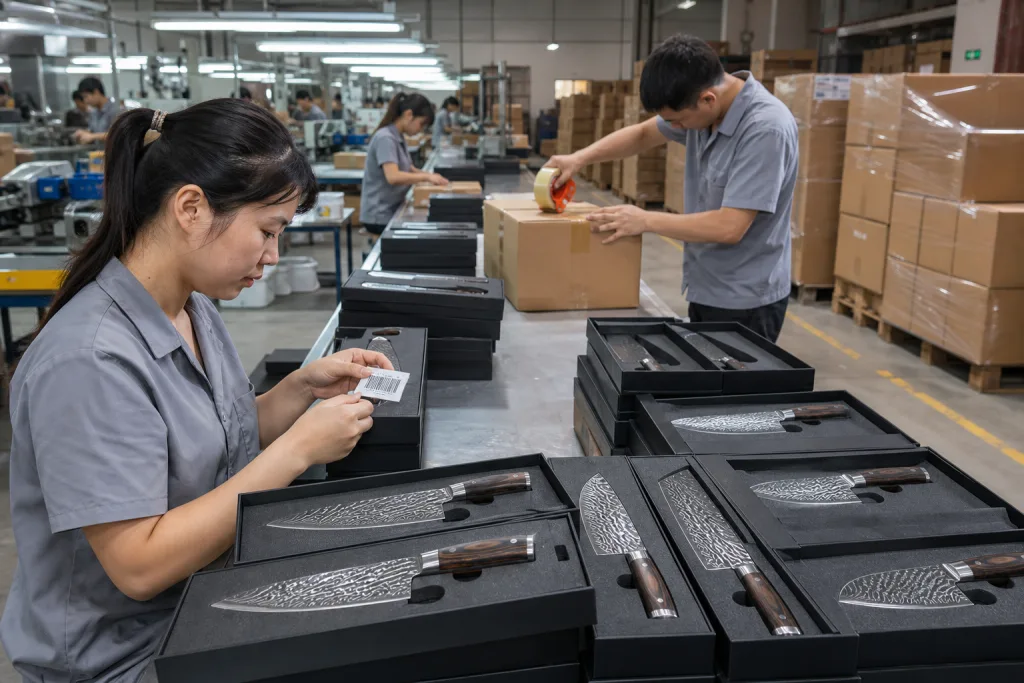
- Packaging type, including bulk pack, sleeve, color box, blister, sheath, display box, set box, insert card, barcode label, warning label if required, and carton mark.
- Inner carton quantity, export carton quantity, carton length, carton width, carton height, gross weight, and net weight, all with units.
- MOQ, quantity price tiers, sample fee, tooling fee if any, packaging plate fee if any, and artwork fee if any.
- Production lead time after deposit, artwork approval, and sample approval.
- Payment terms, Incoterm, named port or place, quotation validity date, and document list.
Incoterms should be written with the named port or place. EXW, FOB, CIF, DAP, and DDP are not interchangeable commercial offers. Ask the supplier or forwarder to state which costs are included and which remain outside the quoted unit price.
Example landed-cost control calculation to verify with a freight forwarder and customs broker: if the FOB unit price is **USD 4.20 per piece, example assumption for one private label kitchen knife quote dated 2026**, and estimated international freight plus destination handling is **USD 0.55 per piece, example assumption to verify by route, carton volume, shipment date, and destination**, then pre-duty landed cost would be **USD 4.75 per piece, example calculation only**. Duty, import restrictions, anti-dumping rules if applicable, product testing, brokerage, domestic delivery, and inventory financing require separate confirmation.
Packaging and Artwork Controls
The cited WOOKTOOL article notes that private label work requires confirmation of logo, color direction, packaging artwork, barcode, carton mark, and sample approval https://www.wooktools.com/blog/private-label-oem-or-bulk-hand-tools/. For a knife program, those controls should be frozen before mass production and checked against the approved sample and packing specification.
Packaging controls should include barcode scan requirement, SKU code, country-of-origin mark where required, warning label where required, insert card, color box material, hanging hole if any, sheath fit if any, master carton mark, carton dimensions, carton gross weight, and pallet pattern if palletization is required.
If packaging changes after the first quote, request an updated packing specification and freight estimate before approval. Confirm export carton dimensions and weights before shipment booking, not only after goods are packed.
Inspection and Compliance Controls
The approved sample, purchase order, artwork file, and packing specification should become the inspection reference. A knife inspection checklist can include blade length, blade thickness, handle fit, edge condition, surface finish, logo placement, packaging condition, barcode scan, carton mark, carton quantity, and quantity verification.
If the buyer uses an acceptable quality limit or sampling plan, it should be named in the purchase order before production starts. If carton-drop checks, corrosion checks, sharpness checks, hardness checks, food-contact tests, or retailer-specific protocols are required, the quote should state who performs them, which method applies, when they are performed, and who pays.
Do not treat a supplier's general export history as proof of compliance for a specific destination market. Kitchen knives, folding knives, outdoor knives, scissors, and multi-tools may face different import restrictions, labeling expectations, age restrictions, retailer rules, or food-contact requirements. If a supplier mentions a standard or certificate, request the current document, issuing body, scope, product model coverage, and expiry date. A standard's requirement is separate from a supplier's certified status.
RFQ Checklist for Private Label Knife Buyers
Use this checklist to keep suppliers quoting the same scope:
- Product category and intended channel.
- Reference model, buyer drawing, photo reference, or physical sample.
- Blade length, blade thickness, handle length, total length, and target weight with units.
- Blade steel, handle material, finish, coating, bolster, rivets, sheath, and set contents if applicable.
- Hardness target or other measurable performance requirement if needed, with test method and acceptable range.
- Logo file, logo method, logo size, logo location, color requirement, and approval standard.
- Packaging type, barcode, insert card, warning label if required, carton mark, and retail display requirement if any.
- First order quantity, target annual volume if known, number of SKUs, artwork versions, and requested price breaks.
- MOQ basis by model, SKU, size, handle material, logo version, packaging artwork, batch, or shipment.
- Sample fee, sample lead time, sample freight payer, number of sample rounds, and written approval record.
- Production lead time after deposit, artwork approval, and sample approval.
- Inspection checklist, sampling plan, defect definitions, packaging checks, barcode scan, and carton mark verification.
- Incoterm, named port or place, units per carton, carton dimensions, carton gross weight, net weight, and palletization requirement if any.
- Commercial invoice, packing list, certificate of origin if needed, test reports if required, and current certificates only where relevant.
- Tooling fees, artwork fees, packaging plate fees, replacement policy for confirmed defects, and charge rules for specification changes.
Methodology, Evidence Basis, and Limits
This article was prepared as an editorial sourcing guide by Vincent Xi, Editorial Author, using the named author profile as the approved byline basis https://tangforge.com/authors/vincent-xi/. No first-person factory visit, product test, supplier audit, customer outcome, certification, or buyer result is claimed.
Market-scale data points were taken from the supplied Chinese knife manufacturing guide, which cites OEC World, IndexBox, and China Daily through the supplied page https://leeknives.com/chinese-knife-manufacturers/. Sourcing-path and private-label workflow context came from the supplied WOOKTOOL and Sourcing Nova pages https://www.wooktools.com/blog/private-label-oem-or-bulk-hand-tools/ https://sourcingnova.com/products/wholesale-kitchen-knives/. Example calculations are labeled as assumptions to verify and are not presented as market prices, supplier quotes, or performance benchmarks.
The main limitation is that the cited sources do not prove any current supplier's MOQ, price, capability, certification, production capacity, compliance status, factory ownership, or delivery performance. Before placing an order, buyers should verify the supplier's business license, factory relationship, sample quality, material declarations, applicable test reports, packaging files, current certificates where required, inspection result, final carton data, and landed-cost estimate with a customs broker and freight forwarder.
Bottom Line for Buyers
A private label knife RFQ should make the supplier quote the whole program: blade, handle, logo, packaging, carton, inspection reference, documents, Incoterm, and change rules. Freeze the approved sample and packaging specification before mass production, then use carton data, inspection results, and landed-cost estimates to decide whether to scale the next order, add SKUs, or move toward deeper OEM development.