Chef Knife Wholesale Supplier Product Development Capability for United States Buyers
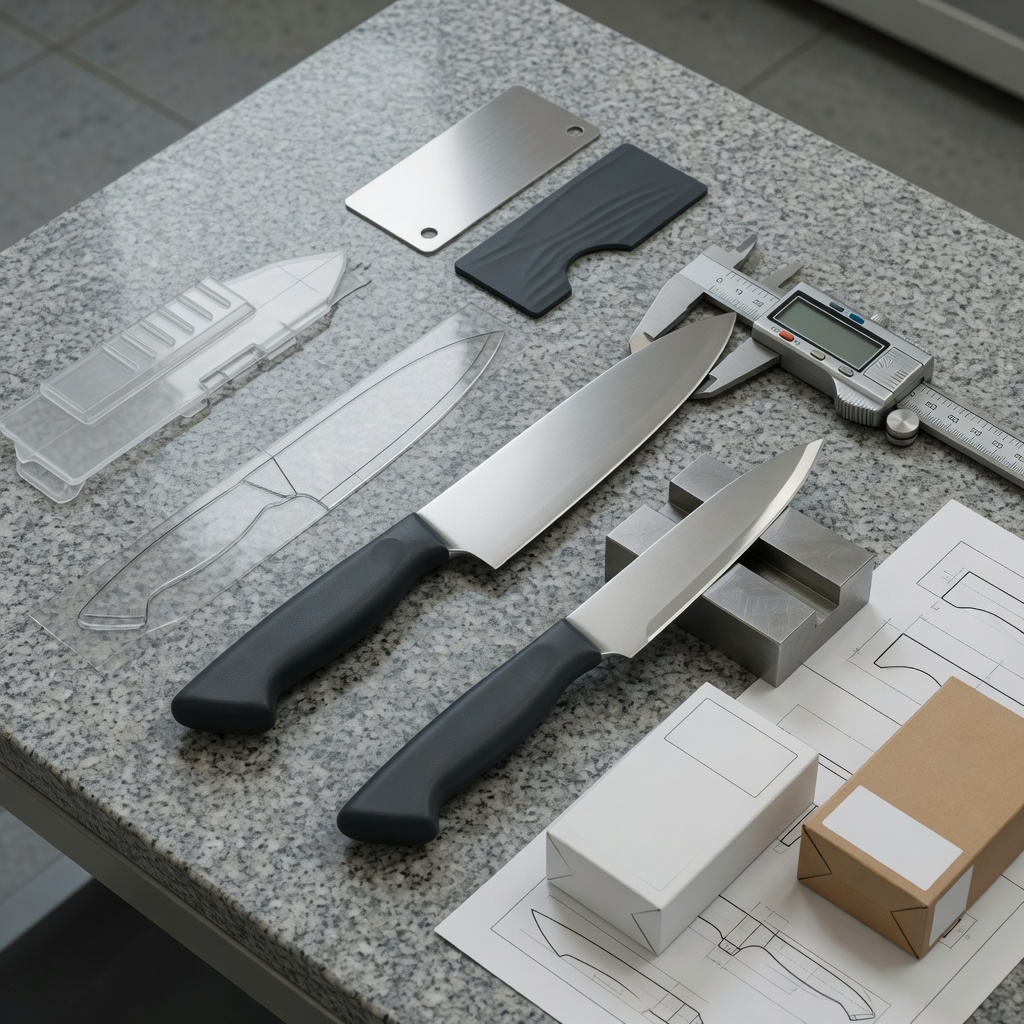
By Vincent Xi Editorial Author https://tangforge.com/authors/vincent-xi/
Decision answer: For United States B2B buyers, chef knife wholesale supplier product development capability is proven only when the supplier links the quotation, controlled drawing, bill of materials, sample record, packaging proof, quality plan, and delivery schedule to the same buyer SKU and revision. Commercial pages can identify useful RFQ questions, but they do not establish current capability for a quoted order. The supplied Fasaka article discusses customization and quality-inspection considerations, the Everwealth capability page self-describes a design-to-production workflow, and the LeeKnives sourcing guide describes private-label choices. Treat those statements as prompts for evidence—not as proof of capacity, material conformity, lead time, import readiness, or performance for a specific chef knife order.
Author basis: The TANGFORGE author profile identifies Vincent Xi as Editorial Author. This article does not claim a factory visit, product test, supplier audit, client outcome, certification, or first-person production experience.
Methodology: Explicit statements from the supplied commercial pages were mapped to RFQ evidence requests. Official United States sources were used only as review checkpoints for marking and tariff-classification work. Commercial statements were not converted into verified factory facts. All numerical specifications and costs below are labeled buyer-set hypothetical assumptions, and the provisional landed-cost total is arithmetic derived from those assumptions.
Limitations and verification: No publication or access date is supplied for the commercial pages, so recheck their content on the dated RFQ issue. For the quoted revision, verify the legal seller, manufacturing location, subcontracted operations, tooling status, design ownership, material designation, sample equivalence, current capacity, origin basis, proposed marking, tariff classification, freight inputs, duties or tariffs, and delivery dates. The official links do not determine order-specific origin, classification, duty treatment, or artwork acceptance without the transaction facts.
Evidence Context for the Supplier-Capability Decision
| Source context | Source-supported use | Evidence boundary |
|---|---|---|
| Author profile: Vincent Xi | Supports the visible byline and Person author data for Vincent Xi, Editorial Author | Does not support manufacturing, testing, auditing, certification, or customer-result claims |
| Commercial supplier-selection context: Fasaka | Supports RFQ questions about customization and quality inspection | Does not verify any supplier's current capability, capacity, material conformity, or order performance |
| Supplier first-party context: Everwealth | Describes demand analysis, CAD customization, proofing, mass production, and design or development services | Represents the company's own statements and is not an independent audit or an SKU-specific guarantee |
| Commercial sourcing context: LeeKnives | Supports RFQ fields for packaging, handle materials, logo application, and other private-label choices | Does not establish current tooling, order minimums, lead times, available capacity, or quality results for a supplier |
| Official United States marking reference: current eCFR country-of-origin marking text | Provides a review checkpoint for proposed country-of-origin marking on the buyer's recorded compliance-review date | Does not decide order-specific origin or approve an article or container layout without the manufacturing facts |
| Official United States tariff reference: current Harmonized Tariff Schedule resource | Provides a lookup checkpoint for classification review on the buyer's recorded classification-review date | Does not make an order-specific classification determination or validate a supplier's duty estimate |
United States Chef Knife Product Development Capability: RFQ and Award Gates
Each supplier response should identify the same buyer SKU, drawing revision, bill-of-materials revision, packaging revision, quotation reference, and sample reference. Require every field to be marked Conforms, Deviation, or Not offered; a blank field should not be treated as acceptance.
| Control gate | Supplier must return | Pass condition | Hold or decline when |
|---|---|---|---|
| Design translation and ownership | Dimensioned blade and handle drawing, bill of materials, finish definition, branding layout, package specification, design exceptions, drawing ownership, and tooling rights | The manufacturability response and quotation reference the same controlled revision and identify every proposed deviation | The response relies on a catalog image, model name, or unversioned quotation |
| Seller and manufacturing identity | Legal seller, invoice entity, manufacturing location, export entity if different, and subcontracted operations | The buyer can identify who is commercially responsible and where each material or process step is proposed to occur | The responsible entity, production site, or subcontracted scope remains unclear |
| Sample equivalence | Comparison of sample material, geometry, heat treatment, finish, handle construction, logo method, packaging, tooling, and process against the quoted production configuration | Every known difference is disclosed before approval, and measured results reference the controlled drawing | An appearance sample is presented as production evidence without an equivalence statement |
| Material, process, and quality control | Exact material designation, proposed process controls, hardness scale and target range, measurement locations, tolerances, cosmetic limits, sampling proposal, report format, and lot-traceability method | The supplier accepts the controls or returns measurable exceptions with methods, equipment, and record examples | Material remains generic, tolerance fields are blank, or unrelated documents are offered as SKU evidence |
| United States marking and packaging | Proposed origin and factual process basis, article and container artwork, application method, package construction, packed dimensions and weights, and production-representative proof | Buyer and importer-side reviewers approve the proposed marking basis and buyer-controlled artwork before production release | Origin is unresolved, artwork is deferred until production, or unsupported claims appear on the package |
| Landed-cost basis | Currency, trade term and named place, product price, order minimum, price breaks, tooling, samples, packaging, inspection, origin charges, packed shipment data, classification proposal, quote validity, and exclusions | Every input has a dated source, scope, owner, and revision so competing quotations can be normalized | Unit price cannot be separated from development, packaging, logistics, or import assumptions |
| Delivery and change control | Trigger-based milestones for drawing review, sampling, approval, production, inspection, cargo readiness, transport, and final delivery, plus an engineering-change process | Each milestone has an owner, dependency, planned date, and committed date when offered | The response gives only a general lead-time estimate or omits the effects of revisions and approval delays |
Product Development Capability Must Freeze the Chef Knife Specification
A supplier cannot quote or sample consistently if the buyer brief leaves critical fields undefined. The controlled development packet should cover:
- Project identity: Buyer SKU, intended United States sales channel, drawing revision, bill-of-materials revision, package revision, quotation reference, and authorized approvers.
- Development route and ownership: Buyer-controlled geometry or modification of a supplier platform, permitted design changes, drawing ownership, tooling ownership, storage, maintenance, replacement, and post-project access rights.
- Blade geometry: Profile datum, heel-to-tip measurement method, blade height, spine measurement stations, tip geometry, tang or bolster construction, grind, edge geometry, surface finish, and dimensional tolerances.
- Material and process: Exact blade-material designation, permitted equivalents, heat-treatment target, hardness scale and range, test method and location, finish process, coating if applicable, and requested material or heat-lot records.
- Handle and assembly: Material composition, color control, texture, fasteners, adhesive if used, assembly method, permitted substitutions, subcontracted processes, and inspection points.
- Branding and packaging: Logo method and location, artwork revision, blade protection, corrosion protection, unit package, retail package, shipping carton, origin-marking area, buyer-controlled product-code fields, and approved consumer-facing claims.
- Quality acceptance: Measurement method, equipment, calibration status, cosmetic defect definitions, sampling proposal, report fields, sample retention, nonconformance process, and lot traceability.
- Change control: Written approval before changes to material, geometry, finish, artwork, packaging, tooling, process, subcontractor, production location, cost, or schedule.
Buyer-Set Example Specification to Verify
Every value in the following table is a buyer-set hypothetical assumption for the same chef knife SKU. Each assumption applies only as of the buyer's dated RFQ issue and must be verified in the supplier's controlled quotation, drawing, and sample report. These values are not source findings, market norms, tested results, or product recommendations.
| Specification field | Example assumption | Scope, date context, and source control |
|---|---|---|
| Nominal finished blade length | 203.2 mm, with 8.0 in as the paired nominal reference | Buyer-set hypothetical assumption for this chef knife SKU as of the dated RFQ issue; verify the datum, accepted tolerance, drawing value, and finished-sample measurement |
| Spine thickness | 2.2 mm at a station 20 mm forward of the heel, with an illustrative tolerance of ±0.10 mm | Buyer-set hypothetical assumption for this chef knife SKU as of the dated RFQ issue; verify the measurement station, instrument, quotation acceptance, and sample result |
| Final edge geometry | 15 degrees per side, with an illustrative tolerance of ±2 degrees per side | Buyer-set hypothetical assumption for this finished chef knife SKU as of the dated RFQ issue; verify the sharpening process, measurement method, inspection point, and sample result |
| Blade and handle concept | Satin-finished stainless-steel blade with a dark molded polymer handle; exact alloy, resin, color control, texture, and substitution rules remain subject to approval | Buyer-set hypothetical material brief for this chef knife SKU as of the dated RFQ issue; verify exact material designations, process records, assembly method, and production-equivalence statement |
A manufacturability review may return measurable exceptions. Before approval, each exception should show its effect on tooling, sample configuration, quality controls, packaging, labeling, cost, and schedule.
The sample record should identify the controlled drawing and bill of materials, sample materials, tooling status, process route, packaging status, measured results, and known deviations. The quotation, package proof, quality plan, purchase order, and production release should cross-reference the same approved revision. Sample appearance approval should not be used to conceal a different production material or process.
United States Labeling and Packaging Outputs from Product Development Capability
On the buyer's recorded compliance-review date, review the proposed country-of-origin marking against the current eCFR country-of-origin marking text. The link is a review source, not evidence that a supplier's usual marking, existing artwork, or sample is acceptable for the order.
Require the supplier to return:
- The proposed country of origin and the manufacturing facts used for that proposal, including relevant production locations and subcontracted operations.
- Proposed marking locations and artwork for the knife, protective components, retail package, and shipping containers, subject to buyer and importer-side review.
- The intended application method, contrast, dimensions, permanence, and a production-representative marked proof or sample.
- A controlled label matrix separating legally reviewed fields, buyer-controlled brand fields, channel-required fields, and optional marketing claims.
- Buyer-assigned product codes where required by the selected channel; the supplier should not invent, reuse, or alter an unapproved code.
- Requested material, finish, coating, adhesive, handle, and packaging declarations showing the issuer, document date, scope, material reference, and SKU or lot mapping.
- Blade-point protection, corrosion protection, unit-pack construction, shipping-carton construction, measured dimensions, measured weights, and the identity and date of the package sample used for those measurements.
- Revision control for logos, colors, origin marking, product codes, warnings, package materials, and carton labels.
If a supplier cites a test, sampling standard, or trade rule, require the exact title, edition or date, stated scope, method, and related report. A standard governs only the scope stated in that document. A supplier's inspection checklist or work instruction is the company's own practice, not the standard itself. Do not describe a supplier, facility, product, process, or lot as certified unless a current document identifies the issuer, holder, site, scope, applicability, and validity period.
Landed Cost and Delivery Controls for United States Wholesale Supply
Normalize every quotation to the same chef knife revision, order quantity, package configuration, currency, trade term and named place, shipment method, United States destination, and quote-validity date.
| Input owner or evidence source | Dated input required for comparison |
|---|---|
| Supplier | Product price, order minimum, price breaks, tooling, sample charges, packaging, inspection charges, origin charges, payment terms, trade term and named place, quote validity, packed dimensions and weights, and proposed tariff classification |
| Freight provider | Routing, transport mode, international freight, insurance, destination charges, capacity assumptions, quote expiry, and the package data used for pricing |
| Customs broker or qualified adviser | Origin review, valuation inputs, classification analysis, estimated duty or tariff treatment, entry charges, and required documents as of the recorded classification-review date |
| Buyer | Final destination, inland transport, receiving, storage, inspection, corrective labeling, rework, returns, and channel-related cost assumptions |
Validate a supplier-proposed classification against the current Harmonized Tariff Schedule resource on the buyer's recorded classification-review date. Until importer-side review is complete, treat the proposed classification and related duty estimate as quotation inputs rather than confirmed order facts.
Provisional landed unit cost = quoted product price under the agreed trade term + allocated development or tooling cost + packaging + inspection + international freight + insurance + estimated duty or tariff + broker, entry, and port charges + inland delivery + buyer-defined correction or rework allowance.
Buyer-Set Landed-Cost Calculation to Verify
Every monetary value below is a buyer-set hypothetical assumption for the same chef knife SKU. The values apply only as of the buyer's dated quote-comparison review and must be replaced with current, scope-matched quotations. They are not supplier prices or market-rate claims.
| Cost line | Example assumption | Scope, date context, and source control |
|---|---|---|
| Quoted product price | US$12.00 per knife | Buyer-set hypothetical assumption for this chef knife SKU as of the dated quote-comparison review; replace with the supplier's quote for the controlled revision, quantity, package, trade term, and named place |
| International freight and insurance allocation | US$1.50 per knife | Buyer-set hypothetical assumption for this chef knife shipment as of the dated quote-comparison review; replace with a freight-provider quote based on approved packed dimensions, weight, route, and transport mode |
| Estimated duty or tariff allocation | US$0.90 per knife | Buyer-set hypothetical assumption for this chef knife import as of the dated classification review; replace with importer-side analysis tied to origin, value, current classification, and applicable treatment |
| Broker, port, and inland allocation | US$1.10 per knife | Buyer-set hypothetical assumption for this chef knife shipment as of the dated quote-comparison review; replace with broker, port, and inland-logistics inputs for the stated United States destination |
| Calculated provisional landed cost | US$15.50 per knife | Arithmetic sum of the preceding buyer-set assumptions for this chef knife SKU as of the same dated quote-comparison review; verify every component before award |
The calculation excludes tooling, samples, inspection, storage, corrective labeling, rework, returns, and post-entry adjustments. State explicitly whether each cost is included, excluded, or pending when comparing suppliers.
Delivery evidence should separate development, production, inspection, transportation, customs, and final delivery. Require a dated schedule that shows:
- The trigger, owner, dependency, and planned completion date for drawing review and the manufacturability response.
- Sample-production and dispatch milestones tied to approved files, materials, tooling, and applicable payment conditions.
- Buyer sample and artwork approval milestones, with production release blocked until written approval.
- Material release, production start, in-process inspection, final inspection, and cargo-ready milestones.
- Planned departure, arrival, customs, and final United States delivery dates, with planned dates distinguished from committed dates.
- A dated statement covering current capacity, material availability, tooling availability, and any capacity-reservation condition.
- The schedule effect of buyer revisions, failed samples, substitutions, inspection holds, package changes, or delayed approvals.
- Quantity-tolerance, partial-shipment, delay-notification, and recovery-plan terms.
Award Decision for the Quoted Chef Knife SKU
- Pass: The drawing, bill of materials, quotation, sample record, packaging proof, quality plan, and schedule reference the same controlled revision. United States origin-marking and classification reviews have named owners. Landed-cost inputs are dated and separable, and critical deviations are closed in writing.
- Conditional: Every remaining deviation is measurable, documented, priced, scheduled, and assigned an approval route before tooling or production release.
- Hold or decline: The supplier cannot link its quotation or sample to the controlled specification, leaves manufacturing origin or labeling unresolved, proposes undisclosed substitutions, relies on unsupported certification wording, or omits the cost and delivery evidence needed for comparison.
For a United States wholesale-supply award, product development capability means traceable control from the chef knife brief through specification, sample, packaging, marking, quality evidence, landed cost, and delivery—not the breadth of a supplier's marketing page.
Discuss Your Requirements
Review our manufacturing capabilities, then share your specifications for a supplier-fit review.