Chef Knife Wholesale Supplier Sample Approval for United Arab Emirates Buyers
By Vincent Xi, Editorial Author
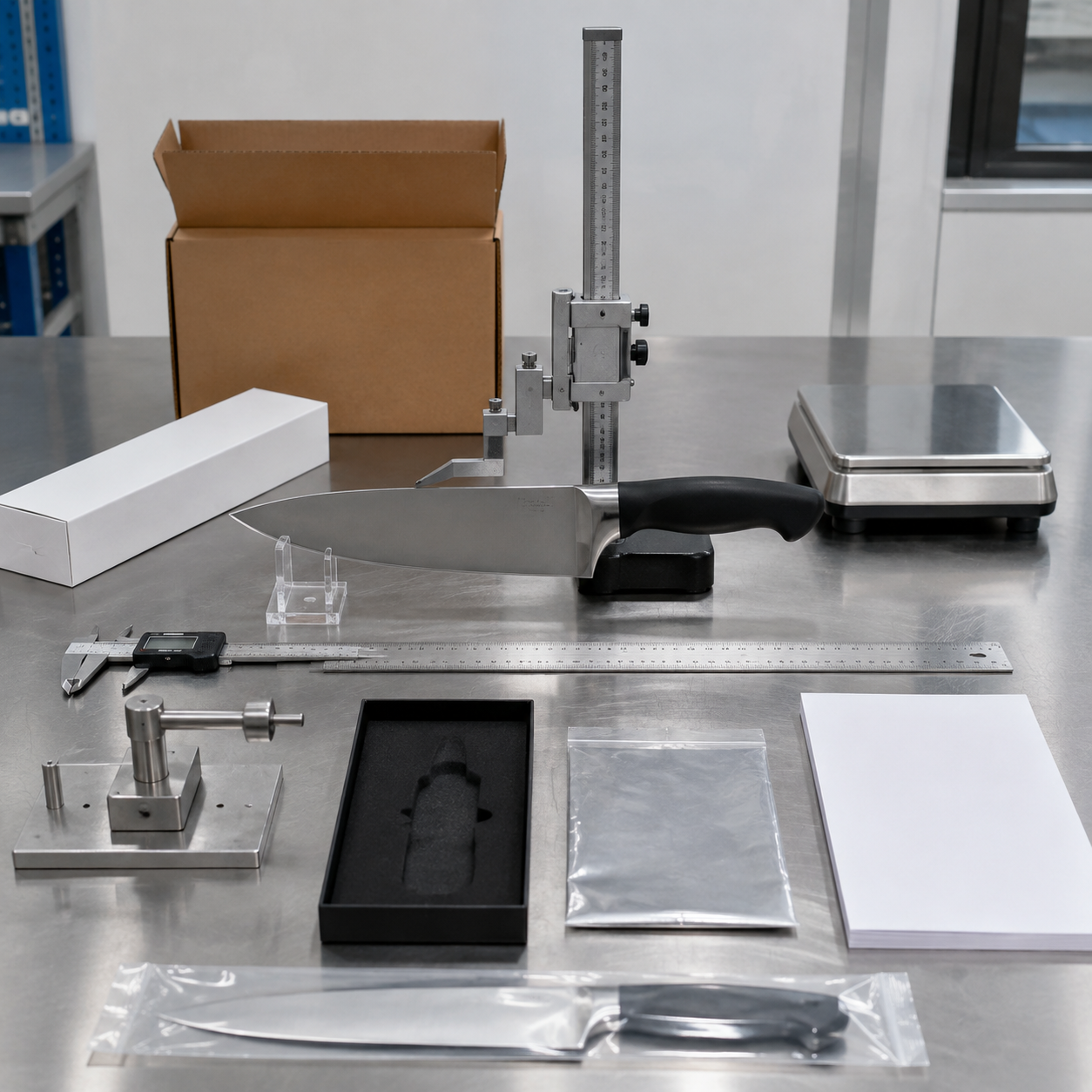
For a United Arab Emirates business buyer, chef knife wholesale supplier sample approval is the release point between an evaluated sample and a bulk commitment. Visual acceptance is not enough. Approve a sample only when its identifier, controlled specification, measured results, material declaration, packaging configuration, quotation revision, and proposed bulk controls describe the same chef knife.
Record the disposition as approved, approved subject to listed corrections, or rejected. A conditional approval should identify every open item, the evidence needed to close it, the responsible party, and the production hold. The purchase order should also state whether the controlled written specification or retained sample prevails if they conflict.
The workflow draws on separate sourcing contexts. Vast State places samples alongside product specifications, MOQ, landed cost, compliance review, inspection, packaging, and reorder planning (Vast State). Marketvalue connects reference samples with RFQ preparation, packaging notes, quality-control work, and export preparation (Marketvalue). These pages provide process context; they do not prove that a supplier, submitted sample, document, or production batch conforms.
Author note: The Vincent Xi profile identifies Vincent Xi as an Editorial Author. It does not document personal factory visits, product tests, client work, or customer outcomes, so this article makes no first-person experience claim.
United Arab Emirates Chef Knife Sample Approval File
Use the following as a buyer-defined release matrix for the chef knife configuration quoted for the United Arab Emirates order. It is not a claim that every supplier follows these controls.
| File section | Evidence to require | Approval hold |
|---|---|---|
| Program identity | Supplier legal entity, proposed manufacturing site, model reference, sample identifier, and RFQ, drawing, quote, artwork, and packaging revisions | Hold when identifiers or revisions conflict or cannot be traced |
| Sample status | Written classification as stock, modified catalog, prototype, or production-representative output, plus every expected difference from the bulk route | Hold when a difference in material, tooling, heat treatment, finishing, assembly, marking, or packaging could affect acceptance |
| Materials and construction | Exact blade-grade declaration, material-source declaration, heat-treatment declaration, handle-material declaration, internal construction, assembly method, and substitution policy | Hold when evidence is generic, unlinked to the sample, or permits an unapproved substitution |
| Measured configuration | Controlled drawing, target values, tolerances, datums, methods, tools, actual sample results, and deviation record | Hold when the priced configuration cannot be matched to measured results |
| Functional evidence | Sample identity, test purpose, preparation, conditions, method, raw results, acceptance rule, and responsible party | Hold when a pass statement lacks traceable results or the tested item does not match the submitted sample |
| Packaging | Complete individual pack, edge protection, inserts, packaging materials, artwork revision, carton arrangement, closure method, pack count, and measured shipping data | Hold when freight, protection, or landed-cost assumptions use a different package |
| Commercial basis | MOQ, price tiers, tooling and sample charges, currency, quote validity, payment terms, named trade rule and edition, origin point, and UAE delivery point | Hold when competing quotes use different configurations, quantities, packaging, or delivery scopes |
| UAE document review | Document register naming issuer, scope, model or material linkage, issue date, and validity where applicable, followed by review from the importer of record or another appropriately qualified UAE party | Hold until the required documents and their acceptability have been determined for the exact product and channel |
| Bulk control | Lot definition, inspection stage, defect classes, sampling basis, acceptance rules, traceability, change control, inspection access, and failure remedy | Hold when the purchase order does not connect bulk production to the approved specification and retained reference |
The signed approval record should name the accepted revision set, disposition, approved deviations, outstanding evidence, closure responsibility, and release status. Approval of artwork, packaging, or a laboratory result should not be treated as approval of the entire configuration unless the record explicitly joins those elements.
Practical RFQ Checklist for Chef Knife Sample Approval
Attach this checklist to the RFQ as a required supplier-response schedule. Require an entry, supporting document, or explicit exception for every item. A blank field should remain open and should not be interpreted as supplier agreement or sample approval.
- [ ] Identify the program: State the RFQ identifier and revision, United Arab Emirates destination, intended sales channel, requested order quantity, target delivery point, and quotation-validity requirement.
- [ ] Identify the contracting and manufacturing parties: Provide the supplier legal entity, quotation entity, proposed manufacturing site, and any planned subcontracted process that could affect the approved configuration.
- [ ] Classify the sample: State whether it is stock, modified catalog, prototype, or production-representative output. Assign a unique sample identifier and list every expected difference from bulk production.
- [ ] Confirm the product configuration: Return the model reference, controlled drawing revision, blade and handle declarations, dimensions, tolerances, finish, assembly, marking, included components, and intended packaging.
- [ ] Submit an exception sheet: List each departure from the RFQ in a line-by-line format. State the proposed alternative, reason, price or timing effect, and evidence required for buyer review.
- [ ] Provide material evidence: Supply the exact blade-grade declaration, handle-material declaration, material-source records offered for review, heat-treatment declaration, and written substitution policy. Link each document to the sample where its scope permits.
- [ ] Provide measured results: Report actual sample values against each controlled target and tolerance. Name the datum, measurement location, method, tool, sample identifier, and result disposition.
- [ ] Define functional evaluations: For every claimed test, state the purpose, preparation, conditions, method, raw-result format, acceptance rule, responsible party, and connection to the submitted sample.
- [ ] Quote the approved package: Describe the edge protection, individual pack, inserts, included components, artwork revision, master-carton arrangement, pack count, closure method, measured dimensions, net mass, and gross mass.
- [ ] Complete the commercial quotation: State MOQ, price tiers, currency, tooling charges, sample charges, payment terms, quote validity, named trade rule and edition, origin point, UAE delivery point, and included or excluded cost fields.
- [ ] Submit the document register: Name each document, issuer, issue date, validity where applicable, scope, and linkage to the product, material, manufacturing site, or batch. Do not replace document details with a general compliance statement.
- [ ] Propose bulk controls: State the lot definition, inspection stage, defect classes, sampling basis, acceptance rules, traceability method, change-control procedure, inspection access, failure handling, and remedy terms.
- [ ] Confirm approval restrictions: Acknowledge that sample approval applies only to the identified revision set and does not authorize unapproved changes to material, source, process, manufacturing site, tooling, subcontracting, finish, marking, or packaging.
The supplier response package should contain the completed checklist, signed exception sheet, controlled drawing, measurement report, material and test evidence, packaging specification, quotation, document register, and bulk-control proposal. The buyer's disposition record should identify the accepted revision set, retained-sample identifier, approved deviations, unresolved items, required closure evidence, responsible party, and whether production remains on hold.
Lock Measurable Specifications Before Sample Approval
The sample, RFQ, drawing, measurement report, packaging proof, and quotation should refer to the same configuration. Require the supplier to list exceptions rather than silently quote an alternative.
Changwen recommends requesting a written steel-grade designation and supporting mill documentation instead of relying on a generic stainless-steel description (Changwen). Treat this as a sourcing recommendation. Use a material document only for the material, batch, issuer, and scope it identifies; do not extend it to finished-knife conformity, food-contact suitability, UAE acceptance, or supplier certification.
The RFQ should supply the target and tolerance for each controlled characteristic. The cited sources do not establish universal chef knife dimensions or acceptance thresholds.
| Controlled characteristic | Unit or scale | Method definition | Sample approval evidence |
|---|---|---|---|
| Blade length and height | mm | Heel datum, tip endpoint, height station, measurement axis, and tool | Target, tolerance, actual result, sample identifier, and setup image |
| Spine thickness and taper | mm | Measurement stations and instrument contact method | Raw result at each named station |
| Blade straightness | mm deviation | Datum surface, support condition, measurement span, and gauge method | Maximum observed deviation and disposition |
| Edge geometry | degrees or mm, as specified | Bevel definition, side, measurement location, preparation state, and method | Raw measurements and agreed acceptance rule |
| Total mass and balance | g and mm from a named datum | Complete knife condition, scale or support method, and reference point | Recorded mass, balance location, and repeatable setup |
| Handle dimensions | mm | Length, width, thickness, measurement stations, and tool | Results linked to the drawing and sample revisions |
| Assembly and finish | Defined defect criteria | Viewing condition, finish reference, inspection method, and permitted limits | Disposition for alignment, joints, gaps, surface condition, and marking |
| Individual pack and master carton | mm and kg | Orientation, external measurement method, pack count, included components, net mass, and gross mass | Measured packed configuration used in the freight quote |
Descriptions such as premium balance, lightweight, sharp, durable, or corrosion resistant are not release criteria unless the RFQ defines a method, result format, preparation, and acceptance rule. Do not infer alloy grade, heat treatment, or internal handle construction from appearance.
Make Sample Checks Reproducible
For each agreed evaluation, record:
- The sample identifier and controlled specification revision.
- The purpose, claimed attribute, result format, and acceptance rule.
- The equipment or laboratory and responsible party.
- The preparation, conditioning, measurement location, environmental conditions, and sequence.
- The raw observations and results rather than only a pass statement.
- Any cleaning, sharpening, damage, or conditioning before another evaluation.
- The deviation, corrective evidence, and final disposition.
For a cutting check, define the test medium, medium condition, blade preparation, cutting motion, result format, and failure condition. For hardness evidence, define the scale or method, measurement location, surface preparation, raw result, and proposed production control. For corrosion or cleaning claims, define the agent, concentration, temperature, exposure duration, cleaning procedure, inspection method, and acceptance rule. For packaging, evaluate the complete approved pack under a route-relevant protocol selected by the buyer and qualified parties.
If the RFQ invokes a standard, identify its exact title, edition, scope, lot definition, defect classes, and decision rules. Apply the standard only within that stated scope. Do not imply that citing a standard certifies the chef knife, supplier, manufacturing site, or UAE market compliance. Verify any certification claim against a current document naming the holder, issuing body, site, product or process scope, and validity.
Use MOQ Evidence to Check the Sample Route
Source-reported MOQ data can help a buyer question whether the sample came from ready stock, catalog customization, or a route involving dedicated tooling. It does not establish quality, repeatability, capacity, or a current offer from another supplier.
- In its January 2025 publication context, Wholesale Chef Knife reported 200 pieces per custom-design scope (Wholesale Chef Knife). This is a source-published program claim, not a TANGFORGE term or market-wide benchmark.
- For its 2026 buying-season scope, Changwen reported 500-1,000 units per SKU for standard catalog programs (Changwen). The range applies only to the source-described program and date context.
- In the same 2026 buying-season source context, Changwen reported 10,000 units per custom-handle-mold or proprietary-profile scope (Changwen). This figure does not establish another supplier's MOQ, tooling requirement, or current capacity.
Verify the applicable MOQ, tooling ownership, price break, material route, process, sample charge, and quote validity in the current supplier quotation. Ask the supplier to state whether the submitted sample used the quoted bulk tooling, materials, heat treatment, finishing, assembly, marking, and packaging. If it did not, keep approval conditional until the differences and replacement evidence are documented.
United Arab Emirates Quote and Document Holds Before Sample Approval
The supplied evidence does not establish a fixed UAE customs classification, duty, tax treatment, labeling requirement, food-contact obligation, or import restriction for the proposed chef knife. Those determinations depend on the exact product, materials, packaging, importer, destination, and sales channel. Confirm them with the importer of record and appropriately qualified UAE customs, legal, testing, or regulatory parties before releasing the purchase order.
Keep sample approval conditional until the quotation and landed-cost worksheet use the same knife configuration, packaging, quantity basis, origin point, delivery point, and named trade rule. Separate the applicable fields for product price, tooling, branding setup, samples, testing, inspection, packaging, origin handling, international freight, insurance, UAE clearance, duties and taxes where applicable, brokerage, payment costs, local delivery, and agreed remedies.
Use the following only as an example calculation structure to verify in the supplier quote and with qualified UAE parties:
Landed cost per saleable unit = verified total of applicable landed-cost fields / confirmed saleable quantity
This structure is not a quoted cost, customs classification, duty rate, tax result, or delivery promise.
Do not finalize freight comparison from a loose knife or provisional package. Require measured individual-pack and master-carton dimensions, net mass, gross mass, pack count, loading assumptions where relevant, delivery point, and quote validity for the approved package. Treat a packaging revision as a controlled change requiring renewed review of protection, shipping data, landed cost, and affected documents.
Carry Sample Approval Into Bulk Production
Retain the approved sample under an identifier linked to the signed specification, drawing, measurement report, photographs, test evidence, packaging proof, quotation revision, and deviation record. Reference that approval set in the purchase order.
Require written authorization before changing material, source, process, manufacturing site, tooling, subcontracting, finish, marking, or packaging. Define how the supplier will connect material records, finished batches, cartons, retained samples, and inspection results.
Set defect classes and remedies for the quoted configuration. Buyer-defined examples may include an incorrect material declaration, an unprotected edge, loose assembly, geometry outside the agreed tolerance, unacceptable finish, incorrect marking, a missing component, or damaged packaging. The buyer and supplier must assign classifications, sampling rules, reinspection terms, and remedies in writing; these examples are not universal classifications.
Use the retained sample for the comparisons it can support, such as appearance and workmanship. Require separate traceable evidence for hidden composition, heat treatment, internal construction, and other attributes that visual comparison cannot establish. Likewise, do not use a material or laboratory document as a substitute for checking whether bulk dimensions, assembly, finish, marking, and packaging match the approved configuration.
Evidence Methodology and Limitations
Methodology: Source statements were separated into sourcing-process context, supplier-published program data, and author-profile evidence. Vast State supplied context connecting samples with specifications, MOQ, landed cost, compliance review, inspection, packaging, and reorder planning. Marketvalue supplied a separate context connecting reference samples with RFQ, packaging, quality-control, and export-preparation work. Changwen supplied a recommendation for written steel-grade identification and date-scoped MOQ claims. Wholesale Chef Knife supplied a separate private-label MOQ and sampling context. The Vincent Xi profile supported only the visible author identity and role. Numerical MOQ claims were retained with their unit, program scope, source, and publication or buying-season context; they were not averaged, generalized, or transferred to another supplier.
Limitations and verification: The cited sourcing and supplier-published pages are not independent factory audits, current quotations, batch test reports, shipping measurements, or UAE legal determinations. They do not establish any supplier's current MOQ, price, capacity, lead time, certification, compliance status, test result, bulk conformity, or customer outcome. Verify each current document with its issuer, connect evidence to the exact model, material, manufacturing site, and batch, and confirm UAE requirements with qualified local parties. Keep release conditional unless the quoted bulk program uses the approved configuration under written change control, traceability, inspection access, and an agreed remedy plan.
Discuss Your Requirements
Review our manufacturing capabilities, then share your specifications for a supplier-fit review.