Chef Knife Wholesale Supplier: Sustainability Sourcing Criteria
Byline: Vincent Xi, Editorial Author
United States B2B buyers should apply sustainability sourcing criteria to the exact chef knife SKU and the environmental claims included in its wholesale supply offer. General statements about a producer’s recycling practices do not establish the content of the knife being quoted.
Start with an agreed drawing and bill of materials. Identify the evidence needed for each proposed claim, compare prices for the same configuration, and define the United States delivery point. Make document acceptance part of the purchase order rather than a request after dispatch.
The controls below are buyer-defined RFQ proposals, not verified statements about a supplier’s products or operations.
United States sustainability sourcing criteria for supplier approval
Use a claim register to keep product evidence, mill averages, site certificates, and future targets separate. For each proposed statement, record the SKU and revision, component boundary, metric and unit, denominator, reporting period, issuer, document identifier, verification date, production linkage, and approved wording.
Apply these award decisions consistently:
- Approve when the evidence supports the offered configuration and the precise claim wording.
- Hold when required documents, calculation details, or material-to-order links are missing.
- Request a claim-free quote when the knife meets the specification but a voluntary environmental statement cannot be supported.
- Reject when the supplier refuses agreed traceability, substitution approval, or acceptance controls.
Removing a voluntary environmental claim does not resolve missing import records, incorrect origin marking, or a physical specification failure.
Blade evidence and the whole-knife claim denominator
Alleima’s April 2024 knife-industry article provides dated, producer-published context. It is not evidence that the quoted chef knife contains that producer’s material or achieves a published recycled-content figure.
Require the intended mill, blade grade, and applicable declaration. The declaration should identify the covered material and component, percentage denominator, reporting period, treatment of pre-consumer and post-consumer inputs, calculation method, and reporting scope. Ask how material covered by the declaration will be linked to the production order and shipment.
If a declaration reports a grade or site average, preserve that qualification in the approved wording. A lot identifier can provide a documentary link; it does not convert an average into a lot-specific measurement. Likewise, descriptions of scrap recovery or furnace efficiency are not substitutes for evidence supporting the proposed recycled-content claim.
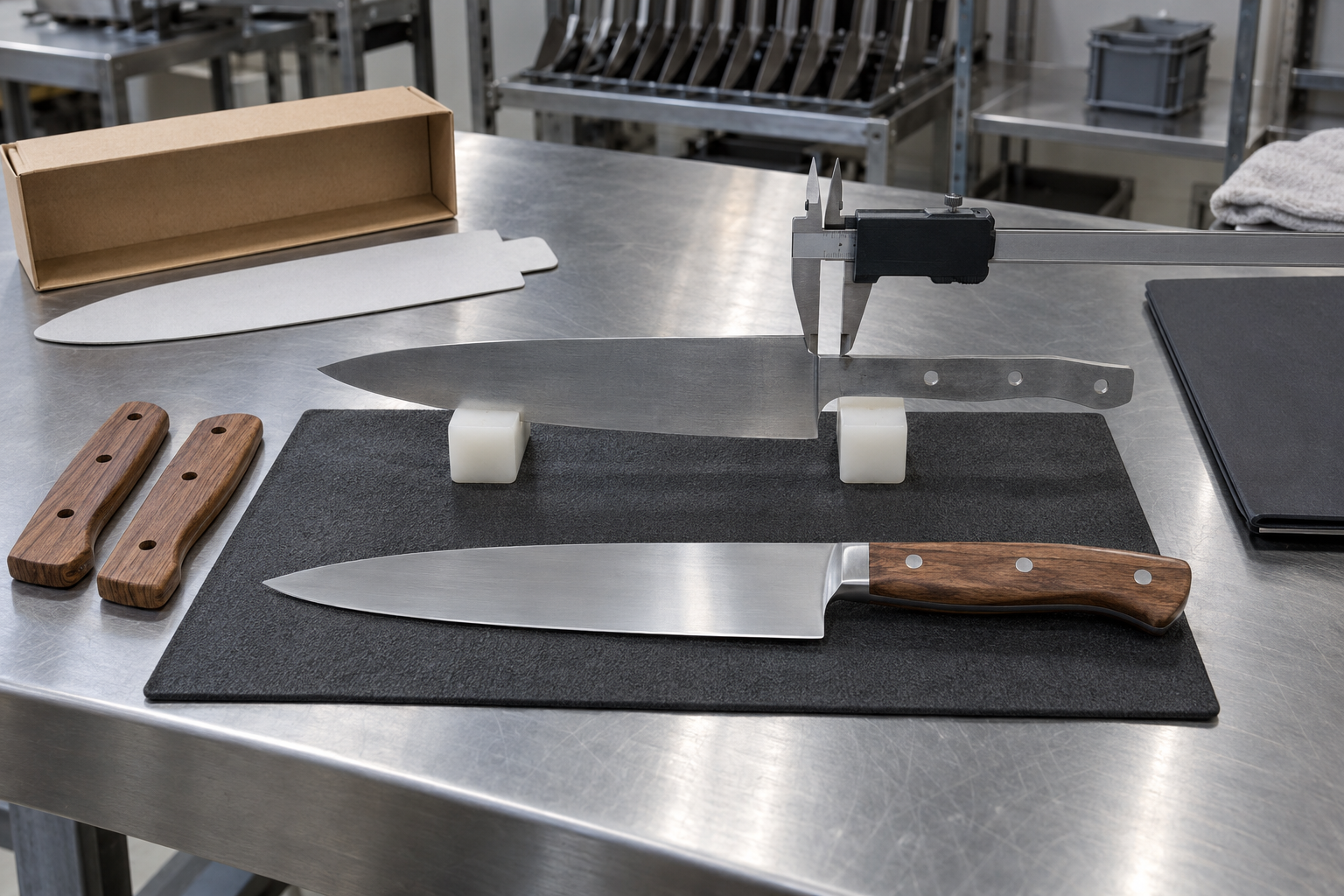
Approve a drawing and bill of materials covering blade grade, length endpoints, spine-thickness measurement location, component masses, handle composition, hardware, coatings, adhesives, and packaging. Set tolerances and inspection methods separately from nominal dimensions.
Example RFQ assumptions—not supplier specifications
Every value below is an example quotation-stage assumption to verify in the supplier quote and supporting records. The example describes a full-tang chef knife with an uncoated stainless-steel blade and hardwood handle scales. It is not measured production data or evidence of supplier capability.
| Item | Example RFQ assumption | Approval check |
|---|---|---|
| Blade length | 200 mm from heel to tip | Confirm drawing endpoints and the agreed tolerance |
| Spine thickness | 2.5 mm at a drawing-defined station near the heel | Confirm the station, measurement method, and tolerance |
| Blade and integral tang mass | 180 g per knife | Confirm the component boundary and mass basis |
| Handle, fasteners, and adhesive mass | 60 g per knife in total | Confirm composition and complete component masses |
| Blade-and-tang recycled fraction | 80% by mass, assumed only for this example | Obtain a declaration with a matching material scope and calculation basis |
Example calculation only—verify all inputs in the supplier quote and records. Assume no recycled content is credited to the handle, fasteners, or adhesive:
- Assumed recycled mass in the blade and tang: 180 g × 80% = 144 g per knife.
- Assumed assembled-knife mass: 180 g + 60 g = 240 g per knife, excluding packaging and any sheath.
- Hypothetical assembled-knife recycled fraction: 144 g ÷ 240 g = 60% by mass.
The example shows why a blade percentage cannot simply become a whole-knife percentage. It does not authorize label wording. Any finished-knife calculation needs verified component inputs and a method consistent with the applicable declarations.
Check handle, packaging, and site claims separately
For hardwood or other plant-based handles, request material identity, botanical species, harvest country, and quantity information for the sourcing and import review. If certified wood is offered, obtain the current certificate, covered entity and material scope, and transaction evidence supporting the claimed input. A certificate for a different entity or material does not substantiate the proposed claim.
For polymer or resin-stabilized handles, request composition information relevant to the environmental wording and substance assessment. Keep coatings and adhesives in the bill of materials rather than treating them as unspecified accessories.
Specify cartons, cushioning, blade protection, and plastic packaging components individually. Review evidence for each proposed recycled-content, degradation, or compostability statement. Where substantiation is unavailable, remove the statement from both the quote and artwork; packaging appearance is not evidence.
ISO 14001 specifies requirements for an environmental management system. A certificate to that standard is not a product-specific recycled-content declaration or per-knife carbon result. If certification is claimed, verify the issuing body, legal entity, producing site, scope, and validity. This is a buyer verification control, not a statement that TANGFORGE or another supplier holds certification.
If social-audit claims affect the award, request the producing-site report, audit date, relevant findings, and corrective-action status. Identify the actual manufacturing route and applicable subcontractors rather than assuming every chef knife is forged.
United States labeling and import approval for the quoted SKU
Keep environmental copy approval separate from import and labeling checks. Review the actual knife configuration, materials, origin, packaging, and distribution plan against requirements applicable on the import date.
- Environmental wording: Use the FTC Green Guides to review substantiation and qualification of environmental marketing claims. Approve wording that makes clear whether the claim covers the blade, another component, the assembled knife, or packaging.
- Country-of-origin marking: Ask a licensed customs broker to review the special knife-marking provisions in 19 CFR 134.43, including the proposed method, location, origin wording, and any applicable exception. Approve sample marking before production; do not presume carton-only marking or a removable tag is sufficient.
- Plant-based handles: Check the product form and classification against APHIS Lacey Act guidance. Have the broker identify any required declaration and supporting plant-material information. A certified-wood claim does not itself resolve filing requirements.
- Forced-labor due diligence: Use CBP’s UFLPA guidance with the broker to define the input and processing-site records needed for the proposed supply chain. Set that document list before ordering rather than relying only on final assembly information.
- California distribution: If distribution includes California, request relevant substance and exposure information for a product-specific assessment using Proposition 65 business guidance. Have qualified counsel determine whether a warning is required before approving artwork.
Buyer approval of documents or labels does not guarantee customs clearance.
Compare supported offers on landed cost and delivery gates
Compare the same chef knife configuration, supported claim scope, packaging, order quantity, and named United States delivery point. Where an environmental premium is quoted, require the corresponding material, documentation, or verification charge to be itemized. Agree the remedy if its supporting evidence is not delivered or accepted.
For buyer quote comparison—not customs valuation—use:
Landed cost per ordered knife = (goods + separately payable packaging + documentation + inspection + freight + insurance + duties and other import charges + brokerage + destination handling + inland delivery) ÷ ordered knife quantity.
Count each charge once and identify what the quoted trade term includes. Record currency, quote validity, exclusions, and any exchange-rate basis. Use the same ordered-quantity basis across offers, then evaluate shortages and rejected units under the agreed remedies.
Have the broker confirm classification, customs valuation, origin, and applicable duty or charge inputs for the actual order. No tariff rate, market price, or supplier lead-time estimate is supplied here. If Incoterms are used, state the rule, named place or port, and edition; separately identify the importer of record and responsibility for clearance and destination charges.
| Order milestone | Required approval or commitment |
|---|---|
| Before deposit | Complete quote, proposed material evidence and claim wording, producing entities, document deadlines, and remedies |
| Before production | Approved sample, drawing, bill of materials, environmental artwork, origin-mark approach, and written substitution controls |
| Before cargo pickup | Accepted required production records, material-to-order links, packing list, marking evidence, and claim-specific transaction documents; written dispatch authorization |
| At receipt | Quantity and drawing checks under the agreed inspection plan, shipment-identity verification, and separate acceptance of claim documentation |
Request production lead time in calendar days from a named approval milestone. Obtain separate goods-ready and document-ready deadlines, the transit basis, and the United States delivery window. Define how document delays or buyer-approved changes affect the schedule.
Keep physical quality acceptance distinct from sustainability-evidence acceptance. A satisfactory sample does not resolve missing production records; each failure type needs an agreed correction, replacement, rejection, or credit remedy.
RFQ Checklist
Send these requirements with the chef knife drawing and require accepted responses and documents to become part of the purchase-order file.
- Specify the SKU, revision, order quantity, minimum order quantity, blade dimensions and measurement locations, component masses, tolerances, and inspection methods.
- Require the supplier to identify the blade grade and intended mill and provide the proposed recycled-content declaration, component scope, denominator, reporting period, pre-consumer and post-consumer treatment, calculation method, reporting scope, and material-to-order linkage.
- Ask the supplier to identify producing entities and subcontractors for the applicable forming, heat-treatment, grinding, handle-production, and assembly operations, with the input and production records needed for United States due diligence.
- Specify handle composition and, for plant-based inputs, species, harvest country, and quantity information; require current certificates and transaction evidence only where a certified-material claim is offered.
- Require the supplier to substantiate each packaging claim separately and submit the exact environmental wording for approval; remove unsupported statements from the quote and artwork.
- Ask the supplier to provide current site-scoped certificates or audit records where those claims affect the award, including covered entity, scope, validity or audit date, and relevant corrective-action evidence.
- Require the manufacturer to submit the proposed country-of-origin marking method and sample evidence for broker review, plus relevant handle, coating, and adhesive composition information for the buyer’s substance assessment.
- Ask the supplier to itemize quoted goods, packaging, documentation, inspection, and logistics charges and state currency, quote validity, exclusions, trade term, edition where applicable, named United States delivery point, and import responsibilities; obtain duty and valuation inputs from the broker separately.
- Specify approval milestones, calendar-day production lead time, goods-ready and document-ready deadlines, delivery window, carton quantities, and shipment weights; prohibit dispatch before written buyer authorization.
- Require production to match the approved sample and material specification, with written approval and replacement evidence before substitutions; agree receiving checks and remedies for shortages, physical nonconformance, unsupported claims, and missing traceability.
Evidence method and what to verify
Method: Sources are separated by purpose. Alleima’s dated article supplies producer-published context; ISO explains the environmental-management-system context; the linked official United States pages support regulatory review. Goldsun’s manufacturing discussion and Fobsourcify’s wholesale sourcing guide are contextual commercial sources, not shipment declarations, producing-site audit findings, or proof of TANGFORGE practices.
The worked example multiplies an assumed blade-and-tang mass by an assumed recycled fraction, then divides that result by the assumed assembled-knife mass. Packaging and any sheath are excluded. No published producer percentage is presented as a current supplier specification.
Limitations and verification: These sources do not establish TANGFORGE’s product specifications, recycled content, certifications, audit status, prices, or delivery capability. Verify document authenticity and current status with the relevant issuer, then confirm entity, site, material scope, reporting period, calculation basis, shipment linkage, and approved wording. Have a licensed customs broker and qualified compliance counsel confirm requirements for the actual configuration and distribution before shipment authorization.
Discuss Your Requirements
Review our manufacturing capabilities, then share your specifications for a supplier-fit review.