Damascus Knife Sourcing Quality Control Inspection for Malaysia
By Vincent Xi, Editorial Author
For Malaysian B2B buyers, a damascus knife sourcing quality control inspection should answer one procurement question: does the shipment-ready lot conform to the signed specification closely enough to release? The RFQ and purchase order should define the blade construction, declared steels, dimensions, workmanship limits, test methods, sampling rules, packaging, evidence, and failure disposition before production begins.
The release file should connect the approved specification revision and reference sample to the inspected SKU and production lot. It should include lot-linked material records, individual inspection results, packing evidence, approved deviations, and an authorized disposition. Development samples and supplier photographs can support product approval, but they do not establish conformity of the finished shipment lot.
Product conformity and Malaysian import readiness are separate decisions. No official Malaysian customs or regulatory source was supplied for this article. Before purchase-order release, the buyer should ask a qualified Malaysian customs broker or regulatory adviser to confirm the current classification, import conditions, labeling, taxes, and document requirements for the exact product and transaction.
Author basis: TANGFORGE identifies Vincent Xi as an Editorial Author. The supplied profile does not document first-hand factory visits, product inspections, knife testing, certifications, or customer outcomes, so this article makes no such experience claim.
Malaysia Quality Control Inspection Release Gates
The following is a buyer-defined procurement framework. It is not presented as Malaysian law, a published standard, a certification requirement, or the operating practice of TANGFORGE or any named supplier.
| Release gate | RFQ or purchase-order control | Required lot evidence | Hold condition |
|---|---|---|---|
| Contract baseline | Controlled drawing, specification revision, approved-sample reference, and document hierarchy | Supplier sign-off and an inspection report naming the same SKU and revision | Missing revision, conflicting documents, or an unapproved substitution |
| Material and construction | Written construction description and the identity of every steel claimed for that construction | Material records linked to the work order and finished lot, plus any buyer-approved verification | Generic steel wording, unrelated records, or broken lot traceability |
| Dimensions and workmanship | Nominal dimensions, tolerances, measurement datums, viewing conditions, defect limits, and methods | Individual readings, observations, photographs, and instrument identification | Missing readings, an individual failure, or an average that obscures failed units |
| Sampling and tests | Lot definition, selection method, sample allocation, defect classes, test methods, and acceptance rules | Carton and unit selection record, test results, and signed disposition | Supplier-selected display samples, incomplete lot access, or undefined acceptance rules |
| Packaging and traceability | Edge and tip protection, pack fit, carton configuration, batch coding, and approved moisture controls | Pack-out results, quantity reconciliation, and lot-to-carton linkage | Product movement, inadequate protection, wrong assortment, or lost traceability |
| Malaysia document review | Document schedule confirmed by the buyer's qualified local adviser | Documents checked against the locally confirmed schedule | Missing, inconsistent, expired, or unverified documents |
A product inspection pass should not be treated as import clearance. Complete shipping documents should not be treated as proof that the knives conform to the contracted specification. The purchase order should state which approvals are required before shipment and any linked balance payment can be released.
Define an Inspectable Damascus Knife Specification
The cited Nothing But Knives article describes modern Damascus as pattern-welded steel made from maker-selected steel combinations. That context supports requesting a written construction statement. It does not establish that the term Damascus identifies one steel grade, layer arrangement, heat treatment, hardness, or performance level (Nothing But Knives).
Replace descriptive sales language with controlled quotation fields:
| Specification field | Buyer definition | Required supplier response |
|---|---|---|
| Product identity | SKU, intended commercial use, drawing revision, and approved-sample reference | Exact offered SKU and a complete deviation list |
| Blade construction | The required layered, pattern-welded, core-and-cladding, or other defined arrangement | Written construction description and available supporting evidence |
| Steel identity | Every cutting-core, cladding, or billet grade claimed for the selected construction | Written grade declarations and available lot-traceable material records |
| Blade dimensions | Length datums, profile, spine-thickness locations, straightness method, grind, edge geometry, nominal values, and tolerances | Offered values with units and tolerances |
| Heat treatment | Required process declaration, hardness target, tolerance, scale, test location, preparation, and sample allocation | Offered range, method, location, and reporting format |
| Pattern and finish | Approved visual range, viewing conditions, surfaces, and limits for pits, scratches, uneven patterning, cracks, or exposed weld defects | Representative sample and written cosmetic exceptions |
| Handle assembly | Material, dimensions, alignment, permitted gaps, fastener condition, finish, and integrity-test method | Construction details, declared materials, and proposed method |
| Edge performance | Test medium, sample preparation, procedure, endpoint, and pass limit | Test capability, sample allocation, and reporting method |
| Corrosion performance | Buyer-supported exposure conditions, method, and acceptance criteria where this risk is material | Proposed method and disclosed care, storage, or material limitations |
| Packaging | Edge and tip protection, movement limits, inner pack, carton arrangement, traceability, and any approved moisture strategy | Pack specification, materials, restrictions, and quotation exceptions |
The approved sample should supplement the written specification, not replace it. Its approval record should identify exactly what it controls, such as pattern range, handle appearance, balance, finish, or packaging presentation. The purchase order should also state which document prevails if the drawing, specification, order text, and sample conflict.
A measurement schedule should name each characteristic, datum, measurement location, instrument type, unit, nominal value, individual tolerance, sample allocation, and recording rule. Each exact value should come from an identified source or be labeled as a buyer assumption that must be verified in the supplier's signed quotation, controlled drawing, inspection plan, and approved sample.
Use Source Data Without Turning Examples Into Requirements
The cited figures provide limited sourcing context. None is a universal Damascus knife specification, quality threshold, market norm, or current supplier quotation.
| Source-reported data point | Unit, scope, displayed date, and source | Appropriate RFQ use |
|---|---|---|
| 46 layers per named-model blade | The unit is layers per blade for the Oishya Sakai Kyuba Gyuto model described by Nothing But Knives on a page displaying May 11, 2021. This is a model-specific construction description (Nothing But Knives) | Require any layer count to be tied to a named construction and SKU; do not treat the count alone as performance evidence |
| 8-10 inches, also stated as 20-25 cm, of blade length | The units are inches and centimeters for a retail chef-knife category range described by Rice Knife on a page displaying October 22, 2024. It is not an RFQ tolerance or a proposed product dimension (Rice Knife) | Use only as category context while the buyer defines the SKU's actual datum, nominal length, and permitted variation |
| 500-1,000 units per SKU | The unit is finished units per SKU for standard catalog products with OEM branding, as stated by Changwen on a page displaying July 3, 2026. It is a source-specific commercial statement, not a market-wide MOQ or current offer (Changwen) | Ask each bidder to return its current MOQ, branding conditions, validity period, tooling assumptions, and quantity breaks in a signed quotation |
The displayed dates are source context, not evidence that the statements remain current. Reconfirm every commercial figure and product-specific value before relying on it in a Malaysia-bound purchase order.
Require Lot-Linked Steel and Construction Evidence
The Changwen page advises buyers to obtain the specific steel grade in writing and request mill certificates instead of accepting a generic stainless-steel description. This is a source-reported procurement recommendation, not proof that a finished knife contains the declared material (Changwen).
The RFQ should ask the supplier to explain how an incoming material record will be linked through the work order to the finished shipment lot. A document for an unidentified or unrelated batch should trigger a hold until traceability is restored or buyer-approved verification resolves the issue.
| Stage | Evidence to request | Buyer decision |
|---|---|---|
| Quotation | Completed specification response, deviations, material declarations, test capability, MOQ, tooling, and separated charges | Compare offers only after aligning their scope |
| Before production | Signed specification, approved product and packaging samples, defect catalogue, inspection plan, and report template | Authorize production after exceptions are resolved |
| During production | Material receipt records, work-order identity, agreed checkpoints, inspection results, and correction records | Contain affected material and approve the response before continuation |
| Pre-shipment | Shipment-lot identity, random-selection record, individual results, photographs, packing evidence, and disposition | Pass, fail, or issue documented conditional approval |
| After sorting or rework | Affected quantity, rework method, replacement traceability, and agreed reinspection result | Release the changed lot only against the new result |
The order should require notice before changes to declared steel, heat treatment, tooling, construction, production site, approved subcontractor, handle material, finish, or packaging. It should identify which changes require a new sample, repeated test, revised risk review, or written buyer approval.
Set Sampling Before Production
The UFamcooks article describes written payment milestones, third-party pre-shipment inspection, and sampling under an agreed AQL plan as sourcing safeguards. These are source-reported commercial practices, not evidence that a particular supplier, sample plan, or shipment conforms (UFamcooks).
That source does not identify a sampling-standard title, edition, inspection level, AQL value, sample size, or acceptance number for Damascus knives. The contracting parties should define:
- The production-lot and shipment-lot boundaries.
- When the lot is sufficiently complete and packed for inspection.
- Who selects cartons and units and how selection is recorded.
- Which checks are visual, dimensional, functional, or destructive.
- The sample allocation for each check and the disposition of tested units.
- Buyer-defined critical, major, and minor defect classes.
- Acceptance and rejection rules for each defect class.
- Any characteristics requiring inspection across the full lot.
- The effect of inaccessible cartons, mixed lots, missing tests, or incomplete packing.
- Containment, sorting, rework, replacement, and reinspection after a failure.
If the contract invokes a published sampling standard, it should identify the exact title, edition, inspection level, lot size, sample size, defect limits, and acceptance and rejection numbers. The standard's requirements must be distinguished from the buyer's additional product rules and the supplier's internal inspection practice. Use of a sampling plan does not imply certification.
Record Individual Inspection Results
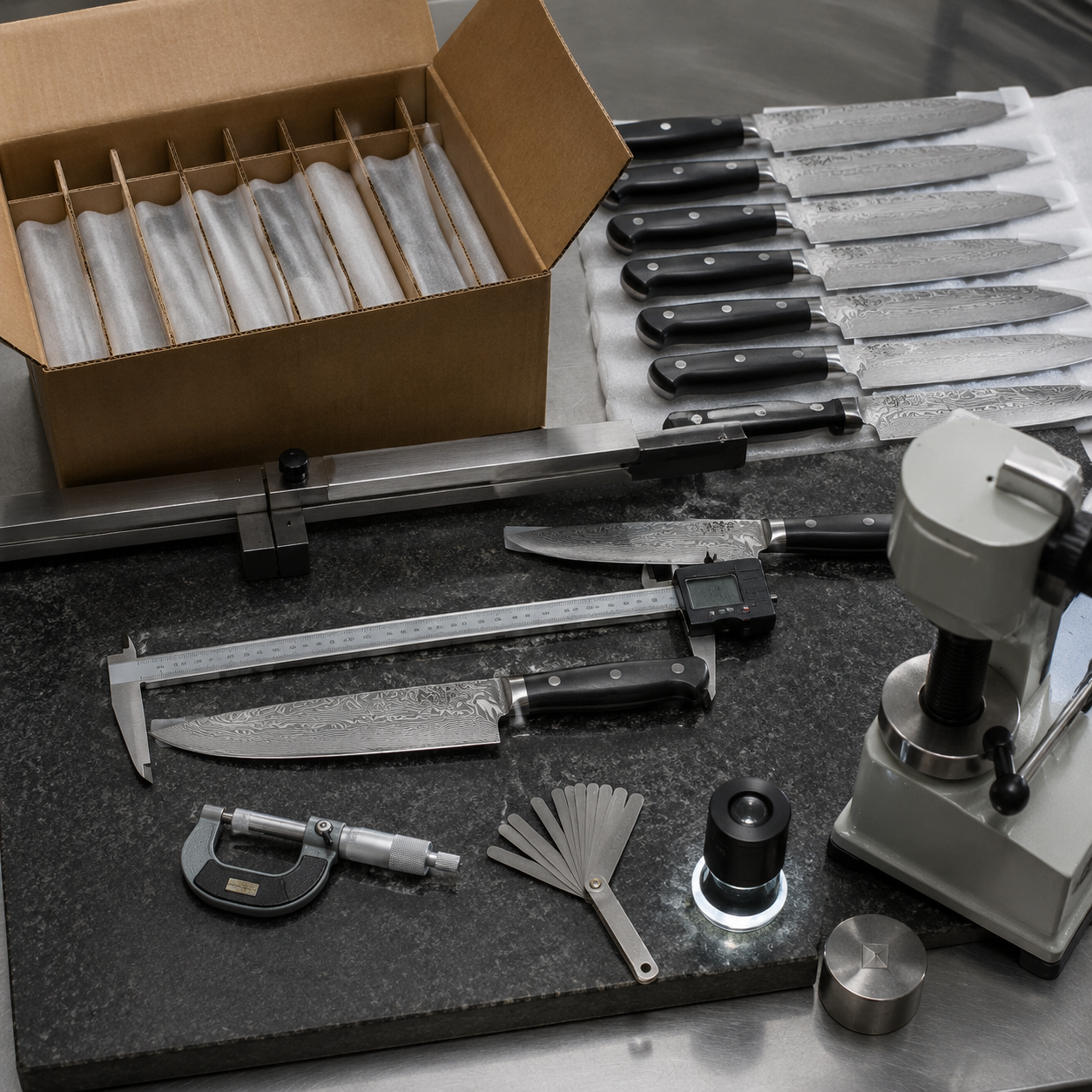
The report should identify the purchase order, SKU, specification revision, available lot, selected cartons, selected units, inspection date, inspector, instruments, and relevant calibration status. Calibration evidence supports measurement control; it does not establish that the product passed its contracted limits.
| Inspection area | Method the contract must define | Evidence needed for disposition |
|---|---|---|
| Identity and quantity | SKU, revision, assortment, lot code, and counting method | Reconciliation among the order, packing list, products, and cartons |
| Steel and construction | Required records and any buyer-approved verification | Traceable link from every document and result to the inspected lot |
| Blade dimensions | Datums, endpoints, locations, instrument, units, and individual tolerances | Individual readings wherever individual limits apply |
| Straightness and geometry | Fixture or reference method, allowable deviation, grind, and edge requirements | Results and disposition for each failed unit |
| Hardness | Scale, method, test location, surface preparation, sample allocation, and permitted range | Each reading, tested-unit identity, and disposition |
| Pattern and finish | Approved sample, viewing conditions, surfaces, and defect catalogue | Separation of allowed visual variation from prohibited structural or workmanship defects |
| Handle fit and integrity | Gap, alignment, movement, fastener, and any buyer-defined load method | Observations and test outcomes linked to each sampled unit |
| Corrosion performance | Exposure, cleaning, drying, observation, and pass criteria supported by the buyer's risk evidence | Results for the identified test samples and lot |
| Packaging | Protection, movement, assortment, moisture controls, carton condition, and traceability | Pack-out observations and affected quantities |
A defect catalogue should pair each reference image with a written description, applicable surface or location, severity class, and disposition. A passing average should not override an individual safety, material, dimension, hardness, or assembly limit when the contract applies that limit to each unit.
The final disposition should be pass, fail, or conditional approval issued by an authorized buyer representative. Conditional approval should identify the deviation, affected quantity, commercial disposition, required correction, and the lot to which the approval applies.
Malaysia Packaging and Documentation Verification
The supplied evidence does not establish a Malaysia-specific corrosion test, tropical-packaging specification, or mandatory moisture-control material for Damascus knives. Destination alone should not be converted into an unsupported product or packaging requirement.
If the Malaysian buyer's route, warehouse, storage, or returns evidence identifies humidity, condensation, salt exposure, or storage duration as a material risk, translate that evidence into a measurable test. Define the exposure medium, temperature, duration, cleaning, drying, observation timing, sample allocation, and allowable result.
Apply the same discipline to moisture barriers, desiccants, protective oils, or storage-life conditions. The RFQ should define the selected material, application, product compatibility, labeling, handling, and pass criteria. Any substance contacting the knife should be included in the approved packaging trial.
Before ordering, ask a qualified Malaysian customs broker or regulatory adviser to confirm the current requirements for the exact product and transaction, including:
- Tariff classification and product description.
- Importer responsibilities and any applicable permit or restriction.
- Country-of-origin, marking, labeling, and language treatment.
- Commercial invoice, packing, transport, origin, and supporting documents.
- Tax, duty, valuation, and record-retention treatment.
- Consistency requirements among descriptions, quantities, values, package counts, weights, and shipment records.
Convert that advice into a controlled document schedule naming the responsible party, required content, submission deadline, review owner, and correction process. The factory's document preparation should not replace the Malaysian buyer's local compliance review.
Practical RFQ Checklist for Malaysia Quality Control Inspection
Use this checklist when issuing the RFQ and reviewing the supplier's signed response. Mark an item complete only when the controlling specification, quotation field, record, or approval is identified. Treat a blank, qualified, or conflicting response as an open exception.
- [ ] The RFQ identifies the Damascus knife SKU, intended commercial use, order quantity, delivery destination in Malaysia, and controlled specification revision.
- [ ] The supplier has returned every required field and provided a consolidated list of deviations, substitutions, assumptions, and exclusions.
- [ ] The offered blade construction identifies the cutting core, cladding or pattern-welded components, and every claimed steel grade.
- [ ] The supplier has described how material records will remain linked to the work order, finished production lot, and shipment cartons.
- [ ] The drawing defines dimensional datums, measurement locations, nominal values, units, individual tolerances, and required instruments.
- [ ] Heat-treatment and hardness fields define the offered process declaration, scale, test location, preparation, sample allocation, reporting format, and acceptance limits.
- [ ] The approved-sample record states which characteristics the sample controls and which written specification prevails if documents conflict.
- [ ] The workmanship catalogue defines permitted variation and prohibited cracks, exposed weld defects, pits, scratches, alignment faults, gaps, loose fasteners, and edge defects.
- [ ] Functional or destructive tests state the method, sample preparation, allocation, endpoint, acceptance rule, and responsibility for replacement units.
- [ ] The sampling plan defines the lot boundary, lot readiness, carton and unit selection method, sample allocation, defect classes, and acceptance and rejection rules.
- [ ] The inspection terms provide access to the completed lot and prohibit replacing random selection with supplier-selected display samples.
- [ ] The report format requires individual results, tested-unit identities, instrument identification, relevant calibration status, photographs, and lot-linked disposition.
- [ ] Packaging requirements define edge and tip protection, movement limits, inner packing, carton configuration, batch coding, and any buyer-approved moisture controls.
- [ ] Any humidity, condensation, salt-exposure, or storage-duration requirement is supported by buyer risk evidence and converted into a measurable method and pass criterion.
- [ ] A qualified Malaysian customs broker or regulatory adviser has confirmed the current classification, import conditions, labeling treatment, taxes, and document schedule for the exact transaction.
- [ ] The quotation separates unit price, MOQ, tooling, samples, testing, inspection, packaging, freight scope, reinspection, sorting, rework, and replacement charges.
- [ ] The quotation identifies the delivery term, named handover point, production lead-time basis, offer validity, payment milestones, and responsibility at each logistics stage.
- [ ] The change-control clause requires advance notice and buyer approval for changes to steel, construction, heat treatment, tooling, production site, subcontractor, handle material, finish, or packaging.
- [ ] The failure procedure defines containment, sorting, rework, replacement, reinspection, evidence submission, and authorization of any conditional release.
- [ ] Shipment and any linked balance payment remain on hold until authorized product disposition and the separately reviewed Malaysia document approval are complete.
Compare price and delivery only after bidders have quoted the same specification and release scope. Before purchase-order release, confirm that the supplier has signed the controlled specification, acknowledged inspection access, accepted the failure process, and closed or documented every exception.
Evidence Methodology and Limitations
Methodology: This review used only the supplied source pages and author profile. Statements were classified as a technical example, retail-category context, supplier-specific commercial statement, sourcing practice, or author attribution. Exact figures were retained only with their unit, scope, displayed page date, and source. No figure was averaged, extrapolated, or converted into a proposed supplier specification. The release gates, evidence tables, and RFQ controls were derived as a buyer-defined editorial framework; they are not presented as a published standard or a named company's operating practice.
Source contexts: Nothing But Knives provides dated editorial context about modern Damascus construction and a named-model layer count. Rice Knife provides a dated retail category range for chef-knife length. Changwen provides a supplier-side recommendation about written steel identification and mill certificates plus a source-specific MOQ statement. UFamcooks provides a commercial sourcing discussion of payment milestones, third-party pre-shipment inspection, and an agreed AQL plan. The Vincent Xi author profile supports only the author's name and Editorial Author role.
Limitations and points to verify: The cited knife and sourcing pages are commercial or editorial sources. They are not official standards, Malaysian legal authorities, current supplier quotations, or independent audits of a proposed shipment. Check their technical examples, sourcing practices, displayed dates, and commercial statements against current primary documents and the supplier's signed quotation. No supplied evidence establishes a TANGFORGE product specification, manufacturing capability, certification, inspection result, customer outcome, or shipment conformity. No official Malaysian source was supplied, so current classification, import conditions, labeling, taxes, and documentation must be confirmed locally before ordering.
When a supplier cites a standard or certification, record its exact title, edition, scope, certificate holder, covered site, issuing body, and current validity. Distinguish the standard's actual requirements from the supplier's internal practices and the buyer's additional acceptance limits. A quality-system certificate does not by itself establish conformity of the finished shipment.
Discuss Your Requirements
Review our manufacturing capabilities, then share your specifications for a supplier-fit review.