Damascus Knife Wholesale Supplier Packing Requirements for Europe
By Vincent Xi, Editorial Author
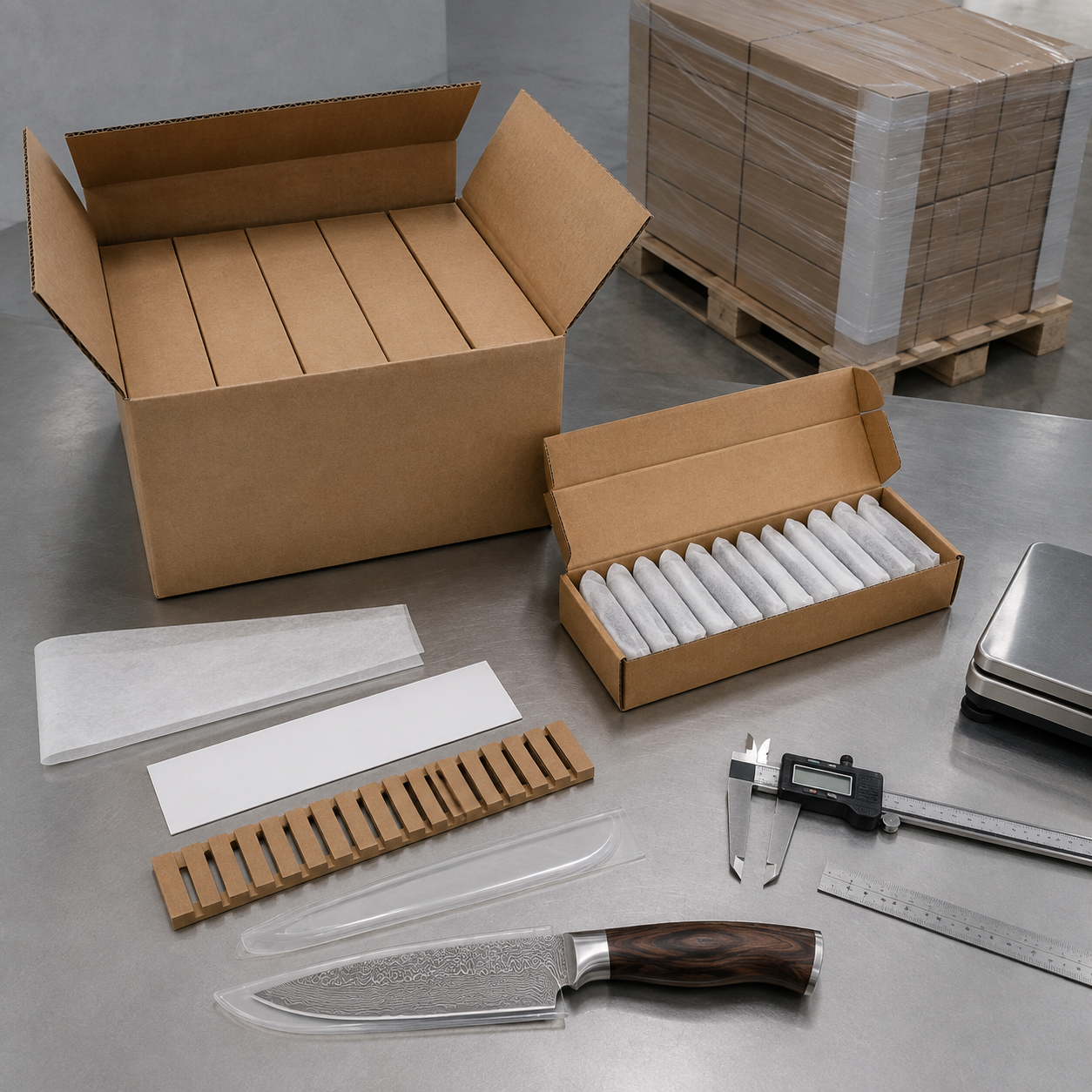
For European B2B procurement, approve a quoted packing price only after the wholesale supplier returns a revision-controlled schedule for the specified damascus knife SKU and destination route. The schedule should define selling-unit protection, pack counts, materials, dimensions, masses, artwork, master cartons, pallets, inspection evidence, permitted deviations, and change control. A response limited to standard export packing does not provide enough information for a like-for-like quote comparison.
Record the importing country, intended sell-through countries, importer or other required business identity, and receiving warehouse. Classify the route as an EU member state, a non-EU EEA destination, or the UK. The buyer should release approved legal identities, languages, product statements, environmental instructions, identifiers, and artwork for each applicable route. The supplier should apply those controlled files rather than infer the content of a generic European label.
The packing requirements below are RFQ and purchase-order controls. They are not presented as statutory requirements unless an official source supports the relevant scope and the buyer confirms applicability to the actual product and route.
Quote-release rule: compare supplier prices only when pack materials, counts, dimensions, masses, artwork revisions, pallet assumptions, evidence requirements, and permitted deviations are aligned.
Editorial basis: the linked author profile identifies Vincent Xi as Editorial Author. It does not support a factory-visit, product-testing, inspection, certification, client, or customer-outcome claim, and none is made here.
Practical RFQ checklist for damascus knife packing requirements
Attach this checklist to the RFQ and require the supplier to complete every item with a committed value, a referenced attachment, or not applicable with a reason. Record exceptions in a separate deviation list; an unchecked or blank item is not supplier acceptance.
- [ ] Identify the buyer SKU, supplier item code, controlled drawing revision, approved-sample reference, finish, sharpened state, and unit net mass.
- [ ] Name the importing country, intended sell-through countries, route category, importing business identity, receiving warehouse, and route-review owner.
- [ ] Specify the edge-and-tip guard material, usable dimensions in millimetres, coverage, fit, retention method, and required approval evidence.
- [ ] Specify every blade- or handle-contact material, including wraps, bags, oils, VCI materials, desiccants, trays, inserts, adhesives, and closures.
- [ ] State selling units per inner pack, inner packs per master carton, selling units per master carton, and rules for remainders or mixed SKUs.
- [ ] Require external dimensions, net mass, gross mass, and tolerances for the selling unit, inner pack, master carton, pallet, and shipment total.
- [ ] Define master-carton style, board specification, dividers, void fill, closure method, carton marks, and the approval record for the loaded carton.
- [ ] Define pallet material, footprint, loaded height, cartons per layer, layer count, securing method, overhang limit, stack rule, and warehouse constraints.
- [ ] List each unit, insert, carton, and pallet artwork file by destination, file name, revision, approval owner, and allocated order quantity.
- [ ] State required packed-sample photographs, count records, dimension records, mass records, identifier scans, and pallet views.
- [ ] State inspection selection, measuring equipment, acceptance criteria, failed-check escalation, rework responsibility, and reinspection responsibility.
- [ ] Require separate prices and MOQs for printed boxes, fitted inserts, pouches, labels, care cards, carton printing, and any route-specific component.
- [ ] Prohibit substitutions to materials, counts, dimensions, artwork, marks, closures, or pallet configuration without prior written approval.
- [ ] Require the supplier's dated sign-off, quote reference, attachment list, assumptions, exclusions, deviations, and validity period.
For quote comparison, transfer the completed responses into a bid table with one column per supplier. Keep any price whose corresponding checklist item is blank, qualified, or based on a different pack configuration on hold until the supplier resolves the difference in writing.
Europe packing requirements to settle before comparing quotes
Each requirement needs a committed value, a stated tolerance, not applicable with a reason, or a controlled attachment. A blank response should keep the affected part of the quote on hold.
| Quote gate | Required supplier return | Hold the quote when |
|---|---|---|
| Document control | RFQ reference, supplier quote reference, issue date, revisions, attachment list, contact, and deviation list | The quote cannot be traced to the current RFQ and packing files |
| Product basis | Buyer SKU, supplier item code, product drawing revision, approved-sample reference, finish reference, sharpened state, and unit net mass | The proposed pack is shown with another SKU or an unidentified knife |
| Selling-unit protection | Guard, contact material, moisture-control provision, enclosure, retention method, insert, closure, and unit label specifications | Materials, quantities, dimensions, or compatibility evidence are missing |
| Pack schedule | Units per inner, inners per master carton, remainder rules, external dimensions, net and gross masses, and tolerances | Counts conflict or freight dimensions are merely described as nominal |
| Destination artwork | Unit, insert, carton, and pallet files assigned to named countries and routes | One undifferentiated Europe file is proposed for EU, non-EU EEA, and UK destinations |
| Logistics pack | Carton construction, closure, pallet material, pallet recipe, securing method, overhang rule, and warehouse constraints | Loaded height, gross mass, footprint, or wood-pack status remains unresolved |
| Approval evidence | Complete packed sample, pack-out records, artwork proofs, measurement records, deviations, and written substitution controls | Evidence does not match the quoted SKU, materials, or revisions |
Packing requirements for the quoted damascus knife SKU
The term damascus knife does not define blade dimensions, handle geometry, finish, sharpened state, unit mass, or packing-material compatibility. Tie every pack decision to the buyer SKU, controlled drawing, or approved sample used for the quote.
| Packing decision | Measurable RFQ return | Approval evidence |
|---|---|---|
| Edge and tip protection | Guard material, usable internal dimensions in millimetres, coverage, and retention method | Dimensioned guard drawing and photographs fitted to the quoted SKU |
| Surface contact | Permitted separator, wrap, bag, foam, tray, or other contact material | Material specification and completed packed sample |
| Moisture-control option | Named oil, VCI material, desiccant, dry-pack method, or not applicable with a reason | Product data, quantity per selling unit in grams or millilitres, placement, and buyer-requested compatibility evidence |
| Unit enclosure | Bag, pouch, folding carton, rigid box, tray, or other specified format | Material specification, internal and external dimensions, closure, and packed gross mass |
| Internal retention | Orientation, support points, permitted movement, and retention method | Recorded result from the buyer-defined handling check |
| Insert or care information | Buyer file name, revision, language assignment, placement, and orientation | Photograph showing the released insert in the completed pack |
| Unit identifier | Buyer-approved value, artwork revision, print method, placement, and orientation | Print proof and scan record when scanning is required |
| Seal or tamper feature | Specified feature or not applicable with a reason | Material description and close-up evidence when required |
Do not infer alloy, layered construction, treatment, corrosion performance, food-contact suitability, care method, certification, or compliance from the word damascus. Do not print a material, treatment, performance, food-contact, dishwasher, certification, or compliance claim unless the buyer-controlled product file supports the exact wording for that SKU and route.
The commercial Knife Sourcing Articles and Damascus Knife Manufacturing OEM/ODM Buyer Guide provide sourcing context for packaging components, artwork, samples, and repeat-order controls. They can inform RFQ field selection, but they are not packaging standards, statutory sources, independent test reports, or evidence about a particular supplier.
The source titled Complete Guide to China Knife Wholesale Markets in 2026 supplies broad commercial context identified by its title as a 2026 guide. It is not used here to establish packaging-component MOQs, supplier capacity, European demand, or a route-specific packing requirement. Obtain separate quoted MOQs, in units, for printed boxes, fitted inserts, pouches, labels, care cards, and carton printing.
Reconcile every packing level
The pack schedule should trace the quoted SKU from one selling unit to the shipment total. Require internal dimensions where usable fit matters and external dimensions for freight and warehouse planning. Mark each value as a design target, supplier commitment, or measurement from the completed approval sample.
| Pack level | Required quote fields | Verification record |
|---|---|---|
| Selling unit | Components; external length, width, and height in millimetres; product net mass in grams; packed gross mass in grams | Dimensioned photographs and scale record for the completed unit |
| Inner pack | Selling units per inner; mixed-SKU and remainder rules; external dimensions in millimetres; net and gross mass in kilograms | Open-inner count record and closed-inner photographs |
| Master carton | Inners and selling units per carton; carton style; board specification; dividers; closure; external dimensions; net and gross mass; tolerances | Loaded-carton count, measurement, weight, and closure records |
| Pallet | Material; footprint and loaded height in millimetres; cartons per layer; layer count; total cartons; gross mass in kilograms; overhang and stack rules | Pallet recipe, loaded measurements, and required-view photographs |
| Shipment | Total selling units, inners, master cartons, pallets, gross mass, declared volume, and deviations | Reconciled packing list submitted before booking approval |
The purchase order should define dimensional and mass tolerances and require disclosure of partial inner packs, partial master cartons, and mixed-SKU cartons. It should also state which external dimensions control freight calculations when the loaded pack differs from the design target.
Example calculation only: assumptions to verify in the supplier's dated quote. The source is arithmetic from the assumptions below, and the scope is one hypothetical single-SKU RFQ. These figures are not measured product, factory, shipment, or market data and have no validity for an actual order until the supplier replaces them with committed or measured values.
| Example input | Hypothetical assumption |
|---|---|
| Order quantity | 1,000 knives for the illustrative SKU |
| Inner-pack count | 10 knives per inner pack |
| Master-carton count | 5 inner packs per master carton |
| Master-carton exterior | 400 mm long x 350 mm wide x 300 mm high |
| Loaded master-carton gross mass | 12 kg per master carton |
The example arithmetic produces 50 knives per master carton, 100 inner packs, and 20 master cartons. The 20 cartons have a calculated gross mass of 240 kg before pallets. Nominal external volume is 0.042 m3 per carton and 0.84 m3 for all 20 cartons before pallets. Replace every input and result with the supplier's dated quote value, tolerance, measurement basis, and actual packed-sample evidence.
Europe packing requirements: separate EU, non-EU EEA, and UK routes
Europe is not a sufficient destination field. Keep a physical pack common only where the approved product, route assessment, artwork, and receiving requirements allow it. Control destination information through a route-specific artwork matrix.
| Route | RFQ identification | Buyer-controlled release | Hold condition |
|---|---|---|---|
| EU member state | Importing member state, intended sell-through member states, importer or other reviewed business identity, and legal-review owner | Approved identities, languages, product statements, environmental instructions, and component artwork | An unnamed EU destination or one file is assumed to cover every intended member state |
| Non-EU EEA destination | Named destination, importer information, intended sell-through country, and legal-review owner | Separately approved artwork based on confirmed EEA incorporation and national requirements | EU artwork is copied without checking the selected EEA destination |
| UK | Named destination and intended sell-through area, importer information, warehouse profile, and UK legal-review owner | UK-approved unit, insert, carton, and pallet files | EU review or an EU contact block is treated as automatic UK approval |
| Country, retailer, or warehouse profile | Named country, retailer where applicable, receiving warehouse, and receiving specification | Language set, identifier, carton mark, pallet data, and environmental instructions | The supplier invents a mark, translates controlled text without approval, or omits receiving data |
For an EU import route, use the European Commission's Access2Markets portal as a starting point for checks by product, origin, and destination. For a non-EU EEA route, use EFTA EEA-Lex to check whether and how a relevant EU legal act is incorporated into the EEA Agreement, followed by current official sources for the named destination. Review the UK separately using UK product safety advice for businesses and the current UK sources selected by the buyer's legal-review owner.
These portals do not approve artwork, classify the actual SKU automatically, or establish that one pack file is valid across Europe. Before releasing artwork, confirm the current product classification, origin, importing country, sell-through countries, legal identities, languages, environmental obligations, and required evidence.
The artwork matrix should record destination, buyer SKU, pack component, file name, revision, approval owner, approval date, and allocated order quantity. The supplier may apply only a released revision. Artwork or a claim used for another customer, SKU, route, or shipment is not approval for the current order.
Master cartons, pallets, and shipment marks
Treat the loaded master carton and pallet as quoted assemblies. The supplier should disclose the proposed construction and measurement basis rather than rely on an undefined factory practice.
| Assembly | Required return | Procurement control |
|---|---|---|
| Master carton | Style, material, wall construction, board specification, internal and external dimensions in millimetres, closure, dividers, void fill, net mass, gross mass, and tolerances | Approve the loaded construction and any requested test method before bulk pack-out |
| Carton marks | Buyer SKU, supplier item code, purchase-order reference, approved description, quantity, net and gross mass, carton sequence format, required lot reference, destination data, and artwork revision | Print only buyer-released content and retain proof approval |
| Pallet | Material, construction, footprint, entry orientation, cartons per layer, layer count, loaded height, gross mass, overhang allowance, securing materials, and stack rule | Check the proposed recipe against warehouse and freight constraints before booking |
| Shipment summary | Selling-unit, inner-pack, master-carton, and pallet counts; gross mass; volume; deviations; and applicable supporting documents | Reconcile totals with the released pack schedule and final packing list |
For a buyer-requested transit test, state the method and revision, sample quantity, test condition, acceptance criteria, test location, and report format in the RFQ. Do not describe a carton as tested unless a current report identifies the tested carton construction, packed SKU, configuration, and acceptance result.
If wood packaging is proposed, the route owner should determine whether the IPPC standard ISPM 15: Regulation of wood packaging material in international trade applies to the selected material and shipment. ISPM 15 concerns wood packaging material in international trade; it is not a damascus knife product certification. A supplier phrase such as export pallet describes that supplier's commercial practice and is not proof of treatment, marking, or compliance. Request current shipment-relevant evidence only after confirming applicability.
Pack-out evidence, acceptance, and substitution control
| Stage | Required evidence | Release decision |
|---|---|---|
| Quote | Completed pack schedule, component prices and MOQs, tolerances, artwork matrix, proposed checks, and deviation list | Compare only complete and equivalent pack configurations |
| Packed sample | Actual quoted knife in the complete selling-unit pack, required inserts and labels, representative inner pack, and representative master carton | Approve, revise, or reject each controlled component in writing |
| Production pack-out | Buyer-defined sample selection, counts, dimensions, masses, artwork revisions, identifier scans where specified, and defect photographs | Release only against written acceptance criteria |
| Pallet and shipment | Loaded-pallet record, reconciled packing list, final counts, gross mass, volume, deviations, and applicable wood-pack evidence | Authorise booking or require correction and reinspection |
Acceptance criteria should be observable and tied to controlled files. Relevant checks include:
- The edge and tip guard matches the approved drawing and fitted sample.
- Contact materials, enclosure, inserts, inner packs, and master cartons match released specifications and revisions.
- Counts reconcile at every pack level, including disclosed remainder packs.
- Measured dimensions and masses remain within purchase-order tolerances.
- Buyer-approved marks are readable, correctly placed, and assigned to the named route.
- Scannable identifiers return the buyer-approved value when scanning is specified.
- Carton condition meets the buyer's written acceptance criteria.
- Pallet footprint, loaded height, gross mass, securing method, and overhang match the released recipe.
- No material, count, dimension, artwork file, mark, or pallet configuration has changed without written approval.
The inspection instruction should state sample quantities by pack level, selection points, measuring equipment, checks, acceptance criteria, failed-check escalation, rework rules, and reinspection responsibility. No universal sample quantity is asserted here. Select the plan according to order size, packing risk, prior evidence, warehouse requirements, and any inspection standard explicitly named in the purchase order.
The purchase order should assign responsibility for replacement packaging, rework, repeat inspection, obsolete artwork, and packing-list discrepancies. Approval of a reference pack does not authorise later changes to guard material, contact material, bag gauge, box board, inserts, adhesives, carton construction, marks, or pallet configuration.
Evidence, methodology, and limitations
Claim-to-source register
| Source context | Supported use | Boundary |
|---|---|---|
| Vincent Xi author profile | Author name, Editorial Author role, and profile URL | It does not support first-hand manufacturing, factory-visit, testing, inspection, certification, client, or customer-outcome claims |
| Knife Sourcing Articles and Damascus Knife Manufacturing OEM/ODM Buyer Guide | Commercial sourcing context for packaging components, artwork, samples, and repeat-order controls | They are not used as legal requirements, standards, independent test evidence, or proof about a named supplier |
| Complete Guide to China Knife Wholesale Markets in 2026 | Broad commercial context identified by its title as a 2026 guide | Its examples are not transferred to packaging MOQs, supplier capacity, European demand, or the quoted SKU |
| Access2Markets | Starting point for product, origin, and EU destination checks | It does not approve artwork or resolve non-EU EEA and UK routes |
| EFTA EEA-Lex | Starting point for checking incorporation of EU legal acts into the EEA Agreement | Incorporation and national implementation still require destination-specific confirmation |
| UK product safety advice for businesses | Separate starting point for the UK product-safety route | It is not evidence that EU artwork or an EU review is valid in the UK |
| IPPC wood-packaging standard | Official scope source for ISPM 15 when applicable to selected wood packaging | It does not certify a knife, supplier, pallet, or shipment without current applicable evidence |
Methodology
Commercial sources were used only for the sourcing-process topics they describe, not as statutory evidence. Official portals identify where EU, non-EU EEA, UK, and wood-packaging checks should begin; no portal reference is presented as a completed legal determination for the actual SKU or route. The numerical example uses arithmetic derived solely from assumptions explicitly marked for replacement in a supplier's dated quote. The RFQ fields, hold conditions, checklist, and approval sequence are buyer-defined procurement controls rather than reported factory practices or test outcomes.
Limitations and what to verify
No physical knife, packed sample, supplier quote, production record, transit-test report, legal opinion, factory certificate, or shipment document was evaluated for this article. Verify the actual blade and handle geometry, finish, sharpened state, unit mass, material compatibility, component MOQs, pack counts, dimensions, masses, tolerances, artwork ownership, identifiers, legal identities, country language needs, environmental obligations, warehouse limits, inspection instructions, and applicable wood-pack evidence.
Check every source for currency when releasing the RFQ, purchase order, artwork, and shipment. Confirm commercial values in the supplier's dated quote and recheck critical measurements during the actual production pack-out. Nothing here establishes certification, legal compliance, packaging performance, manufacturing capacity, or customer outcomes for a named supplier or SKU.
Discuss Your Requirements
Review our manufacturing capabilities, then share your specifications for a supplier-fit review.