Kitchen Knife OEM Business Continuity Planning for Australian Buyers
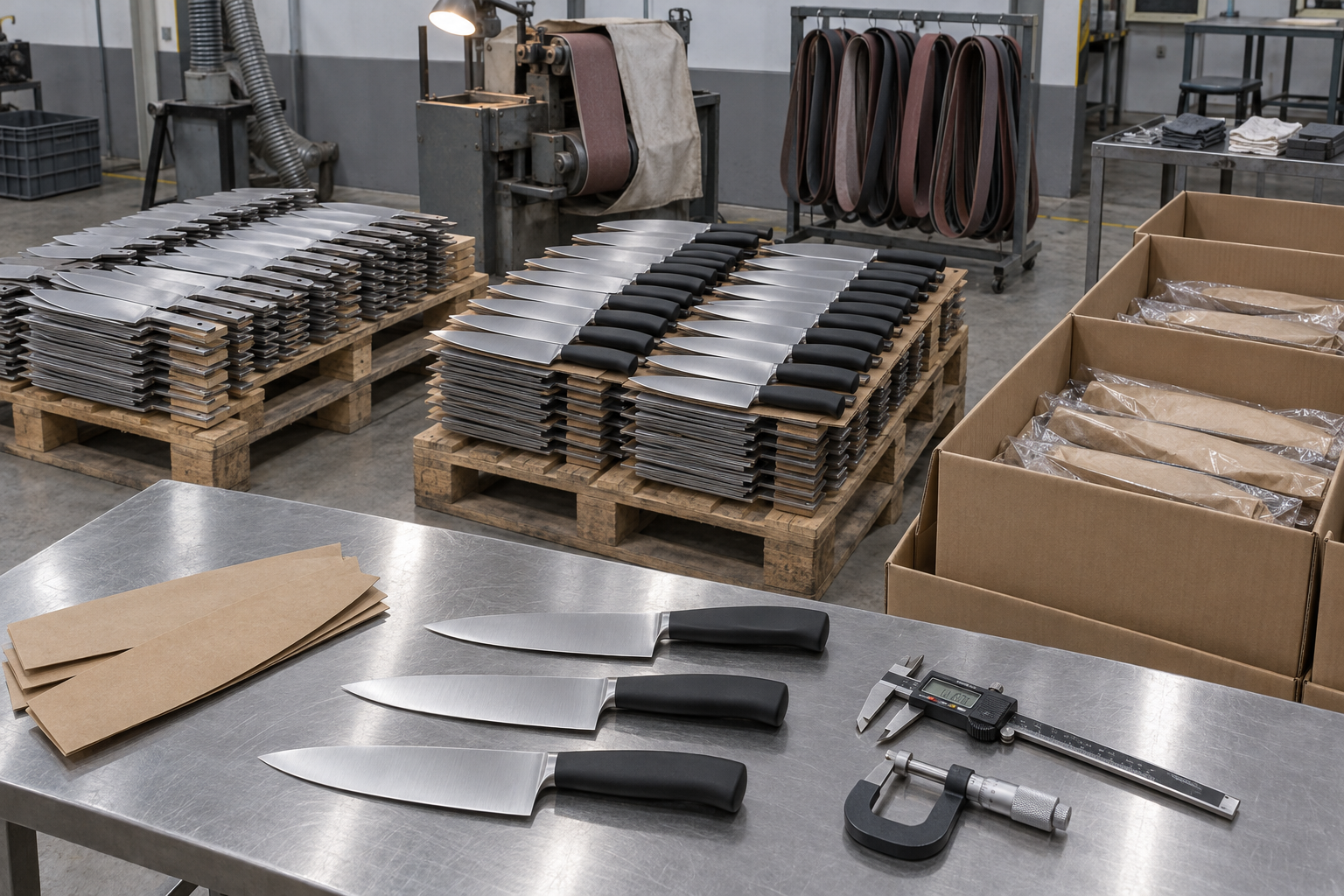
For Australian buyers, kitchen knife OEM business continuity planning starts in the purchase specification, not after a shipment fails. The direct procurement answer is to approve a primary manufacturing route, a named backup for the material or process most likely to stop the order, a buffer quantity or a dated release schedule, and the acceptance checks that backup pieces must still pass. Price is comparable only after each bidder has quoted that same pack. A factory statement that a continuity plan exists is not a substitute for those items on the quote.
This page is for brand owners, importers, and trade buyers in Australia who contract kitchen knife manufacturing in bulk. It is an editorial buying guide. Vincent Xi, Editorial Author, is the named author (https://tangforge.com/authors/vincent-xi/). The role is editorial. The page does not report a factory visit, a production trial, a client program, or a personal production history.
Two public pages set the sourced scope. Data Calculus describes business continuity planning for cutlery and hand-tool operations as preparation for supply-chain delays and equipment failures, through risk identification, response protocols, recovery procedures, and forecasting with vendor management (Data Calculus, cutlery and hand-tool operations). Wolff Industries, writing for food-processing knife users, says a checked backup supplier can keep a missed delivery from becoming a wider stoppage, and it names compatibility, timelines, quality standards, inventory management, a delivery record, and contingency planning as the checks (Wolff Industries, when suppliers cannot deliver). Those checks can be reused against a kitchen knife drawing. They do not qualify a backup until samples match that drawing.
How business continuity planning changes the manufacturing specification
In kitchen knife manufacturing, output stops when any one dependency stops: blade steel or blade blanks, handle material, pins or rivets, heat treatment, grinding, edge finishing, packaging, or the outbound booking. Continuity work is the written response to that list.
The Data Calculus article ties that response to risk identification, response protocols, recovery procedures, and forecasting with vendor management aimed at alternative sources and less downtime (Data Calculus). On an OEM quote, each item needs a line the buyer can accept or reject. The risk line lists single-sourced parts and machines. The protocol line names who notifies the buyer, how soon after the plant knows, and which substitute was qualified beforehand. The recovery line states how mixed lots are marked and how the order returns to the primary specification. Vendor management means the alternate is approved before the shortage, not searched on the day the line stops.
ISO 22301 is the external standard for business continuity management systems. Naming that identifier is not a certificate claim for TANGFORGE or for any plant in the source pages, and it is not a measured result. If certification is an approval gate, read the current document for entity, site, scope, and expiry. A trading-office document does not cover the plant that grinds the blades.
Wolff Industries tells food-processing knife users to check a secondary supplier for compatibility, timelines, quality standards, inventory practice, delivery history, and contingency planning (Wolff Industries). For kitchen knife OEM work, compatibility means the sample meets the drawing on blade length, spine thickness, edge geometry, handle, balance, and pack. A processing-blade plant is not a kitchen knife backup until that match is shown.
What buyers in Australia should quantify before they order
Australia is the destination for the orders this page addresses. A plant stoppage and a freight delay can overlap on a long ocean leg. The cited sources do not give a transit time, a duty, a biosecurity rule, or a labeling rule, so none is stated here. Those points belong with the forwarder and with current official guidance. The manufacturing file still has to record the Incoterm, the port pair, whether finished knives can be held, and who owns them while they wait.
Packaging stays a specification. Require the manufacturer to describe oil, wrap, and carton for the voyage and for the buyer's warehouse. If the buyer will store the goods in a humid Australian location, declare that condition so the pack is quoted against it.
Three figures below are example calculations and assumptions to verify in the supplier quote. They describe one hypothetical SKU. They are not sales, not a recommended buy, and not plant capacity.
Buffer assumption: 10,000 chef's knives is the contracted volume of one SKU in one 12-month contract year, and the buyer chooses 10 weeks of cover. Example calculation: 10,000 knives times 10, divided by 52 weeks in that contract year, equals 1,923 knives when rounded to the nearest knife. The unit is finished knives for that SKU and that contract year on this worksheet, not a stock count, unless the buyer explicitly accepts blade blanks as the equivalent unit. Replace both inputs on the live quote.
Split assumption, on the same 10,000-knife year: seven-tenths on the primary route and three-tenths on the backup route. Example calculation: 7,000 knives on the primary route and 3,000 knives on the backup route in that year. This split is a worksheet device to keep both routes in view. It is not evidence of a minimum load a plant needs in order to hold a fixture.
Recovery assumption: 21 calendar days from written notice of a blade-steel shortage to the first backup-route shipment that passes the agreed check. The unit is calendar days, the scope is one shortage type on one SKU family, and the figure is a negotiation target rather than a measured factory result.
Price the live quantities against each other. Extra cover, on the pattern of the 1,923-knife example, binds cash in Australia or at origin. A second route, on the pattern of the 3,000-knife example, can add unit cost and a second quality signature. One route avoids that second signature and concentrates outage risk.
One plant, a full range, or a qualified second source
An OEM marketing page says many cutlery plants make only part of a kitchen knife range, so a brand that needs several types may buy from more than one factory, and that this can add cost, quality risk, and delay. The same page presents Yingshi as a full-category partner with one schedule, one inspection flow, and one shipment plan, and it describes that firm's raw-material supply as stable for bulk orders (Insight Kitchen Knife, OEM page). That is the vendor's own commercial claim. It is not a census of factories and it is not a description of TANGFORGE machinery or steel supply. Ask every bidder which knife types, steels, and handle materials are made at the quoted site.
One wide-range plant can reduce the number of schedules a buyer must line up, which is the coordination point that page argues. It does not remove steel, heat-treatment, or machine risk inside the plant. A second source covers an outage only after its samples are accepted to the same drawing. A name on a slide is not a production route.
Turn the Wolff checks into quote fields (Wolff Industries). Ask for sample, first-bulk, and repeat-release lead times in days, with the Incoterm. Tie quality to the drawing, the steel callout, the edge, and the cosmetic limit, and add a hardness method only if the buyer will enforce one. Tie inventory to a stated make-to-order rule or to a named hold of blanks or finished knives. Treat a delivery record as a reference or a redacted history the buyer is allowed to see. Contingency means a written alternate for steel, handles, and grinding capacity.
Qualifying two plants costs sample freight, fixture checks, and incoming inspection. An unqualified second name costs less until the day it is needed. If chef's knives and steak knives already come from different plants, do not assume either plant can build the other SKU. Require each quoted plant to list the SKUs it can make to the drawing.
Safety stock, scheduled releases, and the recovery target
A lower piece price is not comparable when it omits backup qualification, a buffer, or re-inspection of substitute material.
Use one manufacturing pack on every bid. Name the primary site, the blade and handle materials, and every subcontracted step. Name the backup steel grade and size, and name the capacity backup together with the samples that qualified it. State the buffer or the release calendar in the buyer's own annual quantity. Treat the 10,000-knife year, the 10-week cover, and the resulting 1,923 knives only as the worksheet pattern. State backup acceptance checks and a lot mark. State a notice period and a recovery target in calendar days, and treat 21 days only as the pattern, not as an agreed term.
Data Calculus includes forecasting and vendor management in continuity practice (Data Calculus). Use a rolling forecast in units by SKU by month, with firm months marked. Ask which purchased parts that forecast lets the plant reserve, in what quantity, and how many weeks ahead.
Safety stock held at origin or in Australia shortens the gap after a missed sailing and pulls payment forward. A release-only plan lowers idle stock and leaves a longer gap. If the plant holds blanks while handles and grinding wait for a release, the quote must say who owns those blanks and who pays if the program ends.
Decision table for manufacturing continuity
Compare at least two kitchen knife OEM bids on the rows below. Replace every example quantity before scoring. Example cells use the labeled worksheet from this page: a 10,000-knife contract year, 10 weeks of cover equal to 1,923 knives, a route split of 7,000 and 3,000 knives, and a recovery target of 21 calendar days. Each of those figures is an assumption to verify in the supplier quote, not a measured operating result.
| Continuity item | What to specify | What to compare | Verify before approval | Trade-off to price |
|---|---|---|---|---|
| Blade backup | Grade, thickness, and blank size that may replace the primary steel | Whether the alternate is already sampled or only described as available | A material document and a sample measured to the drawing | Unit cost can rise, and grind behavior can change |
| Handle and fastener backup | Material, color tolerance, and fastener type | Whether any heat or wash claim is tied to a named method | Do not infer a test the quote never states | A close color match can block some second-source materials |
| Second production route | Site, process steps, and SKUs that route may make | One wide-range plant versus a second plant with accepted samples | The address on the quote must be the plant, not a sales office | A second site adds audit time; one site concentrates machine risk |
| Volume split | Annual knives by route; example assumption is 7,000 primary and 3,000 backup | The backup unit price at that quantity, not at a single sample | Both routes must price the quantity the buyer named | A small backup share may leave fixtures idle |
| Buffer or call-off | Knives and weeks of cover, or a monthly release; example assumption is 1,923 knives for 10 weeks on a 10,000-knife year | Where stock sits, who owns it, and the holding charge | Match cover weeks to the forwarder's current transit quote into Australia | More weeks bind more cash; fewer weeks raise stockout exposure |
| Recovery target | Calendar days to the first accepted backup shipment; example assumption is 21 calendar days after written notice | Whether the bid accepts, rejects, or rewrites the target | Silence is not acceptance | A shorter target can force air freight or idle capacity |
| Backup acceptance | Dimensions, edge, cosmetics, pack, lot code, and any hardness method the buyer will use | Whether backup lots are coded apart from primary lots | Sign the inspection sheet before that shipment is authorized | Failed pieces consume days the recovery target still includes |
RFQ Checklist
- Ask the supplier to name the manufacturing site for each quoted kitchen knife SKU and to list every subcontracted step.
- Require the manufacturer to identify single-sourced materials and equipment, including blade steel or blanks, handles, and heat treatment or grinding.
- Specify the approved backup material and backup process route, or state in writing that no backup is approved.
- Ask the supplier to quote a buffer in knives and in weeks of cover, or a call-off calendar, using the buyer's annual quantity rather than the example worksheet.
- Require the manufacturer to state who owns any buffer, where it is held, and which charge applies if the program ends before that stock is used.
- Specify the acceptance checks that backup-route knives must pass, including dimensions, cosmetic limits, lot identity, and any hardness or edge test the buyer will enforce.
- Ask the supplier for lead time in days for samples, first bulk, and repeat releases, with the Incoterm and the port pair used toward Australia.
- Compare at least one other bid on this same continuity pack so a lower piece price cannot omit backup qualification.
- Verify any continuity or quality certificate against the current document's entity, site, scope, and expiry before treating it as an approval input.
- Approve the first backup-route shipment only after the inspection sheet for that route is signed.
How the guidance was derived, and what to verify
Method. Linked statements above draw only on three public pages. Data Calculus is the source for the cutlery and hand-tool operations frame: risks, response protocols, recovery steps, and forecasting with vendor management aimed at alternative sources and less downtime. Wolff Industries is the source for backup-supplier checks written for food-processing knife buyers: compatibility, delivery timelines, quality standards, inventory management, a delivery record, and contingency planning. The Insight Kitchen Knife page is used only as that vendor's own statement that partial ranges can add factories, cost, quality risk, and delay, and as that vendor's description of its own full-category offer. The 10,000-knife contract year, the 10-week cover of 1,923 knives, the split of 7,000 and 3,000 knives, and the 21-calendar-day target are arithmetic examples built for this buying guide. They were not taken from those pages and they were not measured in a factory.
Limits. None of the three pages is an Australian customs, biosecurity, or product-labeling source, so this guide states no transit time, tariff, or label text. None is a current certificate, audit, or capacity record for the publisher or for the plants those pages mention. Wording about Yingshi stays that company's web copy until the same points appear on a quote and on measured samples. Food-processing knife advice does not show that a plant can finish a kitchen knife to a brand drawing. ISO 22301 is an external standard a buyer may ask to see. It is not a credential claimed for the publisher. No first-hand production trial sits behind the byline. Before an order is released, check the quoted site, the material documents, the sample measurements, the stock-ownership clause, the Incoterm, and the forwarder's current transit time into Australia.
The byline is Vincent Xi, Editorial Author (https://tangforge.com/authors/vincent-xi/). The credit is editorial only. No factory tenure, client program, or personal inspection result is attributed to the author.
Discuss Your Requirements
Review our manufacturing capabilities, then share your specifications for a supplier-fit review.