Kitchen Knife Wholesale Supplier Minimum Order Quantity in Europe
By Vincent Xi | Editorial Author
For a European B2B buyer, a kitchen knife wholesale supplier minimum order quantity is not decision-ready as a single headline number. The quotation must state whether the threshold applies per purchase order, SKU, blade profile, handle variant, decoration, component, process, or packaging version. That scope determines the buyer's total committed units.
The available source evidence does not establish a universal MOQ for Europe. The cited Changwen publication reports several quantity thresholds under its 2026 sourcing context, but those figures apply only to the programs described by that publisher. They are not independent market averages, current supplier quotations, or TANGFORGE supply terms.
The procurement decision is therefore straightforward: compare the lowest reproducible total commitment for the same controlled specification, destination packaging, and reorder conditions. Hold the purchase order if the supplier cannot show how every SKU and variant contributes to that total.
Source-Traceable Minimum Order Quantity Evidence
| Reported quantity | Scope stated by the source | Date and source context | Appropriate use |
|---|---|---|---|
| 500 to 1,000 units per SKU | Standard catalog kitchen knives with OEM branding | Reported in the Changwen sourcing guide under its 2026 sourcing context | A planning reference for checking how a current catalog-based quotation defines its per-SKU threshold |
| 10,000 units | Threshold associated by the source with custom handle molds or proprietary blade profiles | Reported in the Changwen sourcing guide under its 2026 sourcing context | A prompt to separate tooling-dependent customization from catalog selection before comparing MOQ terms |
| 1,000 units per SKU | Changwen's stated standard knife-program MOQ | Reported in the Changwen sourcing guide under its 2026 sourcing context | Evidence of that publisher's stated program threshold, not a Europe-wide or supplier-wide benchmark |
These quantities have different stated scopes and should not be averaged, combined, or transferred to another supplier. The source does not establish what a supplier will quote for a different blade, handle, finish, packaging version, production site, or order date.
The SZCO distributor guide provides a separate source context: it describes distributors as buying inventory in bulk and reselling it in smaller quantities. That distinction can help a buyer determine whether an offer concerns stocked goods or made-to-order production. The page does not establish a factory MOQ or a destination-specific requirement for Europe.
How to Compare Minimum Order Quantity Quotes for Europe
Require each supplier to complete the same MOQ fields before comparing unit prices.
| Quote field | Required supplier response | Reason to hold the RFQ |
|---|---|---|
| Threshold basis | State whether MOQ applies per purchase order, SKU, profile, handle variant, finish, decoration, component, process, or packaging version | The quotation shows only an unexplained headline quantity |
| Line allocation | Show the quoted quantity for every SKU and variant, followed by the total purchase-order quantity | The total cannot be reproduced from the quote lines |
| Combination rules | Identify which SKUs, colors, components, or packaging versions may share a batch | Mixed-SKU or mixed-variant approval remains conditional or undefined |
| Standard and custom scope | Classify each blade, handle, finish, decoration, component, and pack as catalog, modified, or custom | Catalog items and tooling-dependent items are combined under one threshold |
| MOQ reset conditions | List every material, dimension, color, artwork, finish, process, or packaging change that creates another threshold | The supplier retains discretion to split the batch after order placement |
| Quantity tolerance | State permitted overproduction and underproduction in units and percentage, including price, ownership, storage, and disposal treatment | The buyer could be required to fund an undefined excess quantity |
| Custom components and tooling | Quote the minimum component quantity separately from the finished-knife MOQ and identify tooling ownership and reuse terms | Paid components or tooling are not linked to a defined quantity or specification |
| Initial order and reorder | State both thresholds and any material-reservation, tooling, or specification conditions | Only the opening-order MOQ is disclosed |
| Shipment releases | Separate the production quantity from each shipment-release quantity and explain whether releases affect MOQ | Split delivery is presented as an MOQ reduction without written production terms |
| Quote identity and validity | Provide the issue date, expiry date, currency, legal supplier name, production site, specification revision, and authorized approval | The threshold has no accountable or dated commercial context |
A supplier may permit different products to share material, tooling, or production capacity, but the buyer should rely only on the combination rules written into the quotation. Informal statements about mixed orders are not enough when the signed quote still applies MOQ per SKU or variant.
Minimum Order Quantity Across Europe Destination Variants
Destination packaging can multiply an order when a supplier applies MOQ separately to each artwork, insert, carton, or other buyer-approved version. Build the destination matrix before requesting the final quantity and price.
The following rows are quotation controls, not legal conclusions. Neither cited commercial source establishes labeling, packaging, importer, or documentation requirements for the EU, the EEA, the UK, or an individual European country.
| Destination quote row | Buyer input | Supplier MOQ response |
|---|---|---|
| European Union destinations | Buyer-approved destination list and controlled packaging or artwork version | State whether the destinations share a production batch and identify any packaging-component threshold |
| EEA destinations outside the EU | Separately approved destination and packaging inputs | Confirm in writing whether these units share the EU allocation or require another variant quantity |
| United Kingdom - Great Britain | Buyer-approved packaging, artwork, and document inputs | Show the allocated units and any separate component or packaging MOQ |
| United Kingdom - Northern Ireland | A quote row distinct from the Great Britain allocation | Show a separate allocation or confirm in writing that the controlled version shares production |
| Individual European country variants | Buyer-approved country-specific artwork, language, labeling, or packaging inputs | Quote the units by SKU and version, including any print or component threshold |
Do not assume that one generic Europe pack can serve every intended destination. A qualified destination review should define the buyer's required inputs for the actual product, sales channel, countries, and order date. The supplier's task is then to show how those controlled inputs affect production and packaging quantities.
Worked Minimum Order Quantity Calculation
Every figure in this section is an illustrative assumption that must be verified in the supplier's dated, signed quotation. The example is not a supplier offer, market benchmark, forecast, or TANGFORGE term.
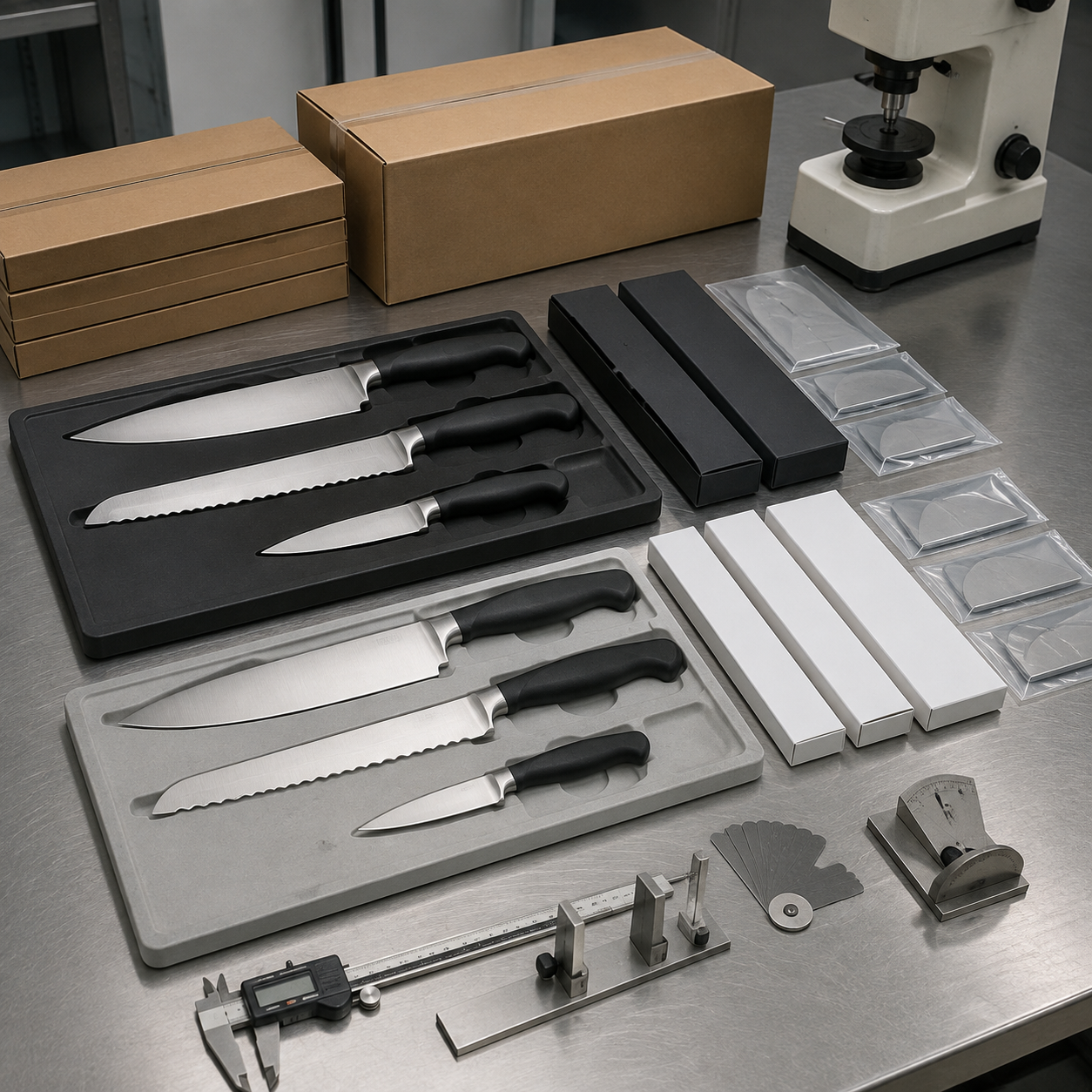
Assume an illustrative assortment contains 3 kitchen-knife SKUs: a chef knife, a bread knife, and a paring knife. Each assumed product has a brushed stainless-steel blade, a molded-polymer handle, and the same packaging version. Assume the supplier quotation applies a 600-unit minimum order quantity per SKU:
3 SKUs x 600 units per SKU = 1,800 total units per purchase order
Now assume the buyer needs 2 destination packaging versions per SKU and the supplier applies the assumed 600-unit threshold separately to each SKU-packaging version:
3 SKUs x 2 packaging versions per SKU x 600 units per SKU-packaging version = 3,600 total units per purchase order
The larger total applies only under those illustrative assumptions. A current quotation may produce a different result if packaging versions can share finished-knife production, if packaging components have their own thresholds, or if the supplier permits an explicitly defined mixed order.
Use one formula for every offer:
Total committed units = sum of quoted units across every SKU, variant, component commitment, and packaging version
Keep production quantity separate from shipment-release quantity. A delivery schedule should not be treated as a reduction in production MOQ unless the supplier states that effect in the signed quotation.
Practical Minimum Order Quantity RFQ Checklist
Use this checklist with the controlled kitchen-knife specification, destination matrix, and supplier quotation. Do not approve the RFQ response while any applicable item remains unanswered.
Before issuing the RFQ
- [ ] Attach the controlled specification revision for every blade profile, blade material, finish, handle, decoration, component, and packaging version.
- [ ] List every required SKU and variant on separate lines rather than requesting a single assortment quantity.
- [ ] Identify the intended European destinations and separate EU, EEA destinations outside the EU, Great Britain, Northern Ireland, and country-specific packaging versions where applicable.
- [ ] Mark each product element as catalog, modified, or custom so tooling-dependent work is not grouped with standard selections.
- [ ] Request separate opening-order, reorder, custom-component, tooling, and packaging-component thresholds.
- [ ] Require the supplier to state the quotation issue date, expiry date, currency, legal contracting entity, production site, and specification revision.
When checking the returned quotation
- [ ] Confirm whether the minimum order quantity applies per purchase order, SKU, blade profile, handle variant, finish, decoration, component, process, or packaging version.
- [ ] Recalculate the total committed units from the supplier's line-by-line SKU and variant allocations.
- [ ] Confirm in writing which lines may share material, tooling, production, or packaging batches.
- [ ] Record every specification, material, color, artwork, process, packaging, or production-site change that resets the threshold.
- [ ] Separate the finished-knife MOQ from material, handle, decoration, packaging-component, and tooling commitments.
- [ ] Record permitted overrun and underrun in units and percentage, including price, ownership, storage, and disposal treatment.
- [ ] Confirm tooling ownership, maintenance, storage, reuse, and replacement terms against the associated component quantity.
- [ ] Compare the initial-order and reorder thresholds and record any material-reservation, tooling, forecast, or timing conditions.
- [ ] Separate the production quantity from shipment-release quantities, storage responsibility, delivery timing, and payment milestones.
- [ ] Verify that every destination packaging version has an allocated quantity and that any shared-batch approval appears in the signed quotation.
- [ ] Incorporate every approved combination rule, exception, and MOQ reset condition into the final signed quotation.
- [ ] Hold approval if wording such as subject to production approval, mixed order possible, or MOQ negotiable is not converted into defined quantities and conditions.
The completed checklist should allow another procurement reviewer to reproduce the total committed units without relying on informal messages or assumptions. The buyer needs a calculation rule tied to a controlled specification, not an unexplained headline quantity.
Methodology and Limitations
Methodology: Numeric MOQ statements were retained only where the supplied source connected a quantity to a product or customization scope and a 2026 source context. Each figure remains attributed to the commercial publisher that stated it. The figures were not averaged, extrapolated into a European benchmark, or used to estimate demand, traffic, price, or the likely terms of another supplier. The RFQ tables, checklist, and calculation method are editorial tools for normalizing current supplier quotations.
Source scope: The Changwen 2026 sourcing guide is used only for its attributed MOQ statements. The SZCO distributor guide is used only for stocked-distribution channel context. The Vincent Xi author profile supports the author name and Editorial Author role; it is not used as evidence of factory inspection, product testing, purchasing activity, or customer outcomes.
Limitations and points to verify: The commercial sources are not independent audits, official market statistics, or current quotations for the buyer's specification. No signed supplier quote, controlled drawing, approved sample, production record, inspection report, laboratory report, freight quote, legal opinion, or destination-compliance file was supplied for this article. The cited pages also do not establish one set of requirements across the EU, the EEA, the UK, or individual European countries.
Before approving an order, verify the contracting party, production site, quotation date, specification revision, MOQ basis, combination rules, custom-component commitments, tooling terms, packaging allocation, destination inputs, quantity tolerance, total committed units, shipment releases, and reorder conditions for the actual kitchen knives.
Final MOQ Approval Gate
Approve the minimum order quantity only when the signed quotation makes the total commitment reproducible from the SKU, variant, component, and packaging matrix. Every reset condition, permitted combination, quantity tolerance, destination split, shipment release, and reorder term should be explicit.
The relevant comparison is the lowest verified total commitment that preserves the buyer-approved kitchen-knife specification for its intended European destinations. A smaller headline MOQ is not a better offer when its scope or resulting order total remains undefined.
Discuss Your Requirements
Review our manufacturing capabilities, then share your specifications for a supplier-fit review.