Knife Sourcing Production Scalability Planning for Australian Buyers
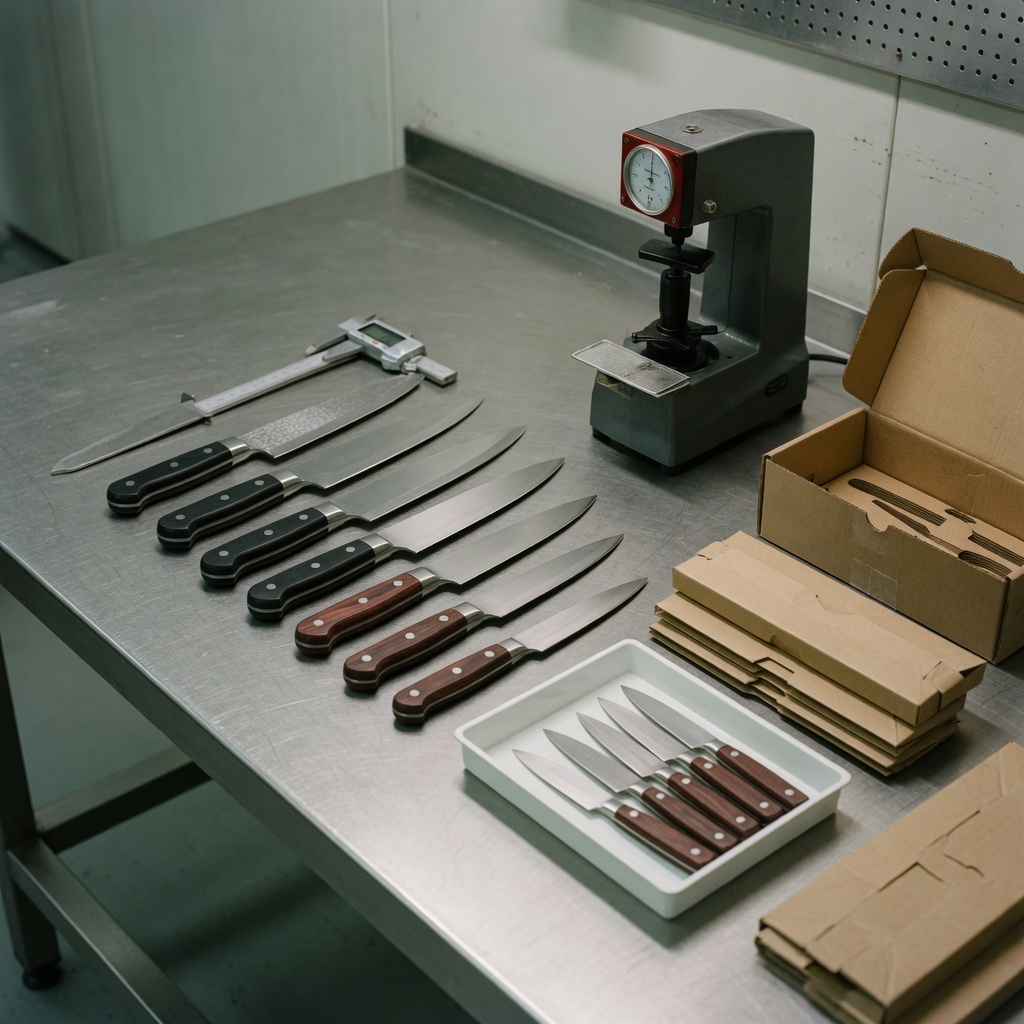
Knife Sourcing Production Scalability Planning for Australian B2B Buyers
Byline. Vincent Xi, Editorial Author. Profile: https://tangforge.com/authors/vincent-xi/.
Decision. For Australian B2B knife procurement, approve repeating OEM volume only when three gates pass: (1) a paid prototype freezes geometry, process route, named steel, hardness window, handle bill of materials, packaging, and QC protocol; (2) a pilot lot from the intended volume cell proves yield, hardness distribution, dimensions, and pack-out; (3) the quote states staged MOQs, monthly capacity for the exact SKU family, a named project owner, Incoterms, and change control. If any gate fails, hold the Australian assortment on a catalog or private-label path and re-sample.
Knife sourcing production scalability planning is that freeze-and-prove contract. It is not a catalog conversion story, and a verbal assurance that a sample house can later run mass does not replace it. Do not assume a private-label run will convert cleanly to full OEM if the factory, tooling, or project team changes.
Public reporting on the Yangjiang, Guangdong knife cluster states cluster knife production of USD 611.61 million last year (unit: USD; scope: cluster knife production as published on that page; as-of: the page’s “last year” wording, not converted here to a calendar year), with 85% of that output exported worldwide (unit: percent of the same published production; scope: Yangjiang cluster exports). The same page describes robotic and AI-automated stamped and forged lines and an integrated steel–forging–handle–packaging chain that can support monthly orders of 10,000 knives (unit: knives per month; scope: cluster-support context, not a quoted factory capacity) (Jing Sourcing Yangjiang knife industry overview). Private-label manufacturer guidance describes a common volume ladder of 50–100 unit prototypes before 500+ bulk (unit: pieces per stage; scope: that guidance’s staging example, not a dated capacity survey), with the same team and exact steel grade plus HRC carried from sample to large runs (Kegani private-label knife manufacturer guidance). A B2B knife manufacturing whitepaper frames steel selection from 5Cr15MoV through Damascus as a price-and-HRC matching problem, and lists inconsistent quality, long lead times, and high MOQ barriers as usual scale-up failures (LeeKnives B2B knife manufacturing whitepaper). Use the decision table and RFQ checklist below to specify, compare, and verify each stage. Treat every numeric example that is not quoted from those pages as an assumption to verify in the supplier quote.
What production scalability planning must lock before volume rises
For knife procurement, production scalability planning is a written control plan, not a promise that a sample cell will later become a high-volume OEM. Freeze SKU geometry, process (stamped or forged), steel grade, Rockwell C window and test method, edge angle, finish, handle material and fastener spec, tang or bolster construction, inner pack and export carton, label fields, inspection hold points, and the named project owner who stays on the account from prototype to mass.
If those items float, unit cost, lead time, and defect mix can move when monthly volume rises. That is a procurement risk to control in the RFQ, not a measured outcome from a named factory. Catalog private-label can be the right first step when an Australian distributor needs a fast, already-tooled range. Full OEM is the right step when blade geometry, steel, or construction is part of the product. The risk is switching commercial models without switching the control plan. Manufacturer guidance that is useful here is dedicated project managers, exact steel grades and HRC, QC at every stage, and continuity of the same team from prototype to large runs, rather than a new cell that reinterprets the drawing (Kegani private-label knife manufacturer guidance).
Gate rule. Freeze early enough to stop silent spec drift, and fund enough prototype and pilot quantity to reveal process capability. Under-sampling a 50–100 unit prototype band (unit: pieces; scope: Kegani staging example) and then releasing a 500+ bulk purchase order (unit: pieces; scope: the same staging example) is a known scale-up failure mode in that guidance: hardness scatter, handle fit, and finish variation can pass a handful of sales samples and still fail incoming inspection. If the bidder cannot freeze those items in writing, do not approve mass.
MOQ and lead-time stages from prototype to repeating OEM
Specify three commercial stages in the RFQ, even if one factory will run all three. Score bidders on whether the same cell, steel programme, and project owner can walk that ladder.
Paid prototype / confirmation samples. Public private-label guidance cites MOQs in the 50–100 unit range for this stage (unit: pieces; scope: Kegani staging example) (Kegani private-label knife manufacturer guidance). Use this lot to freeze steel, HRC, grind, handle, and packaging photos, and retain a sealed golden sample. Unpaid marketing samples are not process-capability evidence. Hold mass if the prototype cell is not the intended volume cell.
Pilot / first bulk. The same guidance cites 500+ units as a bulk threshold (unit: pieces; scope: Kegani staging example). Use the pilot to measure first-pass yield, hardness distribution, dimensional capability, and packing accuracy under near-production conditions. Hold repeating OEM if the pilot report does not match the prototype control plan.
Repeating OEM monthly. Cluster reporting cites monthly orders of 10,000 knives as a volume context that integrated Yangjiang supply chains can support (unit: knives per month; scope: Jing Sourcing cluster context, not a nominated-plant rate) (Jing Sourcing Yangjiang knife industry overview). Ask each bidder to state monthly demonstrated capacity for the exact SKU family, not plant-wide knife counts.
Lead time is named as a buyer pain point in B2B sourcing literature without a single published standard calendar (LeeKnives B2B knife manufacturing whitepaper). Do not copy a generic day-count into the purchase order. Require quoted calendar days for tooling or die change if stamped, prototype, pilot, and repeating mass, each with Incoterms and a statement of what is excluded (mill lead, holiday shutdowns, third-party labs). Label any internal planning calendar as an assumption until the quote returns.
Trade-off. A factory that quotes a very low prototype MOQ but cannot name a monthly rate for the same cell is not offering a scalable path. A factory that only quotes 10,000-piece monthly MOQs (unit: pieces per month; scope: cluster-context benchmark used as a planning stress case) is not offering a controlled path from Australian market tests. Dual-track the RFQ: stage MOQs plus a capacity ceiling.
Stamped versus forged routes and steels that hold at volume
Process choice is a scalability choice, not only a product-story choice. Yangjiang reporting covers both stamped and forged knives running on robotic and AI-automated lines (Jing Sourcing Yangjiang knife industry overview). That page does not rank the two routes by unit cost, energy, or defect rate. In the RFQ, specify stamped or forged for each SKU; require die or tool ownership, storage, and replacement responsibility if the volume cell changes; and score whether the chosen route shares a line, steel programme, and QC plan with the monthly volume the Australian channel needs. Treat any stamped-versus-forged cost ranking as unverified until the quote and first-article from the intended volume cell exist.
Steel is the other half of the price–scale match. The B2B whitepaper positions the buyer’s job as selecting blade steel from 5Cr15MoV through Damascus while matching HRC to retail prices (LeeKnives B2B knife manufacturing whitepaper). 5Cr15MoV is a named stainless grade in that range discussion; Damascus sits at the high-spec, high-variability end of the same discussion. Prefer a named grade, a hardness window, and a corrosion or edge test the factory already runs, over a catalogue adjective. If the Australian assortment includes both a value SKU and a premium SKU, do not put both on one unproven heat-treat recipe.
Example calculation (assumption to verify in the supplier quote, not a published market price, and not an AUD conversion): if a stamped 5Cr15MoV chef knife quotes at a factory unit cost of USD 4.50 at 2,000 pieces and USD 3.80 at 10,000 pieces, the volume delta is USD 0.70 per piece, or USD 7,000 on a 10,000-piece month. That arithmetic only holds if steel, HRC, finish, and reject rate stay inside the prototype control plan. A 2% extra reject rate on a 10,000-piece month is 200 knives; if each rejected unit costs USD 3.80 in materials and labour, that is USD 760 of hidden cost before freight. Replace these figures with the factory’s actual yield data, currency, and validity date.
Trade-off. Moving from 5Cr15MoV to a higher-alloy or Damascus programme can support a higher sell-in ticket, but it can also tighten mill supply, lengthen heat-treat, and raise cosmetic reject risk. Scale the steel that can be bought repeatedly, not the steel that photographed well on one show sample.
Quality consistency when volume and automation increase
Inconsistent quality is listed as a core scale-up pain point in B2B knife sourcing literature (LeeKnives B2B knife manufacturing whitepaper). Automation is relevant only insofar as it serves a locked control plan. Cluster reporting attributes consistent mass production of stamped and forged knives to robotic and AI-automated lines and to an integrated local chain covering steel, forging, handles, and packaging (Jing Sourcing Yangjiang knife industry overview). That is a description of a regional production system, not a certificate for any named plant.
Translate automation into inspectable RFQ items: in-line checks on blade length, width, and thickness; hardness sampling frequency and method; handle bonding or rivet torque; edge angle; finish grade; rust-prevention pack. Require the same inspection protocol on the 50–100 unit prototype, the 500+ pilot, and the repeating monthly lot (unit: pieces per stage; scope: Kegani staging bands applied as the buyer’s control-plan ladder). If the factory proposes a looser sampling rate at volume, that is a cost–quality trade-off the Australian buyer must accept in writing, not a silent change.
Project continuity is part of quality. Guidance that partners should keep the same team from prototype to large runs is a published control, not a plant-tour finding (Kegani private-label knife manufacturer guidance). Name the project manager in the RFQ response and treat a manager change as a process-change notice, so inspection criteria cannot drift between lots.
Trade-off. 100% inspection on a 10,000-piece monthly knife programme (unit: pieces per month; scope: the cluster-context volume used only as a planning stress case) is slower and costlier than statistical sampling, but sampling can miss clustered defects from one bad heat or one bad handle lot. Specify the defect classes that are critical (edge, hardness, corrosion, structural handle failure) versus cosmetic, and fund extra inspection on critical classes during the first three mass lots (buyer-chosen hold-point assumption, not a published industry rule).
Australian knife procurement: labels, pack-out, and freight before scale
This briefing addresses Australian B2B buyers who will import or distribute knives into an Australian sales channel. It is a procurement specification brief, not a country-by-country import manual. The supplied industry pages do not publish Australian duty rates, consumer-safety instrument numbers, or AUD freight tariffs, so those figures are not stated here. Production scalability planning for Australian knife procurement still has local operational consequences the RFQ must capture.
Specify the Australian end use (retail cutlery, foodservice, industrial, outdoor) because it changes steel, edge, and handle duty cycle. Specify labelling fields the channel will actually print or apply—language, care instructions, batch or lot, country of origin—rather than accepting a generic export sticker. Specify packaging that survives the buyer’s warehouse and last-mile pattern. Because this page has no measured Australian climate or freight dataset, treat warehouse conditions, interstate distribution, and port of entry as buyer-owned inputs: name them in the RFQ and require pack-out and rust prevention against those inputs.
Freight should be a separate commercial line. Ask for FOB at the named loading port plus optional prepaid freight to a named Australian destination, with piece count, carton cube, and gross weight per SKU. Do not blend a prototype air shipment cost into the mass-sea unit cost. Example assumption to verify in the quote: if a 500-piece pilot flies and a 10,000-piece lot moves by sea, unit landed cost is not comparable unless those legs are split.
Do not treat manufacturing origin as the sales market. Yangjiang or other production origin is a supply fact to verify (address, process, steel source), not a reason to rewrite the Australian assortment.
Buyer decision table: prototype path versus scalable OEM path
Use this table in supplier scorecards. Every row is a specify, compare, or verify action. Fail the verify column and do not release the mass purchase order.
| Decision factor | Prototype / private-label path | Scalable OEM path | Specify in the RFQ | Verify before PO approval |
|---|---|---|---|---|
| Commercial MOQ | 50–100 units as a published staging example, not a universal law (Kegani) | 500+ bulk then repeating monthly volume; industry context includes 10,000 knives/month cluster support (Jing Sourcing) | Stage MOQ, take-or-pay, and the SKU mix that fills the MOQ | Written quote matching the exact SKU; reject MOQ by factory, not by item if mix is not allowed |
| Process route | Often existing catalog dies or short-run stamps | Dedicated stamped die or forged programme on a named line | Stamped or forged; die/tool ownership, storage, and replacement cost | First-article report from the volume cell |
| Blade steel and HRC | May follow a catalog grade | Named grade (range discussed in sourcing literature: 5Cr15MoV to Damascus) matched to target price and HRC (LeeKnives) | Grade, mill-cert requirement, HRC window, test method | Mill document plus hardness map on the pilot lot |
| QC protocol | Spot check / sample photos | Stage-gate QC with the same team and every-stage inspection (Kegani) | Defect class, sample size, hold points | Pilot inspection report versus prototype report |
| Lead time | Often long and poorly specified in category literature (LeeKnives) | Quoted per stage with exclusions | Calendar days for tooling, prototype, pilot, mass | Capacity calendar including shutdowns |
| Packaging and labels | Maker’s generic export pack | Buyer-defined inner pack, carton, and Australian-channel label fields | Pack spec, cube, weight, label fields | Packed carton from the pilot, opened and measured |
| Project ownership | Sales contact only | Dedicated project manager from prototype through volume (Kegani) | Named manager and change-notice rule | Written assignment in the quote |
| Cost basis | Sample or small-lot price | Volume price that holds steel, yield, and finish constant | Unit price by stage, currency, validity date | Yield and reject rate on the pilot before mass release |
RFQ checklist for knife sourcing production scalability planning
Complete every item before approving a production purchase order. Each line is a specify, compare, verify, approve, or order task.
- State the Australian channel and end use (retail, foodservice, industrial, or other) and the 12-month unit forecast by SKU as a planning assumption, labelled as a forecast unless it is a contracted quantity.
- List SKUs with drawings or controlled photos: blade length, width, thickness, edge angle, tang type, handle material, and finish.
- Declare stamped or forged for each SKU and ask whether the volume cell is the same cell that will run the prototype; require first-article from that cell.
- Name the steel grade; do not accept stainless only. If still choosing, ask the factory to quote 5Cr15MoV and one higher-spec option as separate lines so price and HRC can be compared, consistent with the steel-range framing in B2B sourcing literature (LeeKnives B2B knife manufacturing whitepaper).
- Specify the Rockwell C window, test method, and sampling rate on prototype, pilot, and mass.
- Quote three quantities: the 50–100 piece prototype band, 500+ pilot, and a monthly repeating quantity the channel actually needs; include a 10,000 piece/month line only if that matches the plan, citing it as an industry-context benchmark not a requirement (Jing Sourcing Yangjiang knife industry overview; Kegani private-label knife manufacturer guidance).
- Require lead time in calendar days for tooling, prototype, pilot, and mass, with stated exclusions.
- Require Incoterms, currency, quote validity date, payment milestones as commercial terms only, and a split of unit cost versus packing versus freight.
- Require mill certificates or equivalent steel traceability if the quality system needs them; if not, write not required so the factory cannot add it silently later.
- Attach a QC plan: critical defects (edge, hardness, structural handle, corrosion) versus cosmetic; state whether the same plan applies at volume; retain a sealed golden sample from the approved prototype.
- Name packaging: inner wrap, blade guard, label fields for the Australian channel, carton size, pieces per carton, cube, gross weight, and rust-prevention method.
- Require a dedicated project manager and written notice if that person changes (Kegani private-label knife manufacturer guidance).
- Require first-article and pilot inspection reports before mass is released, including hardness data and dimensional results.
- Ask whether private-label catalog conversion to full OEM happens in the same facility and on the same team; a yes without a control plan is not scalability.
- State that any change to steel heat, die, handle lot, or finish after pilot is a resubmission, not a running change.
- Ask for monthly demonstrated capacity on this SKU family and current load against that capacity.
- Separate air-pilot freight from sea-mass freight to a named Australian destination; do not average them into one landed unit cost.
- Record what will be verified on arrival in Australia (incoming sampling, hardness spot check, label accuracy, carton count) so factory QC and buyer QC are not assumed to be the same activity.
- Specify die/tool ownership, storage location, and replacement responsibility if the volume line changes.
- Approve the mass purchase order only after the prototype freeze, pilot report, and quote lines above match; otherwise hold at the current stage.
Evidence basis, method, limitations, and author
This page is an editorial procurement briefing by Vincent Xi, Editorial Author, Tangforge, author profile: https://tangforge.com/authors/vincent-xi/. It does not claim factory employment, plant tours, laboratory tests, customer contracts, certifications, or personal use of any production line.
Source context 1. Jing Sourcing’s Yangjiang knife industry page reports USD 611.61 million in knife production last year, 85% exported worldwide, robotic and AI-automated stamped and forged lines, an integrated steel–forging–handle–packaging chain, and support for monthly orders of 10,000 knives (https://jingsourcing.com/fb-yangjiang-knife/).
Source context 2. LeeKnives’ B2B knife manufacturing whitepaper describes MOQ navigation, steel selection from 5Cr15MoV to Damascus matched to HRC and retail prices, and scale-up pain points including inconsistent quality, long lead times, and high MOQ barriers, plus OEM/ODM scope for finishes, handles, and packaging (https://leeknives.com/b2b-knife-manufacturing-whitepaper/).
Source context 3. Kegani’s private-label knife manufacturer guidance describes a path from catalog private-label to custom OEM, example MOQs of 50–100 unit prototypes before 500+ bulk, dedicated project managers, exact steel grades and HRC, and QC plus team continuity from prototype to large runs (https://keganico.com/private-label-knife-manufacturer/).
Method. Figures and process claims above are restated from those public pages with their published units and scope. Research-source evidence supports only the factory-cluster, MOQ-stage, and steel-range facts cited. Example unit-cost arithmetic is labelled as an assumption to replace with a live quote. Australian operational items (channel, labels, freight split, incoming inspection) are framed as buyer specification tasks because the source pages do not publish Australian regulatory or freight tables.
Limitations / what to verify. Last year on the Yangjiang production-value figure is not converted here into a calendar year; confirm the live page date before using USD 611.61 million in an internal paper. The 85% export share, 10,000 knives/month context, 50–100 and 500+ unit bands, and the 5Cr15MoV–Damascus steel range are third-party published statements, not audited capacity or price lists for any factory later appointed. Automation claims are regional descriptions, not plant certifications. No standard is cited as a legal requirement for Australian knife imports because that would be unevidenced on this page; name any standard only after a compliance advisor confirms it, and only as a document to collect, never as an implied factory certificate. Obtain current MOQs, lead times, steels, yields, and packing quotes before purchase-order approval.
Discuss Your Requirements
Review our manufacturing capabilities, then share your specifications for a supplier-fit review.