Knife Wholesale Supplier Communication Workflow Review for United States Buyers
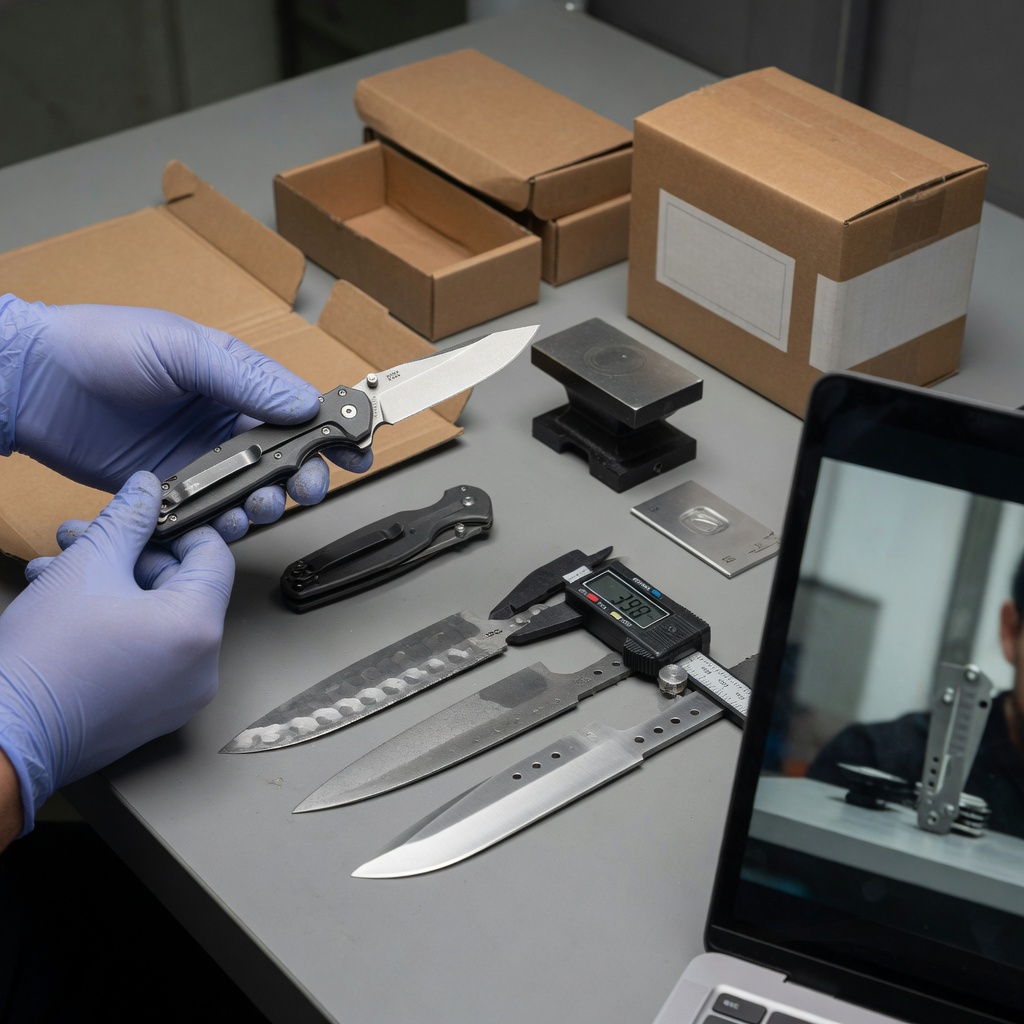
United States B2B buyers should complete a knife wholesale supplier communication workflow review before they compare unit price or release sample funds. Treat the review as a go/no-go control on written evidence. If the first two replies do not capture target channel, knife type, blade steel, lock type, packaging, inspection method, and United States marking and document inputs, the knife is still unspecified. An unspecified file raises the risk of sample rejects, rework, relabeling, or a weak customs-entry description.
For knife wholesale supply, an unexplained liner lock versus frame lock, an unnamed steel grade, or a silent pack-out is a production risk, not a merchandising preference.
Go only when one named owner returns a usable specification, a sample-acceptance method, carton and Incoterms inputs, and a production-update cadence. Withhold sample payment when the first replies are price-only, lock or steel is still unnamed, packaging and origin marking are postponed, video or measured stills are refused, or a United States delivery offer never asks how the knife will be described, marked, or packed.
Byline: Vincent Xi, Editorial Author. Profile: https://tangforge.com/authors/vincent-xi/. The review does not present factory visits, laboratory tests, named customers, awards, certifications, or production-floor experience as evidence. Citation of a source page is not a supplier endorsement.
How this review was prepared, and what it does not claim
This is an editorial communication workflow review for knife wholesale supply, addressed to United States buyers who specify, compare, verify, approve, and order. It is not a steel-selection catalog, a lock-type encyclopedia, a duty-rate table, or a complete import guide. It draws on two source contexts: a retailer-facing wholesale sourcing guide that treats supplier questions as a quality-control signal, and a published ODM procurement sequence that lists process steps from demand confirmation through production photo and video updates. A third manufacturer homepage is cited only for its public claims about communication cost and speed, which remain marketing statements until they appear as named fields on a quotation.
Methodology: The scoring model compares the first two written exchanges against a frozen specification, a sample-acceptance method, and a production-update cadence. Every process interval is attributed to the publisher of the cited page. Homepage testimonials are converted into contract fields (named owner, reply window, rendering count, photo stations). Process intervals are attributed to cited publishers rather than to independently timed supplier inboxes, sample lots, or production lines. Search-volume, CPC, difficulty, traffic, or ranking figures are not used; none are stated or implied for the primary topic. Research-source evidence supports editorial process claims only; it is not keyword-demand evidence.
Limitations / what to verify: Vendor-stated intervals are not treated as independently timed measurements. Duty, additional tariffs, and HTS classification must be confirmed with a licensed United States customs broker as of the RFQ date and again as of the ship window. Marking, consumer-product, and food-contact questions require qualified counsel. Require the live project’s named contact, sample protocol, and update cadence in the quotation—not in a brochure.
Why United States buyers should treat communication as a quality-control gate
A supplier can look complete on a catalog page and still be weak in production. The cited retailer sourcing guide tells buyers to check communication speed and whether the supplier asks about target market, knife type, blade steel, lock type, packaging, and inspection needs. It also states that communication is part of quality control, and that a supplier who only sends prices—or who cannot explain differences such as liner lock versus frame lock—may not be a suitable partner. How Can Retailers Buy Knives Wholesale Without Creating Sourcing Problems?
For United States programs in retail cutlery, private-label folding knives, foodservice blades, or industrial utility knives, those unanswered questions become later defects: steel that does not match a corrosion or dishwasher claim, lock geometry that fails a return test, cartons that miss origin marking, or inspection photos that do not match the drawing.
The trade-off is calendar time versus specification risk. A unit price returned before specification questions is faster at quoting and slower at sample rejection, rework, relabeling, or a missed hold point. A slower first reply that lists steel grade, lock type, hardness method, packaging dieline, and inspection stations costs days up front and reduces change orders after deposit.
Communication workflow review: score the first two exchanges before you fund samples
Use the first two written exchanges as a scoring pass on evidence, not as a personality test. If those messages do not produce a usable specification, do not pay for samples yet.
Demand and channel
- Is the knife for United States retail, e-commerce fulfillment, foodservice, industrial, or promotional use?
- What claims will appear on packaging or a product page (kitchen, EDC, hunting, serrated, dishwasher-safe, and similar)?
- What volume band is being planned, even if the first order is a pilot?
Product architecture
- Knife type: fixed blade, folding, kitchen, or another construction the RFQ names.
- Blade steel as a grade, not only “stainless.”
- Heat-treat target and how hardness will be measured in production.
- For folders, lock type in writing. A liner lock uses a lock bar formed in the liner; a frame lock uses a lock bar that is part of the handle scale. They machine differently, fail differently, and constrain handle materials differently. A wholesale partner who will not discuss that trade-off is not ready to freeze a drawing.
- Edge, finish, handle material, hardware, clip, and pivot stack.
Packaging, marking, inspection, and landed-cost inputs
- Bulk versus retail pack; insert; hang card; window box.
- Country-of-origin mark location on the knife and on the master carton.
- Inspection stations: material, grind, heat-treat, assembly, lock function, cosmetics, packing.
- Evidence method: measured still photos, video, or both.
- Carton outer dimensions, gross and net weight, packing quantity, Incoterms, and the United States destination or port used for delivery planning.
Typical ODM knife procurement steps from demand confirmation to production updates
One published ODM sequence for knives and tools starts with demand confirmation and target-market analysis through proactive client communication. It then describes category recommendations in 1–2 days, followed by product selection, customization confirmation with renderings, quotations, remote sample review via video conferencing, and mass production with regular photo and video progress updates. An ODM Procurement for Knives and Tools: From Demand to Production
Data point 1. Category recommendations in 1–2 days (unit: calendar days; scope: the ODM process described on that procurement page; as-of: as published on the cited page, not presented as a stopwatch-audited measurement; source: Shieldon ODM article). Copy a buyer-required recommendation window into the RFQ and record actual elapsed time on the live thread.
Data point 2. Remote sample review via video conferencing (scope: the same published sequence; as-of: as published on the cited page; source: Shieldon ODM article). The agenda should include lock function, blade centering, grind, logo placement, handle fit, and packaging fit against the drawing.
Data point 3 (example assumption to verify in the supplier quote, not a published industry standard). A United States buyer may require a 1-business-day written reply to specification questions and a 48-hour written deviation list after video sample review (units: business day and hours; scope: buyer-imposed SLA for comparing two knife wholesale files; as-of: the RFQ date). Do not treat those numbers as a certification or as a measured, timed result.
Map the sequence to buyer gates the United States importer actually owns:
- Demand confirmation — channel, claims, and volume band in writing.
- Construction recommendation — steel, lock, handle, with trade-offs stated.
- Rendering and BOM freeze — colors, logo process, hardware.
- Quotation — Incoterms, MOQ, sample cost, lead time, payment, inspection, carton cube, and weights.
- Sample — measured photos plus live video; signed deviation list.
- Golden sample freeze — retained by buyer and supplier.
- Mass production — photo/video at named stations, not only at shipment.
- Final inspection and United States document pack.
Some manufacturers state that a local industrial chain cuts communication costs and speeds delivery, and they publish testimonials that praise fast manager replies, renderings, samples, and support through ordering and manufacturing. LeeKnives Those statements are useful only after they are rewritten as named contacts, revision limits, sample calendars, and production-update cadence on the proforma invoice. Homepage speed claims are not reply-time measurements for the buyer’s file.
Measurable trade-offs: speed, completeness, and who owns the specification
| Trade-off | Faster quoting signal | Cost of that speed | Stronger control to put in writing |
|---|---|---|---|
| First reply | Unit price before questions | Open steel, lock, and pack | Questions first, price second |
| Sample method | Beauty photos only | Hidden lock rock or off-center blade | Video plus caliper photos |
| Production reporting | “Updates only if there is a problem” | Late logo, heat-treat, or grind errors | Scheduled photo/video at named stations |
| Contact model | Shared inbox | Lost context across shifts and holidays | Named owner and backup on the PO |
| Packaging timing | Discuss after sample | Origin-mark and barcode misses | Dieline and marking rules with the RFQ |
| Landed-cost data | EXW price only | Incomparable freight and duty math | Carton cube, net weight, and Incoterms from the same owner |
Example calculation to verify in the supplier quote (not a market price). Suppose two 3,000-piece folding-knife lots (example quantity; unit: pieces; scope: a single private-label SKU; as-of: planning assumption). A 10% unit-price gap (example percentage, not a quoted discount) is not a saving if lock type is still unnamed and origin marking is still “standard export carton.” Relabeling 3,000 blades after arrival is a per-piece labor event. Capture lock callout and mark location before tooling.
Example calculation to verify in the supplier quote (not a freight tariff). Using the same 3,000-piece planning file, 50 pieces per master carton produces 60 cartons (units: pieces and cartons; scope: one SKU; as-of: RFQ planning assumption). Without carton outer dimensions in cm and gross weight in kg from the same project owner who answers steel and lock questions, two United States landed-cost worksheets are not comparable.
Warning signs in wholesale knife supplier messages
- A price list with no questions about United States channel, steel, lock, packaging, or inspection.
- No written explanation of liner lock versus frame lock when the RFQ is a folder.
- Packaging, UPC, and origin marking postponed until after sample payment or tooling.
- Renderings that do not match the quoted bill of materials.
- A sample shipped without a measurement sheet (blade thickness, overall length, hardness if claimed).
- A rotating unnamed inbox instead of a project owner.
- Refusal of video review for lock function and blade centering.
- A generic “always do QC” assurance with no station list, photo protocol, or hold point.
- A DDP United States offer that never asks how the knife will be described for entry, marked, or packed.
- Carton cube, weights, and packing quantity promised “later,” after the unit price is already being compared.
These are process risks. They are sufficient reason to withhold sample funds until the file is specified.
Buyer decision table: compare communication workflows before sample funds
Every row is a specify, compare, verify, approve, or order action.
| # | Decision criterion | Stronger communication workflow | Weaker communication workflow | Buyer action |
|---|---|---|---|---|
| 1 | Opening questions | Asks target market, knife type, blade steel, lock type, packaging, inspection | Sends catalog SKUs or unit prices only | Do not approve sample payment until a written spec questionnaire is returned |
| 2 | Lock literacy | Explains liner lock vs. frame lock (or the RFQ’s lock) and function tests | “Folding knife” with no geometry | Require lock type on the drawing and PO |
| 3 | Steel and heat-treat | Names steel grade, hardness range, and test method | “Stainless, good quality” | Freeze steel and HRC range; require heat-treat records at production |
| 4 | Recommendation window | States a dated window (vendor-stated example: 1–2 days on one ODM page) | No date | Write the required window into the RFQ; log actual days |
| 5 | Sample review | Video conference plus measured stills | Unmeasured photos | Approve only against a signed deviation list |
| 6 | Production visibility | Regular photo and video at named stations | Updates only at shipment | No balance payment without the agreed photo pack |
| 7 | Packaging and marking | Requests dieline and country-of-origin location | “Standard export carton” | Attach marking rules; reject artwork that omits origin |
| 8 | Ownership | Named project contact and backup | Anonymous or rotating names | Print names on RFQ, PI, and PO |
| 9 | Landed-cost inputs | Asks Incoterms, carton weights, and packing quantity | EXW price with no pack-out | Do not compare landed cost until cube and weights exist |
| 10 | Change control | Written ECO for steel, lock, logo, packaging | Verbal “small change” | No mass production without frozen BOM and artwork |
Practical RFQ checklist for United States knife wholesale supply
Copy these items into the RFQ. Each item is there to specify, compare, verify, approve, or order.
A. Ownership and reply rules
- Named project manager, email, and backup; buyer-required written reply window (example assumption to verify in the quote: 1 business day for specification questions).
- English as the language of record for specifications, deviation lists, and purchase orders.
- Currency of record for comparison (state USD if that is how the United States buyer will compare files).
B. Product freeze (state units on every dimension)
- Knife type; overall length and blade length in mm; blade thickness in mm; mass target in g.
- Blade steel grade (a specific designation, not only a marketing name).
- Hardness range and test method; how many pieces will be hardness-checked in production.
- Lock type and function test for folders; explicit liner-lock vs. frame-lock callout if applicable.
- Edge, finish, logo method (etch, stamp, print) and location on the blade or handle.
- Hardware BOM: screws, washers, clip, pivot, adhesives.
C. Packaging, labeling, and United States entry
- Pack type (bulk, hang card, window box, gift box) and dieline file.
- Country-of-origin marking method and location on the knife and master carton. Distinguish the statutory marking requirement for imported articles under 19 CFR Part 134 from any supplier “standard export carton” practice. Carton marking does not replace article marking unless the buyer’s broker confirms that an exception applies.
- Buyer-supplied retail artwork, barcodes, and any warning copy the buyer’s counsel requires (including California Proposition 65 artwork if the buyer’s counsel says it applies).
- If the knife is kitchen/food-contact: supplier disclosure of food-contact materials; buyer legal review of FDA status. Do not treat a catalog claim as clearance.
- Carton outer dimensions in cm, carton gross and net weight in kg, packing quantity, and pallet pattern; photos of a closed packed carton.
- Incoterms, United States destination or port, and which party files United States entry; supplier cooperation on product description while the buyer’s broker confirms HTS.
- Commercial-invoice wording that the buyer can send to the broker; do not let informal duty percentages replace the broker’s classification.
D. Sample approval
- Sample quantity, cost, lead time, sample freight payer, and whether sample steel matches the production heat.
- Video-review agenda and still-photo protocol (calipers on thickness; centering photos; lock close-up).
- Written approve / reject / deviate form; golden-sample retention on both sides.
E. Production communication and inspection
- Photo/video cadence (example assumption to verify in the quote: grind, heat-treat, assembly, and packing—not “as needed”), with station name, date, and lot on each file.
- Inspection plan: dimensions, lock, centering, hardness, cosmetics, packaging; AQL only if the buyer specifies it. AQL is a buyer-chosen sampling rule, not a substitute for named hold points.
- Hold points that require the buyer’s written release before the next station.
- Change-order rule: no steel, lock, logo, or packaging change without a written ECO.
- Shipment pack: invoice, packing list, origin documents, inspection report, material declarations.
F. Commercial terms that depend on the same thread
- MOQ, quantity breaks, currency, payment terms, sample terms, and tooling ownership.
- Lead time from golden-sample approval to ready-to-ship, in calendar days.
- Rework path if a communication hold point is skipped (buyer legal review).
United States labeling, landed cost, and delivery controls in the same thread
Do not open a second conversation about import after steel is already cut. Keep these controls inside the same communication thread as steel, lock, and sample evidence:
- Classification. The buyer’s United States customs broker confirms HTS and any additional tariffs as of the ship window. A supplier’s informal duty percentage is not the landed-cost source of record.
- Marking. Imported articles are subject to United States country-of-origin marking rules under 19 CFR Part 134. That is a statutory marking requirement, not a factory house style. The RFQ should state where the mark appears on the knife and on the carton.
- Kitchen knives. Material declarations for parts that touch food; buyer counsel on food-contact status. A catalog “food-grade” line is not FDA clearance.
- Consumer goods. The buyer owns the consumer-product compliance strategy; the supplier executes the agreed construction and artwork.
- Landed cost. Net weight, carton cube, packing quantity, and Incoterms must come from the same owner who answers lock and steel questions. A workflow that cannot produce carton data cannot produce a comparable landed cost.
- Delivery. Mode, United States destination or port, and document timing belong on the named project contact’s checklist.
Current duty rates are not restated. Rates are HTS- and date-specific and must be verified at RFQ and again before cargo is booked.
How to score the first week without inventing a grade
After the RFQ is sent, keep a log:
- Business hours or days to the first substantive reply (questions versus price-only).
- Whether liner lock versus frame lock (or the RFQ’s equivalent construction) was addressed in writing.
- Whether packaging and origin marking were requested before sample payment.
- Whether video sample review was offered with a measurement protocol.
- Whether carton cube, weights, Incoterms, and a United States delivery point came from the same named owner.
- Whether one named person owns the file.
Compare two suppliers on that log plus the decision table. The lower unit price is not the decision while steel, lock, pack, inspection, and landed-cost inputs are still open. Vendor-stated intervals such as the 1–2 day category-recommendation example must be re-measured on the live email thread. Testimonials about convenient communication are not a substitute for a frozen BOM, a golden sample, and a photo/video production cadence.
Discuss Your Requirements
Review our manufacturing capabilities, then share your specifications for a supplier-fit review.