Knife wholesale supplier product development capability for United States RFQs
Byline: Vincent Xi — Editorial Author.
United States B2B buyers assessing a knife wholesale supplier's product development capability should look for a traceable path from request to release: a controlling specification, written feasibility response, priced sample, aligned quotation, and production authorization. OEM, ODM, private-label, and custom-service language is an RFQ starting point, not proof that a particular knife configuration is feasible.
Compare quotations only after the supplier identifies accepted features, proposed substitutions, sample obligations, tooling, minimum order quantity, labeling scope, and delivery responsibility. Keep the quotation, sample, and production specification tied to the same revision.
This article is limited to knife product-development decisions for United States wholesale supply. The cited supplier pages are attributed, undated reference points; they do not establish current capacity, independently verified performance, or an approved commercial offer.
Verify product development capability for United States knife orders
Read capability from the supplier's response to the proposed knife, not only from a service label. The source contexts below are descriptions on linked supplier pages. Their publication and capture dates are unavailable, so current terms must be confirmed in the RFQ.
| Source context | What the cited page describes | Evidence to request for the RFQ |
|---|---|---|
| OEM and private-label knife sourcing | The page describes a request process covering SKU, quantity, market, requested changes, and timeline, with feasibility before quotation, samples, and approved production. | A written feasibility response identifying accepted features, rejected features, substitutions, tooling needs, and unresolved questions before price comparison. |
| World Backyard wholesale and custom manufacturing | The page describes OEM and ODM work beginning with sketches, CAD files, or reference samples. It lists blade, handle, logo, finish, size, and packaging changes and also refers to ready-to-produce designs. | A quotation stating whether the work modifies an existing knife, applies branding or packaging, follows buyer drawings, or adapts a ready design. |
| LeeKnives OEM service | The page describes mock-ups, prototypes, feasibility trials, and test samples. Listed customization areas include steel, shape, handle, grind, bolster, tang, and add-ons. | A development plan identifying deliverables, approval criteria, revision charges, and records required for the requested characteristics. |
Treat these pages as prompts for evidence, not as proof that an unquoted material combination, mechanism, tolerance, or package can be supplied. A reference to test samples is not a test report, and a quality-control description is not certification. Require acceptance of the actual specification in writing.
Use supplier-stated figures as RFQ checks
The following figures are supplier-stated references, not benchmarks. Each cited excerpt is undated; publication and capture dates are unavailable, and current applicability is unverified. Use the figures to frame questions rather than to set a purchase baseline.
| Data point | Attributed figure, scope, source, and as-of context | Buyer control |
|---|---|---|
| Stated standard minimum order quantity | 100–300 pieces per model, as stated on the World Backyard page. Scope: the page's stated standard MOQ, not an accepted minimum for the buyer's custom configuration. As-of context: undated source excerpt; publication and capture dates unavailable. | Require the minimum for the specified model and revision, including changes caused by materials, branding, packaging, or tooling. |
| Stated mass-production window | 30–45 days after sample approval, as stated on the LeeKnives OEM page. Scope: the page's stated mass-production window. As-of context: undated source excerpt; publication and capture dates unavailable. The excerpt does not establish the calendar-day or business-day basis or a United States arrival date. | Require defined start and completion milestones, day basis, exclusions, and separately quoted development and delivery intervals. |
| Stated quality-control process | Four quality-control steps per the described OEM process, as stated on the LeeKnives OEM page. Scope: the supplier's process description, not a certification or independently verified inspection result. As-of context: undated source excerpt; publication and capture dates unavailable. | Ask for the characteristics, methods, acceptance limits, sampling plan, records, and nonconformance response applicable to the approved knife. |
Do not convert these references into market averages or delivery guarantees. Require the quotation to separate feasibility work, tooling, sample revisions, production, inspection, freight, entry, and inland delivery.
Make the knife development specification measurable
Use a controlling drawing, CAD file, or reference sample and assign it a revision. State which document prevails if dimensions, photographs, artwork, and email instructions conflict. Treat photographs as reference-only unless their controlling features are explicitly accepted.
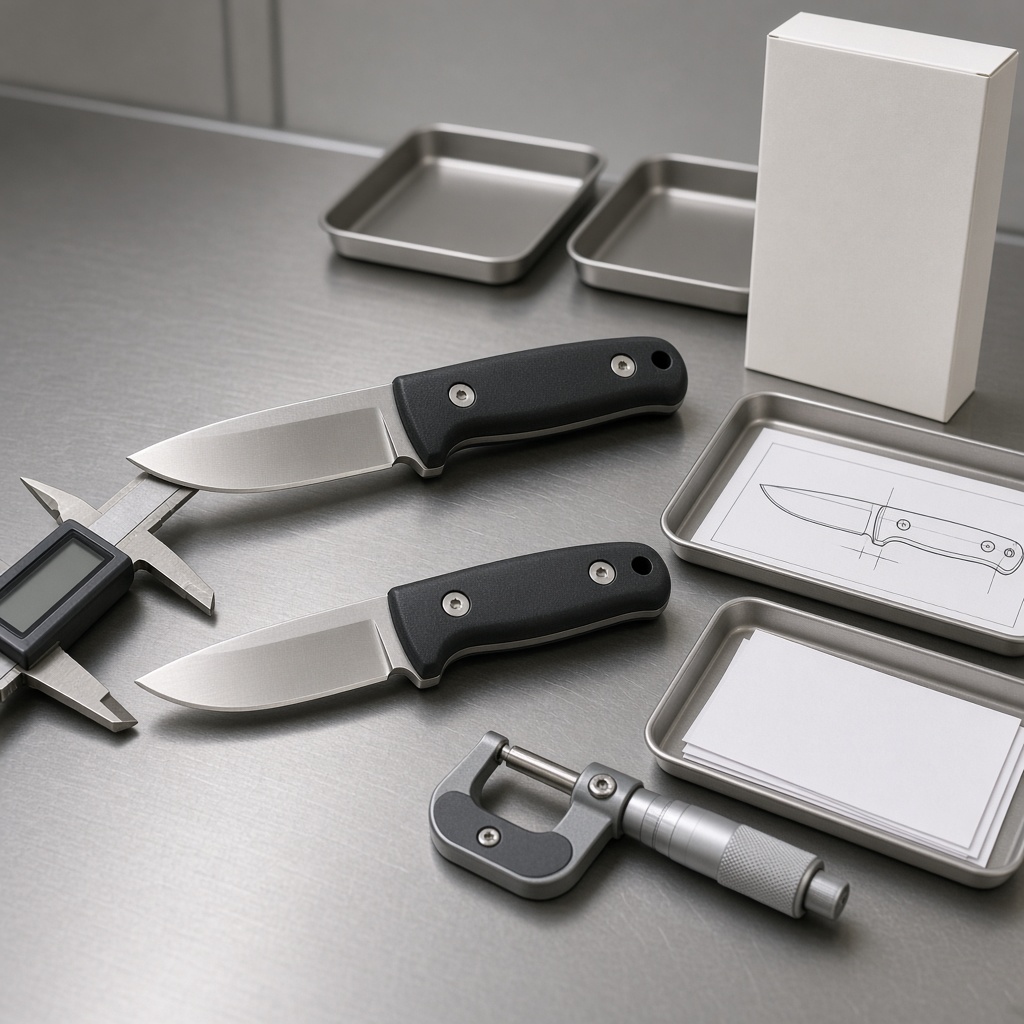
Illustrative buyer-design example—not a supplier product specification: a plain-edge, drop-point fixed-blade knife with buyer-selected stainless steel, a satin finish, full-tang construction, and mechanically fastened black polymer scales. Every dimension and tolerance below is an example assumption to verify in the supplier quote. None is a published capability, measured result, or industry-standard tolerance.
| Characteristic | Example target to verify in the supplier quote | Measurement definition to agree |
|---|---|---|
| Overall length | 210.0 mm nominal; ±1.0 mm proposed tolerance, for the assembled example knife. | Tip-to-handle-end distance along the drawing's defined axis; identify the fixture and measurement tool. |
| Blade length | 100.0 mm nominal; ±0.5 mm proposed tolerance, for the example knife's exposed blade. | Tip to the specified handle-front datum; distinguish this from curved cutting-edge length. |
| Spine thickness | 3.0 mm nominal; ±0.2 mm proposed tolerance, at the example drawing's designated flat-spine station. | Measure at the marked station, not on the bevel; identify the contact faces. |
| Handle thickness | 16.0 mm nominal; ±0.5 mm proposed tolerance, at the example drawing's designated grip station. | Specify the contact surfaces and whether projecting fastener heads are included. |
Require the supplier to confirm whether measurements apply after finishing and final assembly. Agree on measurement-tool suitability, calibration evidence, recording format, and acceptance limits before evaluating the sample.
Specify the exact steel designation, handle-material grade, grind, tang construction, finish reference, hardware, logo location, and packaging configuration. If hardness, corrosion performance, or another tested characteristic matters to acceptance, name the required method, specimen or location, acceptance limit, and lot-linked report. Do not substitute a general quality-control description for that evidence.
Tie sample approval to production release
Use a pass-or-hold record for the proposed knife. Sample approval should not authorize unstated substitutions.
| Release gate | Required record | Hold condition |
|---|---|---|
| Feasibility | Supplier response against the controlling revision, with exceptions and proposed substitutes identified. | Material, construction, tolerance, mechanism where applicable, or packaging remains unresolved. |
| Sample evaluation | Sample identifier, drawing revision, measured results, appearance reference, packaging artwork, and discrepancy disposition. | The sample cannot be matched to the quoted specification or required acceptance evidence is missing. |
| Commercial approval | Agreed sample and revision charges, tooling scope, ownership or reuse rights, production price, and delivery basis. | Development costs or obligations are bundled so alternatives cannot be compared. |
| Production release | Buyer authorization identifying the approved sample, specification revision, permitted deviations, and inspection requirements. | The supplier proposes an unapproved change or cannot identify the production acceptance baseline. |
Require a priced revision process: define which changes trigger another sample, who pays, and how the schedule is reset. Agree on inspection sampling, defect definitions, lot traceability, and rework, replacement, or refund terms before placing the production order. Sample approval does not eliminate the need to define production inspection.
Control United States labeling, landed cost, and delivery at release
Treat labeling and packaging as development deliverables. The World Backyard source description refers to branding and packaging customization; it does not establish the legal sufficiency of any label for a United States sales channel.
Require proposed country-of-origin wording, marking method, and location to appear in the approval package. Identify retail-pack and shipping-pack artwork, barcode responsibility, and any channel-specific information the buyer requires. Have the buyer's broker or counsel review the finished design, classification, origin-marking proposal, and intended United States sales channel, including any opening or locking mechanism where relevant. Do not release production while a legal or channel-acceptance assumption remains unresolved.
Build a quote-comparison worksheet with merchandise value, packaging not already included, origin charges, freight, insurance where applicable, broker or port charges, confirmed duties or taxes, and inland United States delivery. Show sampling, tooling, and revision costs separately, or identify their allocation explicitly. Avoid double counting; mark unresolved amounts as unpriced rather than assigning them a zero value.
Record currency, quotation validity, the commercial delivery term or Incoterm used, named place, payer, exclusions, and delivery endpoint. Compare quotations only on an aligned scope. The cited excerpts provide no verified United States delivered price, freight charge, or tariff rate; obtain transaction-specific figures rather than inferring them from MOQ or production time.
Define the need-by date at the agreed United States receiving location. Require a milestone schedule covering development, approval, material readiness, production completion, inspection release, shipment, entry, and inland arrival. Identify any payment or artwork approval that starts the production clock. Agree on delay notice, corrective options, and buyer authorization for expedited freight or substitution.
Require the invoice, packing list, packaging description, lot identification, and approved specification record to agree before shipment release.
RFQ Checklist
- Specify a controlling drawing or reference sample and list overall length, blade length, spine thickness, handle thickness, steel designation, handle material, grind, tang, finish, hardware, packaging, and the inspection unit system.
- Ask the supplier to state whether the request modifies an existing model, applies branding or packaging, follows buyer specifications, or adapts a ready design, and to identify any tooling.
- Require the manufacturer to return accepted features, rejected features, substitutions, and open feasibility questions before the quotation is compared.
- Specify quantity by model and require MOQ, sample quantity, sample and revision charges, tooling, unit price, packaging, freight, and delivery responsibility as separate quotation lines.
- Ask the supplier to state what starts and ends its production-day count, whether days are calendar or business days, and how development, transit, entry, and United States delivery are scheduled separately.
- Require the manufacturer to show proposed country-of-origin marking wording, method, and location in the approval package and to identify the retail pack and shipping pack.
- Specify the commercial delivery term or Incoterm, named place, United States need-by date, payer responsibilities, and shipment documents required for the lot.
- Verify that cited quality-control steps correspond to named characteristics, methods, acceptance limits, sampling, and records; request a current supporting document for any certification claim.
- Compare quotations only after file revision, quantity, materials, construction, packaging, channel, and delivery scope are aligned.
- Require the manufacturer to match the approved specification and sample for steel, construction, mechanism where applicable, handle, finish, logo position, packaging, and approved origin marking; withhold release for unapproved changes.
- Require inspection criteria, lot traceability, nonconformance reporting, and agreed rework, replacement, or refund terms before ordering.
Methodology and what to verify
The evidence is separated into attributed supplier-page descriptions, supplier-stated numerical references, and buyer-side procurement controls. The sourced figures are transcribed from undated excerpts and retain their units, scope, attribution, and missing-date limitation. The dimensional table is an explicitly labeled RFQ example, not product measurement data. This package presents no production observations, independent test findings, customer outcomes, or certification findings.
The principal limitations are unavailable publication and capture dates, unconfirmed current commercial terms, and the absence of specification-linked acceptance records in the evidence presented here. Reconfirm feasibility, drawing revision, material requirements, sample approval, MOQ, development charges, inspection criteria, marking, delivery terms, and milestone dates in the current quotation and purchase order. Obtain broker or counsel confirmation for the finished knife and transaction. These references do not qualify a supplier, determine legal compliance, or guarantee delivery.
Discuss Your Requirements
Review our manufacturing capabilities, then share your specifications for a supplier-fit review.