Pocket Knife OEM Customization Options for RFQs in Europe
By Vincent Xi, Editorial Author
For B2B buyers in Europe, pocket knife OEM customization options become quotable only when each change is tied to a controlled product baseline. The RFQ should identify the destination and sales route, drawing and bill-of-materials revisions, quantity by variant, measurable acceptance rules, required evidence, and the party responsible for release.
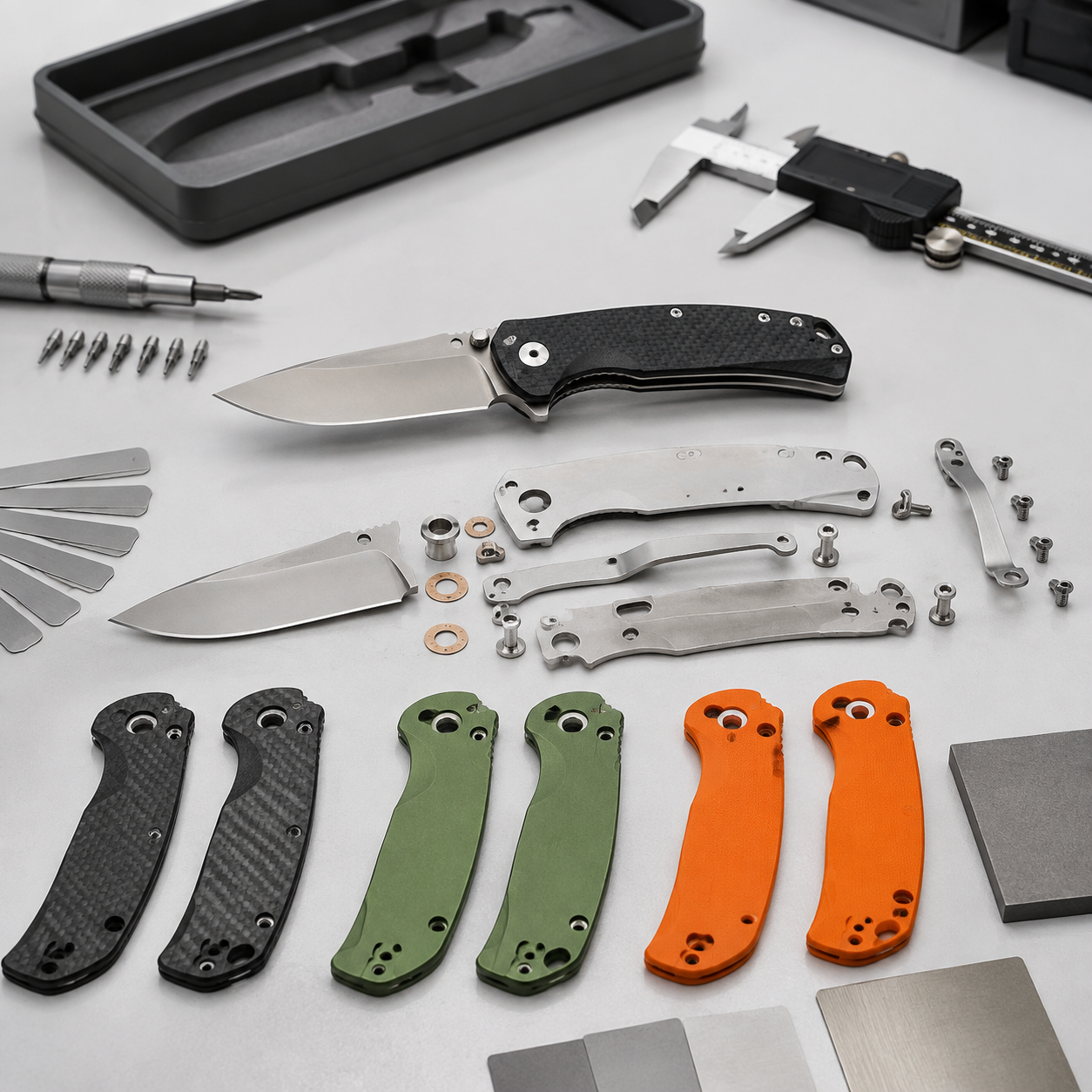
Separate appearance changes from changes that affect construction. Marking, handle color, scale material, blade material, blade geometry, finish, pivot hardware, lock configuration, clip position, and packaging should have distinct quotation lines. Any option that changes an interface or production process should return to manufacturability review and production-equivalent sample approval.
This is a buyer-side control framework. It does not establish that a particular supplier offers an option, can hold an unspecified tolerance, or can supply a legally suitable configuration for every European destination. Candidate suppliers should respond to the same requirements matrix so price, evidence, deviations, and unresolved risks can be compared on the same basis.
Define pocket knife customization options for Europe
Use the matrix below to convert customization requests into controlled RFQ decisions. Confirm every capability through the supplier's signed response, revision-controlled documents, approved samples, and production evidence.
| Customization option | Buyer-controlled input | Supplier response required | Release evidence |
|---|---|---|---|
| Base platform and construction | Supplier platform reference or buyer drawing, opening method, lock type, handedness, closed envelope, target mass, and components that must remain unchanged | Identify standard, proprietary, and custom components; affected tooling; available modifications; and every deviation | Assembly drawing, bill of materials, construction sample, and signed deviation list |
| Brand marking | Controlled vector artwork, location, orientation, maximum area in mm, process, contrast, cosmetic zone, and permanence method | State the marking process, substrate preparation, setup charge, production location, subcontractor status, and inspection method | Artwork proof, production-equivalent coupon, approved appearance sample, and inspection record |
| Handle color, texture, and material | Exact material designation, color reference, finish, dimensional limits, viewing conditions, interface requirements, and substitution policy | Confirm material availability, processing route, material minimums, expected variation, proposed equivalents, and quotation effect | Material record, limit samples, production-equivalent scales, and dimensional report |
| Blade steel and heat treatment | Steel designation, permitted substitutions, hardness range in HRC, test location, measurement method, sampling rule, and traceability requirement | Identify material-document availability, heat-treatment source, batch controls, subcontracting, and price effect | Scope-matched material record, batch-linked heat-treatment record, hardness results, and sample inspection |
| Blade profile, grind, edge, and finish | Controlled CAD revision, dimensions in mm, datums, stock thickness in mm, grind geometry, edge angle in degrees, tip geometry, finish process, masked interfaces, and acceptance method | Return a manufacturability review covering process limits, fixtures, closure clearance, tolerance proposals, dimensional effects, and inspection access | First-article report, closure-clearance result, finish coupon, controlled engineering sample, and approved deviations |
| Pivot, lock, fasteners, and clip | Materials, geometry, thread requirements, assembly torque, force or torque conditions, blade-play method, lock criteria, and clip position | Provide a tolerance-stack review, assembly method, gauge plan, proprietary-component status, and service-part position | Stack-up drawing, assembly specification, functional sample, gauge method, and inspection results |
| Packaging and included items | Pack structure, materials, packed dimensions and mass, blade protection, required warnings, languages, barcode ownership, and transit conditions | Itemize structural and print setup, material minimums, language variants, packing work, and logistics effects | Blank structure, controlled artwork proof, packed sample, material declarations, and agreed transit-test plan |
The Vast State customization article is used as commercial context for customization, tooling, minimum-quantity, lead-time, cost, and quality-control questions. It is not evidence that a candidate supplier offers a listed option or can meet the buyer's specification.
The Dauntless OEM production page is used only as first-party context for manufacturability and approval discussions. It does not verify folding pocket knife capability, capacity, tolerance performance, or suitability for a European release route.
Freeze the baseline before suppliers price variants
Issue every candidate supplier the same baseline package:
- Intended use, intended user, sales channel, and exact European destination countries.
- Route classification for the EU, a non-EU EEA destination, Great Britain, or Northern Ireland.
- Total order quantity, quantity per SKU, material and color allocation, forecast assumptions, and reorder assumptions.
- Supplier platform reference or controlled CAD, drawings, and bill of materials with revision identifiers.
- Target cost boundary and whether it includes tooling, samples, testing, inspection, packaging, freight, duty, tax, or other landed-cost inputs.
- Delivery term, named handover place, requested production window, and the event that starts the lead-time clock.
- Language variants, importer or other economic-operator responsibilities, online-listing information, and document ownership.
- Sample stages, approval authority, reference-sample control, inspection access, and production-release criteria.
For a supplier platform, require a list of the components, interfaces, tools, and processes that remain standard. For a structural change, require a written manufacturability response before tooling authorization. Each requirement should be marked accepted, deviated, or unresolved and linked to the affected drawing, tool, process, subcontractor, inspection method, and available evidence.
A catalogue image, verbal statement, or unreferenced sample does not define the production configuration. Evidence should identify the applicable requirement, SKU, drawing revision, material or batch where relevant, issuer, issue date, and approval status.
Write measurable acceptance criteria
Replace subjective phrases such as premium feel, strong lock, sharp edge, or perfect finish with observable limits. Each requirement should define a nominal value or limit, unit, datum, instrument or gauge, test position, applied condition where relevant, sample rule, acceptance rule, and required record.
| Characteristic | Specification fields | Method details required | Approval evidence |
|---|---|---|---|
| Closed envelope | Length, width, thickness, datums, and tolerances in mm | Blade position, clip inclusion, measurement points, and gauge type | Dimensioned drawing and first-article report |
| Blade geometry | Blade length, stock thickness, grind position, tip position, and edge angle | Datum definitions, measurement locations, fixture, and reporting resolution | CAD comparison, dimensional report, and controlled sample |
| Finished mass | Target and tolerance in g | Included accessories, packaging exclusion, scale resolution, and sample rule | Results linked to sample identities |
| Hardness | Target range in HRC | Test location, surface preparation, instrument, sampling, and treatment of indents | Batch-linked report with the test location identified |
| Opening and closing behavior | Force in N or torque in N.m, blade position, and conditioning state | Fixture, rate, measurement direction, cycle precondition, and retest rule | Method sheet and sample results |
| Blade play | Maximum displacement in mm under a stated load in N | Blade position, fixture, load point, direction, gauge, and preconditioning | Gauge record and results by sample |
| Lock function | Engagement geometry and pass-or-fail conditions for the fitted design | Inspection position, applied condition, gauge or visual reference, and rejection rule | Controlled sample and inspection record |
| Surface finish | Process, masked zones, appearance limits, and thickness in micrometres where applicable | Measurement location, substrate, instrument, lighting, and limit samples | Process declaration, coupon, thickness data, and appearance approval |
| Marking | Position, maximum area in mm, orientation, contrast, and permanence condition | Artwork revision, fixture, viewing method, and agreed test procedure | Artwork proof, coupon, sample, and inspection record |
| Packed product | Packed dimensions in mm, mass in g, component restraint, and blade protection | Pack orientation, measurement method, transit plan, and damage criteria | Packed sample and agreed test report |
Illustrative dimensional assumptions for hypothetical SKU EX-A, to verify in the supplier's CAD response, quotation, and samples: closed length of 100.0 mm with a tolerance of plus or minus 0.5 mm; blade length of 80.0 mm with a tolerance of plus or minus 0.5 mm under the buyer-defined drawing method; and blade-stock thickness of 3.0 mm with a tolerance of plus or minus 0.10 mm at a datum 10.0 mm behind the defined plunge reference. These values are not supplier data, recommended specifications, product claims, legal blade-length thresholds, or requirements from an external standard.
Review interacting choices together. The supplier response should address scale thickness against fastener engagement, finish build-up at pivot and lock interfaces, blade geometry against closed clearance, and steel selection against the proposed heat-treatment and grinding route. Resolve those interfaces against controlled drawings and production-equivalent samples.
Compare manufacturing quotes on the same basis
Request separate prices for recurring production, engineering, tooling, fixtures, color matching, finish setup, packaging setup, testing, inspection, and each sample stage. The quote should state whether a minimum applies to the complete order, each SKU, each color, each material, each finish, or each packaging-language variant.
| Quote element | Required disclosure |
|---|---|
| Production price | Included configuration, quantity break, variant allocation, currency, validity period, and tax treatment |
| Non-recurring charges | Purpose, payment trigger, ownership, storage, maintenance, modification, transfer, and replacement terms |
| Samples | Configuration, quantity, approval stage, included rounds, additional-round price, and timing |
| Materials and processes | Assumptions, permitted substitutions, subcontracted work, and price-adjustment conditions |
| Lead time | Starting event and dependencies on artwork, material, sample, packaging, document, and payment approval |
| Delivery | Delivery term, named handover point, packing configuration, and excluded logistics costs |
| Nonconforming product | Rework, replacement, rejected-unit, and approved overrun or underrun terms |
Illustrative commercial assumptions for hypothetical RFQ EX-A, to verify in the supplier quote: assume 2,400 finished units for the complete order, allocated across three SKU variants at 800 finished units per SKU. Assume a non-recurring tooling charge of EUR 1,800 for the complete order and a custom-packaging increment of EUR 0.35 per finished unit. Under these assumptions, EUR 1,800 divided by 2,400 finished units allocates EUR 0.75 of tooling to each finished unit. Tooling and custom packaging therefore add EUR 1.10 per finished unit. These figures are example inputs and calculations, not supplier prices, market benchmarks, or purchasing recommendations. They exclude freight, duty, tax, inspection, rejects, rework, replacement production, and financing.
Apply destination release controls across Europe
Europe is not a single legal release area. Record the destination and route for each SKU, and do not transfer a conclusion between the EU, non-EU EEA destinations, Great Britain, Northern Ireland, or individual countries without a current, documented review.
| Destination route | Source-supported boundary | RFQ and release action |
|---|---|---|
| EU | The official EU General Product Safety Regulation text states that Regulation (EU) 2023/988 applies from 13 December 2024 within its scope. Applicability and obligations still depend on the finished SKU, supply route, and economic operators | Map product identification, traceability, safety information, technical-documentation, manufacturer, importer, responsible-person, and distance-sale questions to the actual supply chain |
| Non-EU EEA destination | Do not assume that an EU conclusion applies automatically. Check the measure's EEA status, national implementation, language requirements, economic-operator structure, and product-specific rules | Retain the reviewed source, review date, reviewer, destination, and approved product configuration |
| Great Britain | The UK government's knife buying and carrying guidance provides starting context but is not a configuration-specific release decision | Review the actual blade configuration, opening and locking method, sale route, age-control process where applicable, warnings, records, and relevant jurisdiction |
| Northern Ireland | Do not rely solely on a Great Britain or EU conclusion for a Northern Ireland route | Record the applicable product-safety, market-access, sale, and knife-rule analysis for the finished SKU and supply route |
| Named European country | Knife sale, possession, carrying, age-control, warning, and language questions require a destination-specific decision | Have a qualified reviewer assess the finished configuration and sales method, then link the conclusion to the controlled SKU revision |
For material and chemical review, list the actual blade and fastener alloys, coatings, polymers, adhesives, oils, and packaging components. The European Chemicals Agency REACH overview provides regulatory context but is not a material declaration, test report, or SKU-level compliance decision. Supplier evidence should identify the issuer, declared or tested material, applicable component or SKU, scope, issue date, validity period or batch where relevant, and exclusions.
The European Commission's CE-marking guidance states that CE marking is required only for products covered by EU rules that require it and must not be affixed to products outside those rules. Determine the legislation applicable to the finished configuration before making a marking decision. If customization introduces another potentially regulated function, reassess that finished SKU.
Legal obligations apply only within their respective scope. The specification matrices, sample gates, and change controls in this article are buyer-defined procurement practices. A supplier's internal test becomes a contractual requirement only when the method and acceptance rule are documented and agreed. Name an external standard only after checking its current edition, product scope, method, acceptance criteria, and any required laboratory scope. Do not imply certification without a current, scope-matched document.
Set sample, inspection, and change controls
Use documented approval gates that match the customization risk.
| Gate | Decision | Minimum evidence |
|---|---|---|
| Manufacturability review | Whether the proposed configuration can proceed to sampling | Requirement matrix, marked drawings, tolerance response, process route, tooling proposal, and unresolved deviations |
| Appearance approval | Whether color, texture, finish, and marking limits are acceptable | Controlled artwork proof, finish coupons, limit samples, viewing conditions, and approver record |
| Engineering sample | Whether geometry, interfaces, assembly, and function meet the agreed specification | Revision-linked samples, dimensional results, functional results, material records, and approved deviations |
| Packaging approval | Whether the product is restrained, protected, and presented in the controlled pack | Blank structure, controlled artwork, packed sample, material record, and agreed transit method |
| Production release | Whether the approved configuration and evidence are complete | Current drawing and bill-of-materials list, signed approvals, quality plan, reference-sample identity, and change declaration |
| Repeat-order release | Whether the current order still matches the approved configuration | Current revision list, supplier change statement, valid documents, and pre-production confirmation |
The quality plan should define defect classes, inspection timing, sampling method, gauges, measurement conditions, functional checks, record retention, and disposition of nonconforming lots. Relevant characteristics may include closed-blade retention, lock engagement where fitted, opening and closing behavior, blade play, fastener security, exposed sharp areas outside the intended cutting edge, marking accuracy, finish limits, and destination-required information. The buyer and supplier must agree the actual methods and acceptance limits.
Require written approval before changing a material, component geometry, heat-treatment source, coating source, marking process, subcontractor, tool, process location, packaging material, or inspection method. Repeat orders should reference controlled documents and approved samples, not a photograph or previous invoice description.
Pocket knife OEM customization RFQ release checklist
- [ ] List every intended European destination and classify the route as EU, non-EU EEA, Great Britain, Northern Ireland, or country-specific review.
- [ ] State intended use, intended user, sales channel, total quantity, quantity per SKU, variant split, and cost boundary.
- [ ] Identify the supplier platform or attach controlled CAD, drawings, and bill of materials with revision identifiers.
- [ ] Mark critical dimensions and define tolerances, units, datums, gauges, measurement conditions, and acceptance rules.
- [ ] Specify blade steel, substitution policy, heat-treatment target, hardness range, test location, sampling, and batch evidence.
- [ ] Specify handle, liner, pivot, washer, fastener, clip, adhesive, lubricant, and coating materials.
- [ ] Define blade profile, grind, edge geometry, opening method, lock behavior, clip position, and closed retention.
- [ ] Attach controlled artwork and define marking process, location, area, orientation, contrast, and permanence method.
- [ ] Define color references, cosmetic zones, finish limits, viewing conditions, defect classes, and limit samples.
- [ ] Require the supplier to identify standard components, custom components, proprietary parts, proposed equivalents, and subcontracted processes.
- [ ] Request itemized production, engineering, tooling, fixture, sample, packaging, testing, and inspection charges.
- [ ] State whether minimums and prices must be returned by order, SKU, color, material, finish, and packaging language.
- [ ] Define sample stages, approval authority, reference-sample control, inspection access, and resampling requirements.
- [ ] List safety, traceability, material, chemical, packaging, and economic-operator evidence required for each destination.
- [ ] Assign responsibility for destination legal review, importer checks, technical records, online-listing information, and final release.
- [ ] Require all deviations and unresolved questions in a signed requirement matrix before purchase-order approval.
Evidence base, methodology, and limitations
Manufacturing source context
The Vast State article is used to identify customization and commercial scoping questions. The Dauntless production page is used only as first-party process context and not as evidence of folding pocket knife capability. The LeeKnives sourcing article is retained solely as secondary manufacturing-origin context. None of these commercial pages establishes European demand, candidate-supplier performance, product conformity, price, minimum quantity, capacity, or delivery capability.
Regulatory source context
The official EU regulation text, ECHA REACH overview, European Commission CE-marking guidance, and UK knife guidance support only the jurisdictional and regulatory-context statements attributed to them. They do not decide the legal status of an unspecified pocket knife in every European destination or replace route-specific review.
How the requirements and data were derived
Each source was classified as an official regulatory source, first-party commercial page, secondary commercial page, or author profile. Statements were limited to the cited source's stated product and jurisdictional scope. Unverified capabilities were converted into supplier questions, evidence requests, or buyer-defined controls rather than presented as established facts.
The dimensional values for hypothetical SKU EX-A are explicitly labeled RFQ assumptions. The commercial values are explicitly labeled calculation assumptions, and the arithmetic is shown so each input can be replaced with a current supplier quotation. No value is presented as a TANGFORGE product specification, supplier price, market benchmark, legal threshold, external-standard requirement, or keyword-demand metric.
Limitations and points to verify
Before ordering, verify the current platform drawing, materials, substitutions, variant minimums, tooling charges, subcontracted processes, lead-time triggers, sample results, inspection access, destination classification, economic-operator responsibilities, document validity, and batch-level evidence. Regulations, national knife rules, restricted-substance requirements, platform designs, supplier terms, and cited pages can change.
No factory audit, physical product test, legal opinion, current supplier quotation, laboratory review, capacity audit, customer outcome, or certification assessment forms part of this article's evidence base. Inclusion of a commercial source does not establish supplier capability or European legal suitability.
Author basis: Vincent Xi's TANGFORGE profile identifies him as an Editorial Author. No factory visit, hands-on test, customer outcome, or first-person manufacturing experience is claimed.
Discuss Your Requirements
Review our manufacturing capabilities, then share your specifications for a supplier-fit review.