Pocket Knife OEM Digital Integration Readiness for United States Manufacturing Buyers
Vincent Xi, Editorial Author, Tangforge Author profile: https://tangforge.com/authors/vincent-xi/
United States B2B buyers should treat pocket knife OEM digital integration readiness as a manufacturing award condition, not a software walkthrough. Fund a folding pocket knife program only when one revision-controlled SKU moves from 2D drawings and 3D CAD through quoting, prototype and CNC lock, in-process visualization, inspection records, and the commercial documents used to land goods in the United States. Hold the award if the OEM rebuilds a sketch or 2D print as 3D without a deviation log, freezes production from video alone, or lets the invoice description drift from the approved lock type and opening mechanism. Reject the award if a finished knife, carton, packing list, and CAD revision cannot be tied together for a United States receiving team.
This page is an RFQ control set for pocket knife manufacturing. It is not a steel-selection guide, a full factory audit, or a country-market primer. Digital integration here is the OEM’s ability to ingest, convert, freeze, and trace pocket knife product data without breaking lock geometry or the United States commodity description.
Public OEM and ODM education pages describe process menus, not certificates. A budget-and-RFQ page treats design status—idea, sketch, 2D drawing, 3D CAD, or a physical sample—as an input to quote quality, and lists quote fields such as target market, expected retail price, MOQ, blade steel, handle material, lock type, finish, packaging, compliance needs, and quality level (Vaststate OEM budget and RFQ guide). Complete those fields for a United States destination program; this page does not invite other sales markets. An OEM manufacturing page describes specifications or drawings transformed into 3D models for evaluation, then rapid prototyping and CNC machining before mass production (Svegaoutdoor OEM pocket knife manufacturing process). An ODM procurement page publishes CAD design, 3D modeling, renderings, remote sample confirmation via video conferencing, document self-check for export records and HS codes, production progress visualization with photos and videos, and QR codes plus unique traceability codes for folding-knife projects (Shieldon ODM procurement process). Put each published item on the purchase order as an artifact. Do not read any of those pages as a current factory audit, a management-system certificate, or a Tangforge process claim.
Schedule, revision risk, and landed-cost accuracy are the trade-offs that belong on the quote comparison. A complete CAD pack usually consumes more engineering hours before the first blade is cut and reduces silent lock-geometry change after CNC; that is buyer-side comparison logic, not a published factory average. A sketch-only pack can return a first number faster and then adds conversion loops. Vaststate’s design-status ladder is the source for treating “idea” versus “3D CAD” as different quoting inputs, not a measured hour table (Vaststate OEM budget and RFQ guide). For United States programs, the same revision must also drive origin marks, packing lists, and commodity language, including blade-length class, lock type, and opening mechanism.
Digital Integration Readiness Gates for Pocket Knife OEM Manufacturing
Score four gates in order before you fund tooling. Each gate is a purchase-order control.
- Ingest. Can the OEM quote from the file types you actually own, and do they state which file is contractual?
- Convert. If they rebuild your sketch or 2D drawing as a 3D model, who owns that model, and how are deviations logged?
- Freeze. After prototype approval, how are CNC programs, heat-treat lots, and handle-color codes locked to a revision?
- Trace. Can a finished knife, carton, and commercial invoice be tied back to the same revision and inspection lot for a United States receiving team?
If design status is still “idea,” you are buying a paid engineering project, not a production handoff (Vaststate OEM budget and RFQ guide). The drawing-to-3D-to-prototype-to-CNC sequence only protects the buyer if the prototype is measured against the same critical dimensions as the production drawing—not against a rendering (Svegaoutdoor OEM pocket knife manufacturing process).
CAD, 2D Drawings, and File-Handoff Controls
Ask for an acceptance matrix. A buyer-side pack for a custom folding pocket knife typically includes a 2D PDF or DWG/DXF with critical dimensions, a 3D solid in a neutral format, and a BOM covering blade steel, hardness target, handle material, fasteners, lock type, finish, and clip.
STEP geometry exchange (ISO 10303) is a file-format standard for sending solids between systems. Naming STEP, including a managed-model protocol such as ISO 10303-242 (STEP AP242) if that is the protocol the buyer will send, does not mean the OEM holds any management-system certification, and it does not make the 3D file automatically contractual. If the 2D drawing uses ASME Y14.5 geometric dimensioning and tolerancing language, state that as the drawing language the OEM must inspect against. ASME Y14.5 is a drawing-practice standard the buyer may impose; it is not evidence that the factory is certified to any quality-management system.
Specify in writing:
- Which file wins if the 3D solid and the 2D drawing disagree.
- Whether product manufacturing information (PMI) or a separate GD&T sheet defines pivot fit, blade centering, lock-interface condition, and stop-pin location.
- Units (millimetres versus inches) and drawing projection so a United States engineering team does not reverse a bevel.
- Export of assembly mates for liners, scales, backspacer, and clip, not only a closed-knife body.
- Redaction rules for brand artwork so the OEM can tool without receiving unrelated SKUs.
Proprietary native CAD can preserve feature history and sometimes speeds CAM. Neutral STEP plus a stamped 2D drawing usually travels better across quoting, CAM, and a United States quality hold. That is a portability trade-off, not a laboratory result.
If the OEM converts 2D drawings into 3D models, require a deviation list before you approve the model as master. Conversion is useful when the buyer has only prints. It is a risk when the converter changes blade stock thickness or lockbar slot width to fit an existing fixture. Freeze a first-article drawing revision before heat treat and handle machining.
Example calculation/assumption to verify in the supplier quote (not a published lead time): three CAD interpretation loops at 4 working days per loop add 12 working days before prototype release, for one custom folding pocket knife SKU, as of the quote date, subject to the OEM’s actual engineering queue. If those loops are hidden inside a single NRE line, you cannot compare suppliers on schedule or engineering cost.
Example calculation/assumption to verify in the supplier quote (not a published NRE rate): 16 engineering hours for a 2D-to-3D conversion pack that returns STEP, a stamped 2D PDF, and a deviation log, for one folding pocket knife SKU, as of the quote date. Compare the hourly basis and deliverables, not only a lump-sum NRE label.
Rapid Prototyping, CNC, and Remote Sample Confirmation
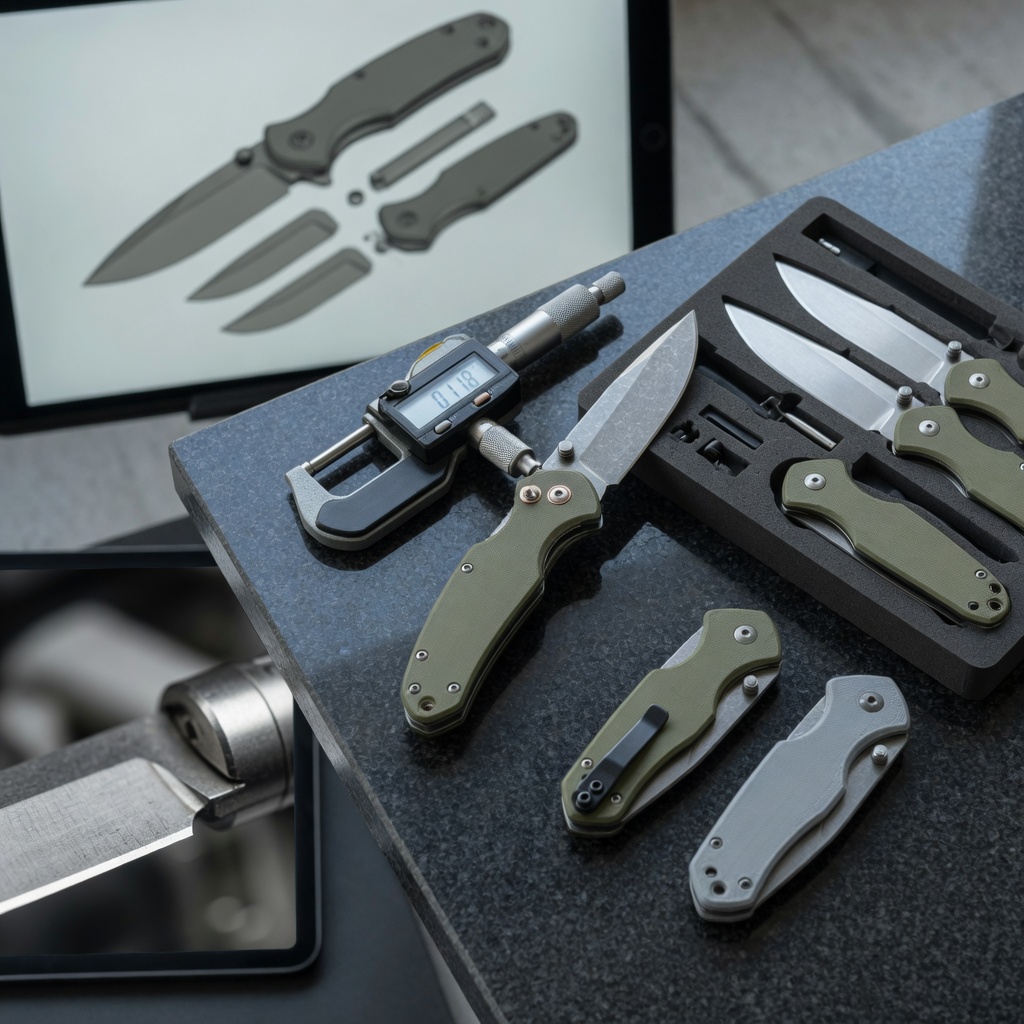
Rapid prototyping and CNC are the first physical proof that the digital pack survived CAM. A public OEM process page places 3D evaluation, rapid prototyping, and CNC machining before mass production (Svegaoutdoor OEM pocket knife manufacturing process). A CNC-machined blade blank and liner set can confirm lock geometry. A polymer 3D-printed handle can confirm outline and clip placement but not production weight, fastener torque behavior, or corrosion performance. Separate those purposes in the RFQ so a handle that looks acceptable on video does not freeze a production scale material.
Remote video sample confirmation is published as a procurement step on an ODM process page (Shieldon ODM procurement process). It can shorten United States review cycles when travel is not justified. It cannot replace a first-article inspection report that lists actuals versus nominals, instrument, and drawing revision. Use video to confirm finish hue, detent demonstration, and opening path. Use calibrated instruments for thickness, hardness, and centering.
Price these trade-offs in the RFQ:
- Printed or soft-tool handles are faster, but production G10, aluminum, or titanium scales will shift balance and clip fit.
- CNC from the production steel proves heat-treat movement earlier and costs more per iteration.
- Video confirmation reduces courier calendar days and increases the chance that lighting hides grind lines or lock-face wear.
Example inspection assumption to verify in the supplier quote (not a standard requirement and not a factory average): first-article blade thickness recorded to 0.05 millimetre resolution with a calibrated digital micrometer, on 100 percent of first-article pieces for one pocket knife SKU, as of the FAIR date. State the CAD nominal, the drawing tolerance, the instrument, and whether CAM stock allowance matches that tolerance. Do not treat 0.05 millimetre as an industry rule.
Ask how CNC toolpaths are regenerated after a CAD tweak to jimping, choil, or lock-face angle. If programmers hand-edit paths and the model is no longer the master, repeat orders will not match the freeze.
United States Labeling, Landed-Cost, and Delivery Controls on Digital Packs
Keep the product and RFQ decision primary. The United States is the receiving market that must inspect, classify, and put away the same folding pocket knife the CAD describes.
For United States manufacturing buyers, the digital pack is incomplete until it includes the objects operations and brokers actually use:
- Commercial invoice description that matches the approved configuration, including manual folder versus any assisted or automatic mechanism you did not intend. Mechanism language is a counsel issue for United States distribution; do not let a CAD lock type and an invoice phrase diverge.
- Packing-list quantities that match lot-coded or serialized cartons.
- Country-of-origin marking plan for the article and/or packaging. United States import marking is a legal framework (including 19 CFR Part 134) that the buyer’s licensed customs broker should interpret for the actual SKU—not a factory marketing line. Naming that regulation is not a claim that any OEM is certified or currently compliant.
- HTS-supporting description. Treat any OEM document self-check for export records and HS codes as a clerical draft until a United States broker or counsel accepts it for the actual entry (Shieldon ODM procurement process). A self-check is not a customs ruling. Do not copy an HS code from a marketing page into the purchase order.
- Artwork control for on-knife stamps, box labels, and any warnings the buyer’s counsel requires for intended United States distribution.
- Incoterm, port of entry, and document cutoff so files arrive before cargo.
Example calculation/assumption to verify in the supplier quote (not a carrier tariff): if ocean transit is 25 calendar days port-to-port and United States customs/broker release is 5 calendar days, plan 30 calendar days of water-side time, as of the quote date, for one packed pocket knife shipment. Production calendar days start only after prototype freeze. Inland United States trucking, destination warehousing, insurance, and duty are separate lines. Confirm actual sailings and brokerage with the forwarder named on the RFQ.
Build a buyer-owned landed-cost worksheet. The OEM should populate origin, net and gross weight, material statements, and carton counts from the same BOM revision as production. The United States buyer should own classification, duty estimates, merchandise-processing fees as applicable, and domestic cartage. Manufacturing origin is a data field on that worksheet. It is not a sales-market target and should not be used to invite orders from markets this page does not serve.
Labeling trade-off: a laser-marked SKU and origin on a liner is durable and needs CAD real estate; paper box labels are cheaper and can drift from the knife inside if the print file is not revision-tied to the BOM. Specify the mark location on the 3D model so it does not land on a grind surface or lock face.
Example assumption to verify in the supplier quote (not a marking standard): reserve an 8 millimetre by 8 millimetre keep-out on a liner or backspacer for a lot or serial mark, located at least 2 millimetres from the lock face, for one pocket knife SKU, as of CAD freeze. Confirm actual laser or etch process limits in the quote.
Traceability Codes, Production Visualization, and Document Checks
Once a folding pocket knife is in mass production, the remaining question is whether a United States receiving team can see and recall the lot without waiting for a mailed photo.
An ODM procurement page lists production visualization with photos and videos, and QR codes plus unique traceability codes, as published process items (Shieldon ODM procurement process). Visualization is not metrology. Specify stations (blade blank after grind, heat-treat coupon, assembled lock, packaged kit), still versus video, lighting, and a filename pattern that includes SKU, revision, and date. Tie progress payments to those station files if schedule risk is high.
QR codes and unique traceability codes can link a unit or inner carton to a work order. Decide the grain in the RFQ: unit serial versus lot code. Unit serials support wholesale chargebacks and warranty isolation; they add marking time and require a database the OEM must actually maintain. Lot codes are cheaper and weaker for isolating a bad pivot batch. Require a live scan path in the sample stage: code on the knife or carton opens a redacted work-order record that shows revision, quantity, and inspection lot—not a static image of a code.
Document checks for export records can catch missing weights, inconsistent carton counts, or incomplete origin statements before sailing. Keep a hard split: OEM clerical completeness versus United States legal classification. If a pre-check tool suggests an HS code, the purchase order should still name the buyer’s broker as classifier for the actual SKU.
Trade-off: more visualization and finer serialization increase NRE and cycle time and reduce mixed-revision time at a United States DC. Under-instrumented production looks faster on a Gantt chart until a mixed-revision clip shipment lands.
Buyer Decision Table for Pocket Knife OEM Digital Integration Readiness
Use this table to specify, compare, verify, approve, or order a pocket knife manufacturing program. Cells are RFQ controls, not published factory promises.
| Control | Specify in the RFQ | Compare / verify | Approve / order implication | Measurable trade-off |
|---|---|---|---|---|
| File ingest | Contractual 2D + 3D formats, units, and projection | OEM imports your sample pack and returns a conflict rule (2D vs 3D) | Do not approve tooling until the conflict rule is in the PO | Neutral files travel; native CAD may keep features |
| Design status | Idea, sketch, 2D, 3D CAD, or physical sample (Vaststate OEM budget and RFQ guide) | NRE, quote validity, and prototype count match that status | Sketch-level quotes are not production prices | Faster first number, higher revision cost |
| 3D conversion | Modeler, IP owner, deviation-log format | Converted assembly checked against your print, dimension by dimension | Conversion is a paid data pack, not a free quote extra | Speed versus silent geometry change |
| Prototype lock | CNC vs print; production steel vs substitute; video vs FAIR (Svegaoutdoor OEM pocket knife manufacturing process) | Actuals table for lock and blade criticals, with instruments | Video-only approval is not a production freeze | Courier/travel cost versus measurement risk |
| Visualization | Photo/video stations and filename convention (Shieldon ODM procurement process) | Redacted folder from a prior folding-knife job | Progress payments tied to station evidence | More files, clearer stop-the-line calls |
| Traceability | QR/lot/serial grain and mark location on CAD (Shieldon ODM procurement process) | Live scan to a dummy work-order record | Codes must appear on the packing list for United States receiving | Unit recall power versus cycle time |
| US document pack | Invoice, packing list, origin mark, draft commodity description | Buyer’s broker reviews pack before first shipment | OEM self-check is clerical, not a ruling | Clerical speed versus classification liability |
| Revision freeze | ECO path after CAM lock | Redacted ECO that updated toolpaths | Post-freeze choil/jimping tweaks are paid ECOs | Flexibility versus repeatability |
RFQ Checklist for Pocket Knife Manufacturing Digital Integration
Each item helps a United States buyer specify, compare, verify, approve, or order.
- State the SKU, folding mechanism, lock type, target blade-length class, and that the destination sales market is the United States.
- Attach current design status—idea, sketch, 2D drawing, 3D CAD, and/or physical sample—and name the contractual master file (Vaststate OEM budget and RFQ guide).
- List accepted ingest formats and the winning file when 2D and 3D disagree; state millimetre or inch units and projection method.
- Attach a BOM with blade steel, hardness target, handle material, fasteners, finish, clip, and packaging components tied to the same revision.
- If 3D conversion is required, order a deviation log and IP ownership clause; do not treat conversion as unpaid quoting.
- Specify prototype purpose: fit, lock function, cosmetics, or production-steel confirmation. Ban mixed purposes on one sample without a written matrix (Svegaoutdoor OEM pocket knife manufacturing process).
- Require a FAIR template with nominal, actual, instrument, and drawing/CAD revision for critical dimensions.
- Define remote video confirmation as supplemental. List required shots and what still needs instruments (Shieldon ODM procurement process).
- Freeze CAM/toolpaths to the approved revision and state the paid ECO path for post-freeze tweaks.
- Name visualization stations, still versus video, and the file-naming pattern tied to SKU and revision.
- Choose lot code versus unit serial/QR; show mark location on the CAD so it does not hit grind or lock surfaces.
- Order a United States document pack: commercial invoice fields, packing list, origin-mark method, net/gross weight, and draft commodity description for broker review.
- Require the OEM to flag any HS/export self-check as non-binding; name the buyer’s licensed broker as classifier.
- Issue a landed-cost worksheet for the OEM to populate origin and weights; the buyer completes freight, duty estimates, and DC inbound.
- Set Incoterm, document cutoff, and whether digital copies must arrive a stated number of working days before cargo. Example assumption to verify in the supplier quote: 3 working days before departure, as of the quote date, for one pocket knife shipment.
- Request redacted evidence from a prior folding-knife program: one CAD-to-CAM folder tree, one FAIR page, one traceability scan path—no customer names.
- Put packaging artwork under the same revision control as the blade steel so box labels cannot ship an old SKU.
- List buyer-specified tests and quality level. Attach current certificates only if they exist; do not write a certification into the PO without a current document.
- State the 2D/3D conflict rule, drawing language (for example ASME Y14.5 if that is the buyer drawing), and whether ISO 10303 STEP is contractual geometry or visualization only.
- Require origin-mark location and method to be shown on the CAD and packing artwork, then reviewed by the United States broker against applicable marking rules before first shipment.
Source Contexts, Methodology, and What to Verify
Source context 1. The Vaststate pocket knife OEM/ODM budget page is used only as evidence that quote quality tracks design-status maturity and that RFQs should capture materials, lock type, packaging, compliance, and quality level. It is not used as a price list, MOQ table, or demand metric (Vaststate OEM budget and RFQ guide).
Source context 2. The Shieldon ODM procurement page is used as a published process menu—CAD/3D, renderings, remote video confirmation, export-document self-check, production visualization, and QR/unique traceability codes—to turn into RFQ artifacts. It is not a Tangforge capability statement and not a dated factory audit (Shieldon ODM procurement process).
Source context 3. The Svegaoutdoor OEM manufacturing page is used to frame the drawing-to-3D-to-prototype-to-CNC freeze before mass production. It is not evidence of a named machine list, steel grade, or customer result (Svegaoutdoor OEM pocket knife manufacturing process).
Methodology. This article is desk research against those public pages, written for United States B2B buyers placing pocket knife manufacturing RFQs. Process claims are attributed to the cited URLs. Numeric schedule, transit, document-cutoff, engineering-hour, keep-out, and tolerance figures are labeled as example calculations or assumptions to verify in the supplier quote. They are not measurements, not factory averages, and not keyword-demand statistics. Research-source evidence supports factual editorial claims only; it is not keyword-demand evidence. File-format and drawing-language standards (ISO 10303, ASME Y14.5) and United States origin-marking rules (19 CFR Part 134) are named only as buyer-specified exchange or legal frameworks, distinct from any company’s certified practice.
Limitations. The cited pages are educational process descriptions, not controlled quality manuals. Software, CNC capacity, and document tools change. United States duty treatment, origin-marking details, carrier rules, and destination restrictions depend on the exact SKU and time of entry; confirm with licensed customs and legal advisors. Do not infer certifications, awards, tests, client names, or factory-visit experience. If a supplier cannot attach a current certificate, do not put that certification in the order. Verify every number in the quote, including working days, calendar days, millimetres, engineering hours, and document cutoffs.
Vincent Xi is named as Editorial Author on the public author profile used as the only experience basis for this page. That basis does not support factory-visit, laboratory-test, client-name, or first-person production claims, so none are stated.
Discuss Your Requirements
Review our manufacturing capabilities, then share your specifications for a supplier-fit review.