Pocket Knife OEM Material Options: Manufacturing RFQs for Europe
By Vincent Xi, Editorial Author
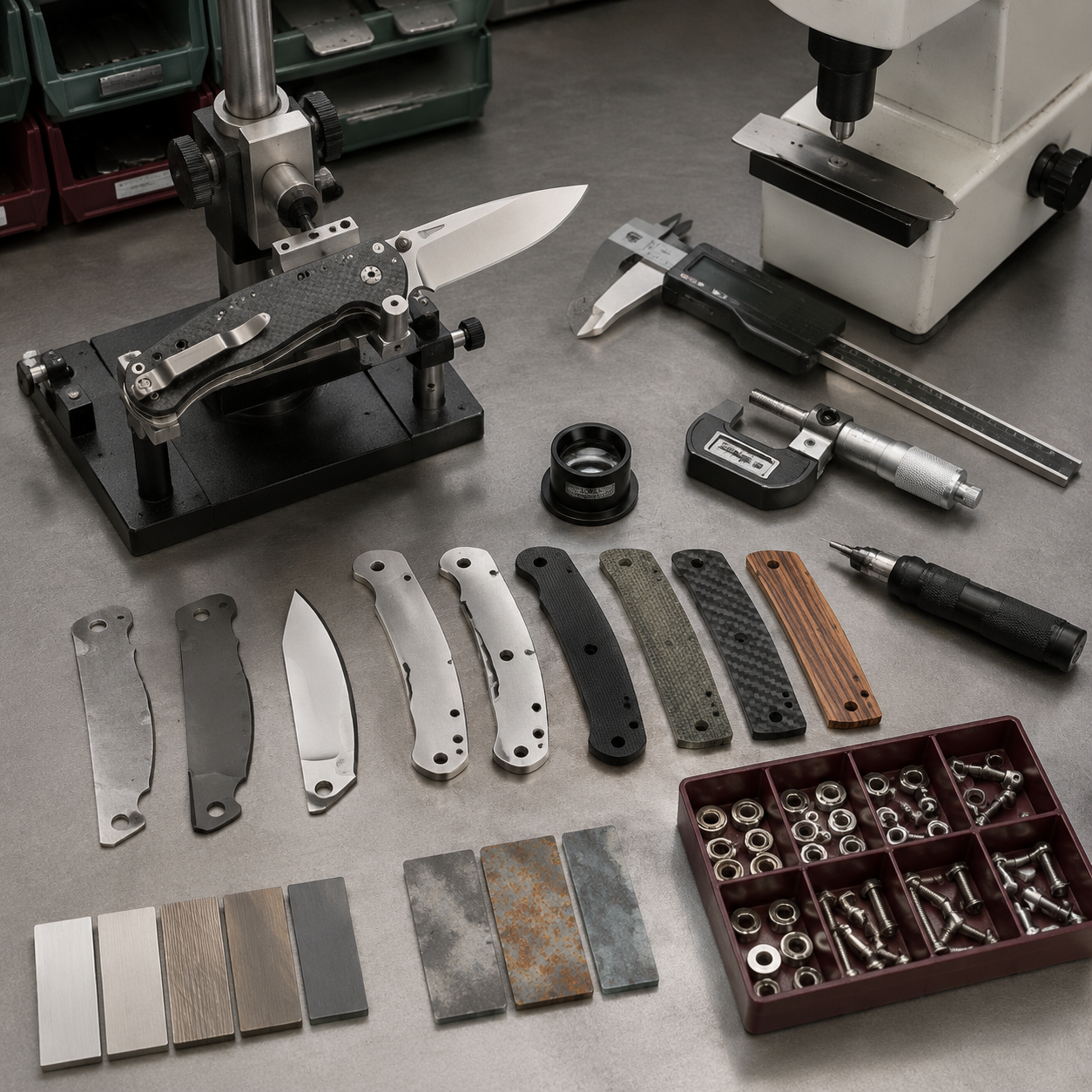
For pocket knife OEM material options intended for Europe, the decisive RFQ document is a component-level material schedule tied to a controlled drawing, bill of materials, sample, evidence pack, and quotation. A blade-steel name alone cannot define the complete manufactured product.
Answer first: advance a supplier proposal only when it identifies the material and relevant process for the blade, scales or handle, liners or frame, lock parts, pivot, washers or bearings, fasteners, clip, coatings, adhesives, lubricants, and contact packaging. The response should also separate material-related price and lead-time effects, map evidence to the submitted sample, and require approval before substitutions.
This is a material-selection and RFQ decision page, not a general pocket knife guide or a material performance ranking. Europe is not treated as one legal destination. EU member states, EEA countries outside the EU, the UK, and other European countries need separate buyer-controlled review rows whenever their requirements differ.
Pocket Knife OEM Material Options for Europe: Set the RFQ Baseline
Lock the commercial and technical baseline before comparing materials. Otherwise, a lower quote may reflect a different finish, inspection scope, packaging system, order quantity, or component construction rather than a genuine material saving.
| RFQ control | Buyer must define | Supplier must return | Hold the proposal when |
|---|---|---|---|
| Product and destination scope | Intended use, maintenance assumptions, exact European sales countries, sales channel, drawing revision, bill of materials, order scope, and approval owner | A recommendation with its product, destination, and order assumptions stated | The recommendation has no stated design or destination basis |
| Blade | Requested designation format, candidate process route, finish, and required evaluations | Exact designation and designation system, controlled source, batch or heat mapping, process route, finish, evidence, and quote effect | The response uses only a trade name, broad steel family, or unsupported equivalent |
| Scales, handle, liners, and frame | Required construction, dimensions, appearance boundaries, and candidate material families | Exact alloy and condition, resin and reinforcement, laminate construction, treatment, or species information as applicable | The proposed material cannot be mapped to the drawing and submitted sample |
| Lock and pivot system | Separate bill-of-material entries for lock parts, pivot, stop pin, washers or bearings, screws, inserts, spacers, and clip | Material, condition, finish, source-control method, and substitution status for each component | Mechanism parts are grouped under generic hardware wording |
| Applied materials | Buyer-requested disclosure for coatings, plating, colourants, adhesives, lubricants, and thread-locking products | Product reference, application or cure route, relevant declaration, and production mapping | An applied material changes without being identified in the quotation or sample record |
| Evidence | Required records, methods, sample identity, acceptance authority, and validity expectations | Documents linked to the proposed component, process route, sample, and manufacturing site | A report concerns an unidentified reference material or unrelated sample |
| Commercial comparison | Common finish, inspection, test, packaging, currency, delivery basis, tooling scope, and quote-validity requirement | Base price plus separated material, tooling, sample, testing, documentation, and lead-time effects | A total changes without a component-level explanation |
A generic description such as stainless steel, aluminium, plastic, laminate, or wood is not enough for approval. Keep the requested designation and supplier-proposed designation in separate fields. Treat any proposed equivalent as unapproved until its identity, process, evidence, sample results, commercial effect, availability, and change controls have been reviewed.
Compare Pocket Knife Material Options by Component
The candidate routes below organise supplier responses; they do not establish that one material family is superior. The supplied sources contain no controlled comparative results for a finished folding-knife design.
Blade quotation routes
| Candidate route | Supplier declaration required | Buyer decision basis |
|---|---|---|
| Martensitic stainless route | Exact grade and designation system, controlled source, material record, heat-treatment responsibility and route, target hardness range, test method and locations, finish, and traceability | Material identity, process records, measurements, and assembled-sample results against buyer-set limits |
| Higher-alloy or powder-metallurgy stainless route | Exact designation, confirmation of whether a powder route is actually proposed, source and availability assumptions, heat-treatment route, grinding and finishing assumptions, test charges, and separated quote delta | Results produced under the same approved protocol used for the other candidate routes |
| Carbon or tool-steel route | Exact designation, surface-protection system, exposed-edge condition, treatment at pivot and lock interfaces, maintenance assumptions, and packaging protection | Finished-blade and assembled-sample results for the buyer-defined corrosion, function, appearance, and maintenance criteria |
Do not infer corrosion resistance, edge retention, toughness, manufacturability, or finished-product suitability from a family name. Those decisions require controlled evidence from the proposed grade, process route, geometry, finish, and assembled sample.
Handle, frame, and hardware quotation routes
| Candidate route | Fields needed for a comparable quote | Sample approval focus |
|---|---|---|
| Metal scales, liners, or frame | Exact alloy, designation system, temper or condition, source, surface preparation, finish, and substitution status | Mass, dimensions, flatness, edge condition, appearance, fastener seating, and buyer-defined functional results |
| Moulded engineering polymer | Base resin, reinforcement type and content, colourant, controlled source, moulding responsibility, conditioning method, and regrind policy | Dimensions around pivots and inserts, surface and colour boundaries, insert retention, fastener results, and buyer-selected environmental evaluation |
| Glass-fibre or carbon-fibre laminate | Laminate designation, controlled source, construction or weave description, manufacturer-supplied resin information, thickness, texture, and cosmetic boundary | Flatness, exposed-fibre and edge-finish boundaries, insert retention, dimensions, appearance, and attachment results |
| Stabilised wood or another natural material | Species, requested source and origin information, treatment method, conditioning record, and permitted variation or substitution | Cracks, voids, grain and colour boundaries, moisture condition, dimensions, edge finish, and sample-to-lot variation |
| Lock, pivot, fasteners, and clip | Separate material and condition for each part, plus heat treatment, coating, thread treatment, lubrication, and installation method where applicable | Dimensions, finish, assembled fit, pivot operation, retention, and buyer-defined wear or load results |
The supplied wholesale-market article recommends requesting exact steel grades and mill documentation in its kitchen-knife context. For a pocket knife RFQ, use that principle only as a document-control prompt: require exact designations and product-specific verification rather than carrying over kitchen-knife performance assumptions.
Evidence Needed to Approve a Material
Every material or process record should identify its title, issuer, issue date, component, material designation, source batch where applicable, tested or declared sample, method, scope, result, and relationship to the quoted production route.
| Evidence area | Method fields controlled by the buyer | Result fields returned by the supplier |
|---|---|---|
| Material identity | Accepted designation system, document type, source mapping, and traceability boundary | Designation, issuer, batch or heat reference, component, sample identity, and document date |
| Hardness | Method, scale, sample preparation, measurement locations, acceptance range, and retest rule | Equipment reference, individual results with units, locations, date, and disposition |
| Dimensions | Drawing revision, controlled characteristics, equipment, measurement conditions, sampling plan, and tolerances | Sample identity, measured values with units, equipment reference, date, and conformity decision |
| Corrosion evaluation | Sample preparation, exposure medium, conditions, duration, evaluation method, acceptance boundary, and post-test function check | Material and finish identity, test conditions, observations, rating or result unit, date, and disposition |
| Cutting evaluation | Cutting medium, conditioning, edge preparation, procedure, applied-load control, stopping rule, result unit, and retest rule | Sample identity, method, individual results, endpoint, deviations, date, and disposition |
| Lock and pivot function | Assembly configuration, fixture, loading direction, operating sequence, acceptance limits, and failure definition | Component identities, setup, results, observations, deviations, date, and disposition |
| Coating or surface finish | Preparation, thickness or appearance method, measurement locations, boundary samples, and acceptance rule | Product reference, applicable batch, application record, measured or inspected results, and sample identity |
The buyer must insert the actual acceptance values. The supplied sources do not support a universal hardness range, corrosion exposure, cutting threshold, lock load, or sampling level for every pocket knife.
If a supplier cites a standard, require the full designation, title, edition, applicable clause or test method, specimen definition, result, and evidence scope. Describe an internal factory method as supplier-defined practice unless current evidence shows that the cited standard and method were followed. Do not call a supplier, site, process, or product certified without checking a current certificate for issuer, scope, site, validity, and relevance to the quoted work.
Europe Destination Controls for Material Options
The supplied citations do not establish current legal requirements for Europe. Keep destination review within the material RFQ, but assign legal and conformity decisions to the buyer's appointed compliance owner or qualified reviewer.
| Destination row | Buyer-controlled entry | Supplier-facing instruction |
|---|---|---|
| EU destination | Each intended EU member state, sales channel, product configuration, dated requirements list, evidence scope, compliance owner, and approval authority | Return evidence against the identified countries and requirements; do not replace the country list with a generic Europe statement |
| EEA destination outside the EU | Exact country, sales channel, dated requirements list, evidence scope, compliance owner, and approval authority | Quote and document the destination separately; do not copy the EU row without buyer approval |
| UK destination | Exact UK scope, sales channel, dated requirements list, evidence scope, compliance owner, and approval authority | Return a separate mapping and identify any buyer-specified material, design, marking, instruction, or packaging effect |
| Other European destination | Exact country, sales channel, dated requirements list, evidence scope, compliance owner, and approval authority | Treat the country as a separate approval row and answer only against its buyer-issued requirements |
These rows are procurement controls, not legal conclusions. Replace unsupported wording such as Europe compliant with a dated requirements matrix that identifies the country, product configuration, sales channel, requested evidence, reviewer, and approval authority.
Normalise Material Quote Deltas
The supplied OEM cost guide treats blade steel, handle material, lock structure, finish, quantity, and QC as connected quotation inputs. Use those categories to compare quote structure, not as evidence of current pricing or material performance.
Require each supplier to quote the same drawing revision, bill of materials, finish, order scope, inspection plan, testing scope, protective packaging, currency, and delivery basis. Separate the response into:
- Base unit price for the controlled material system.
- Unit-price delta for every proposed blade, handle, structural, hardware, coating, or finish change.
- Tooling and fixture charges, including ownership, maintenance, and replacement terms.
- Engineering-sample, testing, documentation, and approval charges.
- Supplier-stated minimum-order, lead-time, yield, and availability effects.
- Quote validity and the assumptions that trigger repricing.
Example quote-normalisation calculation
All values below are explicitly unsourced buyer assumptions or calculations for one SKU and one production order. The as-of date for every input and result is the issue date printed on the supplier quote. Each value must be confirmed or replaced in that dated quote before approval; none is a supplier offer or market benchmark.
| Example input or calculation | Value and scope | Verification required |
|---|---|---|
| Order-scope assumption | 5,000 finished pocket knives for one SKU in one production order | Confirm the quantity, SKU scope, and quote issue date in the supplier quote |
| Alternative blade-material assumption | EUR 0.60 per finished pocket knife for the specified blade-material change within that order | Confirm the component, material designation, unit basis, currency, and quote issue date |
| Handle-tooling assumption | EUR 2,400 total for the quoted handle-tooling scope for that SKU | Confirm tooling scope, ownership, maintenance, replacement terms, currency, and quote issue date |
| Blade-material order calculation | 5,000 finished units x EUR 0.60 per finished unit = EUR 3,000 for that production order | Recalculate from the confirmed quantity and unit delta in the dated quote |
| Allocated tooling calculation | EUR 2,400 total tooling / 5,000 finished units = EUR 0.48 per finished pocket knife for that production order | Use only for like-for-like comparison; confirm the tooling terms and dated order scope |
Use this arithmetic to expose quote differences. Material approval still depends on identity, evidence, sample results, tooling terms, quote validity, availability assumptions, and change control.
Material Sample Approval and Change Control
| Gate | Required action | Hold condition |
|---|---|---|
| Document review | Map every proposed material and process to a component, source-control method, evidence item, quotation line, and substitution status | A declaration or report cannot be linked to the quoted component and production route |
| Engineering sample | Build samples from the declared materials and proposed processes; place the same sample identity on material, process, dimensional, appearance, and test records | The sample identity or production route differs across records |
| Approved reference | Freeze the drawing, bill of materials, material schedule, sample identity, appearance boundaries, test methods, limits, evidence pack, and quotation assumptions | The approval package contains unresolved departures or undocumented equivalents |
| Production release | Apply the agreed lot definition, sampling method, defect classifications, record-retention rules, nonconformance process, and replacement terms | Production records do not connect incoming material, processes, inspection results, and released lots |
For the blade sample, record material identity, heat-treatment record, hardness results, dimensions, grind, edge condition, finish, buyer-defined corrosion and cutting results, and interaction with the lock and pivot system.
For scales, handles, liners, frames, and hardware, record exact material identity, dimensions, flatness, appearance boundaries, edge condition, insert or fastener seating, installation method, and the applicable buyer-defined functional results. Evaluate the assembled pocket knife using documented methods for blade centring, opening and closing, lock engagement, blade play, pivot retention, clip attachment, fastener condition, and surface condition.
Require written approval before changing a material designation, producer, manufacturing site, sub-tier process, heat-treatment route, resin, reinforcement, natural-material source, coating chemistry, finish, adhesive, lubricant, or thread-locking product.
Pocket Knife Material RFQ Checklist
Buyer issue pack
- [ ] List every intended European destination and separate EU, non-EU EEA, UK, and other country rows where applicable.
- [ ] Name the destination-review owner and attach each dated requirements list.
- [ ] Issue the controlled drawing, bill of materials, finish specification, and test methods.
- [ ] Define intended use, exposure, maintenance, appearance, mass, service, and packaging assumptions.
- [ ] State requested material designations and the approval route for any proposed equivalent.
- [ ] Set the order scope, currency, delivery basis, inspection scope, evidence requirements, and quote-validity requirement.
Required supplier response
- [ ] Return a component matrix showing requested and proposed material designations separately.
- [ ] Identify the manufacturing site, controlled material source, relevant sub-tier operations, and traceability method.
- [ ] Map every declaration and report to a component, process route, sample, method, date, scope, and result.
- [ ] Separate base price, material deltas, tooling, samples, testing, documentation, and lead-time effects.
- [ ] State minimum-order, availability, validity, yield, and substitution assumptions.
- [ ] Identify every departure from the drawing, bill of materials, process, evidence, or inspection baseline.
Approval controls
- [ ] Confirm representative samples made from the declared materials and proposed processes.
- [ ] Record sample identity, methods, equipment, results, appearance boundaries, and acceptance authority.
- [ ] Define production traceability, lot inspection, retained records, nonconformance reporting, and replacement terms.
- [ ] Prohibit unapproved changes to materials, sources, sites, sub-tier processes, treatments, coatings, finishes, adhesives, and lubricants.
- [ ] Verify protective packaging through the buyer-defined storage or transport evaluation before production release.
Methodology, Source Context, and Limitations
The editorial method confined each supplied source to a narrow procurement use. Supported purchasing points were converted into component fields, supplier-response requirements, hold conditions, sample gates, quote controls, and verification tasks. No source was treated as controlled evidence for a particular pocket knife material, supplier, manufacturing site, test result, or European destination requirement.
| Supplied source | Use retained in this article | Evidence it does not provide here |
|---|---|---|
| OEM cost guide | Treating blade steel, handle material, lock structure, finish, quantity, and QC as connected quotation inputs | Current market prices, material performance, supplier capability, product conformity, or destination-specific requirements |
| Wholesale-market article | Requesting exact steel grades and mill documentation rather than accepting generic steel wording; its product context is kitchen knives | Folding-knife performance, mechanism suitability, controlled comparative tests, or European legal conclusions |
| Manufacturer-directory article | Manufacturing-origin supplier discovery only | Factory capability, certification, material control, test results, customer outcomes, or suitability for an order |
The worked quote results were derived only from the labelled assumptions through unit multiplication and tooling allocation. They are not sourced prices and must be verified against a supplier quote carrying an issue date, validity period, defined scope, currency, and delivery basis.
No controlled comparative results are relied upon for a blade grade, heat treatment, handle system, lock interface, coating, or complete pocket knife. The supplied sources also do not establish current EU, non-EU EEA, UK, or country-specific legal requirements. Before ordering, verify destination requirements with the buyer's appointed reviewer. Verify material identity, process capability, evidence scope, test methods, sample results, quote validity, manufacturing site, sub-tier sources, order constraints, and change controls with the proposed supplier. Any standards or certification claim requires a current document whose edition, issuer, scope, site, validity, and relevance have been checked.
Discuss Your Requirements
Review our manufacturing capabilities, then share your specifications for a supplier-fit review.