Pocket Knife OEM Sustainability Sourcing Criteria for United States Manufacturing Buyers
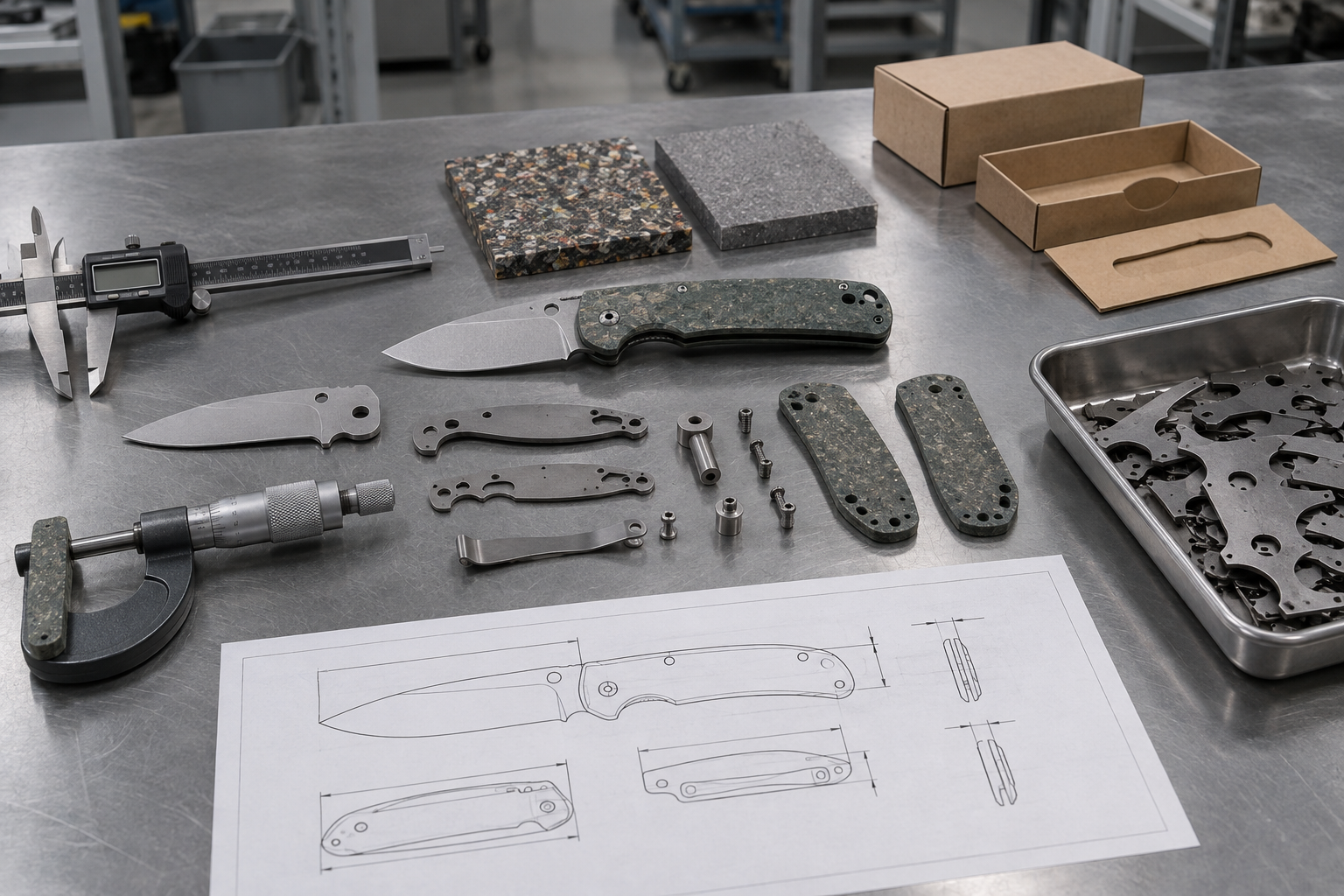
Bottom line: A United States B2B buyer should treat pocket knife OEM sustainability sourcing criteria as manufacturing controls, not marketing adjectives. Put the claim basis, material or component scope, producing site, evidence document and date, SKU or lot link, United States label wording, landed-cost assumptions, delivery terms, and acceptance rules into the RFQ. The supplied pages contain source-specific statements about knife steel, handles, packaging, management systems, and due-diligence topics; none by itself proves that a finished pocket knife or selected OEM meets a buyer's specification.
This article is limited to pocket-knife manufacturing decisions: how to turn sustainability language into specifications, evidence gates, United States label review, landed-cost lines, delivery controls, and RFQ acceptance. It is not a general country guide or a claim that any source page is a current certificate, independent audit, or legal approval.
Byline: Vincent Xi — Editorial Author Author profile: <https://tangforge.com/authors/vincent-xi/>
Author basis: The TANGFORGE author profile identifies Vincent Xi as Editorial Author. It does not establish first-hand factory, materials-test, client-program, customer-outcome, or measured-result experience, so none is claimed here.
United States decision rule: make sustainability sourcing criteria quote controls
For each proposed sustainability statement, use the RFQ to connect the statement to the actual item being bought:
- Require the supplier to identify the material or component, specification, producing site, evidence document and date, SKU or lot link, exact label wording, and any quoted price or delivery effect.
- Hold a statement when it uses terms such as recycled, biodegradable, responsible, or certified without a defined scope, denominator where relevant, site, document date, current certificate, or product-specific test where needed.
- Omit a statement from United States product or packaging files when the evidence cannot be matched to the quoted SKU, producing site, or exact sentence the buyer plans to publish.
Keep supplier evidence, buyer assumptions, and acceptance criteria in separate RFQ fields. Make missing evidence a release-blocking condition. A management-system designation or sourcing topic is not, by itself, proof of a finished-knife material claim.
Evidence base and method for pocket-knife manufacturing
Treat the supplied URLs as separate evidence contexts:
- Alleima: Its article dated April 2024 reports a recycled-content figure and a future target for its knife steel. It also describes certifications, supplier screening, and mineral-due-diligence practices as Alleima's program (Achieving cutting edge sustainability in the knife industry).
- Shokunin USA: Its sourcing discussion presents steel choice, recycled or responsibly sourced handles, SFI, Fair Trade, ISO, and labor topics as considerations. It does not provide a SKU-level test or current certificate for a selected OEM (Ethical Sourcing of Pocket Knives).
- Shieldon: Its ODM page describes biodegradable composites as alternatives to carbon fiber, recyclable packaging, recycled materials, carbon-footprint reports, and an ISO 14001 statement as part of its offer description. It does not establish a current certificate or SKU-specific result for the buyer's order (An ODM Procurement for Knives and Tools).
Method: Record every quantitative statement with its unit, scope, publication or as-of context, and source. Test whether it applies to raw material, component, assembly, or finished knife. Convert a qualitative page statement into an RFQ question instead of treating it as product evidence. Do not infer a current certificate, independent audit, price, freight, duty or tax result, delivery result, carbon result, or customer outcome.
Recycled steel evidence: separate source data from finished-knife claims
- Published figure — 81% recycled content. Unit: percent. Scope: Alleima knife steel. Publication context: Alleima article dated April 2024. Source: Achieving cutting edge sustainability in the knife industry. This is a source-specific steel statement, not a finished-pocket-knife average or selected-OEM result.
- Published target — 83% by 2030. Unit: percent. Scope: the same Alleima knife-steel program. Target context: 2030 as stated in the April 2024 article; it is not an achieved result reported in that article. Source: Achieving cutting edge sustainability in the knife industry.
- Example calculation — 100 grams of blade blank. Unit: grams. Scope: an assumed blade-blank denominator. Assumption to verify in the supplier quote: the cited 81% steel figure applies to that denominator. Under that assumption, the example contains 81 grams of recycled input and 19 grams of non-recycled remainder. This is an example calculation, not order data; it excludes liners, handle scales, clip, pivot, packaging, and blanking yield.
Use these figures as evidence controls, not as a finished-knife claim:
- Specify the buyer-approved drawing revision, nominal dimensions and tolerances for blade length, blade thickness, handle length, closed length, scale thickness, hardware, and clip, together with steel grade, hardness, heat treatment, and finish.
- Ask whether the percentage applies to the melt, strip, blank, blade, component, or finished knife, and require the denominator in the supplier's declaration.
- Require written buyer approval before a mill, grade, feedstock, heat-treatment route, or other material or process input changes.
- Keep recycled-steel wording separate from recycled-knife wording unless the full-product basis is documented.
Recycled-content evidence does not replace dimensional, mechanical, functional, or visual acceptance criteria for the quoted pocket knife.
Standards, component claims, and United States labeling
Alleima's April 2024 article names the ISO 14001 and ISO 50001 management-system standards in the context of certifications it says it holds. Shieldon's cited ODM page states that its production is ISO 14001 certified. Shokunin USA's discussion names SFI, Fair Trade, and ISO as sourcing topics. These are source statements about named organizations or discussion topics; they do not establish current certificate scope for the selected OEM, producing site, or finished knife (Alleima; Shieldon; Shokunin USA).
The same source pages discuss component and reporting options: Shokunin USA discusses recycled or responsibly sourced handles and recycled-material processes; Shieldon describes biodegradable-composite alternatives to carbon fiber, recyclable packaging, recycled materials, and carbon-footprint reports. Treat these as verification leads, not as results for the selected SKU (Shokunin USA; Shieldon).
- Require the legal entity, producing-site address, certificate scope, issue date, expiry date, and order-operation coverage before using a certification statement.
- Specify handle material, scale dimensions, fastener pattern, finish, color, and performance requirements. Require sample approval and drawing revision before production if a proposed composite replaces another handle material.
- List the packaging stack, including substrates, coatings, adhesives, inserts, and closures. State which layer a recycled, recyclable, or biodegradable sentence covers.
- Store the exact United States label sentence, the material or component it covers, the supporting document, and the document date. A source page is not legal approval for an environmental, origin, or materials claim.
- If a carbon-footprint report is offered, require its boundary, reporting year, functional unit, allocation method, data owner, and SKU coverage. Do not derive a carbon result from a recycled-content percentage.
- Ask for country of melt, country of blade finishing, and country of final assembly when origin wording is under review; do not compress a multi-stage route into one unsupported origin statement.
Landed cost and delivery controls for United States OEM bids
Make sustainability-related cost and timing visible in the quote:
- Separate the approved knife configuration price from any material, recycled-content, packaging, documentation, assessment, or reporting charge.
- Separate tooling, sampling, drawing revision, packaging conversion, document preparation, and report costs.
- State the Incoterm, named United States delivery point, currency, quote validity, freight assumption, duty or tax assumption, and handling assumption.
- State the production window, ship window, transit assumption, partial-shipment rule, and change-notification rule.
- Require the supplier to identify the cost and timing treatment for a mill change, material substitution, certificate gap, failed inspection, missing lot document, or label revision.
The cited pages publish no supplier-specific price, freight rate, duty or tax result, scrap rate, lead-time result, or carbon-intensity figure for the quoted OEM. Keep those fields blank until the supplier quotes them, and label any estimate as an assumption to verify.
Buyer decision table for pocket-knife manufacturing bids
| Decision item | Evidence boundary | United States buyer gate |
|---|---|---|
| Blade-steel recycled content | Alleima's April 2024 article is the source for its knife-steel recycled-content figure and future target; the scope is Alleima knife steel, not a selected OEM's finished knife (source). | Require grade, denominator, mill, lot declaration, performance specification, and claim wording. |
| Environmental and energy systems | Alleima's article names ISO 14001 and ISO 50001; Shieldon's page states ISO 14001 certification for its production. Current document scope is not confirmed here (Alleima; Shieldon). | Require current documents for the legal entity and producing site; do not treat a management-system designation as a finished-knife claim. |
| Mineral due diligence and sourcing topics | Alleima describes supplier screening and mineral due diligence; Shokunin USA discusses SFI, Fair Trade, ISO, and labor topics (Alleima; Shokunin USA). | Name covered metals, sites, policy owner, review or audit date, and supporting records. |
| Handle and packaging | Shokunin USA discusses recycled or responsible handles; Shieldon describes composite and packaging options. The sources provide no selected-SKU test or yield result (Shokunin USA; Shieldon). | Approve material, dimensions, performance checks, package stack, and exact United States claim sentence together. |
| Carbon report | Shieldon describes carbon-footprint reports, but the cited page provides no result for the quoted knife (Shieldon). | Require boundary, reporting year, functional unit, allocation method, data owner, and SKU coverage. |
| Landed cost, delivery, and lot acceptance | The supplied pages provide no quote-specific price, freight, duty or tax, delivery, or lot-acceptance result for the selected OEM. | Require separate cost lines, Incoterm, United States delivery point, production and ship windows, and a lot-linked document pack. |
RFQ Checklist
- Specify the buyer-approved pocket-knife drawing revision, nominal dimensions and tolerances for blade length, blade thickness, handle length, closed length, scale thickness, hardware, and clip, plus steel grade, hardness, heat-treatment route, and finish.
- Require the manufacturer to state whether any recycled-content percentage applies to the melt, strip, blank, blade, component, or finished knife, identify the mill and grade, and attach the declaration linking the statement to the relevant lot.
- Ask the supplier to separate source-published material figures from its own verified product claim and to provide the publication or as-of context, scope, denominator, and method for its own declaration.
- Require the manufacturer to provide current certificate copies for the legal entity and producing site, with scope, issue date, expiry date, and site address visible, and to identify whether the certificate covers the order's operations.
- Ask the supplier to identify the metals covered by mineral due diligence, supplier-screening method, policy owner, review or audit date, and supporting records; reject an unnamed category label as evidence.
- Specify the handle material, scale dimensions, fastener pattern, finish, packaging material stack, and exact United States claim sentence; require evidence that matches each sentence.
- Require the manufacturer to price any carbon-footprint report separately and state the boundary, reporting year, functional unit, allocation method, data owner, and SKU coverage before the report is used in a product file.
- Specify the Incoterm, named United States delivery point, currency, quote validity, freight, duty, tax, and handling assumptions, plus production window, ship window, transit assumption, and partial-shipment rules.
- Ask the supplier to document country of melt, country of blade finishing, country of final assembly, and the origin wording proposed for buyer review.
- Require written buyer approval before any mill, grade, handle, packaging, process, or assembly-site substitution.
- Require a lot-level document pack tied to the purchase-order line and SKU, including the material declaration, certificate references, inspection results, and any report used for the label claim.
- Specify incoming acceptance for dimensions, blade finish, hardness, opening and closing function, handle fit, packaging, evidence completeness, and claim wording; define the disposition of a missing document or nonconforming lot.
- Ask the supplier to state how steel offal and handle waste are handled and to leave any unmeasured percentage blank rather than inventing a factory result.
- Require the assembly-site labor or social-audit scheme and audit date before approving living-wage, Fair Trade, or similar language for United States customer use.
- Approve the United States label artwork only after the exact claim sentence, material scope, source document, and document date match.
Limitations and what to verify before a United States award
The supplied pages are supplier or sourcing-discussion pages, not independent audits of the selected OEM. Alleima's quantitative statements and described practices remain statements in its April 2024 article; Shieldon's certification, material, packaging, and report descriptions remain statements on its cited ODM page; and Shokunin USA's sourcing topics remain discussion content (Alleima; Shieldon; Shokunin USA).
Nothing in the source set establishes the selected OEM's price, landed cost, delivery performance, scrap rate, carbon intensity, finished-pocket-knife recycled content, current certificate status, independent audit result, or customer outcome. The 100-gram example is an assumption applying Alleima's published percentage to an assumed blade-blank denominator; replace it with the supplier's actual denominator and supporting document. Before award, verify product dimensions and performance, evidence documents, label wording, origin fields, cost lines, delivery terms, and lot acceptance together. This article does not set a legal claim threshold for United States packaging or sales files.
Discuss Your Requirements
Review our manufacturing capabilities, then share your specifications for a supplier-fit review.