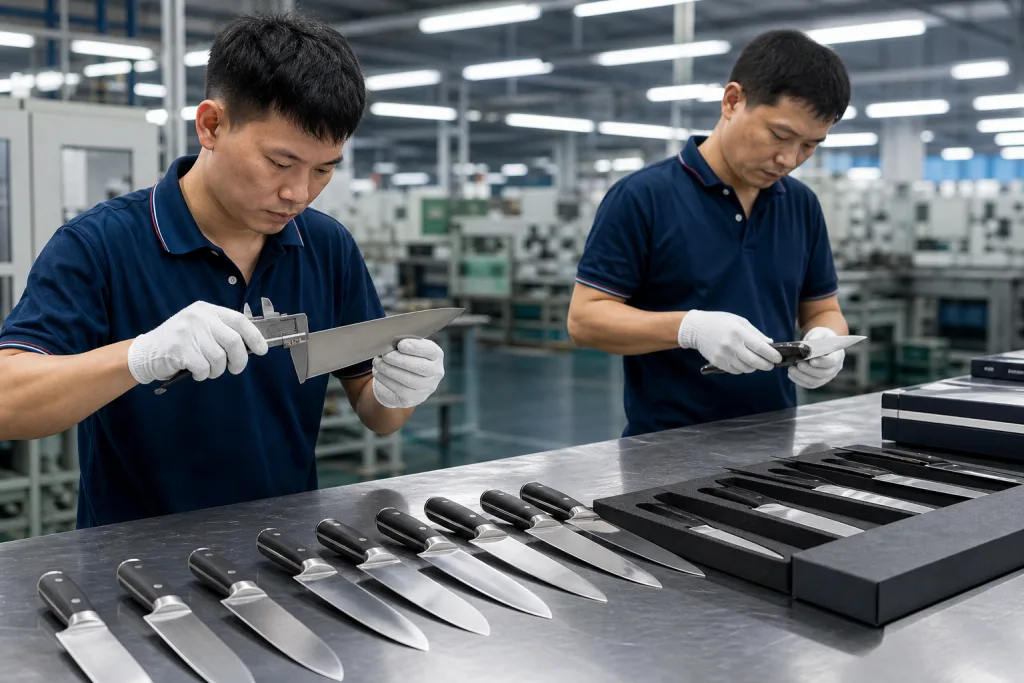
A butcher breaking knife looks simple until it fails on a wet line. Too much blade flex and the cut walks 3-5 mm past the fat line. Wrong handle swell and a nitrile glove slides toward the heel. Push the steel outside the heat-treat window and the edge chips on rib bone. We see it at the trim table. QC pulled one 8-inch sample last season after the grinding line left the tip 0.6 mm thinner than spec. In butcher breaking knife manufacturing, that fault costs more than the knife because one slow station can hold back 12 cutters behind it.
For sourcing from Yangjiang, Zhejiang, China, start with the cut task. “Can you make it look like our sample?” is the wrong question to ask. Tell the factory if the knife is for breaking primals or working tight around bone, then lock blade stiffness, handle geometry, and hardness to that job. A solid butcher OEM program ships steady cartons, not one polished showroom piece. On our Yangjiang, Zhejiang, China export lines, clean orders arrive with a marked spec sheet, handle length in mm, target HRC, carton marking, and one buyer pushback already closed: control in wet gloves or faster washdown. We run lot 1 against the retained sample, then check lot 20 and lot 80 for the same hand feel before packing.
Match The Knife To The Cut
Butcher breaking knife manufacturing should start with the cut on the table, not the model name in the catalog. A breaking knife has to clear primals, seam fat, silver skin, and portion cuts while the operator is leaning into the handle. Thin is not always smart. A 2.0 mm blade can look clean in the sample photo, then bow on chilled pork shoulder and pull the cut line 6-8 mm off the seam. We see it at the grinding line: chatter marks near the belly, heat tint at the edge, and the buyer asking why the knife felt “soft” after 30 minutes. If the blade is stiff but nose-heavy, the worker fights it all day. Wrist complaints arrive before the first carton ships.
For meat-trade brands, I usually spec a spine around 2.5-3.2 mm on common 8-10 inch models, with enough distal taper to keep the tip useful but not whippy. That spec holds up in 0-4°C cold rooms, on polyethylene boards, and in wet gloves. If you are doing butcher breaking knife manufacturing sourcing from Yangjiang, Zhejiang, China, send photos of the actual cut station, carcass size, board height, and glove type, not just “220 mm breaking knife” on the PO. We run into this often. One PO says breaking knife, the sample room builds a narrow boning-style tip, and nobody catches it until trial cutting. QC pulled one sample last year where the buyer wanted a carcass breakdown knife but approved a boning-style tip. The geometry failed in one shift.
The check is simple. The user should push through fat without blade chatter or the handle rolling in the palm. Ask for a heel profile with power near the board, a tip that enters seams without stabbing too deep, and a balance point that stays planted in a gloved hand after 200 cuts. For a butcher OEM program, chasing the thinnest possible edge is the wrong question to ask. We have seen this go sideways on frozen trim work; the edge looks sharp in the showroom, then twists under load and comes back with a 1.5 mm wave near the tip. In this category, control beats delicacy.
Steel And Heat Treat
Steel choice decides whether the knife stays on the rail or comes back to our desk with a red complaint tag. For a breaking knife, I usually spec 55-58 HRC, with enough toughness for the occasional hit on cartilage or small bone. Go harder if the buyer insists, but above 59 HRC on a daily work knife, the edge stops forgiving bad wrist angles. QC once pulled 12 samples from one heat and rejected 3 after the tips chipped on a brass-rod check. That batch did not ship. We logged it on the hardness tester at the grinding line, and the spread was too wide to argue with.
The useful steels in butcher breaking knife manufacturing are mid-vanadium stainless choices and proven martensitic grades: 1.4116, 5Cr15MoV, 8Cr13MoV, and 7Cr17MoV. They are not fancy steels. Good. They grind cleanly on the belt line, pass corrosion checks after the salt-spray cabinet, and keep cost steady when a meat brand needs 3,000 pieces this month and the same spec again next month. If your customer asks for a premium feel, put the money into tighter heat treat control on the same base steel. A shiny steel name printed on the PO will not save a bad tempering curve, and we have seen that argument go sideways after the first return carton. The factory should give you a hardness tolerance of about plus or minus 1 HRC across the batch, with test records from heel, mid-blade, and near the tip.
Edge geometry matters just as much. For wet processing lines, a 15-18 degree per side edge is safer than an ultra-thin polish. It slices cleanly and gives the worker backup when the blade twists through connective tissue. Ask the supplier to show the grind line, not only the polished blade face. On one 8-inch breaking knife order, the buyer flagged a 0.6 mm wander near the heel, and he was right. The user would feel that on day one, especially after two hours on pork shoulder. QC pulled the sample under a 10x loupe, then we checked the heel thickness with a digital caliper.
If you want a tougher workhorse, accept slightly lower first-cut sharpness for a blade that survives repeated trimming and sanitizing cycles. "Can you make it sharper?" is the wrong question. Ask how it looks after 18 washdowns, not after one paper-cut video shot under office lights. In China export programs, we run this tradeoff often, and for meat-trade brands, the math usually points to toughness first. We ship knives for workers cutting 6 hours a shift, so the second-week edge tells you more than the first demo video.
Grip Engineering For Wet Hands
Grip engineering is where 7 out of 10 weak butcher knife programs get exposed. A knife can hit the steel spec and still fail because the handle turns slick after sanitizer wash or pinches a nitrile glove at the finger rest. Fast work shows it. In meat plants, the hand is cold, wet, and moving, often with fat on the glove before the second carton is open. Shape beats decoration. A butcher breaking knife should sit into the palm so the worker guides the cut, instead of crushing the handle just to keep control. We have seen this go sideways: the buyer approved a polished sample dry in the office, then QC pulled the sample on the floor and found slip marks after one shift on the trimming table.
For most buyers, a handle length of 120-140 mm and thickness around 18-24 mm works better than a slim kitchen-profile handle. If the tool will be used with nitrile gloves, we run the grip section a little fuller and add a small guard so the thumb does not ride onto the blade shoulder. TPE overmold and textured PP both work when the mold line is trimmed clean; FRP scales need tighter checking around the rivets so protein residue does not sit in a gap. The wrong question is “which handle looks premium?” Ask whether a wet glove can hold it at 6 a.m. in a cold room. I like a subtle palm swell near the center and a butt that stops slippage without bruising the hand. Our molding line checks the seam with a 0.2 mm feeler gauge before packing, and QC rejects the piece if the flash catches the glove.
- Choose a matte finish with visible texture; reject shiny polish that turns slick after sanitizer wash.
- Keep the balance point close to the front finger rest, usually within 10-18 mm, so the wrist does not fight the blade.
- Test the handle in wet-glove and dry-glove conditions; we ship samples with both notes because the feedback often comes back opposite.
- Ask for a cleaning-friendly profile with no deep gaps that trap fat or protein residue, especially around rivets and butt ends.
If your brand sells into sanitary processing, a seamless tang cover or overmolded build is easier to defend than a decorative rivet layout. The knife should feel like a production tool, not a gift item. In a cold room, grip confidence prevents fatigue and bad cuts. Simple as that. One buyer pushed back on a 3 mm guard because it looked plain; after their plant trial, that same guard stayed in the spec, and the rivet version was dropped from the PO.
What To Lock In At Sourcing
Ask the butcher breaking knife manufacturing manufacturer for a sourcing sheet before you ask for a sample photo. A photo will not show whether the hollow grind is drifting 0.4 mm to the left, whether the tang reaches the last rivet, or whether a brass rivet is sitting proud under a 600-lux QC lamp. For butcher breaking knife manufacturing sourcing, lock four points first: MOQ, confirmed lead time, steel lot, and handle fixing method, whether riveted, injected, or overmolded. A 240-employee factory in Yangjiang, Zhejiang, China can run 3-5 product families in the same week, but your order still needs its own spec controls on the job card. We have seen one PO typo on “black TPR” turn into 1200 pcs of the wrong handle color before QC pulled the sample.
For standard export programs, MOQ is often 1000 pieces for an existing blade and handle combination, then 3000 pieces or more for a custom molded handle. Typical lead time after sample approval is 35-45 days; printed boxes, multilingual labels, or a new color way can push the job closer to 48-55 days if the carton artwork misses the first check on the dieline. A serious supplier should confirm FOB terms, carton quantity, and a pilot run before mass production. For meat-trade brands, lock the final pack spec before you approve the pre-production sample. Do it early. This is where the math doesn't work: changing a blister card after handle tooling is approved saves no money and can cost 7-10 days on the packing line.
| Item | Typical target | Buyer note |
|---|---|---|
| Blade hardness | 55-58 HRC | Built for working cuts; check the incoming lot with a Rockwell tester before grinding |
| MOQ | 1000-3000 pcs | Handle mold, box print, and carton pack decide the real number |
| Lead time | 35-45 days | Count from sample approval and signed artwork, not from the first quotation |
| Inspection | AQL 2.5 major | Use a lot-based final check; QC should pull samples from sealed cartons |
If a supplier cannot state these numbers cleanly, the program is not ready. We run into this with stock-knife traders: they can quote in 20 minutes, but they cannot name the steel lot, grinding line, or handle cavity number. The buyer flagged this on a 2023 EU order after 6 samples came back with two different spine thickness readings on the same 8-inch pattern. That is not butcher OEM work with your spec set.
QC And Compliance That Matter
Compliance looks boring until customs holds 1 pallet, or a retailer asks for the file at 5 p.m. and the sales desk has 12 minutes to answer. For meat-trade brands selling into Europe or North America, we normally prepare ISO 9001, BSCI when the buyer asks for social audit coverage, plus material declarations for the blade and handle. If the handle uses polymer, REACH must be clean, and any food-contact claim needs the matching test file. We have seen this go sideways when a PO says "LFGB" but the report covers only the blade steel, not the TPR handle. Bad shortcut. If you sell into retail, ask for FDA or LFGB support where applicable, but do not assume one certificate covers every market or every part on the knife.
Inspection should be practical, not window dressing. We check blade length with a digital caliper, spine thickness in mm, piece weight, grind symmetry, edge burr, hardness, handle alignment, and logo placement against the approved sample. For export lots, AQL 2.5 for major defects and 4.0 for minor defects is a normal control point. Critical defects should be zero. No drama there. On the line, that means no cracked handles, no loose blades after the pull check, no dangerous burrs from the grinding line, no rust spots, and no print errors on the box. QC once pulled 32 samples from a butcher knife lot and rejected it because 3 cartons had the same SKU typo on the side mark.
The better factories in China run batch traceability every day, not only when a buyer visits. A blade lot number, heat treatment record, and packing date should link back to the order; QC pulled the sample last month and traced a breaking knife lot in 7 minutes from carton mark to furnace record. That is how you solve a complaint without reopening the whole shipment. If the supplier in Yangjiang or elsewhere cannot trace a lot in minutes, they are not ready for a serious import program. Ask for pre-production, in-process, and final inspection photos, not only a shipping video; a 20-second clip of packed cartons does not prove the HRC record or the handle pull check.
Packaging And Launch Timing
Packaging should match the sales channel, not what looks neat on our packing bench. A 10-inch butcher breaking knife for a food-service distributor can ship in a plain white box with a PE edge guard and 24 pcs per master carton; a retail private-label knife needs a color box, hang hole, warning text, and an EAN position held within 1 mm. Overpacking kills margin. For B2B, we check carton burst strength, barcode scan rate, and whether the warehouse team can count inner packs without cutting open every sleeve. For ecommerce orders or distributors using FNSKU labels, SKU stickers, or multilingual EANs, approve the artwork and label file before we run the first 500 boxes. Printed cartons are expensive scrap once they are stacked beside the packing table. The math does not work.
For launch planning, ask for one signed golden sample, one pre-production sample, and one packed sample. Simple sequence. It catches satin finish mismatch, a label placed 8 mm too low, or a tray pressing on the knife tip before mass shipment. QC pulled the sample on one 10-inch breaking knife order and found the edge protector sliding off after a 1.2 m drop test, so we changed the protector length before packing the full lot. Saving 2 days here is the wrong question to ask. A good supplier checks whether the knife sits tight in the tray and whether the edge protector stays on after carton shaking, not just on a clean desk photo. For FOB or DDP work, confirm who pays for carton rework, inland handling, and inspection delays, because those charges appear after the vessel date is booked.
Meat-trade brands do not need flashy packaging. They need knives arriving straight, clean, and traceable, with the same carton count from pallet 1 to pallet 18. We ship better when the PO, barcode file, carton mark, and production spec match line by line; one buyer flagged a single digit typo on the outer carton SKU, and it cost 12 days against an 18-day launch window. We have seen this go sideways over one wrong EAN. If the label roll, carton mark, and packing list match the production spec, the next export run is easier to repeat. That is how a trial order becomes a China supply program without warehouse rework.
Frequently asked questions
For most meat-processing programs, 55-58 HRC is the practical band. That gives enough edge retention for trimming and breaking, while staying tough enough to tolerate occasional contact with cartilage or small bone. If you push to 59 HRC or more, you need tighter heat-treat control and better QC, or you will see edge chipping. Ask the supplier for hardness readings from heel, mid-blade, and tip, and expect a tolerance of about plus or minus 1 HRC across the batch. For export meat brands, consistency matters more than chasing a high number on paper.
Yes, and this is usually where the real performance difference shows up. For wet-glove use, I would target a 120-140 mm handle, 18-24 mm thickness, a matte surface, and a texture that still bites when coated with fat or sanitizer. TPE overmold, textured PP, or FRP all work if the mold lines are clean and the handle does not create residue traps. Add a modest finger guard and a palm swell so the knife does not rotate in the hand. If your workers wear nitrile gloves all shift, test the sample in that exact condition before approval.
For standard butcher knife OEM work, MOQ is often 1000 pieces for an existing construction and 3000 pieces or more if you need a custom handle or custom box. Lead time is usually 35-45 days after sample approval, but that can stretch if you add printed packaging, multilingual inserts, or color matching. A factory in Yangjiang, China with a stable export line should be able to confirm the schedule in writing, including carton count, master carton size, and packing method. If they cannot, the order is not fully defined yet.
Ask for ISO 9001, and BSCI if your buyer requires a social audit file. For materials, get blade steel declaration, handle material declaration, and REACH support for polymer parts if you sell into Europe. For retail programs, FDA or LFGB support may be required depending on the market and contact claim. On the QC side, AQL 2.5 major and 4.0 minor is a normal export standard, with zero critical defects. Also ask for batch traceability, heat-treatment records, and final inspection photos so complaints can be traced without reopening the whole shipment.
A breaking knife is built for control on larger cuts, primals, seam fat, and portioning work. It is usually stiffer, broader, and less delicate than a boning knife. A boning knife is narrower and more maneuverable around joints and tight bone structure. In practice, a breaking knife often runs around 180-250 mm blade length depending on the market, with a stronger spine and a grip that supports long cutting sessions. For meat-trade brands, the mistake is trying to force one geometry to do both jobs. The right tool gives cleaner cuts and less fatigue.
Specify Your Meat Knife Program
Send your target cut, blade length, and market. We will turn that into a workable butcher OEM spec with the right stiffness, grip, and QC plan.
Request a Quote