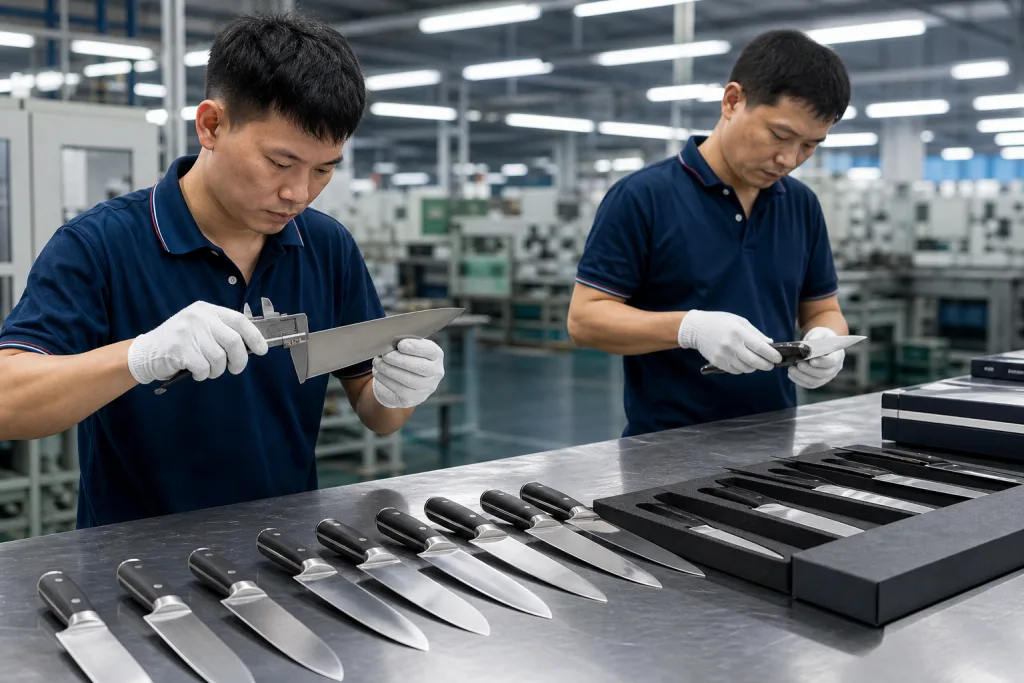
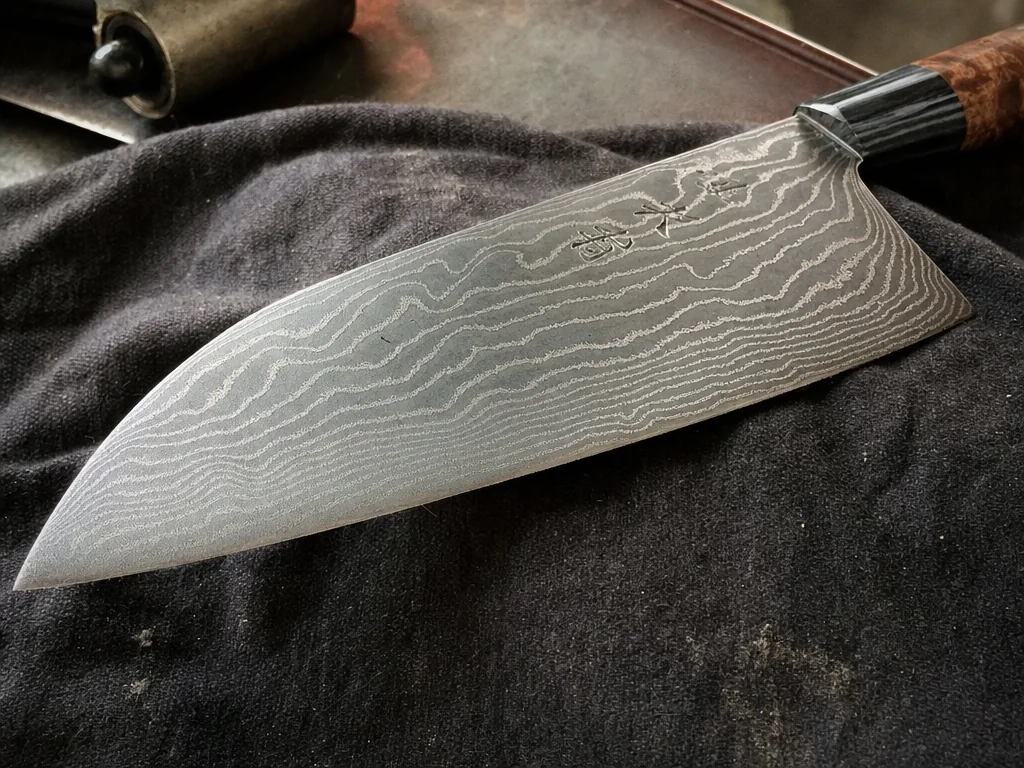
Chinese cleaver cai dao sourcing fails fast when buyers put every cleaver under one SKU. A vegetable cai dao for cabbage, herbs, and boneless pork is not the same build as a heavy-bone cleaver for cartilage and poultry joints. Send a chinese cleaver cai dao sourcing manufacturer only a photo and we get the usual mess: a loose quote, a 2.8 mm blade when your shelf spec needed 1.8 mm, then a fight after QC pulled the sample and checked it with a caliper on the packing table.
For kitchenware importers, lock the cutting task, target retail price, and abuse level before samples. Simple rule. In Yangjiang, Zhejiang, and other knife-making areas in China, export-stable factories will ask for blade thickness, HRC band, handle material, packing format, and your compliance target before they price. That is the correct question set. We have seen this go sideways: one buyer wrote “stronger” on the PO, the factory built a heavy-bone version, and the cost landed 18% higher when the program actually needed a thin-vegetable SKU for supermarket shelves. The math does not work when the grinding line adds steel the end customer never agreed to pay for.
Start With the Cutting Job
The first decision in Chinese cleaver cai dao sourcing is not steel. It is the cutting job. A thin vegetable cai dao should pass through cabbage, scallion, garlic, herbs, and boneless pork without wedging; on our grinding line we usually set a slimmer spine and a clean 15-18 degree edge for this order. A heavy bone cleaver is a different knife: thicker spine, more blade weight, and enough shock margin when the user hits poultry joints or soft bone. Wrong brief, bad result. We see the return note as "edge chips after 3 days," then QC checks the Rockwell slip while the real mistake sits on the order sheet.
For retail and foodservice, write the main use in one sentence. Example: a 220 mm vegetable cleaver for prep stations, or a 180 mm heavy cleaver for poultry and soft bone work. That one line changes the next 6 decisions: blade geometry, tempering target, edge angle, handle balance, carton warning text, and the QC drop check. We run into mixed wording about 4 times a quarter. A Chinese OEM should ask if the knife is sold as a prep knife, a general kitchen cleaver, or a bone chopper; we have seen buyers put all three names on one PO, then flag the carton copy during inspection because the English did not match the sales page. That is where projects start to slide.
There is a pricing consequence too. Thin vegetable models spend money on fit, finish, and edge consistency; QC pulled a sample last month because the choil polish passed, but the edge variance ran 0.4 mm across 12 pcs. Heavy bone models spend money on steel mass and grinding time, then need impact control before packing. One SKU for both jobs looks tidy on a spreadsheet. The math does not work cleanly. Strong import programs split the line into 2 clear products, which cuts buyer confusion and protects sell-through in Europe and North America.
Match Steel To Abuse
Pick steel by the abuse the buyer will put on the blade, not by the prettiest line in the catalog. For a thin-vegetable cai dao, 7Cr17MoV or a close export stainless grade works for most supermarket and Amazon programs: it holds a tidy edge, resists sink-side rust better, and still leaves margin after carton, duty, and Amazon prep fees. We run 1.8-2.5 mm blanks on the grinding line with a fine edge, so pushing hardness past 58 HRC brings chip complaints fast. Bad trade. For a heavy-bone version, go softer and tougher. Simple math: one chipped bone cleaver return costs more than a knife that needs 6 extra passes on a honing rod. QC pulled a 3.5 mm sample last month after the buyer flagged chips on pork ribs; the steel name passed, the HRC setting failed.
| Use case | Blade thickness | Typical steel | Target HRC | Buyer note |
|---|---|---|---|---|
| Thin vegetables | 1.8-2.5 mm | 7Cr17MoV or 14C28N | 56-58 | Clean slicing feel with better rust resistance; keep the edge geometry thin |
| General kitchen cleaver | 2.5-3.0 mm | 5Cr15MoV or 7Cr17MoV | 55-57 | Practical middle choice for mixed retail programs and 1,000-3,000 pc orders |
| Heavy-bone use | 3.0-4.5 mm | 5Cr15MoV or 3Cr13 variant | 52-55 | Put toughness first; shock tolerance matters more than catalog hardness |
The table is only a starting point. Heat treatment beats the steel grade printed on the carton. A chinese cleaver cai dao sourcing manufacturer should show hardness test records, quench and temper ranges, and sample retention data with batch numbers. A one-line promise in a PI gives thin cover. If they cannot show a Rockwell tester log from the last production run, the steel name is decoration. We have seen this go sideways: the PO said 7Cr17MoV, the carton mark said 5Cr15MoV, and nobody caught the typo until pre-shipment inspection. For Chinese export programs, ask for a real HRC tolerance. Plus or minus 1 HRC is believable. "Every blade is perfect" is not.
Weight, Balance, And Grind
A Chinese cleaver earns its place from blade width and board speed, not from extra grams on the spec sheet. For vegetable cai dao, we run 200-280 g on most orders, with enough blade height for knuckle clearance and a broad face to scoop cabbage, scallion, or crushed garlic. For bone chopping, 300-450 g is the cleaner quote, with a thicker heel and a spine that will not twist when the buyer tests chicken joints on a PE cutting board. Weight alone is the wrong question to ask. QC pulled one sample last month at 512 g; the buyer called it a crowbar, and he was right.
Edge geometry is where first-time importers lose the knife. A thin vegetable cai dao usually works at 15-18 degrees per side, with a fine grind and no hard shoulder from spine to edge. A bone cleaver may need 20-25 degrees per side and still cut better in real kitchen use, because toughness matters more than shaving feel once the edge hits cartilage. Specify heel height and flatness tolerance. Put it in the PO. On the grinding line, a blade out of flat by 0.5 mm will drag through prep work, and the whole order starts to feel cheap before the cook even looks at the logo.
Balance point has to match the job. Vegetable models usually feel right with the balance slightly forward of the pinch grip; bone models can sit neutral or a little blade-forward. For private label, ask for a finished sample with the exact handle installed, including rivet count and handle thickness in mm. Naked blades mislead everyone. We have seen this go sideways when a buyer approved a bare VG-10 blade, then flagged the final carton because the pakkawood handle pulled the balance back too far.
Handles And Retail Packaging
Handle design is not decoration. It decides grip with wet hands, grease traps around the bolster, and which food-contact documents your importer will chase before customs release. For a value program, we run injection-molded PP or ABS most weeks; a 110 mm handle mold keeps the unit price tight and will not swell after dish-sink work. For a higher retail line, POM or pakkawood feels better in hand, but the glue line and rivet press setting need bench checks, not guesswork. QC pulled one sample last year where the front rivet sat 0.4 mm proud. The buyer flagged it at once. Fair point. On export orders, ask for LFGB or FDA support for food-contact parts where it applies, especially when the handle finish or adhesive sits near heat, steam, and sink moisture.
Packaging should follow the sales channel. A supermarket cleaver needs a hanging card or retail box that survives pallet handling; we usually test the carton after a 80 cm drop because the two top corners fail first. A foodservice SKU may only need a blade guard and an inner carton. Still, protect the edge. We have opened cartons where blade tips rubbed through thin guards and left rust marks before inspection. Online sales are stricter: give the factory barcode position, FNSKU rules, and carton drop standard before box tooling starts. The math does not work after production. Fixing a box layout in China costs little, while relabeling 5,000 units in a warehouse can eat 2 days of labor and delay dispatch.
For custom branding, laser engraving usually beats pad print on the blade face. Simple artwork comes out cleaner by laser, and it does not wash off after repeated sink work. We ship plenty of cai dao orders this way: laser engraving on the blade, a plain retail box, and no fancy print unless the gift-set margin pays for it. We have seen this go sideways when a buyer asks for metallic ink on a low-cost box, then rejects the sample because the logo rubs after 20 passes with a dry cloth. Wrong place to save money.
OEM Specs And China Lead Times
A chinese cleaver cai dao sourcing manufacturer should quote from a clean spec sheet, not a WhatsApp screenshot. We run our Yangjiang, Zhejiang export line for repeat orders: about 240 employees, around 180,000 units per month across categories, and a normal MOQ of 1,000 pcs per SKU for a private label cleaver. For a cai dao, our merchandiser needs the blade drawing, logo file, handle reference, and packing method before pricing. No guessing. Sample lead time is usually 7-10 days after the drawing and logo are approved; if the buyer changes the spine from 2.5 mm to 3.0 mm after the first grind, QC pulls the sample, checks it with a digital caliper, and the clock starts again. Mass production normally sits at 35-45 days after sample sign-off, depending on steel availability and whether the color box needs a new die line.
Ask for FOB and DDP pricing separately. Blade price alone is the wrong question to ask. A Chinese OEM can make the same blade look cheap on FOB, then the landed cost jumps when packaging, carton loading, and compliance testing were missing from the first quote. The spec sheet should include blade length and height, spine thickness, steel grade with HRC target, handle material, logo position, carton count, and drop-test requirement. We have seen buyers flag a 1 mm logo shift on pre-shipment photos, so mark the logo location on the drawing, not in a loose email. For a long-term program, ask the factory to hold material reserve for one re-order; the next batch of pakkawood can arrive darker, and the hardness reading may sit half a point away on the Rockwell tester.
This is where sourcing discipline earns money. Short sentence, big bill. In China, the best price is often the quote with fewer surprises, not the low number in the first email. We have seen this go sideways when a PO says “wood handle” but the approved sample was pakkawood; that one typo can add 12 days before packing because purchasing has to re-book the handle stock and QC has to re-check the rivet fit. A serious factory in Yangjiang or Zhejiang will treat the drawing as a contract document, not a suggestion.
Quality And Compliance Checks
Export cleavers need to be checked as working tools, not shelf-display knives. For mixed kitchenware orders, I set AQL 2.5 for major defects, 4.0 for minor defects, and zero tolerance for blade cracks, loose handles, rolled tips, burrs, or any edge nick that can cut a packer during unpacking. We run hardness by lot on the HRC tester, set each blade on a flat jig to catch bend, check the satin finish under 6500K white light, and do a pull-and-twist check on the handle. No shortcuts here. On foodservice models, add a 24-hour wipe test for corrosion and a cut test through cabbage stems or potato. “Looks sharp” is the wrong standard. If the edge skips on produce, the buyer will flag it before the second carton is opened.
Ask for evidence, not promises. A useful quality file should include heat-treatment records, HRC checks by lot, raw material certificates, carton count verification, and final inspection photos with carton marks visible. If the model ships into the EU or US, ask what the factory can support for REACH, LFGB, and FDA-related material declarations. In our quote reviews, about 6 out of 20 importers check the blade steel and miss the handle plastic, coating, ink, adhesive, or retail label. That is where cheap programs go sideways. QC once pulled a sample because the blade passed 58 HRC, but the printed barcode label used the wrong ink declaration, and the PO even had the handle color typed as “black” while the approved sample was dark brown.
For the first shipment, I prefer a pilot lot of 300-500 pcs only when the design is new. If the recipe is stable, go to the normal MOQ and write the inspection points into the purchase order, including blade thickness tolerance, handle gap limit, carton drop-test requirement, and photo samples before packing. Simple rule: do not turn every PO into a trial run. The math does not work when a buyer saves USD 0.08 per cleaver but loses 12 days on rework before vessel closing, especially when the grinding line is already booked for another customer’s 2.0 mm cai dao order.
Frequently asked questions
A vegetable cai dao is usually thinner, lighter, and harder to keep slicing cleanly through leafy produce and boneless protein. Think 1.8-2.5 mm spine thickness, about 200-280 g, and 56-58 HRC. A heavy-bone cleaver is built for shock: 3.0-4.5 mm, roughly 300-450 g, and usually 52-55 HRC. If you try to force a thin blade into bone work, you will see chipping at the heel or edge. If you make a bone cleaver too hard, you will see brittle failure. For a buyer, the safest approach is to separate the two SKUs and price them differently.
For most kitchenware importers, 7Cr17MoV or 5Cr15MoV is the practical starting point because it keeps the cost under control and gives acceptable corrosion resistance for export retail. For vegetable cleavers, aim for 56-58 HRC. For heavier, abuse-tolerant models, 52-55 HRC is usually safer. If the supplier pushes a premium steel without showing heat-treatment consistency, do not treat that as an upgrade. Ask for hardness records by lot, not one sample only. If your market is the EU or North America, also ask for REACH and LFGB or FDA-related material support before you lock the artwork.
A normal MOQ for a private label cai dao is often 1,000 pcs per SKU, sometimes higher if you want custom handle tooling or special packaging. Sample lead time is commonly 7-10 days after drawing approval. Mass production is usually 35-45 days once the sample is signed off and materials are ready. If you already have the same steel and packaging in stock, repeat orders can move faster, sometimes 30-35 days. For planning, assume ocean freight and destination clearance will add time on top of factory production. A serious chinese OEM should give you separate timelines for samples, production, packing, and shipment.
Set a written inspection plan before production starts. For most export orders, I would use AQL 2.5 for major defects, 4.0 for minor, and zero critical defects. Check blade straightness, handle fixation, logo placement, edge condition, and packaging count. Measure hardness on each lot, not just one sample. If possible, test a small set for corrosion and cutting consistency on vegetables and boneless protein. For a new program, ask the factory to send in-process photos from grinding, heat treatment, and final packing. If the order is going into retail, also confirm carton drop performance and barcode readability before release.
Yes, but only if you manage compliance properly. For the EU, you need to pay attention to REACH and any food-contact expectations tied to the handle, coating, ink, and adhesive. For the US, ask your supplier for FDA-related material declarations where they apply and make sure the packaging claims are accurate. Do not assume that a stainless blade automatically solves everything. If the handle uses a plastic blend or glued layers, that is where many file gaps appear. Also, if you sell on Amazon, you may need FNSKU labeling and retail carton standards. A good factory in China should be able to support the documents, but you still need to request them early.
Request Your Cai Dao Spec Today
Send blade length, thickness, steel, HRC, packaging, and target market. We will quote the right cai dao build for vegetable prep or heavy-bone use from China.
Request a Quote