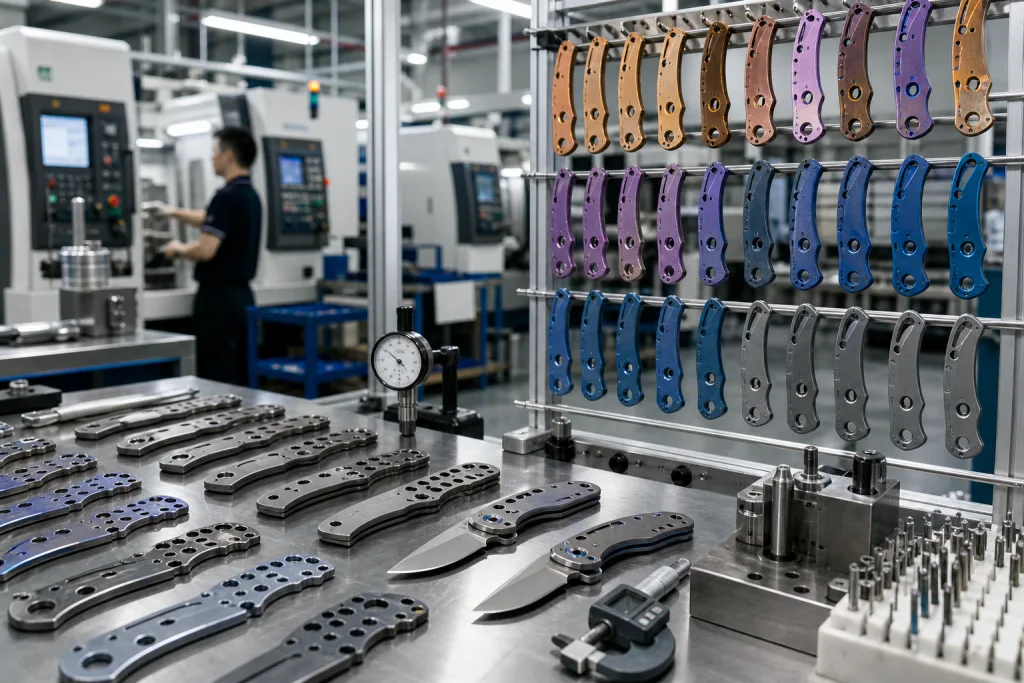
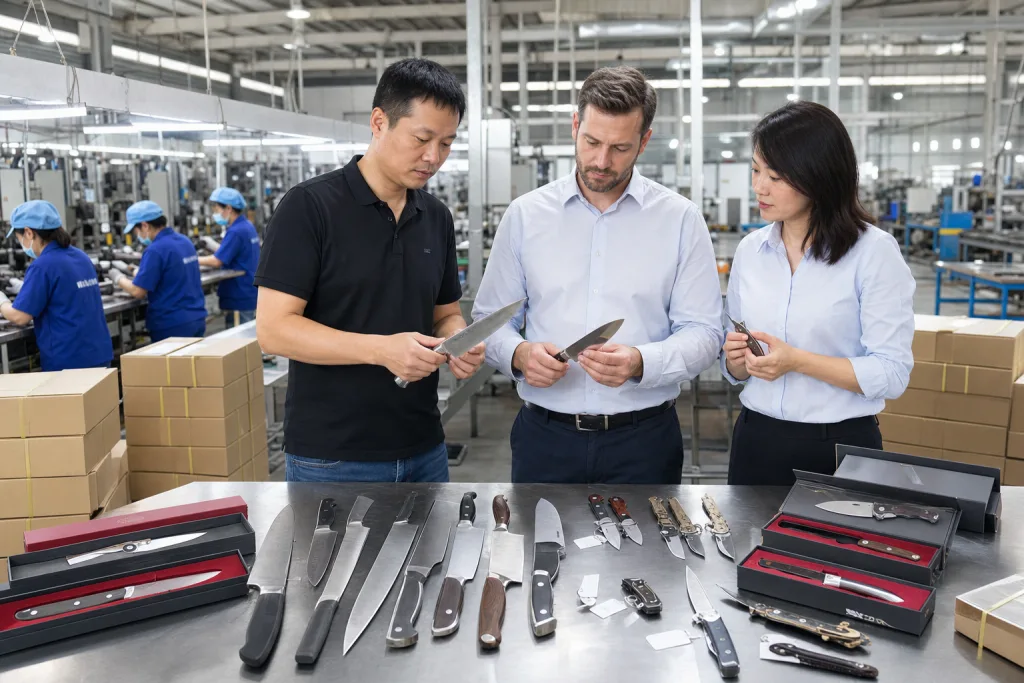
If you are launching a knife line into retail, Amazon, or distributor channels, the first sourcing mistake is treating every SKU like full custom work. In Yangjiang, China, about 7 out of 10 export factories we visit already keep tested blade shapes, handle molds, and color box dielines on the shelf. We run a stock knife rebrand through logo laser, inner box artwork, and final carton marking in 15-30 days instead of 60-90. That gap matters. Last month our grinding line used an existing 2.5 mm chef blade and changed only the laser logo and Pantone handle insert. The buyer got counter samples before their Amazon image deadline, and the caliper check still matched the old approved blade drawing.
Fast is not free. You give up part of the blade geometry control, tooling ownership, and IP clarity, and buyers get caught there. “Custom or stock?” is the wrong question to ask. Start with target margin, order size, and whether you need a white label knife for a 500-1,000 pcs market test or a custom knife cost structure for repeat orders. We have seen this go sideways: a cheap quote left out color box testing, FDA or LFGB paperwork, and sea freight. QC pulled the sample at AQL 2.5, the buyer flagged a PO typo on handle color, and the landed cost no longer matched the launch plan.
What stock rebrand actually means
A stock knife rebrand means we take a blade, handle, and assembly spec already saved in our production file. Same blanking die. Same grinding jig. Same handle fit. Your side changes the logo, gift box, insert card, barcode label, color accent, and sometimes the sheath or clip if that tooling is already on the shelf. Fast, yes. New knife, no. We are printing your brand onto a SKU the grinding line already knows how to run, right down to the logo pad-print fixture and carton label position.
In Yangjiang, China, factories keep tool-ready patterns for kitchen knives, chef knives, pocket knives, and outdoor knives because buyers ask for ETD before they ask whether the spine is 2.5 mm or 3.0 mm. If a plant is running 80,000-120,000 units/month, it can usually put a stock model onto the grinding line faster than it can open a new mold or reset a heat-treatment target. We have seen artwork approval take 12 days while the knife build needed 7. That happens often enough to hurt launch calendars. For a buyer, the gain is clear: MOQs often sit at 300-500 pcs per SKU, sample rounds drop from 3 rounds to 1 or 2, and our engineer is checking logo position instead of redrawing the blade. Packaging slows the job more than the knife, especially when the barcode label on the PO says matte box but the artwork file says gloss.
The tradeoff is blunt. You are not buying unique geometry, and you are not controlling every dimension on the drawing. QC may pull a sample at 2.8 mm spine thickness and it will pass because that is the stock spec, even if your first email imagined 3.0 mm. If your brand story depends on a signature finger choil, a special handle swell, or a silhouette your competitors cannot copy, stock rebrand is the wrong question to ask. It looks cheap at first. Then the buyer flags the same knife on another shelf, and the math does not work so well.
Where custom cost actually starts
Custom knife cost starts before the first finished piece ships. You pay for CAD drawings, 2D or 3D revisions, blade and handle tooling, fixture setup, sample labor, and usually 1-2 correction loops after QC checks the pilot sample with a caliper and Rockwell tester. A modest handle mold can run $1,500-$6,000. A simple engraving die or laser setup is small money beside that. Change the steel, grind geometry, or locking parts, and the job has moved past logo work. The grinding line needs new gauges. We also need a sample fixture that holds the blade at the same angle every pass, or the first 20 pcs will not match the drawing.
That cost makes sense only when the order plan carries it. A full custom knife often adds $0.60-$2.50 per unit versus a stock knife rebrand, but it can improve sell-through when your range needs a distinct blade profile or a handle that feels right after 30 seconds in hand. The wrong question is, "How cheap is the mold?" Ask how many pcs will carry that charge. Spend $3,000 on tooling and buy only 500 pcs, and your landed cost gets ugly fast. We have seen buyers push back on this after the PO. The math does not move. If you buy 3,000-5,000 pcs across 12 months, the picture changes, especially when we can run the same handle mold with two blade finishes and keep the MOQ stable.
In China, a factory should quote tooling separately from unit price, then show the break-even point. If the sales rep bundles everything into one soft FOB number, you cannot see whether the price is competitive or padded to cover the first order. Ask for sample lead time, mold ownership, and what happens if production stops for six months. We run into this on reorders: the buyer flagged a 2 mm handle change, but the old mold was never clearly assigned on the contract. One PO typo can turn a repeat order into 12 days of checking emails instead of 18 days saved by reusing tooling. Those details matter more than the first quote.
The real side-by-side tradeoff
Here is the RFQ math we run before quoting. Put the 3 routes beside the questions your boss asks after QC pulls the counter sample, sets the calipers on the bench, and checks the logo position: MOQ, sample days, launch days, setup cost, and whether the order belongs on a stock line or a new build.
| Route | MOQ | Sample time | Launch time | Setup cost | Best fit |
|---|---|---|---|---|---|
| Stock rebrand | 300-500 pcs | 7-14 days | 15-30 days | $0-$300 | Market test or distributor launch: logo laser, carton mark, barcode, and one AQL 2.5 final check |
| Modified stock | 500-1,000 pcs | 10-21 days | 30-45 days | $300-$1,500 | Color change, sheath, retail box, or a small handle tweak after the grinding line confirms fit and edge clearance |
| Full custom | 1,000-3,000+ pcs | 20-45 days | 45-90+ days | $1,500-$10,000 | New product with a planned 2-year sales cycle, locked mold, blade profile, handle material, and packaging dieline |
The cheapest unit price is the wrong question. Ask what it costs to sell the first 1,000 units. If a stock rebrand puts a live SKU on the shelf in 3 weeks and the distributor sends sell-through data before the second PO, it can beat custom even when the quote is 8-15% higher per knife. We have seen this go sideways. One buyer saved $0.18 on the blade, then lost 25 days because the handle mold came back 0.6 mm proud at the bolster; QC flagged it with a feeler gauge before packing. Bad trade. If the positioning is fixed, artwork has no PO typos, and the volume is real, full custom is the better long-term asset.
Quality still needs proof
Stock is not a code word for cheap steel. We ship stock knives with the same incoming steel checks as custom runs, but the evidence needs to sit in two places: the file and the QC bench. Ask for steel grade, hardness band, and inspection method. For kitchen knives, HRC 56-58 is common; for 70-80% of pocket and outdoor programs we run, HRC 57-59 is a normal working range if the heat treatment is stable. QC should pull 3-5 Rockwell readings from the batch with the HR-150A tester, not from the polished showroom sample. One buyer once sent back a quote because it listed "58 HRC" with no tolerance, no oven lot number, and no test date. Fair pushback. If a quote gives one hard number, ask for batch data from the heat-treatment oven record, not a sales promise.
Compliance is where new brands get burned. Europe usually means REACH-related material controls and, for food-contact kitchenware, LFGB documentation or equivalent migration testing. North American buyers ask for FDA-related food-contact confirmation, plus packaging and labeling control. If your program uses wood, coated metal, or soft-touch polymer, the handle and finish can matter as much as the blade; we once had QC hold 600 pcs because the black coating rubbed onto a white glove after alcohol wipe testing. That delay hurt. We have seen brands argue that the blade passed, so the order should move. Wrong question. A factory in Yangjiang, China should also be able to show ISO 9001 procedures, BSCI or similar social audit status if required, and AQL 2.5 inspection records for visual defects.
The fastest way to lose money is to approve a pretty sample and ignore lot consistency. Ask how the supplier tests sharpness, corrosion, lock strength, and edge retention. Get the method, including the salt-spray hours, paper-cut test, pivot torque check, and whether the grinding line checks edge angle at 15-20 degrees per side. QC pulled one folding-knife sample for us last quarter with a clean blade but a gritty pivot at 0.9 N.m, and that is exactly how a good-looking order goes sideways. For e-commerce, also ask about carton drop testing and FNSKU placement; one wrong digit on a PO label can stop a pallet at the warehouse for 12 days instead of shipping out in 48 hours. Stock or custom, the knife still has to survive the channel. The math does not work if the first review batch comes back with loose pivots or orange spots on the edge.
Which channels fit which route
Pick the route from the sales channel, not from the founder's ego. For an Amazon launch or a distributor test order, stock rebrand is usually the cleaner move. Faster too. We run logo laser, FNSKU labeling, and color box check in the same packing flow; QC scans the first 20 labels before carton sealing, so a 300-500 pc lot can ship in about 12 days instead of 18-25 days for a light custom build.
- Amazon and marketplace sellers: stock rebrand fits a 300-500 pc test lot, with FNSKU labels applied on the packing table and barcode position checked against the platform file before carton sealing.
- Importers and distributors: modified stock is often enough for a house line when the buyer needs one clear change, such as a different handle color, or a 2 mm blade thickness callout printed on the spec sheet and carton mark.
- Gift and promo programs: custom packaging on a stock knife can make a presentable set without a $5,000 tooling bill; the math does not work if the order is only 800 sets and the buyer still wants a foam insert, sleeve, and gift box.
- Premium chef or outdoor brands: full custom makes sense when the handle shape or blade profile carries the brand promise, such as VG-10 at 60-62 HRC, a new tang drawing, or a balance point the buyer checks with a 150 mm ruler.
The mistake is building too much before the channel proves itself. We have seen this go sideways: the buyer approved a new handle mold, then reviews flagged the price point, not the knife. Wrong problem. Start with a stock knife rebrand if you still need to test packaging, pricing, or review quality; after 2-3 repeat orders, exclusivity has a real case and the grinding line has better data to work from.
How to choose without overbuying
Use a simple gate before you approve tooling. If the first PO is under 1,000 pcs, sell-through is still a guess, and your team is split between USD 19.99 and USD 24.99 retail, choose stock or a light stock change. Start small. We run this check before opening a new handle mold because one wrong ABS color chip can stop the grinding line for 7 days, and the Pantone card will not care about your launch date. If your forecast is 3,000-5,000 pcs over 12 months, you know the target customer, and you need a blade silhouette the next seller cannot copy from our shelf, go custom.
Ask the factory five blunt questions: what is the exact FOB price at 500 pcs and 1,000 pcs; what tooling is owned by you versus by the supplier; what lead time changes if packaging is sourced in China versus locally; what inspection standard is used at AQL 2.5; and what is the expected HRC band after 300 units of pilot production. Ask for numbers, not mood. QC pulled one pilot sample last month at 55 HRC when the buyer expected 58-60 HRC, and the buyer flagged it before the carton artwork was even approved. We checked it again on the Rockwell tester. Same result. If the answers stay soft, the product is not ready.
At a serious plant in Yangjiang, China, the sales team should quote both paths on the same call and show the break-even point in plain numbers. A cheap sample is the wrong question to ask if your reorder cash comes 45 days after delivery and the custom mold needs a 30% deposit today. The math does not work for every channel. We have seen this go sideways when a buyer approves a new PP handle, then the PO arrives with the old SKU code typed in one digit wrong. We ship better programs when the sourcing plan fits your cash cycle and the stock your team can carry without choking the next order.
Frequently asked questions
Usually the unit price is 10-25% lower on stock because the tooling has already been amortized, and the upfront cash requirement is much lower. A stock pocket knife might land around $2.80-$4.20 FOB, while a comparable custom knife can run $4.00-$6.50 FOB plus $1,500-$6,000 in tooling. The catch is that packaging, inserts, and compliance still cost money, so the real savings depend on your order size. For 300-500 pcs, stock is usually the better cash decision. Once you are buying 3,000 pcs or more, custom can close the gap if you repeat the order.
Most factories will quote 300-500 pcs per SKU for a stock rebrand, especially if you accept the existing blade and handle combination. If you want a new box, sheath, or a minor handle color change, 500-1,000 pcs is more realistic. Full custom usually starts at 1,000-3,000 pcs because the factory needs room to recover tooling and setup. If a supplier in China offers 100 pcs custom with no setup fee, inspect the numbers carefully; the unit price usually hides the cost somewhere else. Ask for FOB, tooling, and packaging as separate line items.
Yes, but only to a point. You can create a distinct retail item with custom packaging, laser logo, color changes, inserts, and a bundled accessory, but the core blade shape is still shared. That is fine for a test launch or a seasonal offer. It is not enough if your brand story depends on a protected silhouette or a patentable feature. For retail, the real question is whether the customer can tell the difference on shelf and whether your margin still survives after freight, duty, and packaging. If not, move to custom.
Stock rebrand usually takes 15-30 days after artwork approval because the blade and assembly are already in circulation. Modified stock often needs 30-45 days. Full custom normally runs 45-90 days, and longer if the handle mold, packaging tests, or compliance reports need another round. If you need seasonal inventory or a marketplace launch date, that gap matters more than the unit price. A late product is effectively more expensive because you miss the sales window and may have to discount the next batch to clear it.
Ask for the exact steel spec, hardness report, sample photos from the same production line, REACH or other material compliance files for Europe, LFGB or food-contact documentation for kitchen knives, and ISO 9001 or BSCI status if you need audit coverage. Also request the inspection plan: what is checked at AQL 2.5, how many pieces per carton, and whether the supplier can print your FNSKU or carton marks correctly. If the factory cannot answer these points in writing, do not send a deposit yet. You want a paper trail before production starts.
Request both quotes on one SKU
Send one stock rebrand spec and one custom spec. A good China factory should return FOB, tooling, lead time, and packaging options side by side.
Request a Quote