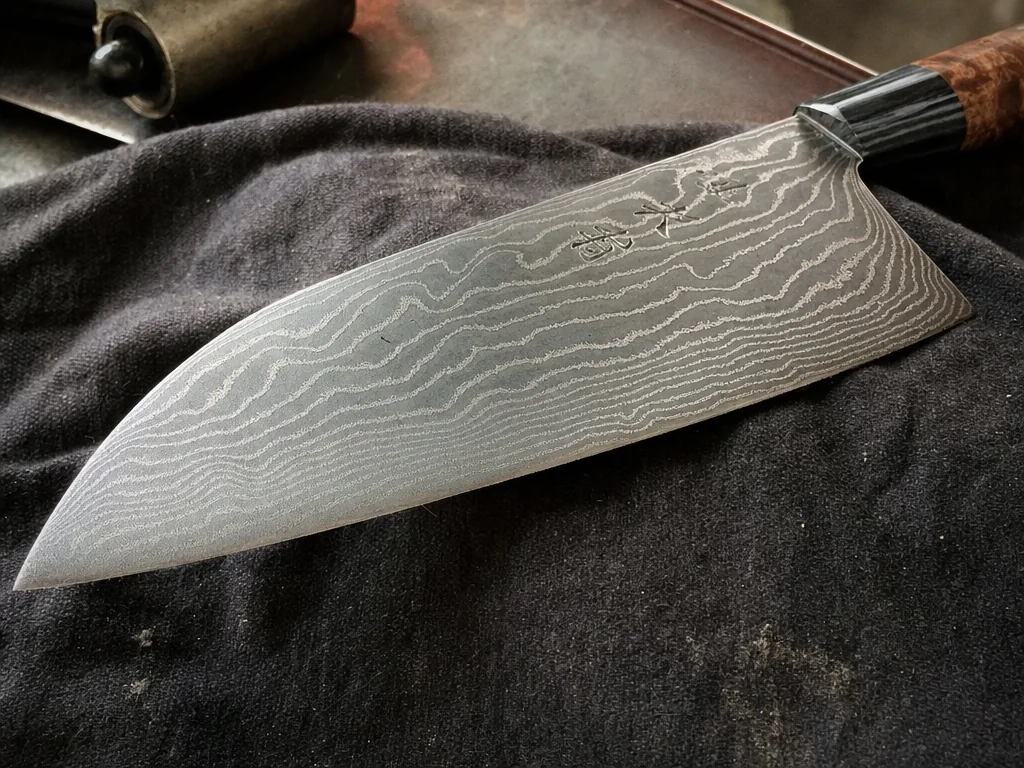
Buying deba knives for seafood lines is not the same job as buying general kitchen cutlery. The blade has to split fish heads, cut small pin bones, and stay stable on a wet PE cutting board through an 8-hour shift. We start with 4.0-6.0 mm spine thickness, single-bevel or modified bevel geometry, and heat treatment control; logo position and handle color come later. Ask color first and the math doesn't work. On our sample bench, the first check is a Mitutoyo caliper on the spine and a Rockwell note from heat treatment, not the laser file.
This is where we see projects go sideways. A deba brief that only says "180 mm blade, black handle" often comes back as a thin chef-knife shape with extra weight near the tip; QC pulled one sample last season at 2.1 mm spine, and the buyer flagged it after one shift on salmon heads. Too late. For fish-processing brands, the spec needs tighter control: named steel grade, target HRC with tolerance, grind angle on the working side, and balance point measured from the heel must match how your operators cut for 8 hours, not how the knife looks in a catalog photo. A serious deba OEM quotes those numbers, then holds them on the grinding line and final inspection.
What a deba knife must actually do
A deba is not a short cleaver. On a fish bench, it must split a fish head without twisting, shave the collar meat close to the bone, and ride the backbone with enough blade weight behind the edge so the cut does not chatter when the operator leans in. Geometry wins the order. Decoration doesn't. For most export programs, a 165 mm or 180 mm deba covers daily seafood prep; 210 mm makes sense when the line handles bigger fish or the buyer wants extra heel reach. We run sample checks with a 0.02 mm feeler gauge at the shinogi, because a mirror-polished blade with a soft shoulder gets flagged after the first cutting trial.
Blade height and spine mass should support controlled force, not fast slicing. A practical production target is 45-55 mm blade height, with the heel carrying the thickest section. We see 6 or 7 buyers each season ask for deba knife manufacturing and leave handedness off the PO; last April one PO even said "single bevel, both hands," which stopped the drawing review for 2 days. Ask earlier. Traditional deba is single bevel and usually right-handed by default. If you need left-handed units, write it in the drawing and plan for a separate grinding setup; the math does not work if QC pulls the sample after the grinding line has finished 300 pcs. In China, especially with a deba knife manufacturing manufacturer in Yangjiang or Zhejiang, the best samples come from brands that define the job first: fillet room with 3-5 kg fish, retail kitchen prep, or mixed seafood work where skin-on fish still hit the board.
Forging the spine and bevel
The thick spine is not decoration. It is why a deba cuts right. We run more steel at the heel, then taper the spine toward the tip so the knife sits planted near the hand, not dragging forward like a nose-heavy cleaver. For forged or semi-forged builds, a workable spec is 5.0 mm at the heel, 3.0-3.5 mm through the middle, and 2.0-2.5 mm near the tip after grinding. The inspector checks it with a Mitutoyo digital caliper before polishing and writes the heel reading on the in-line sheet. One extra pass on the grinding line can remove 0.3 mm. Then the blade feels weak when the operator splits fish heads or trims small joints. Bad saving.
The bevel is where deba OEM orders often turn ugly. A real single-bevel grind needs one steady cutting face and a clean ura on the back. For export production, I usually set the main bevel at 12-15 degrees, then adjust the final sharpening angle by steel grade and operator skill. If the knife must ship sharp for 30 line workers, not one trained chef, add a wider edge micro-bevel. Simple fix. Asking for the thinnest edge is the wrong question to ask; the math does not work after 2 weeks of frozen-fish work. For fish-processing brands, straightness after heat treat matters too. QC pulled samples last month where a 1.1 mm warp passed polishing, and the buyer flagged uneven tray gaps during pre-shipment inspection. Anything over 0.8 mm should be rejected before packing, because polishing cannot hide it once the knife sits in a molded tray.
Steel and heat treat choices
For deba knife manufacturing, choose steel for the prep room, not for a catalog page. Wet seafood counters are rough on blades: staff rinse fast, stack knives beside plastic fish boxes, and leave salt water sitting near the heel. For that job, stainless is the safer call. We run 9Cr18MoV for buyers expecting wet-line use, because the math does not work when a retailer gets 32 rust complaints in the first season. Carbon steel still cuts clean for a premium line with trained users, but the buyer must accept wiping, drying, and oiling after each shift. Heat treat is not a footnote. QC pulled one 180 mm sample at 55 HRC last year; the spine fit looked fine on the bench, then the edge rolled after repeated fish-spine contact during our chopping test.
| Steel option | Target HRC | Best use | Buyer note |
|---|---|---|---|
| 1.4116 | 56-57 | Entry stainless deba | Easy to sharpen, stable, lower chip risk |
| 9Cr18MoV | 58-60 | Commercial seafood and kitchen brands | Good corrosion resistance for wet lines |
| 10Cr15CoMoV | 59-60 | Premium export program | Better edge holding, tighter heat-treat control required |
In China, a serious heat-treatment partner talks about quench medium, temper cycles, furnace load size, and hardness spread by batch. Ask for the Rockwell record. For a deba knife manufacturing manufacturer with a real production system, a 1-2 HRC variance across the lot is workable. Bigger swings mean the furnace process is drifting; we have seen this go sideways after the second container. If your buyers care about cutting performance, request hardness testing on each lot, not one polished sample from the showroom drawer. A factory in Yangjiang or Zhejiang can hit these numbers when the load is controlled and the grinding line does not blue the edge at the last 0.3 mm. My pushback: chasing the highest HRC is the wrong question to ask. For most B2B programs, I prefer 58-60 HRC with consistent grain, because a brittle deba comes back as a return, not as a compliment.
Handle, balance, and finish
Deba buyers often spend 20 minutes on blade steel and 30 seconds on the handle. Then the first wet-hand complaint lands after shipment. Wrong question. The handle has to lock into the palm during washdown, control swelling, and leave no dirt trap at the ferrule. We run a 24-hour soak check on new handle materials. QC pulls the sample and checks the ferrule gap with a 0.10 mm feeler gauge. Traditional wa-style handles can pass for export, but the spec sheet should name the ferrule material, grip shape, and adhesive system before we open the mold or cut the first handle blank. Pakka wood and stabilized hardwood give a warmer shelf look; molded polypropylene cleans faster and holds size better across a 1,000 pcs order. Horn is accepted by some buyers, but we have seen it go sideways when customs or the retailer asks for cleaner material documents. Synthetic or stabilized handles make the paperwork easier.
Balance should sit slightly forward of the pinch point, not turn the knife into a nose-heavy cleaver. On a 180 mm deba, a finished weight around 220-320 g is common, while larger 210 mm models can run 300-420 g depending on steel and handle build. Short test: pinch it. If the blade drops hard, the math does not work for a fish station doing 6 hours of prep. Surface finish affects hygiene and shelf look in the same pass. Ask for a clean spine and no sharp choil edges. For finish, satin or fine polish is safer than a rough belt mark because fish tissue catches fast; our grinding line checks the choil by hand because this is where buyers flag samples. If you need private label work, add laser engraving or blade etching before final sharpening so the mark stays crisp after the final pass. For food-contact exports, plan LFGB for EU buyers, FDA for the US side, and REACH when the importer asks for material screening. Fixing packaging or handle material after sample approval can add 12 days versus 18 days if a new test report is needed.
QC checkpoints that protect your order
Good sourcing starts after the golden sample is signed, when we run bulk on the grinding line. For deba knives, QC must lock straightness, bevel balance, hardness, edge condition, handle tightness, and packaging fit with gauges, not a thumb press at the bench. Six checks. No guessing. QC pulled a 180 mm blade last month that looked clean in the tray, but the spine showed 1.6 mm warp on a flat granite plate. That fails. For a fish-processing knife, edge chips and blade warp are working defects, not cosmetic complaints. Mark them as critical defects on the inspection sheet, or the math doesn't work when the buyer opens 24 cartons at the warehouse.
A practical setup is AQL 2.5 for major and minor defects, with zero tolerance for safety issues such as loose handles, cracked scales, or chips at the cutting edge. Ask the factory to check blade thickness at the heel, mid-blade, and tip with a digital caliper, then match those readings against the approved drawing. On our line, the inspector writes down three readings per blade, such as 3.8 mm, 3.6 mm, and 2.2 mm, not just “OK” in the box. For a China production order, a factory with ISO 9001 discipline and a trained QC team can hold this across 10,000-plus units, but only when the PO gives measurable limits: 3.8 mm heel thickness, 58-60 HRC, or 0.8 mm max warp before packing. In Yangjiang and Zhejiang, the better factories record hardness, measure warp before packing, and photograph packing samples before shipment. We have seen this go sideways when the buyer wrote "sharp edge" on the PO and nothing else. Wrong question. Ask for the edge angle, burr removal standard, and sample cutting test. If you need CATRA-style edge retention data, request it as a development check, not a blanket promise.
How deba OEM sourcing should run
A clean deba OEM program starts with a drawing, not a mood board. Your brief should lock blade length, steel grade, HRC target, spine thickness in mm, right- or left-hand grind, handle material, packaging, and compliance needs. No guessing. Once those points are fixed, we run the grinding line, heat-treatment record, and handle jig from one spec sheet. For most private-label programs, MOQ sits at 1,000-3,000 pcs per SKU, depending on handle type and blade finish. Normal lead time is 35-45 days after sample approval; add 7-10 days for a left-handed version or a custom packaging insert. We have seen this go sideways when a buyer wrote “Japanese handle” on the PO but attached a Western-handle reference photo, and QC only caught it after the handle jig was already set.
For retail-ready freight terms, ask for FOB China first so you can compare the real factory price. After carton count, labels, and destination duties are clear, price DDP. The math does not work if you compare a loose-packed FOB quote against a DDP quote with printed sleeves, FNSKU stickers, and 5-ply export cartons. A Yangjiang factory with 240 employees and monthly output above 120,000 pieces can still miss your target if the packaging spec is vague, so list carton drop requirements, barcode placement, and FNSKU labeling for marketplace channels. If you source from China for a seafood brand, ask for one production sample, one pre-production sample, and one packed master carton sample. QC should pull the sample from the packed carton, not from a clean tray on the office table. Bad shortcut. It tells you whether the deba knife manufacturing process holds up after packing, edge guards, moisture bags, and carton sealing, not just under office lights.
Frequently asked questions
For most export buyers, 9Cr18MoV at 58-60 HRC is the practical default because it balances corrosion resistance, edge stability, and sharpening effort. If the knife will sit in a wet seafood room, stainless is safer than carbon steel. For premium programs, 10Cr15CoMoV at 59-60 HRC can hold a finer edge, but the heat treat has to be tighter and the warp control better. If you are targeting entry-level pricing, 1.4116 at 56-57 HRC is easier to service and less likely to chip when operators are less careful. The right answer depends on whether your buyers want easier maintenance or maximum cutting feel.
Right-handed deba is still the default for most production runs, so that is the easiest and cheapest starting point. If you are selling into mixed operator teams or specialized Japanese-style kitchens, you may need a left-handed version, but you should treat it as a separate SKU. In practice, left-handed orders can add 7-10 days to lead time and often require a separate grinding setup or at least a different finishing workflow. For a new program, I usually recommend a 90/10 split unless your customer base clearly asks for left-handed use. Put handedness in the drawing and on the carton label, not just in the email thread.
For a standard private-label deba, MOQ is commonly 1,000-3,000 pcs per SKU. If you add custom handle materials, special packaging, or left-handed grinding, the MOQ can rise. A realistic sample lead time is 10-15 days, then 35-45 days after sample approval for mass production. If the order includes laser engraving, custom gift boxes, or barcode labeling for FNSKU, add a few more days for packing setup. A factory in Yangjiang or Zhejiang with stable capacity can run these timelines, but only if the spec is clear and the approval process is fast.
The priority checks are blade straightness, bevel consistency, hardness, edge quality, and handle security. For a fish-processing knife, even a small warp or a rough edge can create immediate complaints. I would use AQL 2.5 for major and minor defects, but treat loose handles, cracked scales, and edge chips as critical defects with zero tolerance. Ask the supplier to measure hardness by batch and to confirm the heel thickness, mid-blade thickness, and tip taper against the approved drawing. If the supplier cannot show those numbers, the process is not controlled enough for repeat business.
Yes, but you need to define it from the start. For EU shipments, ask for LFGB and REACH-ready materials where applicable. For US retail programs, FDA-friendly food-contact materials and clean packaging structure matter more than marketing copy. If you are using printed boxes or inserts, confirm inks and adhesives as well. A proper export program also needs carton labeling, barcode placement, and sometimes FNSKU application for marketplace channels. The knife itself is only part of the compliance picture; handle materials, coatings, packaging, and even the way the product is wrapped can affect whether the shipment passes smoothly.
Send your deba spec sheet now
If you need deba knife manufacturing in China, share your blade length, steel, HRC, and packaging spec. We can quote a production-ready OEM plan, not a generic sample.
Request a Quote