Most fillet knife complaints start with one bad match: blade flex against the actual cutting job. Too stiff, and the edge rides over rib bones, so the packer leaves meat on the frame. Too soft, and the tip wanders through salmon skin like a wet-rack sample with no backbone. Last year QC pulled 80 pcs from a 1,200 pc pilot run because the 7 inch blade bent 18 mm under a 500 g load, not the agreed 12 mm. The buyer flagged it fast. Good call.
If you source from Yangjiang, China, or build a line through the Zhejiang export channel, the spec needs to say how the blade bends under load, not only which steel name gets stamped on the carton. Steel name alone is the wrong question to ask. For fishing brands and kitchen brands, we set flex by use case and blade length, then tie it to stock thickness, heat treatment target, and a bench test using a clamp, 500 g weight, and mm deflection reading. We run it before mass grinding. Once the polishing line has finished 1,200 blades, changing flex means rework, scrap, or a price talk nobody enjoys. We have seen this go sideways after a PO typo changed “12 mm” to “18 mm.” That is how a fillet OEM program stays stable across batches and reorder cycles.
What Flex Grades Really Control
Flex is not a hang tag claim. It is the bend we see when the blade is loaded, rides along bone or flesh, then springs back after QC checks it on the bend jig. On a 7 inch fillet knife, that one spec decides whether the user gets one clean pass or makes 3 touch-up cuts near the belly. You feel it fast. Wrong flex feels wrong, even with a fresh 15 degree edge from the grinding line. We treat fillet knife flex grades as a production spec, the same way we treat spine thickness or HRC, not like handle color.
On the factory side, we run bend resistance, recovery, and edge life in the same trial, so the sales words need test numbers behind them. A stiffer blade gives more push and helps new users hold a straighter line, especially when the blank is around 1.8 mm at the spine. A softer flex follows ribs better on long fish and skins closer to the cage. Here is the problem: the market has no common flex scale. One supplier's "medium" can sit near another supplier's "extra-flex"; we've seen this go sideways when the buyer approved only a photo sample instead of asking QC for the bend reading.
Define the job first. Salmon trimming is not dockside cleaning. Whitefish filleting is not kitchen portioning. If you are sourcing fillet knife flex grades for an outdoor or kitchen brand, put the written bend target, blade length, and blade stock range on the PO; we once caught a reorder where "1.6 mm" was typed as "1.8 mm", then the buyer flagged the sample after unpacking 12 pcs. "Is it medium flex?" is the wrong question. Ask how far the tip bends under a fixed load, check it against the master sample, then lock that number before mass production.
Choose Flex By User And Species
Start the flex spec with the user and the fish on the cutting board. For a 7-inch salmon knife, we run extra-flex so the blade rides a long pull cut and slips around soft pin bones without tearing the meat. QC checks it with a 30 mm bend test before packing; if the tip springs back unevenly, the sample gets pulled. A 6-inch kitchen fillet for trim work usually sits in the medium band. Dockside knives for first-time users need more backbone. If the blade wobbles during a fast belly cut, the math doesn't work for returns.
Use the table below as a sourcing starting point, not a fixed rule. Species and hand skill matter. So does blade geometry. Give your fillet knife flex grades manufacturer a target the factory can build and test against: tip deflection in mm, stock thickness, plus a note on whether the grinding line should taper the last 40 mm near the tip. We have had buyers ask for “same as last sample” while the PO changed from 1.5 mm to 1.8 mm stock; that small typo changes the feel in hand.
| Use case | Practical flex | Typical stock | Notes |
|---|---|---|---|
| Salmon and long fillets | Extra-flex | 1.2-1.5 mm | Follows long pull cuts and skins cleanly when the tip is ground thin |
| Mixed fish and kitchen trim | Medium flex | 1.5-1.8 mm | Works for retail 6-inch samples where buyers want control more than bend |
| Dockside or heavy fish work | Stiff to medium | 1.8-2.2 mm | Takes rough cleaning tables and newer hands without the blade twisting too much |
| Premium slicing fillet OEM | Extra-flex with taper | 1.2-1.4 mm | Needs tighter QC on tip geometry, especially after final polishing |
For kitchen brands, a flexible fillet blade often beats a generic slicing knife because it clears curved bones and small proteins with less drag. We have seen this go sideways when a PO says "slicing knife" but the buyer means a 6-inch fillet for sea bass prep. QC pulled one sample last season because the belly section felt right, but the last 25 mm near the tip was too thick after polishing. For outdoor brands, match the flex to the fish species and the customer story. One knife from boat to campsite needs enough backbone at 1.8 mm, not a soft blade that feels good only in the showroom.
Steel, Thickness, And Tempering
Buyers often chase the steel name and miss the geometry that gives the knife its hand feel. This is the wrong question to ask. Hardness matters, but blade stock thickness, taper, and grind decide most of the flex. On our grinding line, a 1.2 mm blade with a clean distal taper bends easier than a 1.5 mm blade made from the same steel and heat treatment. Same steel. Different knife. If the PO only says 'make it flexible', production has no mm target, no bend angle, and no sample standard to follow.
For export orders, we run most fillet knives at 56-58 HRC for balanced models, and 57-59 HRC when the buyer wants better edge retention without making the blade brittle. Push a thin blade too hard and QC pulled samples start showing tip breakage or stress marks at the heel after bend testing, usually on the first 20 pcs checked from the heat-treatment batch. Run it too soft and the edge rolls faster, especially in saltwater use or when the knife is pushed through denser fish. We have had buyers ask for 60 HRC on a narrow fillet profile; the math does not work unless they accept less flex or a thicker spine.
Tempering is the step buyers rarely see, but it decides whether the blade springs back after flex or keeps a bend. In a Yangjiang factory, the carton claim is just ink. The repeatable part is holding stock thickness, heat-treatment window, and grind consistency from blade one to blade one thousand; our inspector checks this with a Rockwell tester and a simple bend jig before packing approval. If you are comparing materials, use a proper stainless steel comparison and keep flex tied to temper; we have seen this go sideways when a buyer changed steel but kept the old flex target, then flagged 7 samples for weak rebound during pre-shipment inspection.
How To Write An OEM Spec
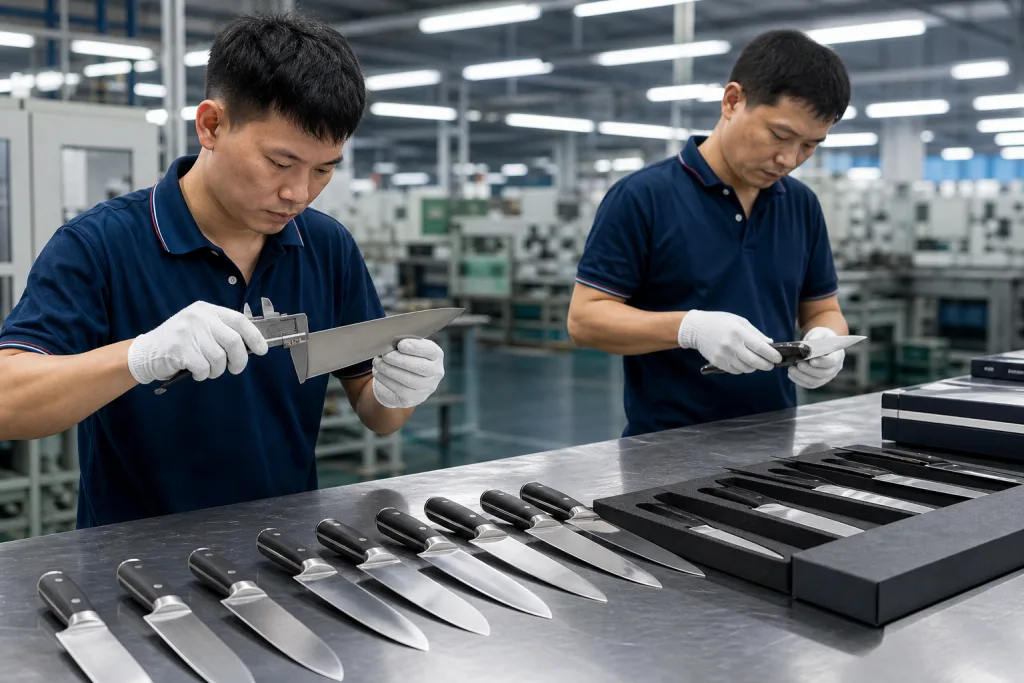
For fillet OEM work, a clear spec sheet beats a loose sample note. “Can you make it medium flexible?” is the wrong question. Write the target use, blade length, heel thickness, mid-blade thickness, steel grade, HRC band, finish, handle material, and the exact bend test for the fillet knife flex grades manufacturer. On our sample bench, we run the first check with a Mitutoyo digital caliper and a basic bend jig. No guessing. Define the bend test. A workable internal target is 100 mm free span, 500 g center load, 18-25 mm deflection for medium flex, and no visible set after 10 cycles.
That detail changes the quote. Once the geometry is fixed, the factory can price blade grinding and heat treatment without adding a safety cushion for unclear requirements. At our Yangjiang plant in China, a custom flex program usually starts at 1,000 pcs per SKU, with 35-45 days after sample approval on normal stainless builds, and we run around 280,000 units per month. Last month QC pulled a pre-production sample that measured 1.8 mm at mid-blade against a 1.6 mm spec; that 0.2 mm miss made the knife feel stiff in hand. Capacity is rarely the problem. The PO has to be tight enough to stop rework.
For a clean fillet OEM order, include:
- Target flex grade tied to the job: 7 inch salmon trimming, 6 inch bait prep, or a retail kitchen set where the buyer wants a softer hand feel
- Blade length and width tolerance, with mm limits shown on the drawing
- Stock thickness at heel, center, and tip
- Edge angle, finish code, and packaging style checked against the artwork file
- Test method, sample quantity, and pass/fail criteria
That spec gives the grinding line a blade it can hold to 0.1 mm. QC can inspect with the same jig, and the packing team can repeat the next PO without chasing three email versions or a buyer note buried in WhatsApp.
Test Flex Before You Scale
Do not scale a fillet program from photos. Nice mirror shots fool people. A production sample has to prove the bend at the target deflection, the bite through fish skin, and the edge after the bend cycle. If the blade flexes but loses sharpness after 30-40 repeat bends, it is not ready for production. If the edge holds but the tip feels dead, the blade geometry is wrong for that market. We have seen this go sideways: one buyer approved mirror polish photos, skipped the 20 mm deflection check on the bench gauge, and found the stiff tip only after the first 600 pcs came off the grinding line. Bad timing. For premium kitchen brands, ask for CATRA testing on the finished blade when the retail price can carry the lab cost.
On export programs, tie the flex test to the quality system. ISO 9001 process control only works when the inspection sheet records the same readings every time: deflection angle, recovery time, burr condition under the loupe, tip alignment, handle gap in mm. For finished lots, AQL 2.5 on major defects is a reasonable starting point for export buyers, with a tighter internal screen for tip damage and handle gaps. QC pulled one sample last month with a 0.6 mm handle gap after oven aging; the buyer flagged it before we even discussed carton artwork. The math does not work if we argue about artwork while the handle is already opening. If the handle or coating touches food, keep REACH, LFGB, and FDA documents matched to the resin, coating, and steel batch we actually buy.
The shop-floor routine is plain: check deflection, check recovery, cut again after repeated bends. Record blade behavior at the start of the run, around the 50% mark, and before final packing. Small drift shows up there, especially after the polishing wheel gets changed or the heat-treat rack is loaded tight. “Does the sample bend?” is the wrong question. The better question is whether piece 3,000 bends like piece 30 after heat treat, grinding, polishing, and handle assembly. That is how we catch drift before it becomes a container of claims in Europe or North America. For packaging and labeling, pair the flex spec with the final carton and retail pack from day one, down to barcode position and PO typo checks.
Avoid The Usual Buyer Mistakes
The first mistake is buying flex by price alone. A blade that is USD 0.15 cheaper FOB but misses the flex target costs more once QC pulls the carton sample and the tip rebounds 18 mm instead of the agreed 12 mm. Returns hurt. Rework hurts more. If the grinding line has to thin the belly again after the handles are riveted, the saving is gone by lunch. One sample proves one sample. A 5-inch kitchen trim knife and a 7-inch fish fillet knife bend differently, even with the same handle mold and the same 0.01 mm caliper reading on spine thickness. Handle balance gets missed too. On 82 g lighter builds, a PP handle or wood handle can make the blade feel stiffer in the buyer's hand, so we check balance point and tip deflection together, not as two separate notes.
The fourth mistake is letting the sourcing team write the spec in vague words. 'Soft', 'easy bend', and 'good quality' give the production manager nothing to set on the batch sheet. We need numbers: blade thickness at heel and tip, flex deflection in mm, tolerance, plus one pass-fail method on the inspection sheet. If the only comparison is FOB, this is the wrong question to ask. Run DDP beside FOB for landed cost, because compliance files and inspection fees can wipe out a small steel saving before the goods leave Ningbo. We have seen a USD 0.08 steel gap disappear after the buyer flagged missing barcodes and a blade guard typo on the PO for 3,000 sets. Small typo. Big delay.
For brands building a wider line, lock the flex family first, then change the visual package. That keeps the blade feel consistent while we ship fishing and kitchen channels with different sleeves, blister cards, or gift boxes. If the brief changes later, adjust the grind or thickness in controlled steps, such as 1.8 mm to 1.6 mm at the spine, instead of redesigning the whole knife. The math does not work when every reorder becomes a new sample round. We have seen 600 pcs reorders turn into 12 days vs 18 days just because the buyer wanted a "slightly softer" blade without a new deflection number. A supplier in Yangjiang or Zhejiang keeps the catalog clean by fixing the flex standard before the artwork, carton mark, and handle color start moving on the packing bench.
Frequently asked questions
For salmon and other long, soft fillets, extra-flex is usually the right starting point. In practical OEM terms, that often means a 6- to 7-inch blade with about 1.2-1.5 mm stock and a balanced 56-58 HRC finish. The blade needs to follow the contour without pushing the flesh apart. If your customer is a strong home user, a medium-flex version can work, but it will not feel as clean on long skinning passes. For commercial fishing buyers, ask the factory for a bend test and a sample cut against a real fillet, not just a hand flex at the table.
Yes, and that is usually the cleanest way to build a family. Keep the handle mold, scale texture, and packaging family the same, then change the blade stock thickness, distal taper, or heat-treatment window to create medium and extra-flex versions. That keeps tooling cost down and makes the line easier to sell across fishing and kitchen channels. For a normal fillet knife flex grades manufacturer, a family order often starts at 1,000 pcs per SKU, so splitting the line into two or three flex levels is still workable if demand is clear. The key is to freeze the geometry before artwork and carton printing.
No. Higher hardness can improve edge retention, but on a thin fillet blade it can also make the tip more fragile and reduce recovery after bending. A lot of buyers push hardness too high and then blame the steel when the real problem is the geometry. For most export fillet knives, 56-58 HRC is a practical middle ground, and 57-59 HRC can work when the blade stock is controlled tightly. If you want extra-flex, do not solve it only by softening the steel. Change thickness, taper, and grind first, then confirm the heat-treatment window.
Use a fixed test method, not hand feel alone. A practical shop-floor method is a 100 mm free span with a center load such as 500 g, then measure deflection in millimeters and check whether the blade returns without permanent set after repeated cycles. Record the result on the first, middle, and last samples from the lot. For export work, that record should sit beside the usual inspection data, including AQL 2.5 for major defects. If you are buying from China, ask the factory to video the test so the result is repeatable on reorders.
Ask for the full set, not just a sample photo. For most importers that means ISO 9001 process control, REACH and food-contact support where applicable, LFGB or FDA documentation for the handle and coating system if they touch food, and a production inspection report with AQL 2.5 or your own agreed standard. If the supplier is in Yangjiang, China, they should also be able to provide material confirmation, carton specs, and drop-test or salt-spray data when the product needs it. If you are buying through a Zhejiang-based trading channel, make sure the factory name and actual production site are clear on the paperwork.
Specify the flex before the quote
Send the use case, blade length, thickness target, and test method, and we will turn it into a repeatable fillet OEM spec for fishing or kitchen lines.
Request a Quote