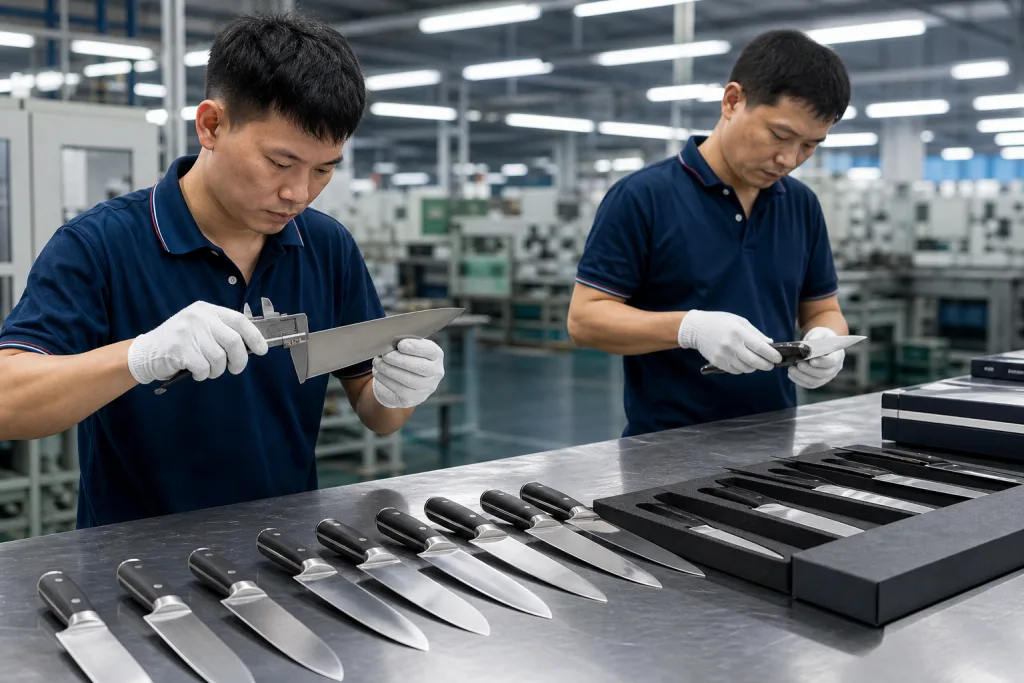
If you source an EDC folder, start at the pivot. Full stop. It sets the opening feel on day one, and it decides whether the blade still sits centered with steady lockup after 5,000 to 10,000 cycles on our open-close fixture. In Yangjiang, Zhejiang, China, buyers often write "smooth action" on the sample sheet; then we run a 300-piece pilot lot, QC checks blade centering at 0.20 mm with a feeler gauge, and the pivot stack tells us which knife can survive production.
Washers versus bearings is not a good-better ladder. This is the wrong question to ask. A 0.30 mm phosphor bronze washer will forgive a pivot bore drifting by 0.03 mm, and the user can wipe it clean in five minutes. On a 3,000 pc run, it also saves about $0.18 to $0.45 per knife. Bearings give the flick that sells in a 12-second video, but a 0.02 mm burr or one grain of blasting media under the race will make the action gritty. We have had QC pull the sample from the first carton for exactly that. For private label EDC OEM, set the pivot by shelf price and real use; chasing the trend is how we have seen projects go sideways.
What the pivot system really controls
Smooth opening is the easy part. The pivot decides how the blade tracks on the liners or frame, how the detent lets go, whether the tip stays centered, and how much side play shows after 5,000 open-close cycles. On our bench we run a feeler gauge and a T8 driver, because a folding knife with a 58-60 HRC blade still feels loose if the pivot stack misses by 0.03 mm. Buyers blame the lock first. QC pulled two pilot samples in our shop, and both problems came from pivot geometry.
Washers forgive. Bearings want cleaner machining and tighter assembly. A washer build will absorb a blade that runs 0.01 mm heavy or a pivot screw that lands a touch over torque without making the action ugly on the grinding line. Bearings cut friction, and they show every miss from CNC or assembly. If the tang is not flat or the pivot barrel is 0.02-0.04 mm short, the knife will feel fine for the first 20 flips and gritty by the time the buyer tests the carton sample. We see the same thing when oil sits heavier on one side. For EDC brands, asking which one feels faster is the wrong question. The end user will not write "lockface drag" or "detent weak" in a claim email. They just say the knife feels off.
Service matters once pocket lint gets into the joint or the lube dries out. A washer knife is easier to tear down and reset; at our repair table, with a parts tray and T8 bit, we usually put one back together in 12 minutes, while a bearing knife with lost balls or a damaged cage takes closer to 25 minutes. For low-cost work knives with a 1,000 pcs MOQ, the math does not work if pivot claims start after shipment. If the sales point is reliable daily carry instead of a fast first flip, choose the pivot for the user environment, not the catalog photo.
When washers make more sense
Washer systems make sense for most EDC runs. Lower part cost, faster assembly, and less trouble when the pivot hole drifts 0.03 mm or the liner comes off stamping with a slight bow. In Yangjiang, Zhejiang, China, we run for repeat orders, not one polished sample from the sample room. On a 3,000 to 10,000 unit private-label folder, a washer stack usually gives QC fewer blade-play notes during the T8 driver check, and we see fewer first-60-day warranty claims.
Phosphor bronze washers are still my pick for mid-market folders. They wear in cleanly and do not gall after a few hundred open-close cycles on the bench jig. Nylon or PTFE-based washers can hit a sharp price target, but heat and side load expose them fast; QC pulled one sample where nylon had mushroomed because the grinding line left a raised burr around the tang hole. For small blades or light-duty EDC, a simple washer system with clean tang polish gives acceptable action. No drama. A bearing spec looks better on a product page, but sometimes the math doesn't work.
Washer setups fit best when you need:
- a target FOB under $18
- field cleaning without loose balls rolling off the repair bench
- better tolerance to dust, pocket lint, and dry retail-store handling
- batch-to-batch stability when we ship 3,000 pcs first and 7,000 pcs later
If you are launching a bread-and-butter SKU, washers cut risk. Retailers learn this after one buyer flags 27 returns for gritty action on a bearing model and asks us to recheck every pivot by hand. The action can still be good. It needs a flat washer, correct pivot torque, and honest break-in, not a showroom flick that only works on the golden sample.
Where bearings earn their keep
Bearings earn the upcharge on a folder that needs a light, fast snap, but only if the target price gives us room for tighter pivot control. On our line, if we hold the pivot bore and stop-pin stack to 0.02 mm, a caged bearing pivot with 18 to 26 balls opens quicker than a washer build carrying the same blade weight. You feel it immediately. Premium EDC buyers pay for that first flick, and reviewers flip the knife on camera before they talk about the steel or lock face.
Bearings are not magic. They work only when the blade tang is flat, the pivot parts stay concentric, and the wash step keeps grinding-line dust and extra oil out of the stack. QC pulled a sample last month with a 0.03 mm burr on the tang; after 20 flips, the buyer flagged the action as sandy. Ceramic balls reduce friction. They do not fix bad geometry. We would rather ship a clean steel bearing set than a cheap ceramic pack sitting in a loose pivot stack.
From the sourcing side, bearings add direct cost and the hidden cost that shows up at final QC. The parts cost more, and on a 1,000 pc run we spend about 12 extra seconds per knife at the assembly bench with the torque driver. This is the wrong question to ask if the buyer only checks piece price. The bigger hit is inspection: blade centering between the liners, pivot torque after adjustment, play at lockup, and rework before packaging if the blade drifts. We have seen this go sideways. If your brand promise is fast action that reviewers notice on the first flip, bearings earn their keep. If your buyer cares more about hard use and easy field service, the math doesn't work, and a solid washer build ships with fewer returns.
Tune the stack, not the marketing
Good pivot action comes from the whole stack, not one shiny line on the spec sheet. At the assembly bench, we check blade tang finish, pivot barrel length, washer thickness or bearing cage height, screw torque, thread treatment, and lubricant as one matched set; the fitter is holding a T8 driver and a 0.01 mm feeler gauge, not a brochure. Small parts decide the feel. If a buyer writes only “ceramic bearing, premium action” on the PO, the grinding line still does not know whether they want drop-shut action or controlled closing, and we have seen this go sideways on a 3,000 pcs OEM run when the buyer flagged the first sample for closing too fast.
A usable factory brief gives numbers QC can test with tools, not adjectives. Set the pivot torque band in N·m, the side-play limit in mm, and the opening feel target after 200 open-close cycles. We usually suggest blade play under 0.05 mm at the tip, checked with a dial indicator, plus closing force kept inside one agreed range across 10 pre-production samples. For a front flipper or flipper tab model, specify detent strength too. If the buyer only says “make it smooth,” that is the wrong question to ask. QC will hang a spring scale on the blade, and a weak detent can make a bearing knife feel loose even when the pivot torque reads inside spec.
Typical pivot stack ranges
| Item | Practical range | Why it matters |
|---|---|---|
| Washer thickness | 0.10-0.30 mm | Changes drag and centering; QC should record the break-in feel after cycling on the bench |
| Bearing count | 18-26 balls | Spreads load across the race and changes how the blade breaks out from closed position |
| Pivot torque | 0.35-0.60 N·m at factory | Too loose gives play; too tight kills action before the carton is sealed |
| Blade tang flatness | 0.03-0.05 mm | Keeps bearing action repeatable, especially after stonewash or bead blast |
| Detent break force | 1.5-3.0 kgf | Controls carry safety and the first-open feel the buyer checks first |
Tune the stack as a system. The math doesn't work any other way. That is the difference between a folding OEM spec we can build 3,000 pcs against and a marketing wish list that fails when QC pulls the sample from the second carton, puts the dial indicator on the tip, and flags side play.
Cost, MOQ, and lead time trade-offs
The cost gap between washers and bearings appears when we price the full knife, not a bag of pivot parts. On a private-label EDC folder, nylon or phosphor bronze washers usually add $0.05-$0.28. Steel or ceramic bearings can add more than one dollar once the bearing set, bench fitting, oiling, and final pivot check hit the SKU. We run that check with a T8 driver at the assembly bench; the operator normally spends another 20 to 30 seconds setting bearing tension and checking blade drop. Small job. Big cost. If the target is a $29.99 retail knife, the math doesn't work unless margin was built in before sampling.
| Build | Typical MOQ | Assembly impact | FOB adder | Risk profile |
|---|---|---|---|---|
| Nylon washer | 300-500 pcs/SKU | Low | +$0.05-$0.12 | Low risk, easy QC |
| Phosphor bronze washer | 300-500 pcs/SKU | Low-medium | +$0.12-$0.28 | Stable, better wear |
| Steel or ceramic bearings | 500-1000 pcs/SKU | Medium-high | +$0.35-$1.20 | Needs tighter tolerance |
Lead time follows the same costing logic. A washer folder is often ready 35 to 45 days after sample approval. A bearing model usually needs 40 to 55 days, mainly when the pivot parts are custom or the PO calls for a fixed cage spec and a named lubricant. Sample development usually takes 12 to 20 days. QC pulled a sample here last month because the pivot screw sat 0.2 mm proud after anodizing, and that kind of miss burns days fast. We have seen this go sideways when a buyer approves the action feel, then changes steel grade or packaging after the PP sample. In China sourcing, splitting the pivot choice from the rest of the BOM is the wrong question to ask.
We ship both FOB and DDP. FOB is still the cleaner comparison if your team controls freight. Use it as the baseline. DDP helps with landed-cost planning, but it can hide inland trucking swings and carton-spec changes. One buyer flagged a quote after the carton packout changed from 24 pcs to 36 pcs and the unit cost was never broken out. If you are buying from a folding knife pivot bearing systems manufacturer, ask for hardware cost on one line, bench time on one line with assembly minutes shown, and inspection cost tied to the pivot check. That is how you see where the money goes.
What to specify in OEM work
For repeatable results, put the pivot spec in the PO and on the sample approval sheet, not in a 47-message email chain. Write six items in plain words: pivot type; washer material or bearing type; target torque in N.cm; blade play limit checked at the tip in mm; grease or oil code; and whether the knife must still open clean after a dry cycle test of 1,000 openings. If all you write is “smooth action,” you are asking the wrong question. QC pulled one sample at 0.35 mm side play with a feeler gauge after the grinding line had already packed 600 pcs. The rework bill was already on the table.
For EDC brands, the OEM brief needs the blade steel and thickness; liner or frame thickness; pivot screw type; and the hand feel after break-in, with 200 open-close cycles before final inspection as the baseline. If the model ships to Europe or North America, tie the program to ISO 9001 process control on the line, REACH on handle and coating inputs, and AQL 2.5 for appearance and function inspection. The pivot is metal, but grease, washers, threadlocker, and even the inner polybag still affect compliance and shipping stability. We ship cartons through 30 to 45 days of ocean transit, so small material mistakes show up fast. One buyer flagged a PO typo where “nylon washer” turned into “copper washer.” After salt-spray feedback came back from Germany, the math did not work.
At our Yangjiang, Zhejiang, China factory, we run about 120,000 folding knives per month with 240 employees. The pattern is plain: brands get better production when they freeze the pivot spec early. Then we run the grinding line, set the assembly target on the torque driver, and build to one feel instead of chasing a moving sample. Simple. If you are moving from a concept to a saleable SKU, control this part first. On one 5,000 pcs OEM order, changing from loose ball bearings to phosphor bronze washers after PP sample approval cost 12 days vs the normal 6-day assembly window. We have seen this go sideways more than once, usually right after the buyer asks for “just one small change.”
Frequently asked questions
No. Bearings can feel faster on day one, but they are not automatically smoother in real use. If the tang is not flat, the pivot barrel is off by a few hundredths of a millimeter, or the lubrication is uneven, the action can feel gritty or inconsistent. A good phosphor bronze washer setup can feel cleaner than a poor bearing setup, especially after 500 to 1,000 openings. For EDC knives, the better choice is the system that matches your target price, your assembly control, and your user environment.
For that price band, washers are usually the safer choice. Nylon or phosphor bronze washers keep cost down, simplify assembly, and reduce the chance of returns caused by lint or contamination. A bronze washer system often adds only $0.12-$0.28 FOB, while bearings can add much more once extra inspection is included. If your buyer wants a premium feel at this price, you can still improve action with a polished tang, controlled pivot torque, and better lubrication. That usually gives you more value than chasing a bearing spec.
Yes, but only if the rest of the design supports them. Ceramic balls can reduce friction and make the knife feel lively, but they do not fix sloppy geometry or poor assembly. You still need a flat tang, consistent pivot length, and clean assembly. In practice, a good caged steel bearing system is often a better business choice than a cheap ceramic one. If you do choose ceramic, expect higher parts cost, tighter QC, and more attention to contamination during assembly and packaging.
Ask for pivot torque, blade centering, blade-play measurement, and cycle behavior after at least 500 to 1,000 opens. If the knife uses bearings, ask whether the assembly is cleaned before lubrication and whether the bearing cage height is checked against the pivot barrel. For shipment, I would also ask for AQL 2.5 appearance and function inspection, plus a drop or vibration check if your packaging is export-facing. The goal is not just a smooth sample. It is consistent action across the batch.
Send the full stack, not just a picture. Include blade steel, blade thickness, handle material, lock type, pivot type, washer or bearing preference, target open feel, target retail, and estimated annual volume. If you already know the channel, say whether the knife is for Amazon, specialty retail, or distributor programs. That helps the factory choose the right assembly process and cost level. For China sourcing, the best quotes come when the buyer defines the performance target first and the marketing language second.
Lock the Pivot Spec Before Production Starts
Send your target price, opening feel, and volume. We can quote washers or bearings, then tune the stack for EDC performance and stable factory output.
Request a Quote