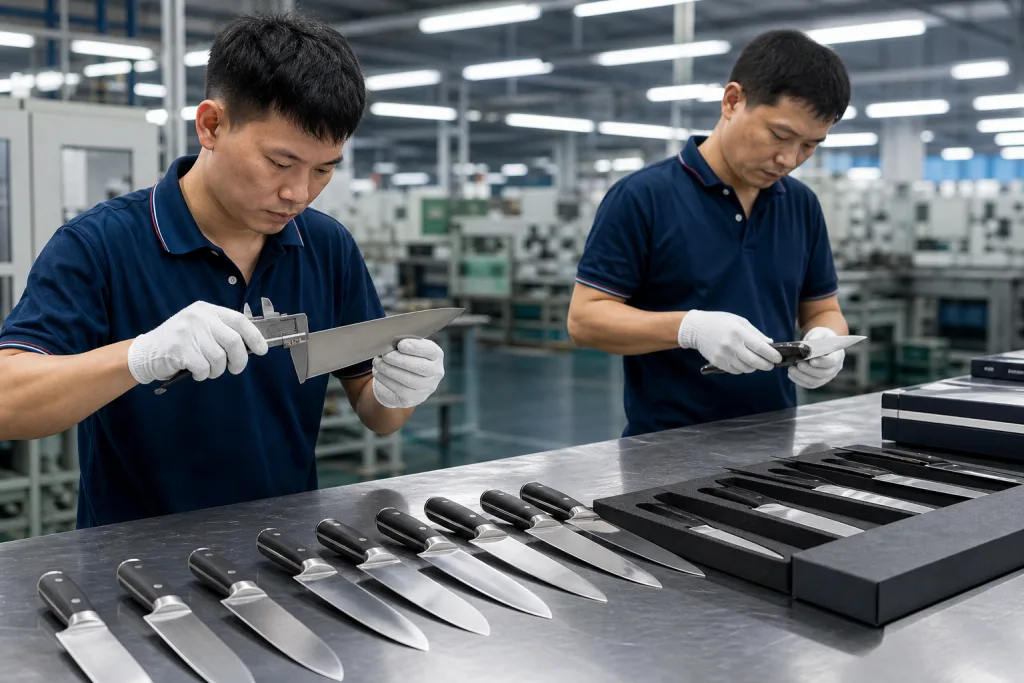
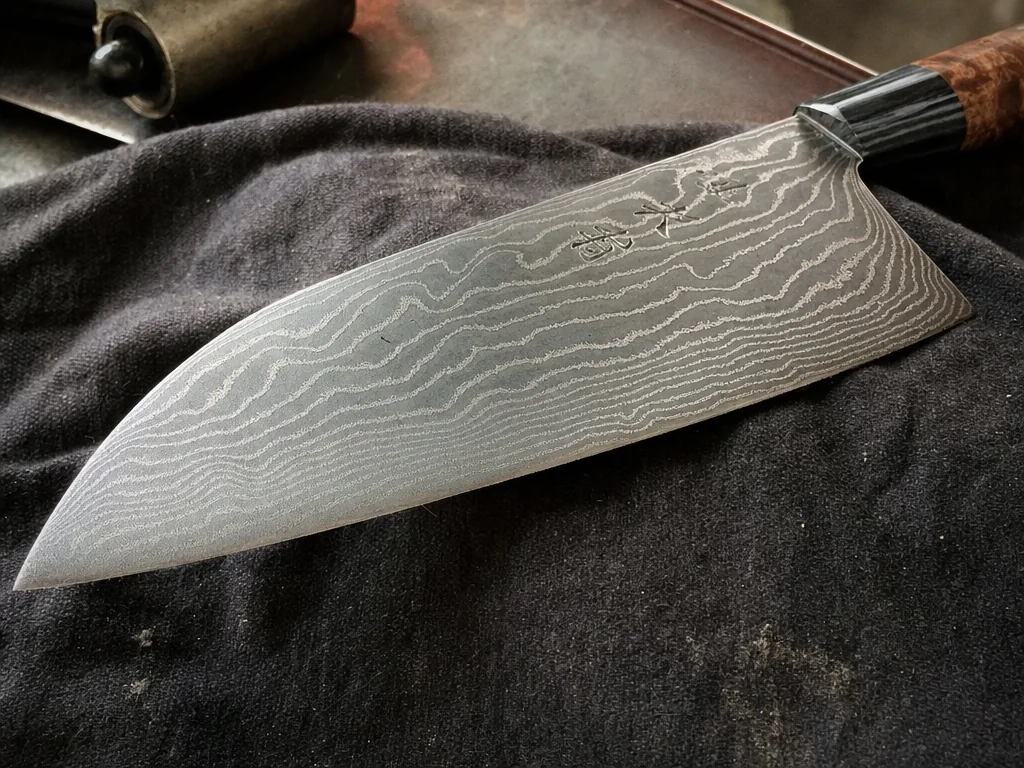
A titanium frame-lock knife looks simple on a spec sheet. On the grinding line, it is not forgiving. We see scrap when the CNC pocket walks 0.03 mm, the lock face comes off the fixture at the wrong angle, or a stonewash drum hides a burr beside the pivot washer. Small miss. Big complaint. Titanium grade, lock bar bend, detent ball height, and pivot washer flatness decide whether the knife flips clean or feels sticky after 200 cycles on the bench jig.
If you are checking a frame lock titanium knife OEM manufacturer in Yangjiang, Zhejiang, or another China knife base, the lowest FOB quote is the wrong first question. Ask for the titanium grade, pivot hardware drawing, blade steel, HRC band, clip style, lock engagement at 30% to 50%, and the tolerance record from a 500 pc trial order versus a 3,000 pc repeat order. We run fit photos before packing. QC pulled one sample last month where the lock sat at 62% after assembly, and the buyer flagged it before we shipped. A serious frame OEM should send cycle test notes, lock face photos, and inspection data before price talk; we have seen this go sideways when the buyer only circled the quote sheet and skipped the lock bar sample check.
Why Titanium Changes The Cost Curve
A titanium frame costs more for a plain shop-floor reason: mistakes have nowhere to hide. Grade 5 titanium eats carbide end mills faster than steel. On our Haas-style CNC cells, a pocketing pass that stays clean on 420 handle steel can show chatter after 80-120 frames if the operator misses the tool offset. Every pocket, detent hole, chamfer, and clip recess adds spindle time. Miss 0.03 mm on the lock bar relief and the sample may still flip open, but QC will feel the sticky lockup at the bench before the buyer ever touches it.
That is why a frame lock titanium knife OEM manufacturer in Yangjiang, China usually quotes above a liner-lock or aluminum handle program even when the blade size matches. The math doesn't work. On a mixed-line factory with 20,000 units/month capacity, titanium folders still move slower because the handle is not trim; it is the lock. We run a pin gauge at the pivot, check the lock face contact, then do a lockup test after assembly. The overtravel stop, pivot seat, and scale alignment all have to land cleanly. One bad batch of warped scales can burn 2 days, not 2 hours.
If you are sourcing from Zhejiang or China more broadly, ask how the factory controls scrap. A shop that says it can make titanium but cannot explain tool wear, anodizing rejection rate, or hand deburr after CNC is pricing off hope. We have seen this go sideways: the buyer flagged purple anodizing spots on 500 pcs because the supplier skipped ultrasonic cleaning before the tank. For premium EDC buyers, a blunt scrap number beats a pretty unit price. Real frame OEM value means we ship the same knife 500 times without drift, with QC pulling samples before the lock face walks out of spec.
What Your RFQ Must Specify
If you want pricing you can compare, your RFQ has to kill the guessing. “Titanium EDC knife” is too thin. We usually see 8 to 15 factories quote that phrase with 8 to 15 different builds, then the buyer asks why one price is USD 19 and another is USD 34. Cheapest is the wrong question to ask. Ask what is inside the quote. For a frame lock titanium knife OEM brief, lock the size, working spec, finish standard, and unit-price scope before our sales team opens the costing sheet. Simple as that. Our costing clerk will ask for blade thickness in mm before she checks CNC handle time, because 3.0 mm and 3.5 mm do not run the same on the grinding line.
- Overall length, closed length, blade length, and blade thickness in mm.
- Titanium grade: TC4 or 6Al-4V, with finish called out as stonewash, bead blast, or anodized.
- Blade steel and HRC band, plus cryogenic treatment or standard heat treat only.
- Pivot system: phosphor bronze washers or ceramic bearings, plus lock bar insert if required.
- Packaging: box, pouch, insert card, barcode, and Amazon FNSKU if needed.
Put the business terms in the same RFQ: target order quantity, quarterly forecast, sample quantity, and FOB Shenzhen, FOB Shanghai, or DDP to your warehouse. We run quotes this way because the math moves fast. A frame lock titanium knife OEM manufacturer may quote the knife at USD 28, then add USD 3-6 for branded packaging, USD 1-2 for laser engraving, and a separate testing fee. Last month QC pulled the sample after the PO said bead blast but the approved handle sample was stonewash; that one typo cost 6 days. We have seen this go sideways. If you want private label, write it. If you want ODM with your own handle contour, write that too, including a 2D drawing or STL file if you have one. Fewer email rounds gives you a quote closer to your real landing cost, and it saves the grinding line from chasing a spec that was never written.
Machining Details That Decide Fit
Titanium gives no second chance in the small areas a buyer touches first and forgets to put on the drawing. Lock bar thickness and the relief cut decide closing feel; frame stiffness changes detent break, then shows up as lock stick after stonewash or anodizing. We run the lock relief on the CNC line with a 0-25 mm micrometer, then check fitting with a 0.05 mm feeler gauge before the blade goes to final assembly. Fast check. A sound titanium frame should lock at roughly 30-50 percent on the blade tang, and the contact patch needs to stay there through the batch. If one PO moves from 25 percent to 60 percent, the math doesn't work. QC stops it.
Common failure points
- Pivot hole tolerance drifting beyond +/-0.02 to +/-0.05 mm, usually after the reamer has passed its clean life by 300-500 holes and the operator is still trying to finish the tray.
- Overtravel stop cut too shallow, so the lock bar takes a set after repeated flip testing on the bench, often before 80 cycles.
- Blade centering lost after anodizing or clip assembly, especially when the clip screw pulls the frame by 0.1 mm and the buyer sees daylight on one side.
- Sharp internal edges at the lock relief or clip pocket, the kind buyers flag in the first 10 seconds of sample review with a thumb rub.
Good frame OEMs control this with a fixed machining sequence: rough mill, heat stabilize if needed, finish mill, deburr, tumble or blast, then final fit. The order matters. Titanium moves after surface work. We have seen this go sideways when a shop polished the lock face too hard to hide cutter marks; one batch came back with lock stick after only 40 open-close cycles on the bench. If blasting pressure is loose at the cabinet, color anodizing looks patchy under retail lighting. "Same process" will not pass. The buyer will ask for photos under 5000K light, then the argument starts.
For premium EDC brands, I would rather QC pull 18 pieces from a 600-piece run than ship almost-right fit. In Yangjiang and Zhejiang, the factories worth using can talk through 0.02 mm pivot clearance, 6Al-4V spring feel, lockup percent, and why the PO says stonewash while the approved sample tag says satin. That typo happens. The buyer flagged it last May. This is the difference between a credible frame lock titanium knife OEM manufacturer and a general knife assembler.
Steel, Heat Treat, And Lock Interface
Do not price blade steel like it sits alone on the spec sheet. On a titanium frame-lock folder, the blade steel, heat treat, detent, tang geometry, and lock face decide how the knife flips, settles, and locks. We run S35VN, S45VN, M390, or Elmax at about 59-61 HRC for premium EDC, then check 3 points per blade on the Rockwell tester after temper. Ask better. If the buyer asks only for “best steel,” this is the wrong question to ask. M390 at a loose 58 HRC with a sticky lock feels worse than S35VN held clean at 60 HRC, and the customer will feel it before reading the blade mark.
For a premium build, ask for the heat treat window, not just the target HRC. We have seen one trial lot hit 60 HRC and the next lot drop to 57 HRC because the furnace loading changed from 80 blades to 140 blades. Same drawing. Different knife. That knife will not behave the same in CATRA, edge roll checks, or warranty returns. Good frame lock titanium knife OEM sourcing should state the test method, sample size, and acceptance range. We run hardness checks on each heat lot, then keep a written record for quench and temper; if cryo is used, we log that cycle too. QC pulled the sample before assembly, not after 500 knives were already packed, because finding a soft batch after final wipe means rework, carton delay, and an awkward call with the buyer.
The lock side matters too. Some frame OEM builds use a hardened steel lockbar insert to slow wear and keep lockup stable after 1,000 open-close cycles. It adds cost, but the math usually works for a knife selling above USD 150 retail. Without an insert, the lock face finish and contact angle need tighter control; we normally check the tang under a 10X loupe because one rough grinding mark from the grinding line can make the lock stick. Specify whether the blade should be full stonewashed, satin, or DLC coated, since coating thickness at the tang changes friction by a small amount that the thumb still feels. The buyer flagged this once on a PO as “black blade only,” and the sample came back clean-looking but with late lockup.
Cost Drivers And Real Quotes
Buyers ask for a titanium folder quote, then compare two different knives. One factory includes pocket clip screws, a T6 driver, nylon pouch, printed box, and insert card. Another prices only the assembled knife body on the bench after final wipe-down. A third quotes DDP Europe with duty and inland trucking buried in the line, then copies VAT from an old PO. We saw it last month: the buyer flagged a USD 6 gap, but the low quote had no T6 driver, no carton mark, and no spare clip screws. Same spec first. For frame lock titanium knife OEM sourcing, check the BOM line by line before arguing price.
| Program | MOQ | Indicative FOB unit price | Lead time | What changes the number |
|---|---|---|---|---|
| Prototype sample | 1-2 pcs | USD 95-160 | 25-35 days | CNC handle milling, first tooling setup, finish approval sample |
| Pilot order | 300 pcs | USD 28-45 | 45-60 days | Blade steel choice, anodizing rejects, bearing grade, retail box size |
| Repeat production | 1000 pcs | USD 22-35 | 50-70 days | Shared hardware, stable jigs, lower scrap from the grinding line |
These numbers are normal for a proper frame OEM in China, but hardware can move the quote before anyone touches blade steel. A custom pivot with a 0.02 mm fit, a milled titanium clip, or two-step anodizing can add USD 1-4 per unit. Better steel adds more. QC pulled blade samples over 60 HRC twice this quarter, so we check heat treat on the Rockwell tester instead of trusting the line on the quotation sheet. Ask for DDP before the spec is frozen, and the math does not work. Use FOB until the knife, carton size, warning label, and barcode position are locked; after that, compare landed cost, not factory cost alone.
Quality Checks That Protect Margins
Premium EDC buyers rarely lose money on the first sample. The damage shows up on the 1,200-piece lot that passes a quick table check, ships out, then comes back after retail launch. We run the quality plan from incoming steel heat numbers, to in-process fit checks at the grinding line, to final carton inspection. For a frame lock titanium knife OEM manufacturer, ask for AQL 2.5 on major defects and a separate 100 percent function check before packing. QC should record blade play in mm, not just tick “OK”; on our bench, a 0.2 mm side wiggle gets written down, even if the knife still flips clean.
On function, start with blade centering and lock engagement. Then check open-close action, clip tension, and screw torque with the actual T6/T8 driver setting shown on the report. A practical durability screen is 3,000 open-close cycles on sample pieces, plus a lock-up check before and after cycling. Short test. Real value. For Europe, ask for REACH declarations on coatings, pigments, and handle treatment, because one black PVD coating issue can freeze a shipment at the forwarder. If you sell through Amazon or a major distributor, get carton labels, inner boxes, and FNSKU placement approved before the first mass run; we have seen a PO typo on color code “GY” versus “GR” stop packing for 2 days.
Factory paperwork matters too. ISO 9001 tells you the system exists; BSCI helps when your retail partner asks for social compliance. Material traceability cuts down arguments when a batch feels different, especially on titanium scales after stonewashing or bead blasting; QC pulled one sample last year where the blasted scale looked 2 shades lighter under the light box. In Yangjiang, Zhejiang, and other knife production bases in China, factories that document lot numbers, inspection photos, and test results are usually the ones that can keep a premium frame OEM program stable for 2 or 3 seasons, not just one launch. This is where buyers ask the wrong question: lower unit price is nice, but the math does not work if 3 percent of titanium folders come back with lock slip or loose clips.
Frequently asked questions
For a real premium program, 300-500 pcs per SKU is the normal starting point. You can sometimes get 100-200 pcs if the design is already tooled, but the unit price usually jumps by USD 5-12. A first sample run is often 1-2 pcs, then a pilot of 30-50 pcs before mass production. If you want special anodizing, milled pockets, or a custom clip, add 10-15 days to the schedule and expect stricter color tolerance. A good factory in Yangjiang or Zhejiang will separate sample cost, pilot cost, and repeat-production pricing instead of hiding them in one number.
For premium EDC, S35VN, S45VN, M390, and Elmax are the usual candidates. The right choice depends on your target price and the level of corrosion resistance you need. Most buyers land in the 59-61 HRC band. Below 58 HRC, edge retention starts to look weak for the segment; above 61 HRC, you may get better wear resistance but higher risk of brittle behavior if the heat treat is not controlled. Ask the factory for the heat lot report, hardness range by batch, and whether cryogenic treatment was used. If they cannot state those details, the steel choice is not really specified.
Normalize everything to the same basis before you compare. Make sure each quote states FOB or DDP, blade steel, titanium grade, clip type, packaging, engraving, and test scope. One factory quoting USD 30 may actually be more expensive than a USD 34 quote if the cheaper quote excludes the pouch, box, and QC documents. For a 1000-piece order, a USD 3 difference is already USD 3000. If you sell into the EU or US, ask whether the price includes REACH paperwork, barcode labels, and export carton setup. A clean quote is not the cheapest one; it is the one with the fewest surprises.
Start with geometry and finish. The lock face angle, tang surface, and lock bar relief have to be cut correctly before any cosmetic finishing happens. A light stonewash or controlled bead blast is usually safer than an aggressive polish, because over-polishing can increase friction. Ask for a hardened insert if the knife is positioned above USD 150 retail. Then require a 3,000-cycle test on sample pieces and a post-cycle lock check. If the lock starts sticking after anodizing, the issue is usually in the finish stack or a tolerance drift around the pivot, not in the marketing copy.
Approve at least three things: a cosmetic master sample, a functional master sample, and a pilot batch of 30-50 pcs. The master samples should lock in blade centering, clip tension, anodizing color, and hardware finish. The pilot batch should be checked with AQL 2.5 for appearance and 100 percent for function. If you sell on Amazon, approve carton art and FNSKU placement before the run starts. This is where many buyers get burned: they approve a pretty sample but never freeze the functional standard. A premium frame lock knife needs both, or your repeat order will not match the first one.
Send Your Titanium Frame-Lock RFQ for Factory Pricing
Share your target price, blade steel, finish, and annual volume. We can quote sample, pilot, and mass production separately so you can compare real landed cost.
Request a Quote