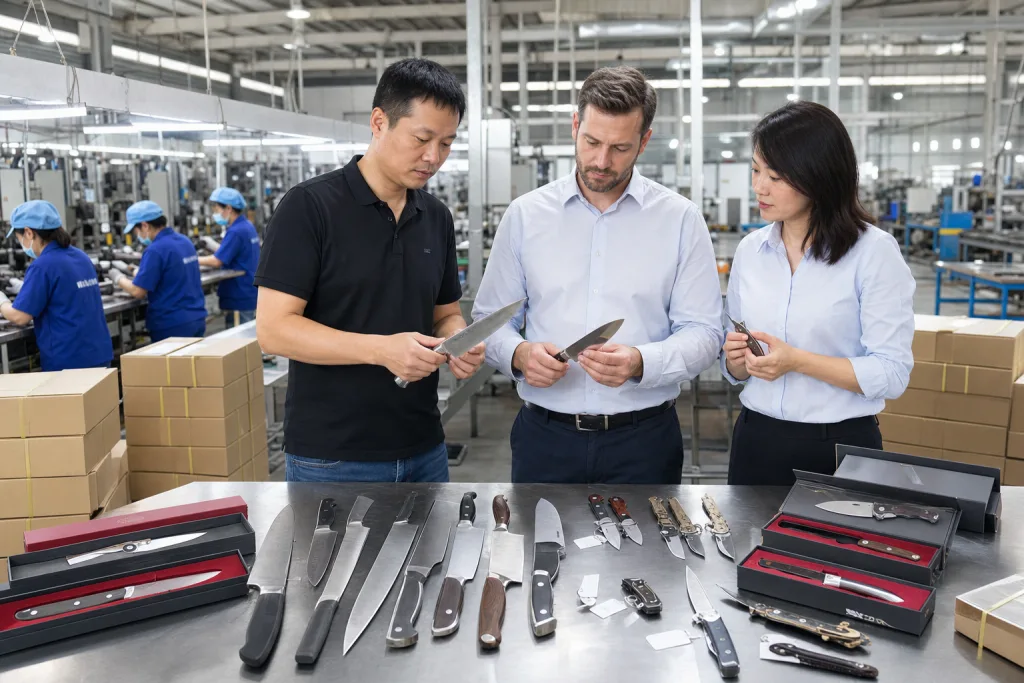
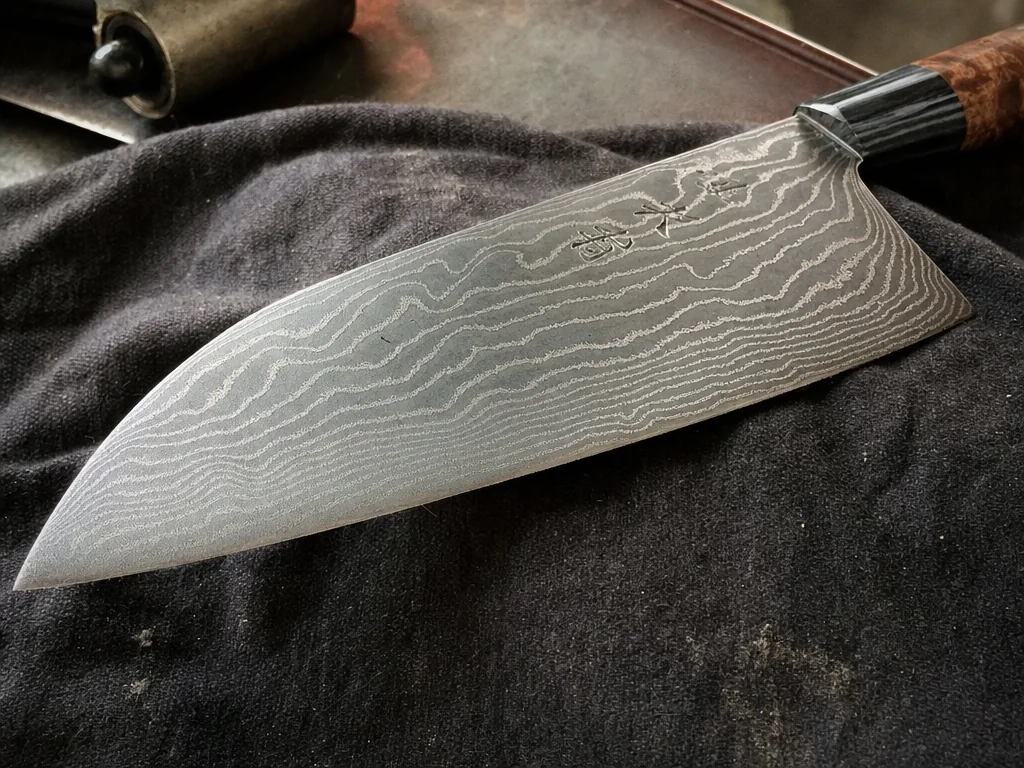
Honesuki boning knife sourcing starts with one blunt test: will this blade survive chicken joints through an 8-hour prep shift? The buyer is not asking for a basic poultry knife. They need the grind, hardness, and handle geometry held inside a tight range, so the edge tracks through wings and thigh bones without chipping or rolling sideways in the cut. We run a tighter spec than a generic boning knife for pro-kitchen brands: edge angle checked at the grinding line, handle fit checked with a 0.10 mm feeler gauge, and sample comments frozen before we cut bulk steel. Loose supplier talk gets expensive here, especially in Yangjiang, Zhejiang, China.
A good honesuki OEM talks in numbers: 150 or 180 mm blade length, 58-60 HRC, 2.0-2.5 mm spine, and a lead time your purchasing team can put on a calendar. If the supplier cannot explain the bevel, inspection points, and compliance documents, the math doesn't work; you are dealing with a catalog reseller, not a honesuki boning knife sourcing manufacturer. QC pulled one sample last season where the PO said 180 mm, the carton label said 175 mm, and the blade measured 178.6 mm. Small miss. Big argument. The right factory shows batch control from signed sample to carton load, with hardness records, bevel checks, and AQL notes buyers can pass to their own team without rewriting half the file.
What A Honesuki Really Is
A honesuki is a poultry boning knife made for close work around joints, cartilage, and small bones. The Japanese pattern pushes the tip forward and keeps weight near the heel, so the cook can open a chicken joint without wrestling with a wide, bendy Western boning profile. For sourcing, this is not decoration. Geometry decides how the knife behaves on the prep table. A butcher-supply brand does not need a display piece. You need a knife that breaks down birds fast, leaves a clean cut, and still feels right after 5 shifts; on our grinding line, a 150 mm sample with too much belly was flagged because it rode over the chicken joint instead of entering it.
For export markets, 6 out of 10 buyers ask for a single-bevel or near-single-bevel honesuki, but the spec has to be written cleanly. A true single-bevel grind needs a handed spec, usually right- or left-handed, and the factory must know whether the back is flat, slightly relieved, or hollow-ground. Vague wording costs money. Leave that line open and the supplier may ship an asymmetrical double-bevel that looks close in photos but cuts different in hand. We have seen this go sideways. In Yangjiang, Zhejiang, China, a serious honesuki OEM team will talk about grind angle, blade length, and hardness in the same PO review; QC pulled one sample last month because the right-side bevel was 70/30 on paper but closer to 60/40 under the angle gauge.
If your customer base includes chefs, commissaries, or poultry processors, the honesuki sits between a utility knife and a boning knife. It is not a fillet knife. It is not a broad chef knife either. Do not sell it as “flexible boning.” The buyer flagged that wording on one carton mark because their end user expected bend, then complained after trial cutting 30 birds. This is the wrong phrase for the product. The distinction helps you position the SKU correctly and avoid returns from buyers who wanted flex instead of control.
Spec The Blade Geometry
Blade geometry is where most honesuki sourcing mistakes start. Set the blade length first, then choose how much tip strength and belly the cook should feel in hand. For commercial kitchens, 150 mm is still the safer main size: line cooks control it faster, it suits smaller hands, and it gets fewer balance complaints during carton check. We run 150 mm on roughly 7 out of 10 export honesuki orders; during first carton inspection, QC checks the pinch-point balance with a ruler mark and a quick hand test. Simple check. A 165 mm or 180 mm knife gives more reach for volume poultry prep, but the balance moves forward and the point is less forgiving near joints. If your brand sells both foodservice and retail, spec one entry size and one pro size with clear carton labels. One knife for every user? Wrong question.
For a true single-bevel request, put the bevel angle in degrees and the handedness in the PO. Write it clearly. A practical export spec is a 15-18 degree sharpened side with a 0-3 degree relief on the back, depending on the steel and target user. We have seen orders go sideways because the buyer wrote “Japanese bevel” but missed right-hand or left-hand; the grinding line followed the old sample, while the new artwork said something else. Costly little typo. If you need a knife for mixed operators, ask for 70/30 or 80/20 asymmetry. That works better for North American and European kitchens, where most users have not trained on Japanese-style bevels and will blame the knife after two shifts.
Do not ignore thickness. A heel thickness around 2.2 mm and a point taper down toward 1.6 mm keeps the knife rigid enough for joint work while still feeling accurate at the tip. Too thin, the edge chips. Too thick, the knife wedges on cartilage and the cook blames the steel. On one 300-piece pilot run, QC pulled the sample after measuring the heel at 2.8 mm with a digital caliper, and the buyer flagged the knife as “heavy” before testing it on chicken backs. The math does not work if the blade only looks slim in photos. For honesuki boning knife sourcing, this middle spec is the difference between a pro kitchen tool and a display knife with a sharp-looking profile.
Choose Steel And Hardness
Choose steel by what the cook does after 200 chickens, not by the neatest spec sheet. For a stainless commercial honesuki, 10Cr15CoMoV works when the buyer needs a sharper retail story, AUS-10 is safer for repeat MOQ runs, and 14C28N is the better pick when old stock came back with rust spots near the heel. We run these on the grinding line with 1.8-2.2 mm spine targets, and the burr tells the truth after 3 minutes on a #1000 stone. VG10-class steel takes a cleaner polish and feels better in hand, but the heat-treat window is narrow and the quote moves. 3Cr13 sells on price. For a serious pro-kitchen label, the math does not work.
Hardness decides whether that steel choice survives service. For this knife category, 58-60 HRC is the working band for most export markets. Below 57 HRC, the edge fades fast in daily poultry prep; above 61 HRC, the edge feels crisp, but chip risk rises when the cook twists through a joint or knocks bone. We have seen this go sideways when a PO says “boning knife” and the end user treats it like a small cleaver. Ask the China honesuki OEM for the heat-treatment sheet, not just a catalog line: quenched hardness range, tempering temperature, and cryogenic treatment status. QC should pull 5 pieces from mass production and check them on the Rockwell tester, not only test the showroom sample. If the supplier cannot explain the furnace process, the steel name is mostly marketing.
In Yangjiang and other knife-making clusters in China, the factories that ship steadily to Europe and North America keep hardness inside a tight window across repeat lots. One test blade proves little. Lot 2 has to match lot 1. We watch this closely after the buyer changes handle color or adds a logo etch, because the production schedule can get squeezed to 12 days instead of the planned 18 days and the grinding line starts pushing too fast. QC pulled one batch last year for a 2 HRC spread across the same carton. That is where complaints start.
Handle, Finish, And Hygiene
For foodservice brands, set the handle spec around sanitation first and shelf look second. POM is still our safest default: it will not swell, wipes clean fast, and survives daily wash-down better than 8 out of 10 wood-handle samples we see on new honesuki projects. G10 or reinforced composite is worth quoting when the buyer wants a heavier retail feel and accepts the price jump. Pakkawood shoots well in catalog photos, but commissary buyers push back on it because it reads decorative, not hygiene-first. We run 2.8-3.2 mm rivet holes on most samples, and QC flags any daylight at the scale edge because sauce and poultry fat find that gap before the first week is over.
Blade finish decides how the honesuki looks after real prep work, not after studio lighting. For most pro-kitchen lines, I would spec a clean 400-600 grit satin finish. It looks controlled, hides light rack marks, and lets an inspector see stains or burrs under a bench lamp. Rough blast is risky if the texture is too open; residue can sit in it after chicken breakdown. Mirror polish sells in photos, then shows the first scratch from a stainless prep table. The math doesn't work for most foodservice SKUs. If the knife has a bolster or finger guard, keep that transition smooth. On one 300-piece trial, QC pulled the sample because polishing compound was sitting in the handle seam after buffing.
Judge the knife by cleaning behavior, not showroom shine. Simple test. It should rinse in under 10 seconds, dry without water sitting at the handle junction, and leave no hidden pocket around the tang, rivets, or guard. In a factory in Yangjiang, Zhejiang, China, that means putting the handle assembly, rivet finish, and polishing standard on the sample PO before the first piece is made. We have seen this go sideways: the buyer approved the blade profile, forgot to specify flush rivets, then rejected cartons after the grinding line had already finished production.
Compliance And Inspection
Compliance is where 3 importers out of 10 lose a week because they ask for reports after the deposit lands. For EU orders, confirm LFGB and REACH exposure before we cut steel for the honesuki run; for US orders, FDA food-contact requirements are the floor. Retail packaging needs its own check: ink rub after 50 strokes, glue smell 30 minutes after box sealing, and coating contact inside the color box. ISO 9001 and BSCI tell you something about the factory, but they do not clear the knife itself. We have seen a clean certificate wall beside a batch with a 0.4 mm handle gap and hardness drifting 2 HRC off target. QC pulled that sample at the grinding line. Bad timing.
Use a plain inspection plan and put it on the PI, not in a late-night chat after packing starts. For honesuki boning knife sourcing, we check blade dimensions with calipers, bevel symmetry with an angle gauge, hardness on the Rockwell tester, logo position against the artwork, handle fit at the bolster, and edge burrs with a white cloth. AQL 2.5 works for appearance and functional defects on normal consumer and foodservice orders. For cracked handles or badly ground edges, 6 buyers we deal with set tighter internal rejection rules before carton packing. This is the wrong place to save inspection time. The math does not work if QC finds those defects after the container is sealed.
| Check | Target | Why It Matters |
|---|---|---|
| Hardness | 58-60 HRC | Controls edge retention and chipping when the knife hits poultry bone |
| Blade length | 150 or 180 mm | Matches prep style, hand size, and the claim printed on the carton label |
| Bevel angle | 15-18 degrees on the sharpened side | Keeps cutting feel close from approved sample to bulk shipment |
| Inspection level | AQL 2.5 | Catches visible defects, loose handles, rough grinding marks, and packing errors |
| Compliance | LFGB, FDA, REACH as needed | Reduces customs holds and buyer chargebacks |
If the factory in Yangjiang says it can ship without test reports, that is a procurement problem, not a paperwork shortcut. Ask before deposit. Last month, the buyer flagged a PO typo: FDA was written on the box spec, but LFGB was missing from the test line.
MOQ, Pricing, And OEM Terms
Most buyers ask for the unit price first. Wrong starting point. If packing, logo work, and inspection terms are missing, the USD 4.20 quote can become USD 5.30 before the carton is sealed. For a standard stainless honesuki with POM handle, a workable FOB range from China is USD 4.20-6.00 at 300-500 pcs, depending on steel grade, grind work, and packaging. We run a flat V grind faster than a tight single-bevel order; the bevel jig needs resetting, then one worker checks the heel, tip, and 2.0 mm spine by hand. A mid-premium build with 10Cr15CoMoV, laser logo, and cleaner satin finish usually moves into the USD 6.80-11.50 range. Add retail gift packaging, printed sleeves, or a magnetic box, and the extra cost is usually USD 0.40-1.20 per set.
Lead time needs the same discipline. For an existing knife platform, sample lead time can be 10-20 days, and production can land around 45-60 days after sample approval. New handle mold? Add mold trial, balance checking, and edge correction before your sales team promises delivery. We once had QC pull a honesuki sample because the heel gap was 0.8 mm larger than the approved drawing; small on paper, visible in the buyer's hand. A 240-person knife factory in Yangjiang, China with stable lines may still have a monthly output of 80,000 pieces or more across mixed product categories, but your order only moves fast if the spec sheet is clean from day one. Missing blade thickness is not a small detail.
For honesuki OEM terms, lock in carton count, barcode placement, sample charge policy, and whether the factory will run private label or laser engraving on the same line. If your customer wants retail-ready units, tie the buying discussion to private label, packaging, and inspection before the deposit is paid. Fixing the spec after the first container is booked is where the math doesn't work. We have seen a PO typo put the EAN sticker on the inner box instead of the color sleeve, and the buyer flagged it during pre-shipment inspection. For a brand that also sells kitchen or outdoor knives, keep the honesuki in the same steel family; your sourcing team will carry fewer spare parts, fewer test reports, and fewer complaint emails after the first 2,000 pcs ship.
Frequently asked questions
For poultry breakdown, yes, if your team wants a rigid knife with point control. A honesuki usually gives you more leverage around joints than a flexible Western boning knife. A common export size is 150 mm with a 2.0-2.5 mm spine and 58-60 HRC. That spec holds up well on chicken, duck, and small bird work. If your operators are used to soft, flexible blades, the learning curve is real, so the best answer depends on how your customers trim meat. For mixed kitchens, many brands choose a 70/30 or 80/20 grind instead of a strict single-bevel.
For most buyers, 10Cr15CoMoV or AUS-10 is the practical middle ground because it gives good corrosion resistance, workable sharpening, and stable hardness in the 58-60 HRC range. If you want a premium retail knife, VG10-class steel can work, but it costs more and requires tighter heat-treatment control. If your customers clean knives aggressively or work in wet environments, avoid very soft entry steels unless price is your only goal. Ask the factory for hardness reports by lot, tempering data, and a sample test piece before you approve production. That matters more than the steel name on the spec sheet.
For a branded honesuki, 300-500 pcs per SKU is a realistic MOQ if you want custom logo work and retail packaging. If you use an existing blade platform and simple carton packaging, some factories in Yangjiang, China can go lower, but the unit price usually rises. Sample lead time is often 10-20 days, and production is commonly 45-60 days after sample approval. If you ask for a new handle mold, a true single-bevel grind, or special gift packaging, add time. The cleanest way to protect schedule is to freeze steel, handle, logo, and carton spec before the sample is approved.
Ask for AQL 2.5 on appearance and basic dimensional checks, then define zero-tolerance items for cracks, loose handles, and badly ground edges. For a professional kitchen knife, that is more useful than a vague promise of full inspection. You should also ask for hardness testing, bevel verification, edge condition checks, and packaging verification before shipment. If the knife is sold in Europe or North America, keep LFGB, FDA, and REACH documentation on file. ISO 9001 and BSCI are good supplier signals, but they do not replace a written QC checklist. The best factories will show you their inspection sheet before you pay the deposit.
Yes. Most honesuki OEM factories can do laser engraving, etched logos, printed sleeves, gift boxes, and master carton markings. The important part is deciding the marking method early, because logo placement can affect finish and packaging line speed. If you are selling to foodservice accounts, keep the packaging practical and stackable. If you are selling retail, define barcode size, retail box dimensions, and inner carton count before production starts. Private label is easiest when the factory already has a stable knife platform, because you are paying for branding and QC control, not redesigning the entire product from scratch.
Send Your Honesuki Spec Sheet
Share your blade length, steel target, handle material, and annual volume. We can quote a honesuki OEM program from Yangjiang, China with sample timing, MOQ, and FOB terms.
Request a Quote