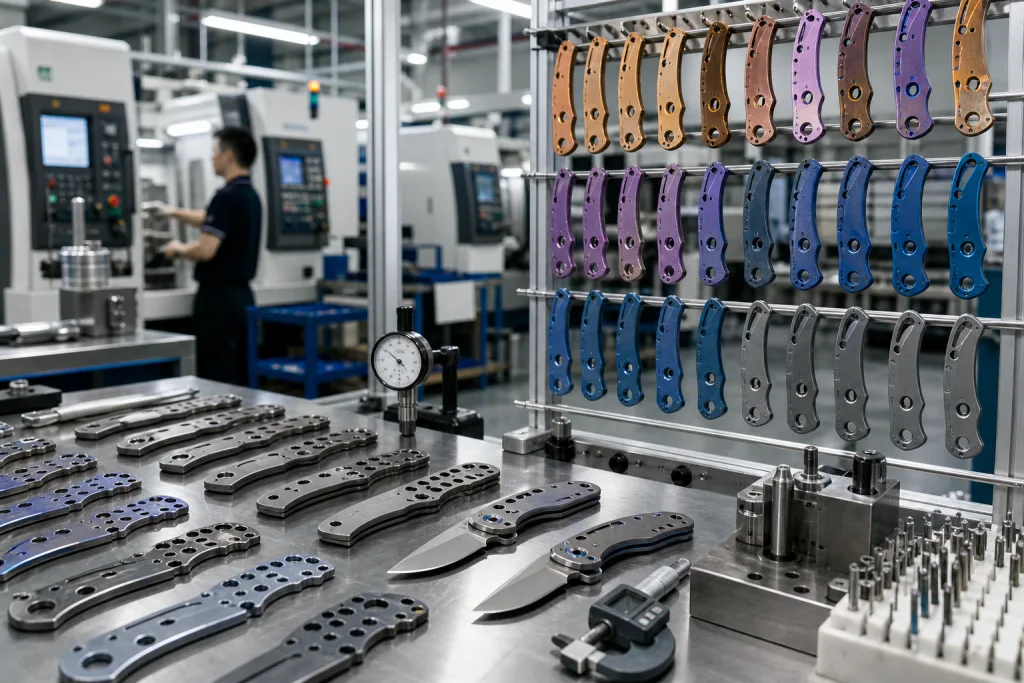
Sourcing knives from Yangjiang, China, starts with the steel grade on the quote, but the quote is only page one. We have seen two “stainless” blades in the same HRC band come out of knife salt spray testing with different rust maps after 48 hours. Why? The grinding line left 0.12 mm deep scratches on one batch, and QC could see the brown dots sitting right inside those marks under a 10x loupe. The other batch had cleaner polishing, better passivation, a tighter coating spec, and dry inner cartons with no water marks on the kraft paper. That difference becomes claims, returns, and chargebacks in Europe or North America.
Good stainless knife QC is the wrong place to chase the biggest lab number. Ask the corrosion test knife question that affects the PO: which part was tested, under which standard, and what rust point counted as failure? At a 240-employee factory in Yangjiang, China, we run production-scale blades at 80,000 units per month, but a loose spec still gives you soft answers. QC pulled one sample last season where the blade passed, but the rivet area showed red rust because the PE bag trapped moisture after carton sealing. Small miss. Big argument. Match the test setup to your use case, target price, and packaging system, or the math does not work.
What salt spray actually measures
Knife salt spray testing shows how one finished knife assembly reacts inside a controlled chloride chamber. That is all. It is not a promise that the knife will survive every kitchen sink, dishwasher rack, sea container, or damp stockroom. We get about 6 buyers a month reading a corrosion test knife report as if it guarantees 24 months in Ningbo warehouse air. Wrong question. The chamber, usually run under ASTM B117-style conditions with a 5% NaCl mist, speeds up chloride attack; the report only has sourcing value when the tested surface, hanging angle, masking area, and rust location are recorded. QC should write blade face up at 15 degrees, handle masked 20 mm from the bolster, and red rust on the spine. Not just “pass.”
For sourcing, the value is side-by-side comparison. If one stainless knife QC sample shows first red rust at 48 hours and another at 192 hours under the same setup, that says something solid about finish quality, passivation, or coating integrity. It does not make the 192-hour knife magic. It has buffer. In Yangjiang, China, we see the biggest lab-to-market gap when the buyer writes only the blade steel on the PO and leaves out the spine, tang, rivets, and blade finish. The grinding line can polish the blade face to 800 grit while leaving the spine closer to 240 grit; QC pulled samples last year where rust started right on that rough 240-grit edge.
Use the test to check process control first: same supplier, same steel, same finish, same chamber setup, and no surprise red rust at 24 hours on the next lot. Then check lot stability and price. If a coated knife costs USD 0.18 more but only moves first rust from 48 hours to 72 hours, the math does not work for most retail programs. We have seen this go sideways: one clean lab photo got approved, then mass-production rivets showed pin-point rust under AQL 2.5 inspection, 7 pieces found in a 200-piece check. If the report cannot answer that kind of sourcing question, it is decoration.
How to specify ASTM B117
If your sourcing team needs a report they can act on, put the method name on the PO. ASTM B117 knife testing is still the reference most North American buyers ask for; ISO 9227 shows up more on EU and Asia files. The standard by itself is too thin. We still need the salt concentration, chamber temperature, pH, sample angle, inspection timing, and pass/fail line. Last month QC pulled 3 blade samples from our salt fog chamber, and the buyer's PO only said "salt spray OK." That is the wrong question to ask.
A workable spec for stainless kitchen knives reads like this: 5% sodium chloride solution, 35 C chamber temperature, continuous fog, pH 6.5-7.2, inspection every 24 hours, with photos logged at 24, 48, 96, and 240 hours. For an export order, ask the factory to confirm whether we tested a blade blank or a fully assembled knife with handle, rivets, and ferrule. Crevices matter. Red rust often starts beside a 3 mm rivet hole or under the ferrule edge while the flat blade face still looks clean. We see it on the bench under the LED lamp. If the supplier says "passed 300 hours," ask what happened before the edge bevel was ground and after sharpening. A polished blank from the grinding line is not the same corrosion surface as a finished knife.
For procurement, the goal is not a thicker report. The goal is repeatability. Fixed, documented test conditions let you compare this lot against the last lot from the same plant in China, or against a second sourcing option in Zhejiang, without guessing. We've seen this go sideways when one report tested 6 loose blades and another tested 12 assembled knives; the math does not work, even if both files say ASTM B117 on the cover. One buyer flagged this after receiving cartons marked "240H PASS" while the lab photos showed rust at the bolster after 96 hours.
Steel, finish, and edge matter
Buyers often put too much weight on the steel grade and miss the surface condition. We see it in RFQs about 3 times a month: 5Cr15, 3Cr13, or 420J2 is circled in red, while the finish line is blank on the PO. Same stainless family, different rust result. Higher carbon, chromium tied up after heat treatment, rough belt marks from a 240# pass, or an overheated edge from final grinding can change the answer. Surface wins. A mirror-polished blade usually spots less than a rough satin blade because water beads off cleaner and chloride residue has fewer grooves to sit in; QC has pulled samples where the satin side showed pin spots after 24 hours while the mirror sample stayed clean.
Heat treatment still matters because a blade at 56 HRC can behave differently from the same design at 59 HRC if the tempering window or retained austenite level changes. Do not use HRC as a corrosion score. Wrong question. It measures hardness. Corrosion is a separate issue. If the supplier offers a black coated or stonewashed knife, ask whether the coating is PVD, electroplated, or paint-based, and whether the salt-spray test was run before or after edge sharpening. On our grinding line in Yangjiang, China, a 0.3 mm edge burn mark or exposed steel at the bevel can turn “light spotting” into red rust in 3 days, and we have seen this go sideways when the buyer approved coated samples before sharpening.
For a stainless knife QC file, I want steel grade, heat-treatment range, surface roughness if available, and finish type in the same record. Put them on one sheet. The math does not work if those are missing. Without them, the salt-spray number is just a lab note, not sourcing data; last quarter QC rejected 2 lots because the report said “pass” but the actual samples had unpolished plunge lines trapping salt residue.
Read results like a buyer
The first bad call is accepting one pass/fail line with no photos. A usable report should mark the start point of corrosion, the affected area in mm², and whether QC saw tea-colored stain or real red rust. For sourcing, one 1 mm spot inside a spine hole is not the same issue as pitting across a 45 mm edge bevel. We see this about 2 times a month: the buyer flags “rust,” the lab writes “pass,” and nobody opens the 10x close-up photo from the salt-spray cabinet. Bad habit. You are buying finished knives that must sit in import cartons, spend 6 months on a shelf, then handle wet hands in a kitchen.
| Sample type | Test hours | Typical outcome | Buyer action |
|---|---|---|---|
| Polished stainless kitchen blade | 48-96 | Minor edge spotting may appear when passivation is weak | Accept only when the cosmetic limit is written in mm² |
| Brushed blade with exposed rivets | 96-240 | Rust often starts at rivet heads or tang openings after the handle seam holds moisture | Check assembly sealing and inner-bag packaging |
| Coated outdoor knife | 240-500 | Failure usually starts at scratches, holes, or edge wear from the grinding line | Inspect coating adhesion and abrasion resistance before mass packing |
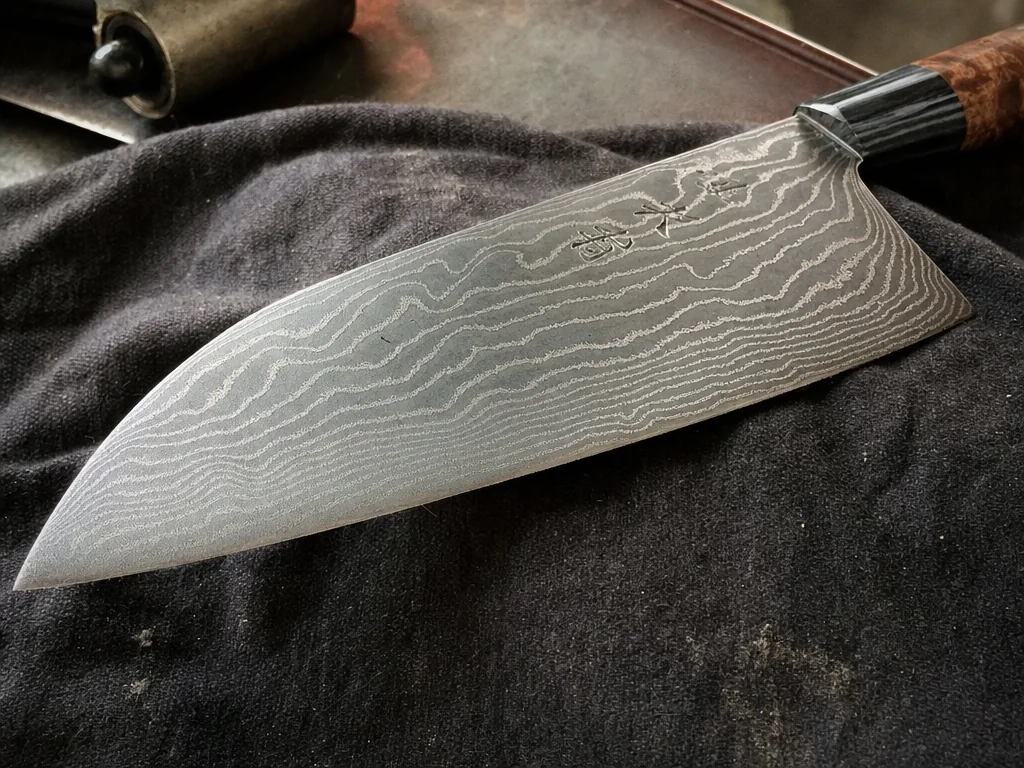
| Damascus decorative blade | 24-72 | Pattern steel contrast can hide early oxidation near the etched layers | Request close-up photos and separate core/cladding notes |
This table is a buying guide, not a lab law. The wrong question is “did it pass?” Ask what failed first, where it failed, and whether the same mark would pass on the shelf sample. Use the report so you do not pay for a 240-hour spec on a 48-hour product, or accept a batch that should have stopped at pre-shipment. For a real order, tie the result to AQL 2.5 cosmetic limits, a photo standard, and the exact reject wording on the PO. We have seen one missing word on “surface stain allowed” turn into a 3-carton argument when QC pulled the sample at final inspection.
Packaging can make or break results
A knife can pass the chamber and still arrive with red spots if the pack is wrong. We have seen 24-hour NSS samples come out clean, then the same blade came back rusty after 32 days on a humid sea route because the paper insert held moisture. One carton we opened in QC had water trapped under the tip guard. Another had condensation inside a loose 0.03 mm polybag after the buyer's warehouse sat at 82% RH for a weekend. Cheap VCI paper makes it worse. Buyers often call it a steel problem. Sometimes it is. Often the box did it.
Ask for a packaging review with the salt-spray report. For kitchen knives and chef knives, check the packing table like a factory check, not a desk form: blade oil coverage, insert moisture below 12%, blade contact with acidic paper, and master carton tape strength for export loading. For private-label shipments, test the assembled knife in the exact retail pack, not a loose blade sitting in a plastic tray. We run this because the math does not work if a clean 60-62 HRC blade fails after the sleeve absorbs water; QC pulled one sample last season where the blade was fine but the printed sleeve hit pH 5.2. That is not a blade failure. If your order is going into retail distribution in Europe, check REACH and packaging material compliance in the same pass. For food contact markets, the handle and any blade coating need to match LFGB or FDA expectations, even when the rust test looks fine.
Salt spray data and packaging data belong in the same sourcing file. Split them, and sooner or later QC will pull a sample with rust at the edge while the chamber report still says pass. We've seen this go sideways over a 1,200 pc trial order, and the claim cost more than a proper packing test.
Build a QC spec that works
A usable sourcing decision starts with a short QC spec that leaves no guessing room. Put the product type first, then the test method, pass limit, and proof package. Example: stainless chef knife, ASTM B117, 5% NaCl, 35 C, 240 hours, no red rust on blade face, no rust bleeding from rivets, with photos at 0, 24, 48, 96, and 240 hours. Add steel family, hardness band, and finish type, such as 420J2 at 52-54 HRC with satin finish or X50CrMoV15 at 56-58 HRC with mirror polish. We run the same line on the PO and the QC checklist. Why? A 0.2 mm deeper grind mark near the bolster can hold salt and fail the same steel. QC pulled one sample last month: blade face passed, but the rivet hole showed orange bleed after 96 hours under the salt-spray chamber lamp.
Tie that spec to factory control. ISO 9001 only means something when the plant can show in-process stainless knife QC and batch traceability, not just a clean final report. If the factory in Yangjiang, China can show 3 previous lots with the same heat treatment, polishing wheel, rivet supplier, and salt-spray result, you can compare it against a second source in China or in a Zhejiang trading channel without trusting one showroom sample. For OEM knife sourcing, I ask for 2 retention samples and a written note on whether the test was done before or after sharpening. Small line. Big headache saver. We have seen claims go sideways because the buyer tested after edge grinding, while the factory report was taken before sharpening. The grinding line changes the exposed edge condition in one shift, sometimes from a closed polish to fresh burr marks at the bevel, so the timing matters.
If you want a spec that holds up in a claim dispute, keep it short, measurable, and tied to the exact knife you are buying. “Corrosion resistant” is the wrong wording; put the hours, rust limit, photo points, and sample quantity on the PO before we ship. The math does not work if 5 samples ship clean from the showroom and 2,000 pcs arrive with rust at the handle pins. We had one PO where the buyer wrote “anti-rust blade” in the remark box, no hours, no AQL line, no rivet rule. That is not a QC spec.
Frequently asked questions
There is no universal number, because the answer depends on steel grade, finish, and price point. For a mid-range stainless kitchen knife, 96-240 hours under ASTM B117 or ISO 9227 is a realistic sourcing target. A low-cost stamped knife may only need a short screening test, while a premium chef knife with polished finish and sealed handle joints should perform better. I would not accept a report that only says "passed" without the rust location, sample orientation, and inspection intervals. Ask for photos at 24, 48, 96, and 240 hours so you can see whether the failure is cosmetic spotting or true red rust at the edge, tang, or rivets.
No. ASTM B117 is an accelerated corrosion test, not a literal simulation of cutting tomatoes, dishwashing, or sea freight. It creates a controlled salt fog so you can compare products under the same conditions. That makes it useful for procurement, but only if you treat it as a ranking tool. A knife that survives 240 hours in the chamber may still rust in a wet drawer if the packaging is poor or the user leaves salty residue on the blade. Use the test to compare process stability, not to promise lifelong rust immunity. For buyer decisions, the value is in repeatability and relative performance, not absolute real-world prediction.
Ask for the steel grade, hardness range, surface finish, test standard, salt concentration, chamber temperature, pH, and the exact sample state. The report should say whether the knife was tested assembled or as a blade only, before or after sharpening, and whether the result was based on first rust, area percentage, or complete failure. For sourcing, a clean report should also include photo evidence and the acceptance standard you agreed on, such as no red rust on the blade face and no rust migration from rivets after 240 hours. Without those details, the number is not actionable.
Because many corrosion starts happen at crevices, not on open blade surfaces. Rivet heads, liners, tang slots, and ferrules can trap moisture and salt residue. If the handle material is a low-grade metal component or the sealing is weak, rust will appear there first even if the blade face looks clean after 96 hours. This is common in assembled knives, especially when the packaging holds humidity during transit. For importers, the fix is not just better steel. You need better assembly control, dry packaging, and a salt-spray report on the complete knife, not only the blade blank.
Not automatically. You should reject based on the agreed acceptance criteria, not on emotion. A tiny spot at a hidden edge may be acceptable on an economy SKU if the spec allows cosmetic variation, while the same defect on a retail chef knife can be a clear fail. Set the rule before production: for example, AQL 2.5 for appearance, no red rust on the main blade face, and no rust at functional areas like the edge, tang, or locking mechanism. If the supplier cannot align with that rule, the lot should be held until rework or replacement is confirmed.
Spec the rust test before you buy
Send your steel grade, finish, target hours, and packaging format. We will turn it into a production-ready salt-spray spec for your next order from Yangjiang, China.
Request a Quote