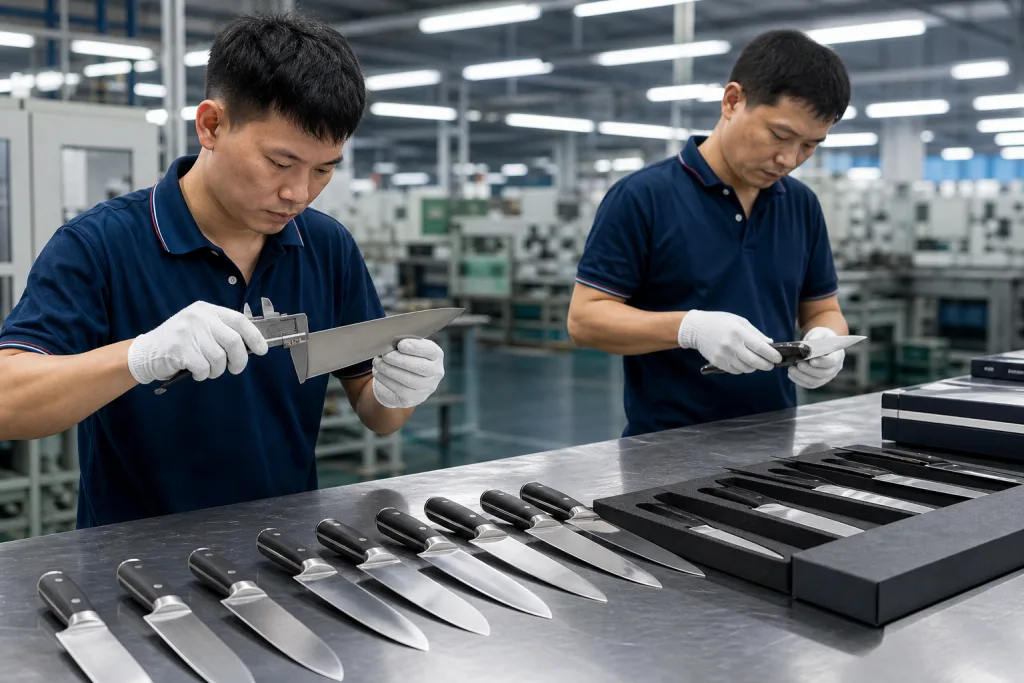
Liner lock folding knife manufacturing looks easy until QC fills the sheet with repeat notes: side-to-side blade play over 0.20 mm, lockup at 15% on one knife and 55% on the next, weak detent snap, and pivots backing out after 300 open-close cycles. We catch it on the bench with a Mitutoyo dial indicator and a T8 driver. Not in a meeting. Last month QC pulled 32 pcs from a 500 pcs pilot run and flagged 7 for uneven lock feel before packing. For EDC and outdoor brands, those misses turn into returns, one-star photos, and a buyer asking why batch two does not feel like the signed approval sample.
If you source liner lock folding knife manufacturing from a Yangjiang, Zhejiang, China manufacturer, “what is your unit price?” is the wrong first question. The knife is a stack: blade tang geometry, liner spring force, pivot tolerance, washer thickness, stop pin position, and heat treatment all need to land in the same window. Move one part and the lock shifts. We can run a clean blade at 58-61 HRC and still lose the build when QC pulls a sample with shallow lock bar engagement or a detent hole off by 0.15 mm. Small miss. Big headache. The math does not work when the grinding line, drilling jig, and final assembly table are each chasing their own tolerance.
How liner lock geometry really works
Treat the liner lock as a loaded spring, not a steel tab. On our grinding line, a 0.15 mm shift at the lock face can change the bite enough for QC to pull the sample, even when the blade profile and G10 scales match the drawing. If spring force drifts between 500-piece batches, the lockup angle drifts too. Same look. Different failure.
Critical dimensions on the production line
If you only approve a visual sample, you are buying a lucky assembly. If you approve dimensions, fixtures, and functional limits, you are buying a process.
Steel, liners, and heat treatment
For buyers, the practical question is not “What steel is best?” It is “Which steel, heat treat window, and liner thickness give me acceptable performance at my target FOB?”
QC checks that catch blade play
For liner lock folding knife manufacturing, QC signs off the action before anyone argues about polish marks. We run lockup on the bench with a 0.15 mm feeler gauge and a closing check jig; if the blade has side play, closes off-center, or the liner bites only the tang corner instead of the lock face, QC pulls the sample before packing sees a carton. Pretty handles won’t save a loose lock. The buyer will flag it on the first open-close test.
OEM sourcing terms buyers should lock down
That is also where a solid partner in Yangjiang or Zhejiang adds value. They can tell you which spec changes are real upgrades and which are just cost.
Failure modes and how to prevent them
A liner lock is not a guess if the drawing calls out the lock face angle, liner thickness, and stop-pin diameter in mm. Last month on our grinding line, QC pulled 32 pcs from a 500 pc pilot run; 3 showed late lockup after ceramic tumbling rounded the lock face by about 0.08 mm. That is where orders get expensive. Nice samples mean little. Production has to survive tight pocket clips, dusty hands, and 12 months of warranty emails, and we have seen this go sideways when the buyer approves a sample but leaves the lock geometry as “same as sample” on the PO.
Frequently asked questions
For most OEM programs, MOQ is 500-1,000 pcs per SKU. Simple models with standard steel and packaging can sit near the lower end, while custom handles, special finishes, or mixed-color runs usually push you higher. If you need laser logos, custom boxes, or accessory kits, plan for extra setup time and a slightly higher unit cost. A factory in Yangjiang or Zhejiang will often quote differently for a repeat order versus a first production run because the tooling and process controls are already proven.
A practical target for many EDC liner locks is 58-61 HRC. That band gives a workable balance of edge retention and toughness for steels like 8Cr13MoV, 9Cr18MoV, D2, and 440C. If you go too soft, the edge dulls quickly. If you go too hard, you raise the risk of chipping or heat-treatment variation. Always ask for batch hardness reports, not just one sample reading, because one measured knife does not prove the whole lot.
Use a functional test, not a visual check. Lock the blade open, apply lateral pressure by hand, and confirm there is no perceptible side-to-side movement. Then verify the lockbar contact area, centering, and pivot torque on the same unit. For production control, request a first article report and final lot check under AQL 2.5 for appearance, plus a stricter 100% functional screening if the model is premium or safety-sensitive. Blade play is usually a stack-up problem, not a packaging problem.
For a standard liner lock folding knife, sampling usually takes 7-15 days after the spec is locked. Mass production is commonly 35-55 days after sample approval, depending on steel availability, surface finish, and packaging complexity. If the job needs new tooling, a custom clip, or special heat treatment control, add time. Ask the factory to separate sample time, production time, and shipping time so you can see where the schedule risk really sits.
At minimum, ask for dimensional drawings, steel and hardness records, first article inspection data, packaging specs, and batch traceability. For export programs, you may also need REACH-related declarations, carton labeling details, and any retailer-specific barcoding or FNSKU requirements. If the factory claims ISO 9001, that helps, but the real proof is whether they can show actual process records from Yangjiang or Zhejiang, not just a certificate on the wall.
Request a controlled OEM quote
Send your target price, blade steel, and lock requirements. We will map the tolerances, QC checks, and lead time before production starts.
Request a Quote