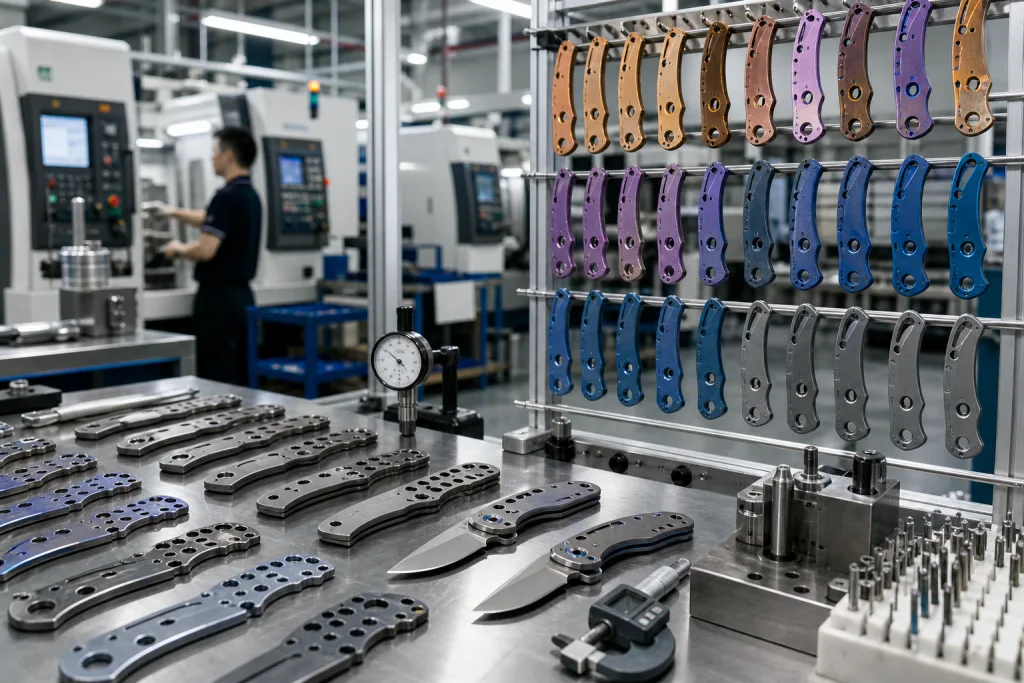
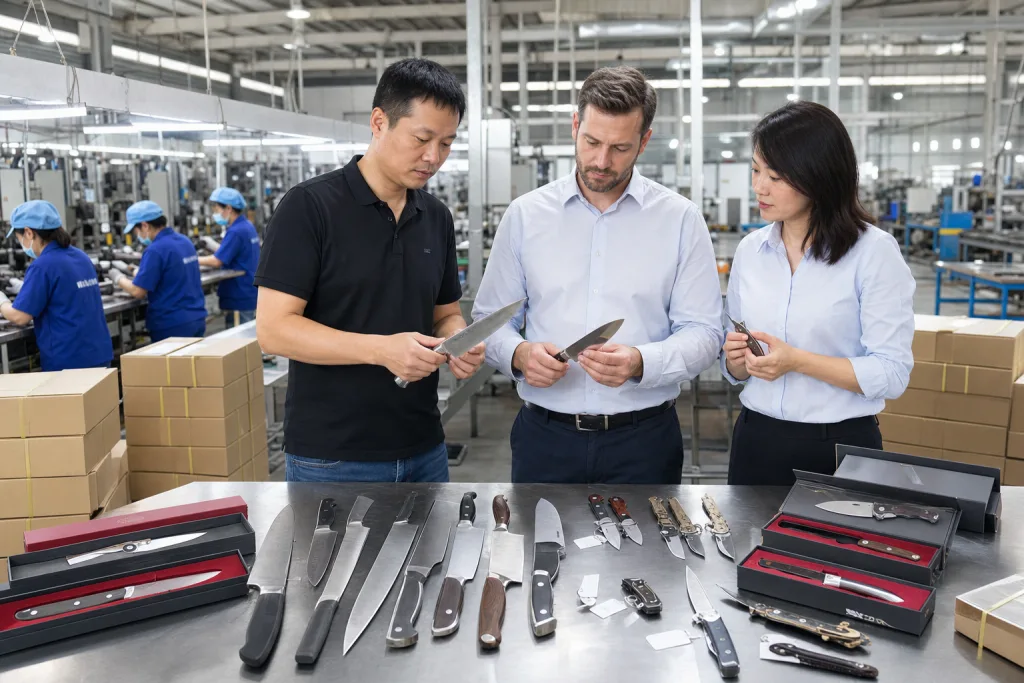
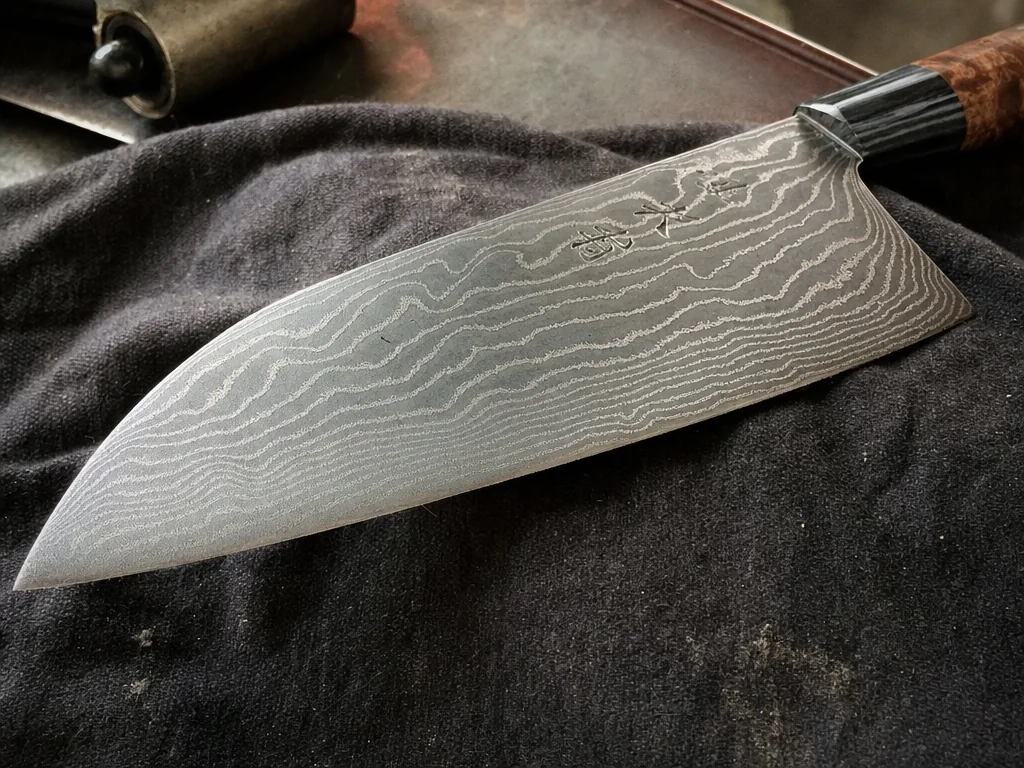
If you are buying a nakiri knife OEM program for retail, the drawing is only page one. We run most orders at 165 mm or 170 mm, with a 1.8-2.2 mm spine at the heel, a flat push-cut feel, and a shelf look that does not swallow the FOB. The carton, barcode label, color box, and retailer margin still need room. From Yangjiang, Zhejiang, China, we have seen 24-piece trial cartons pass sample review, then lose margin because the buyer added a thicker insert tray after the quote. Better to set blade thickness and steel grade against the target shelf price first, then check handle weight and box finish on the packing table before PP approval. Showroom lights are kind. One polished sample can lie.
A nakiri sells because shoppers understand it in 5 seconds: straight edge for vegetables, easy add-on beside chef knives and paring knives. Simple story. Trouble starts when the edge is 0.6 mm behind the bevel, the balance point sits 18 mm too far forward, or QC pulls a sample with uneven satin lines from the grinding line. Then it feels like a short cleaver with no clear job. A good kitchen knife private label brief gives the factory numbers to hold in mass production: blade length and spine thickness for cutting feel, HRC target for heat treatment, handle material and logo position for shelf appearance, MOQ and packing style for cost control. Asking for “premium feel” is the wrong question to ask; the math and the spec sheet need to agree.
Why the nakiri sells in retail
The nakiri sells because the shopper understands it in 5 seconds. No lesson on Japanese blade profiles needed. From arm's length, it reads as a vegetable knife: straight edge for full board contact, tall blade face so sliced cucumber rides up the steel instead of spreading across the board. On our sample table, buyers usually pick up the 165 mm nakiri before they ask about HRC; the shape sells faster than the spec sheet. At the last Canton Fair, one buyer tapped the spine with his fingernail and said, "This one is for salads, right?" Good sign.
For kitchenware brands, the nakiri fills a clear slot in the range. A 165 mm or 170 mm nakiri sits between a paring knife and a chef knife without taking the same job from either SKU. It becomes the knife for cucumber rounds, cabbage strips, herb piles, and onion prep when the customer wants clean push cuts. We run it often in 3-piece and 5-piece sets; one EU buyer flagged the carton mockup because the nakiri looked too close to the chef knife, so we raised the blade height to 50 mm. The set made more sense on shelf. Small change. Better read.
Do not call it a vegetable cleaver unless you mean it. This is the wrong question to ask in 7 out of 10 retail briefs we see. A vegetable cleaver tells the shopper to expect a heavier Chinese-style blade, while a nakiri is flatter, thinner, and built for control. For a kitchen knife private label program selling into Europe and North America, push sharpness and easy vegetable prep, not novelty. QC pulled one pre-shipment sample last month because the grinding line left the edge too thick at 0.45 mm behind the bevel; that is the kind of detail that decides whether the knife feels right in a customer demo.
- Best retail length: 165 mm or 170 mm
- Typical blade height: 45-55 mm
- Common use case: vegetable prep, herb chopping, clean push cuts
- Price logic: clear utility, low explanation cost, good attach rate in sets
Build the spec sheet first
For a nakiri knife OEM quote you can compare line by line, start with a spec sheet that leaves the factory no room to fill in blanks. We have watched 7 programs die at RFQ stage because the buyer mailed one sample and wrote “durable and sharp” in the email subject. That is not a spec. The sample room can trace the profile with a contour gauge, but the grinding line cannot price stable mass production without blade dimensions, steel grade, hardness, and surface finish targets.
For a nakiri, the base dimensions are plain. Write blade length, blade height, spine thickness, edge angle, handle length, total weight, and balance point, then write the inspection method beside each one. Caliper check. HRC tester. Digital scale. If you leave these blank, the factory will run its own tooling. We have seen this go sideways: a 180 mm blade landed at 245 g with 2.6 mm spine thickness, and the buyer flagged it as too heavy for Western retail users after QC pulled the sample from the first pilot batch.
| Spec item | Practical target | Why it matters |
|---|---|---|
| Blade length | 165-180 mm | Fits normal retail shelf expectations and gives enough cutting area for daily vegetable prep |
| Blade height | 45-55 mm | Gives knuckle clearance; buyers usually check this flat nakiri profile before they check the handle |
| Spine thickness | 1.8-2.2 mm | Cuts cabbage and onion cleanly while still surviving carton drop tests and normal export handling |
| Steel hardness | 56-58 HRC | Works as a safe default for mainstream stainless programs and keeps edge-chip claims under control |
| Edge angle | 12-16 degrees per side | Gives a sharp retail demo cut without turning every hard chopping complaint into a factory return |
| Weight | 180-240 g | Controls hand feel; QC pulled samples outside this range usually feel cheap at the low end or tiring at the high end |
Put tolerance in writing too. If blade length tolerance is plus or minus 2 mm and the hardness window is 56-58 HRC, production has a target the line leader can check against during in-process inspection. No guessing. The wrong question is “can you make it like this sample?” Ask what tolerance they will sign on the PI. That is how you compare suppliers in Yangjiang, Zhejiang, China on equal terms instead of paying for sample-room polish that disappears after the first 500 pcs.
Choose steel for the channel
Steel is where about 30% of nakiri RFQs go wrong: the buyer pays for steel the shelf price will not carry, or saves USD 0.35 and gets returns after the first container. For most nakiri programs, austenitic or martensitic stainless is the safer pick because this knife sits in daily prep, not a display box. We run 1.4116 for price-driven sets, X50CrMoV15 when EU buyers want a cleaner spec sheet, and 5Cr15MoV at 56-58 HRC for supermarket and online sets. Simple steel wins here. It sharpens fast on a 1000 grit stone, survives damp warehouse storage for 12 days before loading, and gives QC a cleaner pass rate after the salt spray cabinet and 1.2 m carton drop test.
If you move up the line, 9Cr18MoV, AUS-10, or VG10 can support a stronger premium claim at 58-60 HRC, but only when the edge geometry is controlled and the quench process repeats batch after batch. Higher hardness looks good in the catalog. Wrong question. If the blade is ground too thin at the heel, the math doesn't work after real board use. QC pulled one 0.18 mm edge sample last season from the grinding line; the buyer liked the first tomato cut, then flagged micro-chips after onion and board testing. Chipping complaints cost more than a slightly slower cut.
For brand owners, steel has to match the sales channel. Mass retail and promotional programs need a forgiving blade that stays sharp enough for ordinary home prep and keeps after-sales emails under control. Specialty culinary lines can justify better steel and tighter grind control, especially when the buyer checks spine polish, bevel symmetry, and handle fit under a desk lamp at final inspection. We have seen this go sideways when a PO says VG10, the sample is 60-62 HRC, and the carton test shows edge damage before shipment. If you have access to CATRA-style edge retention testing, use it. If not, set one repeatable bench test: 20 cuts on tomato skin, 30 cuts on onion, then cardboard, using the same cutting board, 3 samples per lot, and the same inspector each time.
- Mainstream retail: 1.4116 or 5Cr15MoV, 56-58 HRC, better for 3,000-10,000 pc runs where returns matter more than catalog bragging
- Mid-premium: 9Cr18MoV or AUS-10, 58-60 HRC, only with stable grinding and hardness records from each heat-treatment batch
- Premium kitchen knife private label: VG10-class build with stricter grind control, checked for heel thickness, bevel symmetry, and spine finish before packing
Make the handle feel right
The handle is not decoration. It decides whether the nakiri feels like a knife the customer buys again or a 2.99 promo piece from the lower shelf. A nakiri needs forward control, because the user is push-cutting cabbage, onion, and herbs, not rocking through parsley with a curved chef blade. We test this at the sample bench with wet hands, a 10 mm carrot stack, and 20 push cuts before anyone starts arguing about color boxes. Balance and grip texture carry the sale as much as the printed logo. Sometimes more.
For standard OEM programs, pakkawood, polypropylene, ABS, and G10 all work, but they speak to different price points on the shelf. Pakkawood gives a warmer look, especially with a full tang and two clean rivets. Polypropylene is the cost fighter; we run it often for supermarket sets because it handles dishwasher claims better. G10 or micarta pushes the knife into a higher retail lane and leaves more wholesale margin. Natural wood can work, but the math gets tight: moisture control, sanding consistency, and end-grain sealing add production time, and QC pulled more than 30 handles last season for small gaps near the bolster.
In a 165 mm nakiri, a handle length of 115-125 mm is a safe range for most Western users. A total knife weight around 180-240 g keeps the blade stable without making it feel dull in the hand. The balance point should sit just ahead of the choil for a Japanese feel, or near the front of the handle for a more familiar Western grip. Small detail, big trouble. If you are building a kitchen knife private label line, ask your factory for handle cross-section drawings, surface finish notes, and laser engraving position before mass production. We have seen this go sideways after a buyer approved samples, then flagged that the logo sat 3 mm too close to the butt on the first PO.
Finish matters too. A clean satin blade, straight grind lines, and readable logo placement sell better than heavy decoration. On the grinding line, uneven satin marks show up fast under a 6000K inspection lamp, especially near the heel where the operator changes pressure. Buyers in Europe and North America accept restrained design when the edge cuts cleanly and the handle feels solid in the first five seconds. This is the wrong place to chase fancy trim.
MOQ, price, and compliance
MOQ is where sourcing gets real. In Yangjiang, Zhejiang, China, a 240-person knife factory can run standard nakiri programs at about 30,000-60,000 pieces per month if the grinding line, handle assembly, and packing benches stay on one rhythm. Start with the BOM: blade steel and thickness, handle mold, handle color, logo process, tray fit, retail box print, carton mark layout. We had one buyer ask for 6 handle colors across 500 pcs total. No chance. Each color means a separate resin batch, line change, first-piece check, and color card sign-off under the QC light box. The math doesn't work.
| Program type | MOQ | FOB target | Lead time | Notes |
|---|---|---|---|---|
| Stock blade, printed box | 500 pcs | USD 3.80-5.20 | 30-35 days | Good for a test launch when blade profile, handle mold, and master carton size stay standard |
| Custom handle color and logo | 1,000 pcs | USD 5.50-8.50 | 35-45 days | Normal private label route; confirm logo position in mm on the pre-production sample |
| Premium steel, gift box, laser engraving | 2,000 pcs | USD 9.00-14.00 | 45-60 days | Fits retail and gift programs where the shelf price can carry the box and engraving cost |
Compliance belongs in the quote. Not after the deposit. For Europe, ask for REACH-related declarations on handle material, printing ink, coating, and any glued component, then check that the supplier name matches the test files and the PI. We have seen one PO spell the factory name two different ways; the buyer flagged it during document review. For food-contact orders, LFGB or FDA papers depend on the selling market and the part touching food. ISO 9001 tells you the factory has a basic quality routine; larger retailers often ask for BSCI before they release the vendor code. For shipment control, AQL 2.5 is a common acceptance level for appearance, quantity, and packaging. QC pulled samples on one nakiri order last season because the barcode was 8 mm too close to the carton edge. If the program ships DDP into Amazon or a distributor warehouse, lock carton dimensions, gross weight, and barcode placement before mass production starts on the grinding line.
Inspect the knife like a buyer
QC on a nakiri cannot be a soft checklist. The blade is honest: straight edge, flat profile, wide face. Bad work shows fast under a 600 mm inspection lamp. We check blade straightness first, then spine polish and the grind line on both faces; edge balance gets checked with a paper cut and a board cut, not just by eye. On the grinding line, if the taper runs off by 0.3 mm near the heel, the knife feels cheap as soon as the buyer picks it up.
Cut the sample. No shortcut. The knife should break tomato skin cleanly and slide through onion layers without heavy wedging. We run 20 chops on a PE board and watch whether the edge tracks straight. If the handle is bolted, riveted, or molded, twist it by hand and run a fingernail across the seam. QC pulled one sample last month because the rivet sat proud by about 0.2 mm. Small defect. Big complaint. If it is laser engraved, wipe it 30 times with a damp cloth and check that the logo stays readable without scorching the coating.
For export batches, we run a final inspection plan with visual checks and cut tests, not a carton glance at 5 p.m. AQL 2.5 for appearance and count is a normal starting point, with fixed checks for blade width, spine thickness, handle fit, and edge alignment. Ask the supplier to record hardness by batch, not by one sample piece; on VG-10 orders, we still want the Rockwell tester record, not a photo of a single blade marked 60-62 HRC. Require photos of the pre-pack label, inner carton label, and master carton shipping mark before release. If you sell through retail or ecommerce, add barcode verification, FNSKU labeling where needed, and outer cartons that can pass a drop test. We have seen this go sideways: the knife was fine, but one wrong digit on the carton label caused 312 units to sit in a warehouse.
Good factories do not push back on this. They already use the caliper, Rockwell tester, barcode scanner, and packing table records every day. The wrong question is whether inspection slows shipment. Ask whether you want to find the problem in Yangjiang, with the goods still on our packing table, or after the buyer flags it.
Frequently asked questions
Not exactly. A nakiri is usually thinner, flatter, and lighter than what most buyers mean by a vegetable cleaver. The nakiri is built for clean push cuts and fast prep, while a Chinese-style vegetable cleaver is often wider and heavier. For retail, that difference matters because it changes the story, the balance, and the price point. A standard nakiri for home kitchen sales is often 165-180 mm, around 180-240 g, and 56-58 HRC if you choose mainstream stainless. If you call it a cleaver, some buyers will expect a much heavier blade and may judge the knife incorrectly.
For a practical nakiri knife OEM program, expect 500 pcs if you use a stock blade and simple printed packaging, 1,000 pcs if you want custom handles or laser logo work, and 2,000 pcs or more for premium steel plus gift packaging. In China, custom tooling is not the only cost driver; handle color, box structure, and accessory inserts also push MOQ. A factory in Yangjiang, Zhejiang, China with stable kitchen lines can usually keep lead time around 30-45 days for standard builds, but premium programs often need 45-60 days. The cleaner your spec sheet, the lower the risk.
For most retail nakiri programs, 1.4116, X50CrMoV15, or 5Cr15MoV at 56-58 HRC is the safest commercial choice. It is easy to sharpen, resists rust well, and tolerates ordinary home use. If you are building a higher-margin line, 9Cr18MoV, AUS-10, or VG10-class steel at 58-60 HRC can support a better story, but only if your heat treatment and grind control are consistent. Do not spec a hard steel and then ignore geometry. A 58-60 HRC blade with a poor bevel is worse than a simpler steel with a clean edge. For Europe and North America, balance performance with compliance and warranty risk.
For a nakiri, stamped construction often gives you better value and cleaner cost control unless you are targeting a premium forged story. A stamped blade can be thin, light, and very effective for vegetable prep, which is exactly what most shoppers want. Forged builds may look more substantial, but they usually add cost, weight, and lead time without improving sales unless your market expects a heavier feel. If your target wholesale price is under USD 8.00 FOB, stamped is usually the smarter route. If you go forged, specify the bolster, taper, and handle weight carefully so the knife does not feel front-heavy.
Ask for the basics first: ISO 9001, a recent BSCI audit if you need retail compliance, and clear documentation for REACH, LFGB, or FDA-related material declarations. Then check whether the factory can hold hardness in a narrow band, for example 56-58 HRC for mainstream stainless. You should also ask for carton photos, barcode verification, and an AQL 2.5 inspection plan. A real export factory will not dodge questions about blade angle, handle material, labeling, or lead time. It will have answers, samples, and a production calendar. If the supplier cannot explain packaging and inspection in detail, they are not ready for European or North American buyers.
Send Your Spec For A Quote
If you want a nakiri knife OEM program sized for your channel, send your target price, blade length, and packaging brief. We can turn that into a factory-ready spec.
Request a Quote