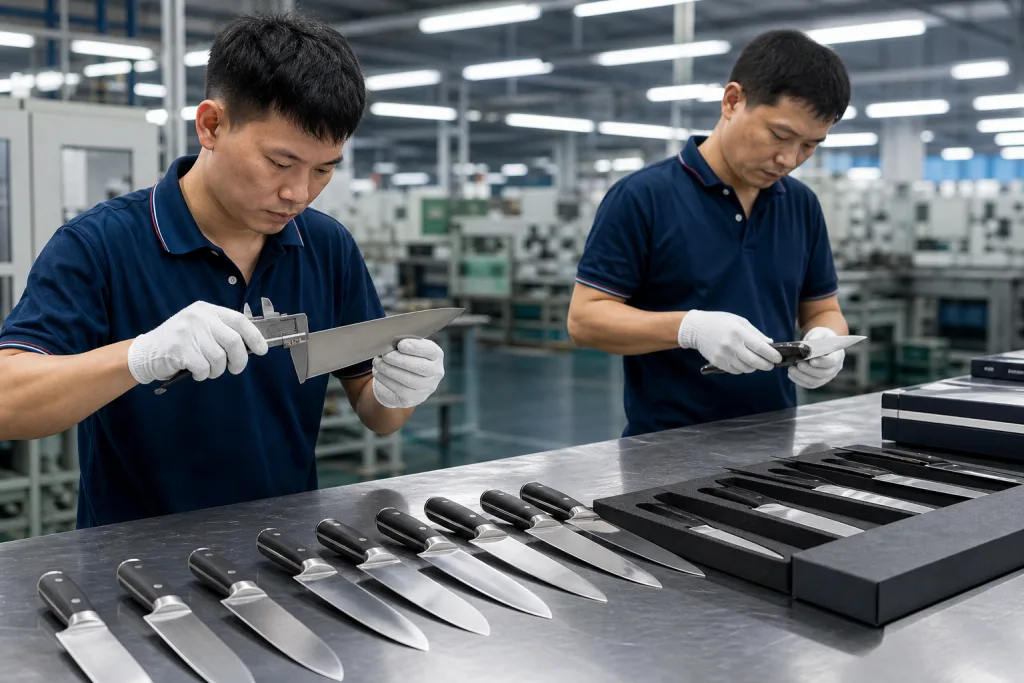
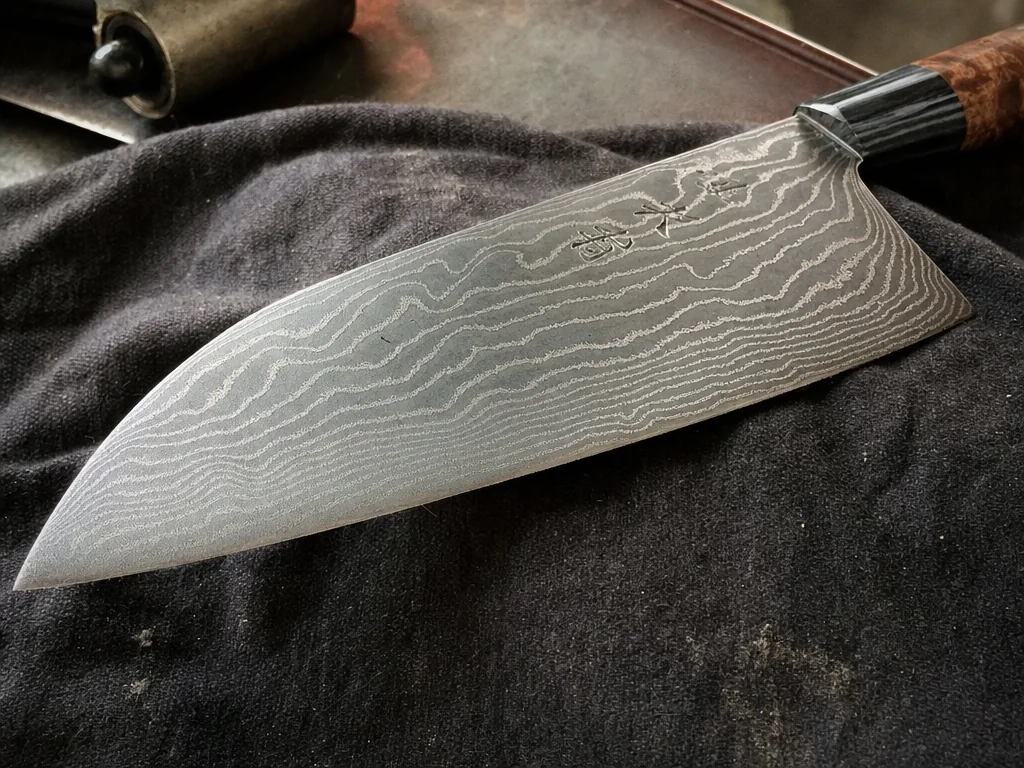
Buyers asking about nakiri vs usuba are usually choosing between two customer jobs, not two blade shapes. A nakiri is a double-bevel vegetable knife, so retail staff can sell it fast: flat edge, clean push-cuts, familiar sharpening angle. Simple SKU. An usuba is single-bevel and less forgiving. QC has to check the ura, edge line, and bevel consistency under the inspection lamp; if the grind is off by even 0.3 mm, the buyer will see it when slicing a 2 mm cucumber sheet.
If you are sourcing from a nakiri vs usuba manufacturer in China, start with your sales channel and after-sales risk. In Yangjiang, Zhejiang, and the wider China knife supply chain, we see brands put nakiri into retail sets and Amazon cartons because returns stay lower; usuba works better as a specialist SKU with training notes, sharper carton warnings, and a buyer who understands single-bevel use. For a factory running 240 employees and output around 300,000 pieces per month, this is not a cosmetic choice. The math changes on the grinding line: one usuba batch can need 2 extra edge checks per carton, more hand correction, and packaging copy that says which side to sharpen. We have seen this go sideways. One importer came back after 17 pieces in a 500-piece order were sharpened by customers on the wrong side.
What actually changes between them
Start with geometry. A nakiri is a double-bevel vegetable knife in most export orders, with a mostly flat edge for push cuts on the board. Simple knife. Easy sell. An usuba is single-bevel, built for cleaner vegetable faces, katsuramuki peeling, and prep where a 1 mm steering error shows in the slice. That one-sided grind changes the order sheet fast: sharpening instructions must state right-hand or left-hand use, and QC has to check food release on the ura side, not just the front bevel. On our grinding line, a 165 mm nakiri can pass with the normal left-right bevel check at 15 degrees per side; an usuba needs the ura side checked under the bench light, or QC will pull the sample for uneven hollow and burr drag.
For a brand owner, nakiri vs usuba sourcing is the wrong question if it starts with appearance. A nakiri sells faster to home cooks and culinary schools because the user does not need a knife lesson before chopping cabbage. An usuba belongs in chef catalogues and Japanese-style kitchen ranges where the customer already knows katsuramuki or fine vegetable prep. In China, including Yangjiang and Zhejiang suppliers, I would put the real number at about 7 out of 10 factories able to quote both, but maybe 3 of those can ship both cleanly after pre-production. Double bevel is routine. Single bevel needs steadier finishing, a better hand on the wheel, and tighter edge QC, especially when the buyer flags steering on the first sample and asks for a second DHL sample before deposit.
Size matters too. Most nakiri models sit in the 165 to 180 mm range. Usuba can use similar blade length, but blade height, taper, and grind decide whether it feels correct or awkward. For first-time users, nakiri wins. Simple math. For a specialist knife that shows craft and technical credibility, usuba gives the stronger story, but the math does not work if the factory treats it like a flat-edged nakiri with one bevel removed. We have seen this go sideways when a PO says “single bevel” and the artwork still shows a double-bevel edge icon, then the buyer asks why the carton label and sample knife do not match.
Who should source each knife
If your brand sells through Amazon, DTC, department stores, or broad cookware retail, nakiri is the safer commercial pick. A merchandiser can sell it in one PDP line: flat-edge vegetable knife, double bevel, easy for home cooks. Put cabbage or celery in the photo. Done. On our side, we run about 6 nakiri samples for every 1 usuba sample through the grinding line, because the double bevel holds steadier at 15-17 degrees per side. QC also sees fewer first-round edge comments during AQL 2.5 inspection, mostly because the buyer is not fighting single-bevel expectations on the first carton. Fewer surprises.
Usuba belongs in a tighter range. It makes sense when your assortment already has chef knives, sashimi tools, or a Japanese-style series where buyers understand single bevel geometry. It sells to professionals, culinary schools, and serious home cooks. Not cart-fill shoppers. We have seen this go sideways: one buyer placed a usuba beside USD 19.99 kitchen sets, got chipped-edge reviews in week two, then pushed the complaint back to the factory. The math does not work. If your average basket value is around USD 35 to 80, nakiri fits better. If you are building a premium set with knives in the USD 70 to 180 range, usuba can work as a hero SKU or an advanced-user add-on, but the PO must state right-hand or left-hand grind before we open the production sheet. One missing word there can hold the line for half a day.
Service load matters too. Nakiri creates fewer support tickets because the double bevel forgives off-angle cuts, rushed washing, and home sharpening on a basic 1000 grit stone. Usuba is strict. If the customer chips the edge or sharpens the flat side like a Western knife, your after-sales team may hear about it in 12 days, not 18. QC pulled one usuba sample last month for a 0.3 mm overgrind near the heel; on a single bevel, that small mark shows fast under the inspection light. That is why importers in China-sourced programs often start with nakiri, then test usuba after 2 or 3 repeat knife orders prove the audience is ready. If you need broad volume with lower return risk, nakiri is the better sourcing decision.
Spec targets that matter in OEM
For a nakiri vs usuba OEM quote, we start with the spec sheet, not the sales copy. Edge geometry first. Steel and finish next. For nakiri, we usually set blade length at 165 or 180 mm, spine thickness around 1.2 to 1.8 mm, and hardness around 56 to 60 HRC for stainless steels such as 5Cr15MoV, 7Cr17MoV, or better grade options if the target FOB can carry it. On the grinding line, QC checks the first 20 pcs with a Mitutoyo digital caliper before the operator opens full speed. For usuba, the grind gives less cover: the bevel must be clean, the blade face has to stay flat, and the steel band usually sits harder, often 58 to 61 HRC depending on the steel family and selling market. Small miss, big scrap.
The handle drives half the complaint rate. Nakiri usually ships with Western POM, pakkawood, or stabilized wood handles because buyers place it as a daily vegetable knife for broad retail. Usuba often sells better with wa-style handles or a slim octagonal profile, especially when the brand copy talks about Japanese technique. We run handle length, tang structure, bolster style, and logo position before sampling starts; last month one PO had a 3 mm handle-length typo and the buyer flagged the sample as “unbalanced.” Fix the drawing first. Cosmetic revisions will not save a wrong handle spec, and a nicer laser logo will not fix a handle that pulls the balance 12 mm too far back.
From a sourcing angle, asking whether the knife is “premium” is the wrong question. Ask whether your spec repeats at 500 pcs, 2,000 pcs, and the next reorder. In a Yangjiang production line, a double-bevel nakiri keeps a consistent feel more easily than a single-bevel usuba, because the bevel check is faster and the flatness rejection rate is lower; on one 1,200 pcs usuba run, QC pulled 37 blades for face waviness before polishing. We have seen usuba projects go sideways when the buyer wanted a clean 58 to 61 HRC single bevel but accepted loose tolerance notes on the sample sheet. The math doesn't work. Usuba is not a bad choice. It needs a sharper brief, with tolerance targets tight enough to survive production and field use in China-export programs.
Cost, MOQ, and lead time
Blade shape is not the first thing that moves the quote. Finish work, steel grade, handle spec, laser logo depth, and box construction move it first. We run basic OEM nakiri jobs in China around FOB USD 2.80 to 6.50, depending on steel, handle, laser logo, and box. On the last 420J2 nakiri quote, the buyer changed from a white carton to a magnetic gift box; that added USD 0.42 before the grinding line even touched the blade. Small change. Real money. Usuba costs more when it is made properly. Single-bevel grinding eats more bench time, the edge needs cleaner refinement, and QC rejects more pieces for uneven shinogi lines. A realistic FOB band is USD 4.50 to 10.00 or more for better-made programs, especially when the inspector checks the bevel under a 10x loupe instead of just wiping the blade and packing it.
MOQ usually starts at 1,000 to 3,000 pieces per SKU for standard OEM work, with the final number tied to handle tooling, packaging, and steel availability. For usuba, we often quote 1,000 to 2,000 pcs, but the math gets tight if the buyer wants a new pakkawood handle mold for one color and only one trial PO. Lead time is commonly 35 to 55 days after sample approval and deposit. Custom packaging, gift box inserts, or serial laser marking add another 7 to 15 days because the packing line waits for printed materials and barcode checks. We have held finished knives for 6 days because the PO barcode had one wrong digit. For a true small-batch usuba with high polish and strict edge finish, expect higher cost and slower output; QC pulled samples before for a 0.3 mm bevel drift, and that delay was real.
| Item | Nakiri | Usuba |
|---|---|---|
| Typical FOB | USD 2.80 to 6.50 | USD 4.50 to 10.00+ |
| Common MOQ | 1,000 to 3,000 pcs | 1,000 to 2,000 pcs |
| Lead time | 35 to 50 days | 40 to 55 days |
| Buyer risk | Lower | Higher |
For price-sensitive programs, nakiri gives more room to protect margin. For specialty positioning, usuba can carry a higher ticket if the finish and story hold up: clean single bevel, stable edge, good polish, and insert card copy that does not look copied from a catalog. The buyer will notice. We have seen this go sideways when a buyer asks for usuba pricing at nakiri cost. Wrong question. In China, a difficult knife does not land at the same cost as a simple one, and the grinding line will prove it before the first AQL 2.5 inspection starts.
Quality control is not the same
QC for nakiri vs usuba should not carry the same checklist weight. A nakiri needs a straight edge line, even left-right grind, no visible warp on the granite surface plate, tight handle fitting, and a clean factory edge before packing. Simple enough. A usuba needs all of that, then a slower check on single-bevel geometry, blade flatness, and steering through a real carrot or daikon cut. QC pulled 12 pcs from a 300 pcs pilot lot last month; 2 looked fine on the bench but drifted right in cutting. We checked them again on the granite surface plate. The visual pass failed us.
For commercial sourcing, ask the factory for controls you can measure: edge retention testing, 0.3 to 0.5 mm tolerance targets where appropriate, and incoming steel certification where the program needs traceability. If you sell into Europe or North America, confirm REACH, LFGB where applicable for food-contact components, and packaging compliance. For tighter factory discipline, ask for ISO 9001 process control and AQL 2.5 inspection for major defects on finished goods. We run HRC spot checks on the Rockwell tester and record blade thickness before grinding; without those numbers, the supplier is just saying "trust us," and the math does not work.
At the factory level in Yangjiang or Zhejiang, good production is not only machine output. It means holding the same bevel angle from the first PP sample to the last export carton. On a busy grinding line, the difference between acceptable and annoying often comes from finishing control, not the base steel. For usuba, a 0.2 mm shift at the shinogi line can change the cut feel and make the buyer flag steering in the first kitchen test. For nakiri, the user may never notice. That is why usuba needs a bigger QC budget, not a prettier inspection report.
Branding, compliance, and packaging
Branding should match the work on the cutting board. Nakiri sells better in simple retail packaging with clean vegetable-prep photos and plain claims like “easy vegetable prep” or “straight-down chopping.” Usuba needs technical copy that names the single-bevel grind, katsuramuki-style work, and right-hand or left-hand handling. Short copy costs orders. Last month QC pulled a 180 mm usuba sample from the packing table; the color box only said “Japanese chef knife,” and the buyer flagged it because their shop staff could not explain the bevel at the counter.
For private label runs, laser engraving and blade etching are normal add-ons, and custom boxes start to make sense around 500 pcs per SKU. A nakiri can ship in a paper sleeve or kraft box for retail and promo channels. Usuba needs an insert card with sharpening angle, storage notes, best use, and a small bevel diagram if the buyer accepts the artwork space. This is not decoration. We have seen this go sideways: one customer used a single-bevel usuba like a Western chef knife, then sent back photos of edge chips after two weeks. The math does not work when one unclear card turns into a return claim.
Compliance belongs in the brand file, not only the shipping file. For North American buyers, FDA-related food-contact expectations and clear material declarations matter. For Europe, REACH and retail packaging marks matter. For an Amazon-ready program, we run FNSKU labeling, carton marks, and outer-box drop-test checks before carton artwork is signed. In China, 7 out of 10 packaging problems we see start because the box is decided after the grinding line has already run the first 2,000 blades. If you are working with a nakiri vs usuba manufacturer in Yangjiang or elsewhere in China, lock packaging before mass production, not after sample approval. Reprinting 3,000 color boxes because one PO typed “USUBA” as “USABA” is a bad use of 12 days.
A practical sourcing decision
Source nakiri first if you want lower return risk, cleaner retail copy, and fewer home-cook complaints. Source usuba only when the buyer wants a premium Japanese-cuisine line and will accept user training plus tighter QC. Simple fork. The blade shape is not the hard part; the real sales question is how much education, QA, and after-sales work your team can carry when 1 carton comes back with “too hard to sharpen” written on the claim sheet. We saw that exact note after a customer ran a single-bevel edge through a pull-through sharpener.
For most kitchenware brand owners, nakiri should be the first SKU. We ship it with fewer complaints because the double bevel feels familiar, the box copy is easier, and the grinding line can hold the edge geometry across a 1,000-piece run. Usuba fits brands already selling chef tools, but it needs sharpening guidance, honest product photos, and tighter factory control on bevel side, blade flatness, and final burr removal under a 10x loupe. QC pulled one usuba sample last season because the bevel photo on the PO showed right-hand grind, but the buyer's listing copy said universal use. That goes sideways fast. If your sales team cannot explain the knife in 20 seconds, the buyer will not buy it in 10. The math doesn't work.
When you shortlist a supplier, ask for two samples side by side, not one. Test chop feel on carrots and onions, then check herbs for bruising. Resharpen both samples and see whether the edge comes back clean after 6 passes per side on a 1000-grit stone. QC should pull a sample through dense cabbage and check if the blade tracks straight within 1-2 mm; we run that check on a flat cutting board, not in the showroom. This is the fastest way to separate a real nakiri vs usuba manufacturer from a factory that only knows how to laser a logo. In Yangjiang, Zhejiang, and the wider China supply chain, the right partner repeats the same result across 1,000 pieces, not just one pretty sample.
Frequently asked questions
For most retail programs, yes. A nakiri is easier to understand, easier to sharpen, and less likely to generate complaints. It usually works better in the USD 35 to 80 price range because customers do not need special training to use it. Usuba can sell well, but it needs more education, stronger product pages, and a buyer who already understands single-bevel knives. If your channel is broad-market ecommerce or general kitchen retail, nakiri has the better conversion profile.
For a standard stainless nakiri, 56 to 60 HRC is a practical range. It balances sharpness, durability, and easier sharpening for consumer use. For usuba, many programs target 58 to 61 HRC, depending on the steel and the market. Harder is not automatically better. If the steel is too hard for the intended use, you increase chipping risk and after-sales complaints. Ask the factory to match hardness to the channel, not to chase a number for marketing.
For custom knife OEM work in China, a common MOQ is 1,000 to 3,000 pieces per SKU. Nakiri usually sits comfortably in that range because the double-bevel grind is easier to repeat. Usuba can also be produced in similar volumes, but if you request premium polish, special handle tooling, or custom packaging, the MOQ may move up. A smaller batch is possible in some factories, but the unit price rises fast because setup costs are spread over fewer pieces.
Not strictly, but it usually makes more sense. A wa-handle or slim octagonal handle supports the balance and positioning expected from an usuba. If your brand wants a more modern Western presentation, you can use a different handle, but make sure the ergonomics do not fight the blade geometry. For nakiri, Western handles are common and often better for mass retail. The handle choice should match your customer, not just the aesthetic brief.
Set measurable specs before sampling: bevel angle, flatness, hardness, edge sharpness target, and visual finish standards. Require pre-production samples and a first-article check. For usuba, add cutting tests on vegetables and confirm the knife tracks straight without pulling. Ask for AQL 2.5 on finished goods and make sure the factory understands your packaging and labeling requirements. In practice, the best risk control is to choose a factory that already makes similar single-bevel knives at scale, not one that is guessing.
Send your knife brief for quoting
Tell us your target price, bevel type, steel, and MOQ. We will match the right nakiri or usuba spec from our China production line and flag the risks before sampling.
Request a Quote