Oyster knives look simple on a sample table. Service is rough. We see failures when the guard is under 18 mm, the tip bends during the twist, or the handle turns slick after 20 minutes in saltwater and sanitizer. If you source for a barware or seafood-tool brand, the product photo is the wrong first check. QC pulled one sample last season that looked clean under the light box, but the tip folded at 7 N.m on our torque jig.
At our 240-employee factory in Yangjiang, Zhejiang, China, we start most oyster knife OEM projects with one question: will this knife work first at a raw bar counter or inside a seafood gift kit? That answer sets the steel, guard geometry, handle finish, and packaging before we cut the first sample. Standard MOQ is often 1,000 pcs, with lead time around 35-45 days after sample approval. We run most specs at HRC 52-56, set the guard wide enough to stop the thumb, and leave enough tip thickness for twisting shells without snapping. One buyer pushed for a thinner, sharper tip because it looked “premium”; the math doesn’t work when staff are opening 300 oysters a night.
Define the Use Case First
Price comes after the job. A cocktail-bar oyster knife doing 200 covers a night is not the same knife a seafood market drops into a rinse tub 30 times a day. We ask for shell size, hand size, right- or left-hand bias, and the user: trained shuckers or weekend guests. For an oyster knife OEM project, the spec sheet needs to fix blade length, overall length, handle thickness, guard style, and pack count per carton. Leave those blank and the EXW price looks clean, but the first sample will wander. It always does. QC pulled one last year with a 2 mm handle gap because the PO only said “comfortable grip.”
A practical spec sheet should include these points:
- Blade length: usually 65-90 mm for most retail and foodservice use; 75 mm is the size we run most for mixed oyster cartons.
- Overall length: often 150-210 mm; short handles suit gift packs, while 190 mm and above gives better palm support when the shucker is working in wet gloves for a full shift.
- Handle finish: smooth for gift sets; textured or overmolded for seafood counters where the knife sits in water between batches and the buyer flags any slip during sample testing.
- Packaging: single card, pair pack, restaurant bulk, or gift box; confirm inner box quantity before carton artwork starts, or the carton dieline gets revised twice.
- Branding: laser mark for stainless blades, pad print for plastic handles, or embossed logo when the mold budget allows it and MOQ can carry the tooling cost.
If you sell through distributors, ask for one sample built for abuse, not display. Drop it. Dunk it. Open 50 shells. A seafood-tool buyer in China or Europe will care more about wet-glove grip than a polished rendering, and “make it premium” is the wrong question to ask. We’ve seen this go sideways when the buyer approved a nice photo but never tested the guard height on a real shell. Good oyster knife OEM sourcing starts with usage, not aesthetics.
Guard Design Stops Injuries
The guard is the safety part buyers under-spec most. On an oyster knife, the hand sits 8-12 mm from the blade shoulder, usually wet, cold, and pushing hard. If the guard is too small, or treated like decoration, the index finger slides forward and the cut happens fast. We check it on the sample bench with wet cotton gloves, a taped 30-second twist test, and a 1.5 kg push on the blade shoulder. Dry showroom demos are almost useless.
For barware and seafood lines, I want a guard with a real mechanical stop, not a soft flare made for nice catalog photos. Wrong question: “Can we make the guard smaller so it packs cleaner?” The math doesn't work if the buyer wants a safe knife and a tight retail insert. If the handle is round, we run texture or TPR overmold so the grip does not roll in the palm. If the handle is slim, the guard still needs enough projection to catch the finger without jamming in a 12 mm gift box insert. Feel matters. The user should know the blade direction without looking, because the shucker is watching the oyster, not the knife.
During sampling, ask the factory to test the guard with wet hands, nitrile gloves, and 50 repeated twist motions per sample. If the handle shifts, the guard still has to block the finger. QC pulled one sample last season because the guard looked fine in CAD but missed the glove by about 3 mm during twisting; the buyer flagged the same issue after their chef test. We have seen this go sideways. This is one of the simplest ways to separate a serious oyster knife OEM manufacturer from a generic knife assembler in Yangjiang, China. A logo does not stop slips; the geometry does.
Tip Strength Beats Sharpness
7 out of 10 first-time buyers ask us for a sharper tip. Wrong target. An oyster knife needs a controlled, rounded point that gets into the hinge and stays alive when the user twists sideways. If the point is too fine, QC sees tiny chips after the pry test, often during the first 30-piece check. If the blade is too thin, it flexes and feels cheap in the hand. On our grinding line, we pass the sample with a tough tip and a spine thick enough to take side torque, even if it does not look as “sharp” in the showroom photo.
For most oyster OEM runs, 420J2 or 3Cr13 is the steel that makes sense. Saltwater resistance beats a fancy cutting edge here. A typical HRC band of 52-56 works well for this category. Go above that and the math gets bad: the tip gains hardness but gives up toughness. Go below it and the buyer flags the sample as soft after opening 20-30 shells. We run the Rockwell tester first, then I check the blade shoulder to handle transition under a 10x loupe, because that spot takes the load when someone leans hard into a tight shell.
Put 3 numbers on the drawing: spine thickness at the base, thickness near the tip, and tip radius. A useful starting point is 2.0-2.8 mm at the base, with a progressive taper and a rounded tip radius, not a needle point. We have seen this go sideways when a PO only says “sharp tip” and the sample room guesses; one barware buyer rejected 2 rounds because the approved sample and mass production drawing used different tip notes. If the factory cannot explain those mm targets before tooling, you are not yet talking to a disciplined oyster knife OEM manufacturer.
Materials and Compliance Matter
For seafood service, the material stack beats the product photo. Always. The blade sits in salt water, crushed ice, and 50 sink-and-dry cycles, so we check the tip and heel for orange spots after a 24-hour salt cup test. The handle still needs grip after sanitizer, not just a nice catalog color. A polished finish should pass a buyer's eye on a retail peg and still wipe clean behind a bar at midnight. Ask for material declarations by component. A generic product certificate is the wrong question to ask; QC pulled one sample last month where the 420J2 blade passed, but the blue TPR colorant paperwork was missing from the file.
| Part | Common options | Buyer note |
|---|---|---|
| Blade | 420J2, 3Cr13, 2Cr13 | Good corrosion and cost balance for seafood use; check the tip after salt testing |
| Handle | PP, TPR overmold, ABS, Pakka wood | PP and TPR give better wet grip; for dishwasher orders, confirm the handle after 65°C wash cycles |
| Finish | Polished, bead-blast, stonewash | Polish wipes clean faster; bead-blast hides small rack marks from the grinding line |
| Compliance | LFGB, FDA, REACH | Request reports by material, with blade, handle, and colorant listed separately |
If your market is Europe, LFGB and REACH are not optional paperwork. For North America, food-contact declarations and traceability carry the same weight. A serious supplier in Yangjiang, Zhejiang, China should show material batch records, colorant details, and test reports for the handle and blade finish. We run this check before mass production because the math does not work after 3,000 pieces are packed, cartons are sealed with 12 kg gross weight labels, and the buyer flags a missing batch number on the PO.
How OEM Sourcing Works in China
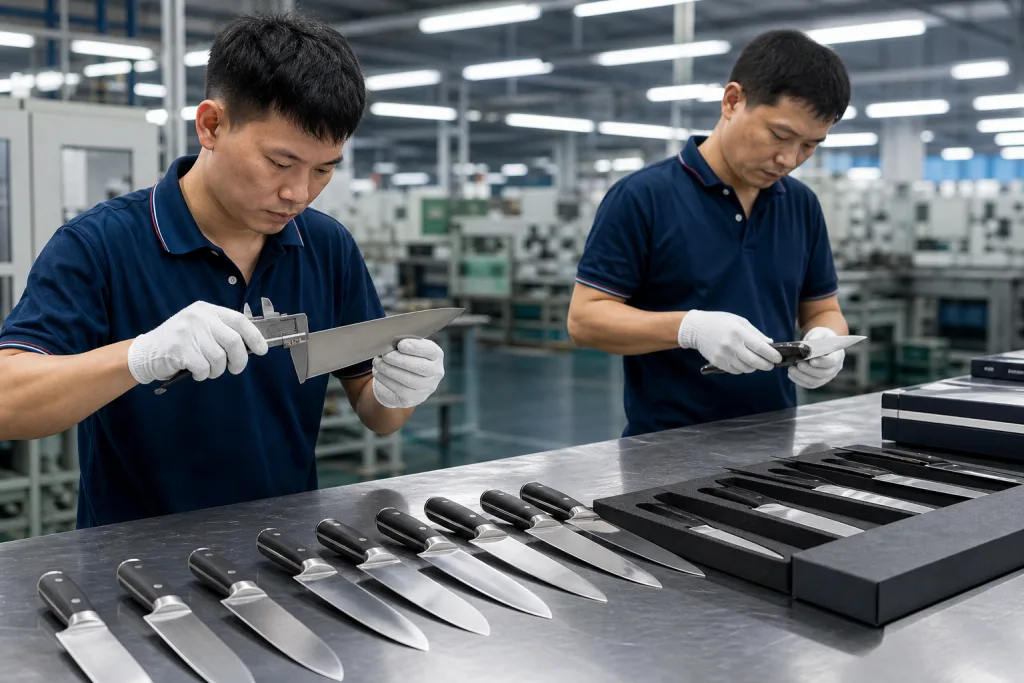
A clean oyster knife OEM order should run in one line: brief, drawing, sample, approval, production, inspection, shipment. Keep it tight. The brief needs blade length in mm, guard shape, steel grade, handle material, logo position, carton pack, and sales market, plus one reference photo if the buyer has it. If the PO only says “oyster knife, black handle,” the grinding line has to guess the blade belly, guard height, and handle texture. That gets expensive fast. We convert a proper brief into a dimensioned drawing and a sample schedule, then QC checks the first sample with digital calipers before anyone releases 1,000 pcs to the line.
At our 240-employee factory in Yangjiang, Zhejiang, China, monthly output for oyster shucking knives usually sits around 18,000-25,000 pieces, depending on handle complexity and packaging. Standard MOQ is often 1,000 pcs for a private-label run. Special handle colors, new PP or TPR molds, or 3-piece seafood gift sets can push that to 3,000 pcs because the mold room needs setup time and the packing line has to test the tray fit. Lead time is usually 35-45 days after sample sign-off; repeat orders can save 7-10 days when carton artwork, EAN barcode, and inner box size are already confirmed. We ship faster when nobody changes the warning label after mass production starts.
When you compare suppliers, ask who owns the drawing, what happens if the first sample needs a 1.5 mm guard adjustment, and whether the plant runs laser engraving or pad print in-house. Ask who checks the insert card text. We once saw a buyer flag “shucking” misspelled on a gift box after the pre-shipment sample, and the math did not work after 1,000 printed cartons were already stacked by the packing table. Oyster knife OEM sourcing is not just unit price; this is the wrong question to ask first. The real test is whether QC pulled the sample early enough to catch small details before your selling season closes.
Price, Packaging, and Quality Checks
For this category, FOB knife price is the wrong question to ask. Landed cost means the knife, printed carton, PET insert, EAN-13 barcode sticker, compliance file, and the defect rate QC records sitting on the table. A retail oyster knife might ship as a single blister, a 2-piece gift set with EVA tray, or a 24-piece bulk foodservice pack; we run separate packing labor sheets and carton CBM for each style. Small change, big bill. Last month a buyer asked why the same knife was USD 0.07 higher in a gift box. Simple answer: 18 minutes extra packing time per 100 sets, plus a larger master carton that dropped the loading count by 312 sets. For DDP pricing, send the destination postal code, carton count, and expected annual volume. Three lines. Without them, the math doesn't work.
On quality, I would not accept a program without an AQL 2.5 plan for general defects and zero tolerance for sharp burrs, loose handles, and cracked guards. QC pulled the sample after grinding last week and found a 0.3 mm burr near the tip; that knife fails, even if the pad-printed logo looks clean. Ask for a wet-grip test, a logo clarity check under the inspection lamp, and a torque check around the tip using the same twist a restaurant worker makes at the shell hinge. We use a gloved hand and a steel fixture on the bench, not a showroom demo. If the tip stays bent after that test, the steel or heat treatment is too soft. If the guard moves under thumb pressure, the handle or tang design needs work. We document this before shipment with photos, defect counts, and carton numbers.
Packaging is part of the product, not decoration. Barware brands often push for a cleaner shelf face and matte printed card. Seafood brands care more about 5-layer carton strength, stack height, and whether the guard rubs through the insert during transit. We have seen this go sideways: one PO had the Amazon FNSKU typed with one wrong digit, and 36 cartons had to be relabeled before booking. Painful job. If you sell through Amazon or a club channel, ask the supplier to label cartons, master packs, and each retail unit correctly on the first run. That saves more money than shaving USD 0.01 from blade steel.
Frequently asked questions
For most seafood and barware brands, 420J2 or 3Cr13 is the practical choice. Both handle saltwater, ice, and repeated washing better than harder, more brittle options. I usually target HRC 52-56 for this category. That gives enough toughness for twisting at the hinge without making the tip feel dead. If your brand wants a more premium look, you can change the finish, handle, and branding first; you do not need exotic steel to sell a good oyster knife. Ask the supplier for material certificates, heat-treatment range, and corrosion expectations before you approve the sample.
It is the main safety feature. A weak guard is a real problem because hands get wet, cold, and fatigued during service. I want a guard that gives a physical stop, not just a visual shape. In practice, that means enough projection to catch the index finger and enough texture or overmold to keep grip stable. During sampling, test it with wet hands and gloves, then repeat the motion 20 times. If the hand can still creep forward, the design is not ready for bar use. A better guard reduces injury claims and improves buyer confidence at retail.
For a standard oyster knife OEM run with existing tooling, a realistic MOQ is often 1,000 pcs. If you want custom handle color, special packaging, or a new mold, 3,000 pcs is more common. Lead time is usually 35-45 days after sample approval, then add a few days if you need carton art, barcode labels, or export documents revised. Repeat orders can be faster if the supplier already has your approved packing spec. In Yangjiang, China, a good factory should tell you the schedule in writing and not hide behind vague estimates.
Yes, and that should be part of the quotation from day one. Most oyster knife OEM programs support laser engraving on the blade, pad print on the handle, or a printed insert card in the box. If you sell into retail, ask for a shelf-ready pack with barcode, SKU, country of origin, and if needed FNSKU or distributor label placement. For Europe, check LFGB and REACH needs before approving colorants or coatings. For North America, confirm food-contact documentation and carton labeling. It is cheaper to get packaging right before mass production than to relabel thousands of units later.
Use AQL 2.5 for general inspection and zero tolerance for sharp burrs, loose handles, bad logo placement, or cracked guards. I would also request a wet-grip check, a tip torque test, and a visual review of the finish after cleaning. If the knife is for retail, check carton drop resistance and print registration on the box. If it is for foodservice, focus more on handle security and corrosion risk. A serious oyster knife OEM manufacturer should give you an inspection report, photos, and carton counts before loading. That keeps the shipment predictable and makes claims easier if something slips through.
Send your oyster knife spec
Give us the target market, guard style, steel preference, and pack format. We will turn that into a quoted OEM plan with FOB and DDP options.
Request a Quote