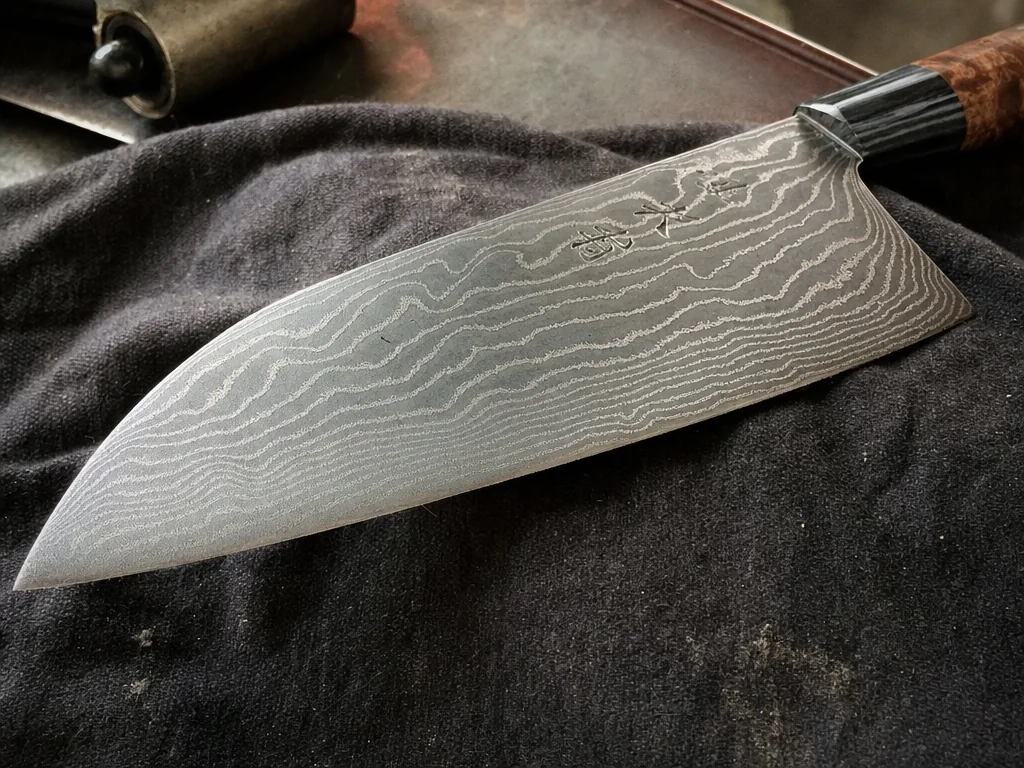
If your range jumps from a small paring knife straight to a full chef knife, buyers see the hole in about 30 seconds. A petty knife, usually 120-150 mm, covers the prep where the chef knife feels bulky and the paring knife is too short: shallots, strawberries, herbs, garlic, citrus, fat trimming, and other close work. We have had buyers flag this during sample review with one blunt PO note: “Need middle knife.” Fair point. In retail sets, that missing blade is often the one customers pick up first.
For a petty knife OEM program, asking whether it can just be a smaller chef knife is the wrong question. The math does not work. Geometry and balance need to fit close control, especially around the tip and heel. On our grinding line, we check that area by mm, not by eye, and QC pulled samples before when the heel was too thick for clean board contact. From our factory in Yangjiang, Zhejiang, China, we see better results when the petty is built as its own SKU with a 1,000-piece MOQ, 35-45 day production lead time, and a clear job inside the set. Treat it as filler, and we have seen this go sideways.
Why the petty belongs in the set
The petty is the middle blade most kitchen sets forget. Sell only a paring knife and a chef knife, and the cook has two bad choices: a short blade that runs out of reach, or too much steel sitting on the board. The set feels short one tool. A solid petty knife OEM program fills that gap with one blade for trimming, peeling around curves, and shallow slicing. It should not make daily prep feel clumsy. On our grinding line, the better 135 mm samples usually come in around 1.8 mm at the spine before final polishing, and that is where the hand feel starts to make sense.
For most sets, 120 mm to 150 mm is the working range. At 120 mm, it behaves like a large paring knife, good for trimming fat, cleaning fruit, and small hand work. At 135 mm, it earns its place as the utility blade for herbs, tomato tops, citrus, sausage, and quick board cuts. At 150 mm, it starts to touch the small-chef-knife slot, which can work when the buyer wants one extra blade in a three-piece or five-piece set. In retail sets around 3 to 7 knives, that overlap sometimes helps the shopper understand the added knife, as long as the profile does not look copied. We have had buyers flag the 120 mm version as “too similar to the paring” during sample review, then approve the 135 mm after QC pulled the same handle and finish for side-by-side checking.
Do not force the petty into a heavy, thick format. Wrong question to ask. The user is buying control, not another small chef knife. The blade should feel light out of the box, with a tip that can slip under membranes, trim strawberry tops, and reach tight cuts without twisting the wrist. If you are working with a petty knife OEM manufacturer in Yangjiang, China, ask for sample comparison across 120 mm, 135 mm, and 150 mm lengths before locking the set architecture. We run this check before tooling confirmation because a wrong blade length can add 12 days of resampling versus 3 days for a normal edge adjustment. Cheaper to catch it here. We have seen this go sideways when the SKU looked right on the PO but sold like a duplicate small chef knife.
Steel and geometry that sell
For petty knife OEM sourcing, steel and grind beat decoration. Buyers often ask for the same build as an 8-inch chef knife. Wrong question. A petty works closer to the food and closer to the fingers, so the blade has to clear orange peel, tomato skin, and garnish trimming without feeling jumpy in the hand. We run most export samples at 56-60 HRC, matched to steel family and target FOB. Below that, the edge feels tired after 2-3 prep shifts. Push it past the sensible range and QC watches the brass rod check for micro-chipping, mainly when the knife is going into a 6-piece value set with a thin plastic tray.
A practical production target is a 1.8-2.0 mm spine, tapered toward the tip, with a fine secondary edge off the grinding line. Simple spec. It gives enough stiffness for straight slicing without making the petty wedge through a shallot. We have seen 27 buyers over-spec thickness because a heavy blade looks stronger in catalog photos. The math does not work. At 2.5 mm, the sample looked solid, then the buyer flagged drag during lemon slicing and asked why the petty felt like a short chef knife.
| Steel | Typical HRC | Buyer Position | Notes for OEM |
|---|---|---|---|
| 50Cr15MoV | 56-58 | Value retail | Easy coil and bar stock in Yangjiang, stable heat treatment for entry sets when MOQ is 1,200-3,000 pcs |
| 7Cr17MoV | 55-57 | Promo and volume | Lower cost with acceptable rust resistance; edge life is shorter, so do not sell it as a premium petty |
| AUS-8 | 57-59 | Mid-tier | Good toughness and easy resharpening for export buyers; QC usually asks for 3 hardness points per blade lot |
| 14C28N | 58-60 | Higher spec | Better edge stability and stronger retail story, but only if the margin covers tighter polishing and scrap control |
Before locking steel for a run, start with our [steel comparison guide](/materials/steel-comparison.html), then ask for real hardness readings and edge-retention samples from the same batch. We ship samples with the HRC marked on the blade bag, not only typed on a PI. QC pulled one petty sample last month because the bag said 58 HRC and the test point read 55.7 near the heel. For a petty, the best spec is the one your customer can sharpen in 3 minutes and use every day, not the one with the longest material sheet.
Handle, balance, and grip choices
A petty knife earns its place only when the handle lets the user repeat the same cut 50 times without shifting grip. Short blade, small mistakes. On a 120 mm petty, we usually set the balance point about 10-18 mm in front of the bolster or front handle face, depending on steel grade and tang length. If the knife sits handle-heavy, tip control gets loose on shallots. If the nose pulls down, peeling and trimming feel jumpy. QC pulled one 100-piece sample last season where the resin handle added 9 g over spec; the buyer flagged the tip feel before they even asked about carton marks. For most retail programs, a target knife weight of 95-130 g is realistic, depending on blade length and handle material.
Handle design has to fit the set you are building. Molded ABS or POM is the clean choice for value and mid-tier retail: it stays stable in washing tests, wipes down fast, and holds shape across a 3,000-piece run from the injection mold. Pakkawood or composite gives gift sets a warmer look, but moisture control and final buffing need tighter checks; we have seen light color bands show up after the second sanding pass on the buffing wheel. If the range includes a chef knife and utility knife, match the petty handle profile so the box reads as one family on shelf. Buyers notice that. You can review handle formats in our [handle materials guide](/materials/handle-materials.html).
For grip shape, aggressive sculpting is the wrong question to ask. A petty is used in short bursts, often with a pinch grip, so the spine, choil, and heel transitions need smooth finishing from the grinding line and hand-polish bench. We run a fingertip check along the choil because a 0.3 mm sharp corner is enough to create a hotspot complaint. Rounded edges reduce hand fatigue and cut returns, especially on repeat prep work like strawberries, garlic, and small fish trimming. In a Yangjiang, Zhejiang, China factory, this comes down to mold accuracy, belt-grit sequence, and final hand feel. Simple work. Real shelf impact. A petty that feels balanced and calm becomes the blade customers reach for first.
MOQ, lead time, and OEM specs
Commercially, the petty earns its slot because it drops into an existing knife program without a full line reset. At our factory in Yangjiang, Zhejiang, China, we run a new custom petty knife OEM SKU from 1,000 pcs; sample development takes 10-15 days, and bulk production takes 35-45 days after sample approval. Good test size. A brand can put a 120 mm or 150 mm petty beside its paring and chef knives, then check sell-through before paying for a full block set. On the grinding line, we check spine thickness with a digital caliper before polishing. If the approved sample is 1.8 mm and bulk creeps to 2.2 mm, the buyer feels the heavier tip on the first cut.
The spec sheet should be short and tight. List blade length, overall length, steel grade, HRC, blade thickness, edge angle, finish, handle material, logo method, packaging, carton quantity, and inspection standard. Miss one line and the workshop will fill the blank. We have seen this go sideways from one PO typo: “matte handle” became “mirror handle,” and QC pulled the sample only after the logo pad had already been made. For export programs, lock the inspection standard before tooling starts, usually AQL 2.5 for major defects and AQL 4.0 for minor defects, unless the retailer gives a stricter plan.
| Item | Typical petty spec | Why it matters |
|---|---|---|
| Blade length | 120-150 mm | Covers prep jobs too large for paring knife trimming and too small for chef knife board work |
| Spine thickness | 1.8-2.0 mm | Keeps the knife quick in the hand; buyers notice a heavy tip during sample review |
| Hardness | 56-60 HRC | Balances edge holding with drop resistance during retail use |
| MOQ | 1,000 pcs | Covers a first petty OEM run without loading the warehouse with slow stock |
| Lead time | 35-45 days | Fits seasonal launches when artwork, barcodes, and carton marks are approved on time |
| Inspection | AQL 2.5 | Gives retail buyers a fixed defect limit before shipment release |
For buyers who need private label or packaging support, put the petty on the same sourcing track as the rest of the set. Same handle resin batch. Same logo film. Same carton board weight. Asking only how cheap the petty can be is the wrong question. The math does not work if a petty knife saves USD 0.08 but arrives with a warmer handle color than the chef knife. We ship mixed sets often, and the buyer flags color drift faster than edge angle because it shows on the shelf in 3 seconds.
How it fits retail pricing
The petty is a blade choice, and it is also a shelf-price tool. In a three-piece set, it makes the box feel finished. In a five-piece set, it can justify the next price step because the buyer understands the job in 5 seconds. Small prep knife. Clear use. In a gift set, it makes the assortment look planned without adding much cost, especially when we already run the 120 mm or 135 mm blank on the grinding line and the same handle mold is open for the chef knife.
This is why petty knife OEM sourcing should be checked against shelf price, not only factory cost. If the petty adds USD 1.20 to 2.50 in ex-factory cost but moves the set from USD 29.99 to USD 39.99 retail, the math works. If it only adds one EVA slot, one color box revision, and no price lift, the math does not work. We have seen this go sideways during quotation review when the PO says "utility knife" but the artwork calls it "petty"; QC pulled the sample, checked the belly against the 135 mm drawing, and the naming had to be fixed before mass packing.
Use the petty to solve one real consumer problem. The customer is not asking for another blade length. They want a knife for strawberries, citrus, garlic, and small vegetables that does not feel clumsy on a 300 mm cutting board. Say that clearly. The petty sells better across Europe and North America when the packaging shows it as a daily prep knife, not a small technical add-on. If you are building a broader lineup, keep the handle shape and finish aligned with your [chef knives](/products/chef-knives.html) and core product range so the set still reads as one family when the buyer lines up 6 SKUs on the sample table.
Quality control and compliance
For export buyers, a petty knife carries the same compliance load as any kitchen knife, and gift sets add extra test points. EU orders need REACH checks on ABS, pakkawood, TPR, epoxy, color coating, and printed sleeves; our merchandiser usually asks the lab to list each material against the BOM, not just the item name. If the blade or handle claims food contact, confirm LFGB or FDA suitability where the account asks for it. BSCI and ISO 9001 files also matter when the retailer’s audit team wants the factory profile before sampling; we have had buyers pause a PO over one missing audit expiry date. It happens. In China, 7 out of 10 knife factories can grind a petty blade. Fewer keep the paperwork clean enough for a supermarket buyer, especially when the PO has three handle materials and the carton mark file has one typo in the 128 mm blade spec.
QC should start with edge consistency, tip alignment, surface finish, and handle fit. On a petty, a 0.5 mm visual offset at the tip shows fast, because the blade is short and the buyer’s eye goes straight there. Check grind symmetry and edge polish under a 10x loupe; small blades do not hide belt marks from the grinding line. For export shipments, we run carton drop tests, moisture checks on wood-look handles, and spot checks on laser logos so the mark is not burned too deep or too shallow. QC pulled a sample last month where the logo looked fine at 30 cm, but the laser had cut through the black coating at the heel. That one failed. If you need branding support, use our [laser engraving service](/services/laser-engraving.html) or [custom packaging service](/services/custom-packaging.html) so the final retail presentation stays consistent from sample room to bulk packing.
The practical rule is simple: do not treat the petty as a cheap add-on. Wrong question. It is a precision tool and a shelf signal for the rest of the set. If the petty arrives with a clean tip, even handle gaps under 0.3 mm, and no logo burn-through after the first AQL 2.5 pull, the buyer trusts the whole box faster.
Frequently asked questions
For most kitchenware brands, 120 mm to 150 mm is the right range. A 120 mm petty feels close to a large paring knife and is good for precision work. A 135 mm model covers the widest use case in retail sets because it handles herbs, fruit, and small vegetables without feeling oversized. A 150 mm petty can work if you want a more visible step between the paring knife and the chef knife. If your set already includes a 200 mm chef knife and a 90 mm paring knife, 135 mm is usually the safest commercial choice.
For value sets, 50Cr15MoV at 56-58 HRC is the standard practical choice. It is easy to source in China, predictable in heat treatment, and acceptable for most retail programs. If you want a better mid-tier story, AUS-8 at 57-59 HRC gives you a better balance of edge retention and toughness. For a higher-spec line, 14C28N at 58-60 HRC gives stronger marketing value and better edge stability. The wrong move is choosing a hard steel without proving the grind and heat treatment first, because a petty with poor geometry will still cut badly.
For a new custom petty knife SKU, 1,000 pcs per model is a realistic starting point at many export factories in Yangjiang, China. If you need multiple handle colors or logo variations, the effective MOQ can rise because each variant needs separate setup and packing control. Sample development usually takes 10-15 days, and production is often 35-45 days after sample approval. If you already have existing tooling or a standard handle platform, the MOQ can sometimes be reduced, but the tradeoff is less flexibility on finish and packaging.
Yes, but you need to manage the compliance details properly. For the EU, check REACH-related material requirements for handle components, coatings, inks, and adhesives. For food-contact positioning, LFGB is often useful, and some buyers also ask for migration or material declarations. For the US, FDA-relevant food-contact expectations may apply depending on the materials and the channel. If you are selling through retail accounts, keep ISO 9001, BSCI, and test reports ready. The knife itself is straightforward; the paperwork is what slows importers down.
Use packaging that makes the knife legible at shelf distance. For retail, a window box or printed paper sleeve works well if the blade finish and handle color are part of the sale. For Amazon or marketplace programs, make sure the barcode placement, carton count, and FNSKU labeling are decided before production starts. If the petty is sold as part of a set, the outer carton should clearly show the blade count and size mix. For value programs, keep packaging simple and durable; for gift sets, invest in a cleaner insert and better print control so the petty looks intentional, not like a filler item.
Build your petty knife range
Send your target set price, blade size, and packaging format. We can quote a petty knife OEM program with clear specs, sample timing, and export-ready documentation.
Request a Quote