Slip joint pocket knife manufacturing looks simple until the first 1,000 pcs order lands on the assembly bench. The parts look plain. The feel does not. If the blade closes weak, the spring bites too hard, or a 0.3 mm liner gap shows under the QC lamp, the whole traditional line feels cheap. We have seen buyers pass a clean photo sample, then reject bulk cartons because the nail nick pull felt different from box 4 to box 19. For a gift brand, this is not just a pocket tool. It is hand feel. The buyer decides in three seconds.
A serious slip joint pocket knife manufacturing manufacturer in China checks backspring tension and blade walk before talking steel grade and unit price. At TANGFORGE in Yangjiang, China, we run traditional pocket knives this way: set the snap first, then fit the blade, spring, liners, and handle scale around it. On the grinding line, a 0.1 mm miss at the tang can change the closing feel. QC pulled one sample last month for that exact finding under the bench lamp. Asking “Can you make it cheaper?” is the wrong question. Better ask whether the bulk order will still feel like the approved sample after 12,000 openings on the test bench. For slip joint pocket knife manufacturing sourcing, that is the difference between a sample that photographs well and a product buyers reorder.
What buyers pay for
In traditional slip joints, buyers pay for feel before they pay for features. Assisted openers and modern liner locks sell the mechanism; a slip joint sells the hand feel. Blade walk matters. Backspring pressure matters too. On our grinding line, a 0.08 mm burr at the tang can change the close from clean snap to scratchy drag, and QC will catch it before packing. For heritage counters or gift programs, the knife needs to feel deliberate without acting stiff. The joint cannot rattle. Over-tightening the pivot is just as bad. We check pull weight by hand at the bench, then confirm blade play under 0.15 mm, half-stop position when the pattern uses one, and a final close that lands tight without feeling forced.
From a sourcing side, the risk is simple. A weak sample still photographs well, but the first 200 retail buyers will feel bad snap in two seconds. We have seen this go sideways when a buyer approved handle scale color and ignored blade play. Wrong question. Slip joint pocket knife manufacturing is a mechanical fit job, not a styling job. Ask the factory for blade play in mm, spring gap target, and the pivot torque method at assembly. We run a torque driver at the bench; finger-tight assembly is not a process. If the supplier cannot explain those points, you are not dealing with a serious slip OEM. You are dealing with a reseller of generic parts. For traditional lines, that is a bad place to start.
For premium gift sets, the buyer also needs to define the intended user feel before tooling starts. A collector-style knife can take stronger snap and tighter fit, say a firm nail nick pull with no daylight at the backspring. A corporate gift knife often needs smoother action, because complaint risk goes up when office users think the pull is too hard. We had one PO where the buyer wrote “easy open” in the remarks but approved a stiff sample, and the math did not work once the order reached 3,000 pcs. The right spec follows the channel, not just the handle material.
Backspring feel and snap
The backspring sells the knife. In slip joint pocket knife manufacturing, this part wins the reorder or gets the sample rejected after 10 openings at the buyer's desk. Spring profile and heat treatment set the base feel; final grinding on the tang face decides the walk-and-talk. Too much preload feels harsh. That hard snap wears out a daily-carry user after a few open-close cycles at the counter. Too little preload feels like a promo knife from a 3,000-piece rush order. No mystery there. QC pulled one sample last month where the blade could be pushed out of closed position with 1.8 kg of force, and the buyer flagged it before we even got to the carton spec.
We run backspring tuning in three shop-floor passes. First, the spring blank goes through heat treatment and hardness check, normally in the 45-48 HRC range depending on steel and pattern. Then the grinding line dresses the spring face and blade tang contact points for that exact pattern, using the fixture for that run, not a generic drawing from last year's folder. After assembly, the team sets pivot tension with the Torx driver, then checks the closed position, full open, and the half-stop if the pattern has one. Paper specs only get you halfway. Sample rounds matter. For one traditional pattern, we may build 2-3 tuning samples before locking the production spec. One clean counter sample means little if the next 500 pieces come off the bench with a different hand feel.
Buyers ask for a 'strong snap' without saying what strong means. This is the wrong question to ask. Send a reference sample, give a target blade opening resistance, and confirm whether the pattern needs a half-stop. A half-stop gives a heritage line more character, but it adds another tolerance point at the tang, and the math gets tight when the handle is only 3 mm thick at the liner stack. We've seen this go sideways: one PO said "firm snap," the sample room built it heavy, QC measured the pull over 3.2 kg, and the buyer came back saying it felt unsafe for retail customers.
Materials that sell well
On traditional pocket knives, price comes first, then steel. If a buyer asks, "What is the best steel?", I usually ask for the shelf price first. Wrong question otherwise. For an everyday carry gift line, we run 420HC or 12C27 most often; 8Cr13MoV works when the buyer needs a lower factory price and does not need a premium steel story. It sharpens fast. The corrosion claim is also easy to defend on the sales sheet. For a collector slip joint, 154CM or a controlled Damascus build can sell, but the math doesn't work on a USD 12-15 factory-price program after mirror polishing, hand fitting, and scrap are counted. Last month in our Yangjiang shop, QC pulled 32 first-run samples from the grinding line; the main rejection was not steel failure, it was uneven bolster blending after the operator changed from a 240 grit belt to a fresh 400 grit belt too early.
| Component | Common choice | Buyer note |
|---|---|---|
| Blade steel | 420HC, 12C27, 8Cr13MoV, 154CM | Target hardness often 56-59 HRC for balance and edge stability; we check with a Rockwell tester before final assembly |
| Backspring | Stainless or carbon spring steel | Spring temper drives the snap more than the grade name on the PO |
| Liners | Brass, stainless, or nickel silver | Nickel silver gives heritage lines the older shop-counter look buyers ask for |
| Handle | Bone, wood, jigged synthetic, Micarta | Natural materials need color sorting, moisture checks, and a tighter gap limit at the pins |
For compliance, stainless blades make EU and US sourcing cleaner, but finish control still decides the claim, especially on dyed bone, coated handles, and gift-box inserts. We have seen this go sideways. One buyer flagged a PO typo that said "food grade knife set," then asked for LFGB and FDA paperwork on a pocket knife packed as a picnic gift. Fair question, but it slowed approval by 6 days because the carton artwork already showed a cutting board. The knife still gets judged on steel, fit, and finish; our normal outgoing check uses AQL 2.5, with blade rub, backspring gap over 0.20 mm, and weak half-stop called out before packing. QC uses a 0.20 mm feeler gauge at the spring and liner, not guesswork. If you need to compare steels before locking the spec, use a structured knife steel comparison instead of trusting one catalog line written for every model.
OEM process in China
A reliable OEM flow looks simple on paper. Then the grinding line checks the homework. First we need the drawing or a reference sample, not a catalog photo with half the bolster hidden. The factory confirms pattern, blade count, steel, handle material, finish, and packaging, usually down to blade thickness in mm and closed length tolerance before any die work starts. Tooling and sample production come next. A clean two-blade traditional pattern can reach a working prototype in about 12 days; a gift version with bone handle, brass liners, engraving, and custom box often needs 18-25 days because QC checks jigging depth, liner gap, logo position, and box color one by one.
At TANGFORGE, a realistic starting point for one slip joint pattern is often an MOQ of 300 pcs, with the better commercial range sitting at 500-1,000 pcs if you want stable unit cost. Lead time after sample approval is commonly 45-60 days, depending on handle supply and finish complexity. We ship more than 50,000 traditional pocket knives in a scheduled month when materials are ready, but pushing every pattern through at that speed is the wrong question to ask. QC pulled a sample last season with a 0.35 mm backspring height difference; the knife still opened, but the buyer flagged the uneven back line. Small miss. For heritage or gift brands, that costs more than three saved days.
For a slip joint pocket knife manufacturing quote, ask whether the factory handles private label, laser engraving, and packaging in-house or sends them outside. Fewer handoffs mean fewer color mismatches and delivery excuses. We have seen this go sideways when a PO said “satin bolster” but the outside engraver worked from an old mirror-polish sample. The math doesn't work when 300 pcs need rework because the barcode sticker, insert card, and bolster finish came from three different desks. If your program needs coordinated branding and ship-ready cartons, a single-source setup through OEM manufacturing and custom packaging keeps the carton mark, insert card, barcode, and knife finish under the same production check.
Quality control that matters
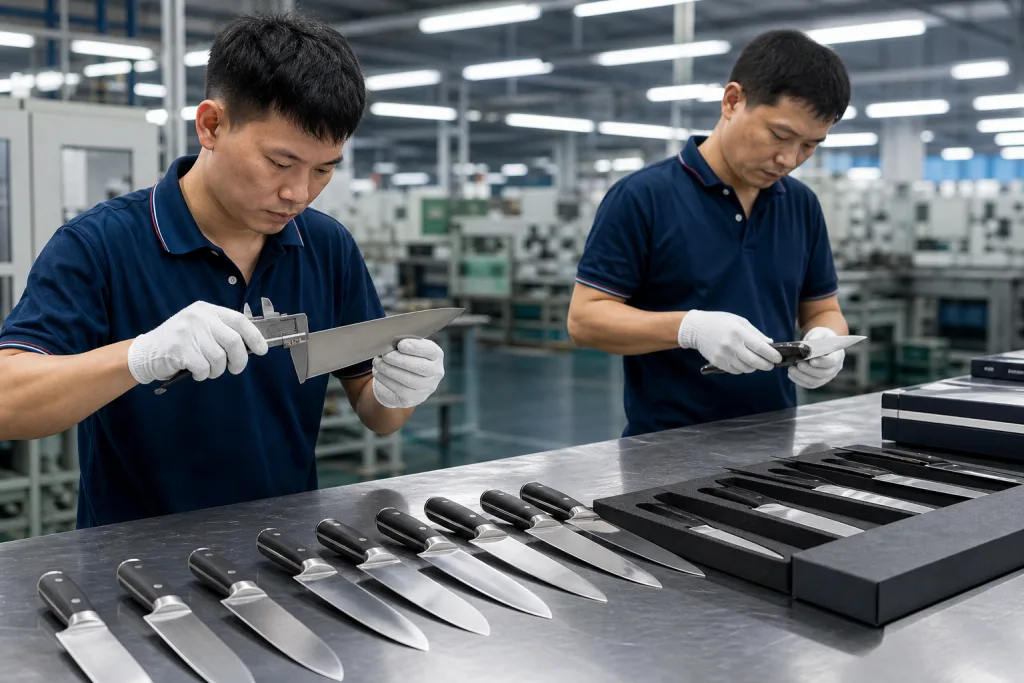
Traditional slip joints do not need show-off testing. They need inspection with teeth. We check blade play under 0.20 mm with a feeler gauge, then check centering, spring pull, scratch control, logo position, and whether the handle sits proud at the bolster. Do it early. This happens before the carton artwork reaches the packing table, while the brass liners and nickel silver bolsters are still on the QC tray. Small defects cost money. On a premium pattern, a 0.4 mm shield gap or cloudy nickel silver bolster is not “handmade character”; QC pulled samples like this before, and the buyer flagged the whole 600-piece lot as “cheap hand finish.” Sample approval must lock the tolerance before mass production starts.
A practical QC plan uses AQL 2.5 for major defects, with separate appearance checks for bone handle color, shield placement, and polishing marks around the pins. Bone causes the most buyer pushback. Define the approved shade range with 3 signed samples under the same light box, not one photo on WhatsApp taken beside a window. We mark the master sample bag with the PO number because one typo on a color code can send the polishing line back two days. Hand-finished traditional knives are not injection-molded parts, and asking every jigged bone scale to match 100% is the wrong question to ask. The math does not work. If your market is Europe, ask for REACH-related material statements where relevant. If your knife set includes food-contact accessories or packaging inserts, confirm the right documentation before shipment.
We run functional checks on every batch: open-close cycle sampling at the QC bench, blade retention review, tang wear inspection, plus a fit check at the half-stop if the pattern has one. On our grinding line, a weak backspring usually shows up after 30 open-close cycles, not on the first snap. Listen for it. One buyer once asked us to skip the cycle test to save 12 hours; we refused, because we have seen this go sideways after shipment. If you want tighter control, study the plant's knife quality inspection method and ask how nonconforming units are reworked, recorded, and rechecked. That answer tells you more than a sales sheet.
Pricing, packaging, and launch
Traditional slip joint pricing comes from bench time, not the pattern name on the quote sheet. A 3.5 inch stainless model with ABS scales and a white tuck box can land in a lower FOB band than the same frame with jigged bone, a nickel silver shield, blade etching, and a rigid gift box. The math moves fast. On our grinding line, one extra mirror-polish pass adds 6-8 minutes per knife, and QC will still pull the sample if the spring sits 0.3 mm proud at half-stop. Buyers often ask steel grade first. Wrong question. For this category, the cost is in hand assembly: fitting the spring for clean walk-and-talk, finishing flush pins without halos, and final buffing without burning the scale edge.
For heritage labels and gift programs, packaging carries part of the product promise. It also cuts complaints. If the knife is going to retail shelves or a corporate gifting order, lock the carton size, insert material, barcode format, and FNSKU label position before mass production. We have seen a launch lose 12 days because the PO said "black insert" while the approved photo sample showed kraft paper. The knife was fine. The box caused the delay. For private label work, the opening feel has to match the blade finish, shield, and handle material. A polished bolster sitting in a thin paper tray looks cheap, even when the knife passes inspection. When we run the knife build and presentation work on one schedule, we ship closer to the target date.
Use plain commercial terms. FOB is cleaner when your freight forwarder already handles pickup and export papers. DDP fits a landed-cost project where your team does not want to chase trucking, customs, and last-mile delivery. Before release, confirm the carton drop test result, master carton count, and final photo sample. We run a 1.2 m drop test on packed cartons for most gift-box orders, because crushed corners become buyer pushback before anyone opens the knife. QC pulled one sample last season for a torn corner on the inner sleeve, not for the blade. That is how launches go sideways. A traditional slip joint should arrive as one finished retail item, not loose parts dressed up with a logo.
Frequently asked questions
For a traditional slip joint pattern, a practical MOQ is often 300-500 pcs per design. If you choose natural bone, stag-style finishes, or multiple blade variants, 500-1,000 pcs is more realistic because setup and sorting take longer. For a simpler stainless model with synthetic handle and standard box, some factories in Yangjiang, China can support a lower trial run, but unit cost will be higher. Ask whether the MOQ applies per color, per handle material, or per complete SKU, because those are not the same thing.
Ask for a video of the exact sample opening and closing from several angles, then compare it with a physical sample if possible. Good walk-and-talk is not just noise; it is the consistency of resistance through the travel, the firmness at the half-stop, and the clean seating at close. A factory should be able to explain pivot torque, tang contact, and spring pressure in plain terms. If they cannot quantify or repeat the feel across 10 units, the production batch will probably drift. For heritage lines, that drift is what customers notice first.
For most gift and heritage programs, 420HC, 12C27, or 8Cr13MoV is a safe stainless choice because it balances corrosion resistance and sharpenability. Typical working hardness is 56-59 HRC. If you want a more premium spec, 154CM can work, but the rest of the knife has to support that positioning: better polishing, tighter fit, and stronger packaging. Handles like bone, wood, and nickel silver look traditional, but they need tighter moisture and color control than synthetic scales.
For Europe and North America, ask for material declarations, REACH-related statements where relevant, and factory quality records. If packaging or inserts touch regulated channels, check LFGB or FDA expectations for the accessory set, not just the knife. You should also request ISO 9001 evidence if the factory claims formal process control, plus inspection records tied to AQL 2.5. If the supplier cannot match paperwork to the exact lot number, the documentation is too generic to be useful.
A straightforward custom slip joint program often takes 45-60 days after sample approval. Add time if you need bone handle matching, custom shields, laser engraving, or printed gift packaging. If you are developing from scratch, prototype rounds can add another 10-20 days because backspring feel is usually tuned by iteration, not by one drawing. In China, the best projects move fast only after the customer has locked the feel, the finish, and the packaging spec. Rushing that step usually creates rework.
Build the right slip joint line
Send your reference sample, target retail, and packaging spec. We will align the backspring feel, materials, and QC plan before production starts.
Request a Quote