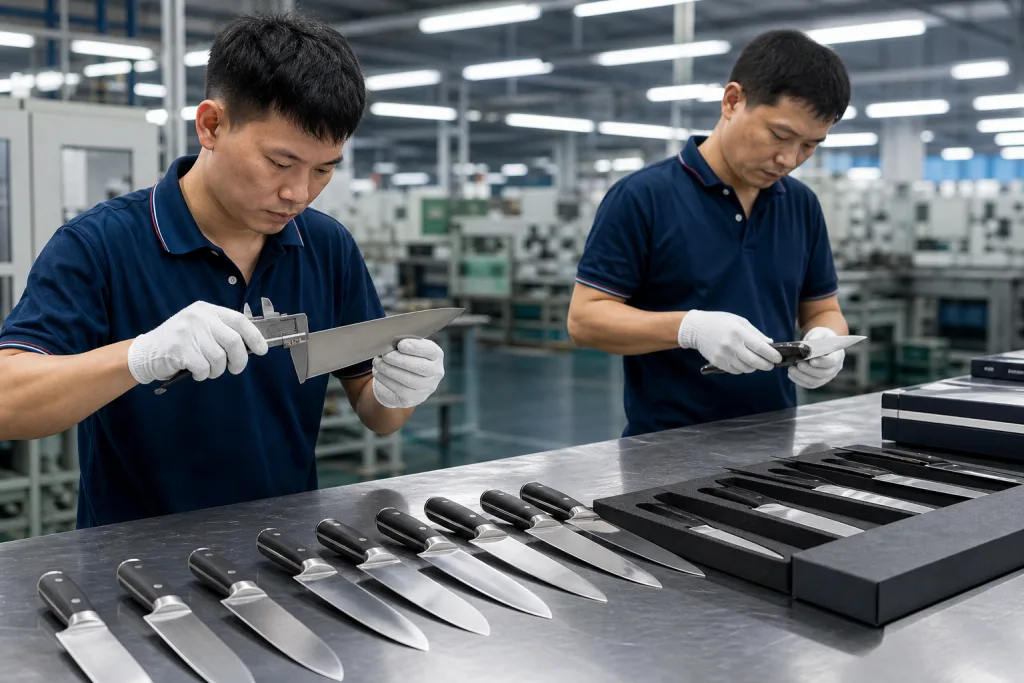
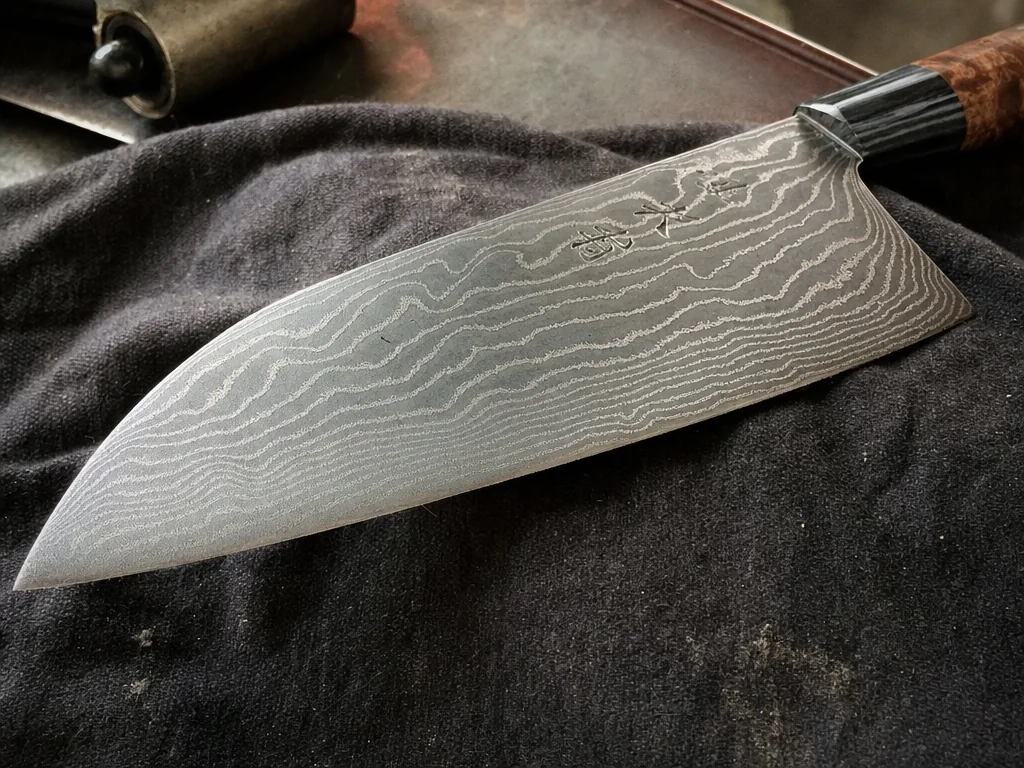
Bad slicers usually fail at the cut, not in the photo. The blade looks slim, but the spine stays too thick, the tip bites into the meat, or the edge angle is set like a chef knife. We catch this on the sample bench. QC pulled one 270 mm blade through brisket last month; it looked clean on the table, then stopped halfway at the shoulder. Not good. For brisket, roast beef, ham, and salmon, the knife has to pull from heel to tip without dragging the blade face. A sujihiki slicing knife OEM program should begin with that cutting test. Catalog shape is the wrong question to ask.
From our Yangjiang, China factory, we see buyers approve appearance first, then come back 42 days later with complaints from the carving line. We run 240,000 units per month, but the real starting point is still 500 pcs MOQ per SKU, 35-45 days for production after sample approval, and a spec sheet that fixes blade length, spine thickness, steel grade, HRC, and handle balance before tooling starts. Small numbers matter. On the grinding line, a 0.2 mm change behind the edge can decide whether brisket releases cleanly or tears at the fat seam. If you source sujihiki slicing knife OEM for a kitchenware or BBQ brand, this control protects margin and cuts returns before cartons leave our dock.
Why sujihiki geometry sells
A sujihiki is a slicer. Not a chef knife stretched in CAD. It has one job: one clean draw cut with low drag. On brisket, the edge has to catch the bark, pass through the fat cap, and leave meat fibers clean, not fuzzy. We run this on the sample bench with a 270 mm trial blade, 1.8 mm spine, and a quick paper-and-roast test before quoting. If QC sees bark tearing under the LED bench lamp, we adjust the grind before anyone talks about the gift box. The right shape is narrow, with a calm belly and a point that starts the cut without making the user saw. Most buyers in Yangjiang or Zhejiang pick the sample that feels steady through the board stroke, not the one with the loudest side profile.
Foodservice and BBQ users move fast. Gloves on. Board wet. Sauce on the handle. Geometry has to carry the cut because service hands are not gentle. Too much belly turns the knife into a skinny chef knife, and the clean draw cut is gone. Too short, and the user needs 2 or 3 strokes for one slice; we have seen buyers flag that because the brisket face looked torn in catalog photos. For most OEM lines, the useful range is 240-300 mm. We like a long flat section, a controlled tip, and blade height with enough knuckle clearance without making the knife feel tall. Start with cut behavior before handle color or logo position. Styling cannot fix bad geometry. We have seen this go sideways after a buyer approved a pretty black handle, then rejected the first carton because the grinding line left the edge too thick behind the bevel.
- Long straight edge, sized so one draw cut can finish a brisket slice without a stop mark on the meat face.
- Thin profile, around 1.8-2.2 mm on common samples, so the bark opens cleanly instead of cracking apart under pressure.
- Controlled tip geometry, checked on the sample bench, that starts cleanly at the bark and exits without lifting the slice off the board.
Blade specs that control slice quality
The spec sheet should read like a production drawing, not catalog text. Put the heel spine, tip spine, 12-15 degrees per side edge, and distal taper in mm on the file, or the factory can ship a blade that looks clean in photos but drags through brisket. For a sujihiki slicing knife OEM program, we run 240 mm, 270 mm, and 300 mm sizes; each size gets its own grind type, target weight, and balance point, usually checked at pre-production sample stage. Small numbers matter. QC pulled one 270 mm sample last year with a 2.5 mm heel spine instead of 2.0 mm, measured on the Mitutoyo caliper after the grinding line signed off. The buyer flagged it on the first test slice.
| Spec | Recommended OEM range | Why it matters |
|---|---|---|
| Blade length | 240-300 mm | Clears brisket and roast slices in one pull, so the user is not sawing back over the same cut |
| Spine thickness | 1.8-2.2 mm | Keeps the blade from wedging while still giving enough stiffness for retail handling |
| Edge angle | 12-15 degrees per side | Gives sharp factory bite without making returns spike after home users hit a board too hard |
| HRC | 58-60 | Practical hardness for stainless slicers that need edge life and fewer chipped-edge complaints |
| Blade height | 28-35 mm | Leaves knuckle clearance without turning the blade face into extra drag |
Ask for the cross-section drawing, not just the blade outline. A 0.3 mm spine change, or one flat section left by the grinding line, can make the knife push meat fibers instead of opening a clean slice. We have seen this go sideways when the PO says “thin slicer” but no one writes 1.8-2.2 mm on the drawing; one buyer sent back 12 PPS knives over that exact miss. If the factory cannot show taper from heel to tip, this is the wrong question to ask as a buyer. You are not buying a controlled slicing tool. You are buying a shape.
Steel and heat treat choices
Start with the return-rate target, not the steel name the buyer saw in a catalog. For price-sensitive carving sets, we run 14C28N or a close fine-grain stainless at 57-59 HRC; the edge comes back on a 1000 grit stone, and after-sales calls stay below about 3 cases per 1,000 pcs when the bevel is stable. For a sharper retail story, AUS-10 or 10Cr15CoMoV at 58-60 HRC gives more bite without making the grinding line chase burrs all afternoon. VG-10 or a close stainless grade can sit at 60-61 HRC for a cleaner first slice through brisket, but the furnace chart, temper time, and final edge angle need to match the PO. We have seen buyers ask for hard steel, then reject chips after 300 cuts. The math doesn't work.
On a sujihiki, a straight 270 mm edge shows heat-treat mistakes fast. Soft spots feel jumpy through roast beef. Over-hard blades chip at the heel or 20 mm back from the tip, which is where QC pulled the sample on one failed pilot run last year. Warping is worse here than on a short utility knife; the buyer will lay the blade on a table and spot a banana curve in 2 seconds. In a Yangjiang, China factory, the clean route is vacuum heat treat, controlled tempering, and a final straightness check with a flat gauge before sharpening. For upper-tier orders, cryogenic treatment can be added, but it will not save dirty steel, rushed tempering, or a wavy final grind.
- Choose steel for the end user and return-rate target, not for a brochure claim.
- Hold tempering tight across the batch, especially when MOQ pushes past 1,000 pcs and racks leave the furnace uneven.
- Test edge retention on cooked brisket and sharpening behavior on a 1000 grit stone, not just hardness.
Handle balance for repeat carving
Carving and brisket work expose handle mistakes fast. Too much butt weight makes the knife feel dead. Too little handle mass, or a palm swell below 18 mm, makes the user clamp down and fatigue after 40-50 slices. For a sujihiki slicing knife OEM project, we usually set balance at neutral or 10-20 mm blade-forward, then check it again after final buffing on the digital scale; on a 270 mm blade, the grinding line can take off 6-9 g more than the drawing suggests. Small change. Big feel. The handle needs enough mass to steady the pull stroke, but not so much that it drags through brisket. A 240-270 mm knife usually lands well in the 160-220 g total weight range, depending on steel and handle construction. QC pulled one 270 mm sample last season that looked fine on the bench, but the buyer flagged it after carving roast beef for 15 minutes. The math was simple: the rear bolster was too heavy, and we had to cut 14 g from the back end before the sample passed.
Material choice should follow the sales channel. POM works for wash-down rooms and foodservice buyers because it handles sanitizer, hot water, and daily rack storage; we ship a lot of these into hotel and catering lines with 500-1,000 pcs MOQ. G10 grips better when wet and survives BBQ use, mainly when we run a light bead-blast or shallow texture instead of mirror polish. Pakkawood or stabilized wood sells better in retail and gift channels, but moisture control has to be tighter; we reject handles with open pin gaps over 0.2 mm because water will find them. Gloves change the spec. If the knife will be used with gloves, a slick polished handle is the wrong one to approve. We have seen this go sideways after a buyer approved a glossy black handle from photos, then rejected the pre-shipment sample because the glove test failed on the carving table. For carving stations, I prefer a handle length around 125-135 mm so the user can choke up for control or move back for reach without losing purchase. Full tang construction raises perceived value. Hidden tang designs cut weight and give a cleaner premium feel when the epoxy fill, pin fit, and final contour are done properly.
OEM sourcing that protects margin
Good sujihiki slicing knife OEM sourcing starts before the coil or bar stock reaches the grinding line. Quote the blade length, steel grade, hardness band, handle material, logo method, and packing format before we open the sample ticket. We run standard China programs at 500 pcs MOQ per SKU, 7-10 days for a sample from an existing profile, and 35-45 days for mass production after approval. Custom gift boxes, printed inserts, or Amazon-ready labels add 5-7 days in the packing room; barcode position, carton marks, and 300 gsm versus 350 gsm insert paper still get checked on the bench with a caliper and carton knife. That is the timing buyers should budget when comparing Yangjiang and Zhejiang suppliers in China. Rush it, and the math does not work.
Ask for a commercial quote in FOB terms first, then DDP if you need landed-cost visibility for Amazon or a distributor warehouse. The quote should split knife cost, packaging cost, engraving cost, and carton work, because we have watched margin disappear in a USD 0.18 sleeve upgrade or a laser logo left off the first PI. For a sujihiki slicing knife OEM manufacturer relationship, approving from photos alone is the wrong question to ask. Photos hide edge waviness and handle gaps. Approve one physical sample, one packed sample, and one carton sample. QC pulled a packed sample last month where the knife passed, but the inner tray was 3 mm short and the tip punched through during drop testing. Small miss. Expensive fix. That is the minimum needed to avoid a shipment that looks acceptable on paper but fails at the warehouse dock.
- MOQ: 500 pcs per SKU for standard builds.
- Sampling: 7-10 days for existing tooling, 15-20 days for new handle work.
- Production: 35-45 days after sample sign-off.
Quality checks and compliance
A slicing knife is only as good as the inspection behind it. For commercial orders, we check blade straightness on a flat gauge, compare left-right edge symmetry under the inspection lamp, press the handle fit at the bolster, verify logo position against the approved sample, and run carton drop testing before packing release. AQL 2.5 is a normal starting point for major defects, but sharpness, satin finish, tip alignment, and inner-box packing need their own reject limits on export lots. We have seen a 2 mm logo drift get flagged by a BBQ brand buyer after QC pulled the sample from carton 7. Small miss. Big email. For Europe, confirm REACH and LFGB where applicable. For North America, check whether your handle and coating choices match FDA-related contact expectations. ISO 9001 and BSCI do not make a knife cut better by themselves. They prove the factory controls the work, from incoming steel tags at the warehouse door to the final carton stamp on the packing table.
The complaints usually start small: a loose insert, a tip bent by 1.5 mm, a burr left at the heel, or a handle scale that feels raised after washing. For BBQ and kitchen brands, the inspection routine has to match real use. We run cut tests on paper, tomato skin, and cooked brisket; then we check edge retention after a fixed cut count, not after someone says it “still feels sharp.” Wrong question. If you want a formal benchmark, ask for a CATRA-style edge retention reference on the steel you choose. In China, export factories should document incoming material checks, in-process checks at the grinding line, and final random inspection before shipment. We have seen this go sideways: saving USD 0.08 by skipping one inspection step turned into 300 warranty claims after the first carton left Yangjiang.
Frequently asked questions
Start your sujihiki OEM spec
Send your target length, steel, finish, and pack format. We will turn it into a buildable China factory spec with MOQ, lead time, and export-ready details.
Request a Quote