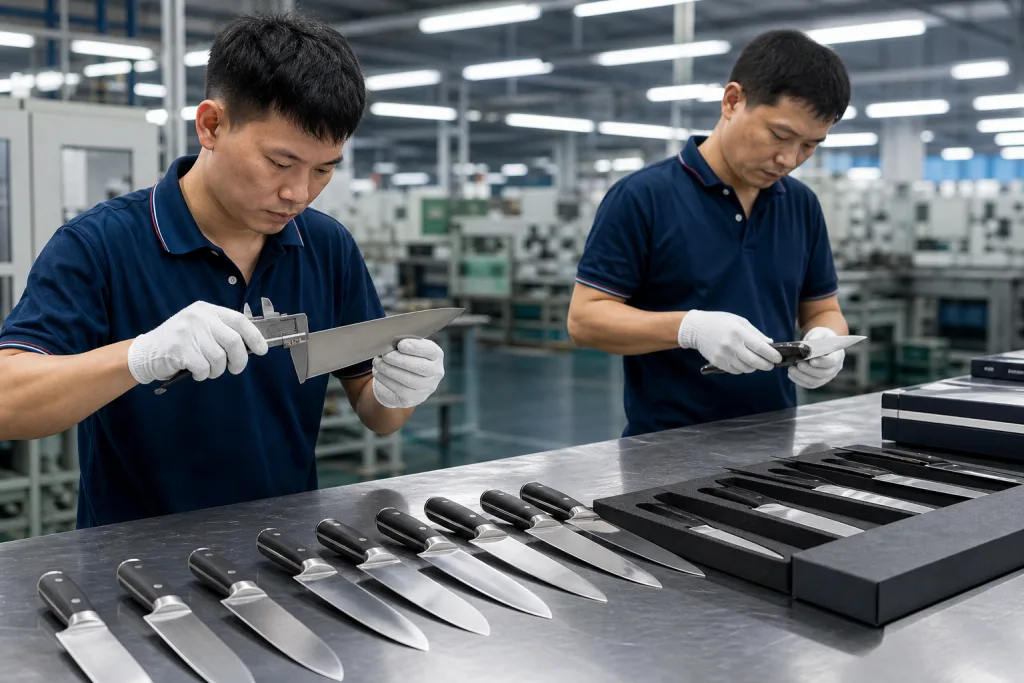
VG10 looks clean on a spec sheet. It looks different once the blanks hit the grinding line. The steel name helps sell a kitchen series, but it does not rescue a bad heat treat. We run 3 hardness checks per lot on a Rockwell tester, then QC checks edge width at the heel and tip in mm before packing. In Yangjiang, China, we have seen a 1 HRC drift turn into 800 pcs of buyer pushback after the first sharpening test, because the edge feel changed from one carton to the next. Stable programs come from process control, not the steel name. Asking only, "Is it real VG10?" is the wrong question. The bill shows up later, when hardness moves around or the edge angle shifts from carton to carton.
For a kitchen brand, "premium" is not the point. What matters is whether your vg10 knife steel sourcing manufacturer can repeat 60-61 HRC on every batch, hold the agreed bevel geometry on the belt grinder, and make the knife feel the same on the sharpening stone after 500 pcs, 2,000 pcs, and the reorder. A solid VG10 OEM line in China should show mill certificates, heat-treat batch hardness records, MOQ terms, and lead time terms, including what happens if QC pulled the sample and it drifts by 1 HRC. We have seen this go sideways when a PO says 60-62 HRC but the buyer expects 60-61 HRC. Small range, big argument. The math does not work once the blades are ground.
What VG10 Gives You
VG10 is a balance steel, not a magic steel. Buyers reorder it for that reason. Edge life beats basic 1.4116, and the chromium content handles wet prep, late wiping, and 3-5 minutes near the sink without making the customer nervous. Sharpening stays normal, so after-sales noise stays lower. On our line, QC pulled a 210 mm chef sample after a 200-carton trial because the buyer cared more about clean tomato cuts on day 10 than the hardness note on a sample card. That is the right question.
My view is simple. VG10 fits a home cook buying one good knife, a boutique shop needing a premium shelf item, or a distributor chasing margin without selling a brittle blade. At 60-61 HRC, it holds an edge and still comes back on a 1000-grit water stone or a normal ceramic rod. We run chef knives at about 0.18 mm behind the edge before final sharpening; when the geometry is clean, the user gets smooth slicing with less drag through cabbage and cooked meat. Bad geometry kills it. No steel will rescue that.
The common mistake is buying VG10 for status, then pairing it with a 0.45 mm thick grind and a 22-degree-per-side edge, plus a soft handle build that wastes the steel. The math does not work. One EU buyer flagged it on a PO last year after prep tests showed the knife wedged in onions and felt dead after 30 carrots. A good kitchen knife program starts with the use case. A 20 cm chef knife for daily prep needs a different balance than a petty or santoku, and different again from a slicer. VG10 works best when the drawing, heat treat, and grinding line stop fighting each other.
Source The Steel, Not The Story
For VG10 sourcing, the invoice by itself tells us nothing. We ask for the mill certificate with the heat number and chemistry range. The PO must also state whether we are buying strip, a blank, or a finished blade. We match that paper to the blade lot before we run the grinding line, usually while the first rack is still sitting by the 120-grit belt. QC pulled a sample on this before: the steel tag showed one heat number, the carton label showed another. If the supplier cannot tie the paper to the blades on the rack, do not buy the story.
For kitchen lines, the commercial numbers have to match the factory math. A steady Yangjiang line can run 80,000-120,000 kitchen knives per month after tooling and QC settle down, but a custom VG10 project still starts at 1,000-3,000 pcs per SKU because packing setup and handle jigs cost money. Lead time runs 35-50 days after sample approval, or 48-62 days if the buyer adds G10 handles or wants blade coating with a printed gift box. That is normal. Overnight flexibility on VG10 is the wrong question to ask. The math does not work. Heat treat runs on its own clock. So does straightening to a 0.15 mm gauge. So does final sharpening on the wet belt.
| What to Ask | Target | Why It Matters |
|---|---|---|
| Steel certificate | Heat number plus chemistry | Lets QC match each blade lot back to the mill paper |
| Hardness after temper | 60-61 HRC for chef knives | Keeps edge life acceptable without turning sharpening into a buyer complaint |
| MOQ | 1,000-3,000 pcs per SKU | Covers real custom setup, including packing setup and line-change cost |
| Lead time | 35-50 days after approval | Leaves room for heat treat and the final AQL inspection after handle fitting |
| Final QC | AQL 2.5 major, 4.0 minor | Catches bent tips, uneven bevels, and loose handle gaps before shipment |
If the quote comes in too cheap, stop and check what the factory is actually buying: true VG10 from the mill, a documented equivalent with paper, or just "VG10" typed on the PI. We have seen this go sideways over a 0.2 mm blade thickness mismatch, and once over a buyer-flagged typo on the PO that changed the finish callout. Small miss. Fast damage. On one batch, QC checked the spine with a caliper and caught the gap before packing. In China, that difference lands on your margin before the goods even ship.
Heat Treat Drives The Result
VG10 behaves well in a vacuum furnace when the chart is honest: austenitize at 1040-1080 C, quench, then double temper. We run by furnace chart records, not by the heat-treat master's memory from Tuesday. Cryogenic treatment can reduce retained austenite, but it will not fix a furnace drifting 8 C or a rack packed too tight near the door. QC pulled samples last month and found light edge decarb under a 200x microscope. Catch it there. Before any batch moves to handle assembly, we check for edge decarb, coarse grain, quench bend over 1.5 mm, and a signed temper record instead of a hand-adjusted note written after lunch.
For kitchen lines, chasing the top hardness number is the wrong question. A chef knife usually cuts best at 60-61 HRC. A slicer or petty can run 61-62 HRC if the grind is thin and the edge angle is held tight. A heavier prep knife should sit around 59-60 HRC for better durability. Push VG10 into the 63 HRC range and the math does not work for most retail buyers: we see more chipping claims than cutting benefit, especially from customers using glass boards or skipping regular honing. On the Rockwell tester, we check 3 points per blade batch; a 1 HRC swing gets a red mark on the QC sheet.
Heat treat also has to match edge preparation before shipping. Steel is not magic. If the final grind is rough, the customer feels drag even when the VG10 is sound. If the edge is too acute, micro-chipping complaints come back fast, often with photos after 7 days of home use. We have seen this go sideways when a buyer asked for a thinner edge but kept the same warranty terms. The better answer is a controlled edge angle, clean polishing on the grinding line, and a documented hardness band with narrow tolerance. Big hardness claims look good on a spec sheet; real kitchens punish them fast.
Edge Retention Versus Sharpenability
This tradeoff decides whether VG10 belongs in your kitchen line. Buyers pay for edge retention. Six months later, they complain if the knife fights the stone. One EU buyer flagged a sample after a six-month home-use panel: the knife cut 20 percent longer, but their chef needed 11 minutes to bring it back on a 1000 grit stone instead of 5. We timed it again on the bench with the same stone. Same result. The math does not work. End users call that a bad knife.
The balance comes from the full build, not the steel name. Hardness sets the ceiling. Edge angle sets bite. Thickness behind the edge sets drag. On the grinding line, a tired 600# finishing belt can leave the heel rough even when the HRC report looks strong. A 15-degree-per-side edge at 60-61 HRC with a clean 0.12-0.18 mm thickness behind the edge often beats a thicker blade at 62-63 HRC once prep starts. This is the wrong question to ask: "What is your max HRC?" Ask what the edge measures after final grinding, and ask QC to mic three spots from heel to tip with a blade mic. Skip cardboard. Cut tomatoes and onions for bite, then fish and cooked proteins for drag and control.
If possible, ask for CATRA data or a standardized comparative cut test, but do not let a lab number beat user feedback. We have seen this go sideways. For a premium kitchen line, the target is simple: the blade should come back on a 1000-3000 grit stone in 6 to 8 passes per side. It should hold its working edge through normal prep and stay controllable on the board. QC pulled one sample last quarter because the burr was still hanging at the heel under 10x magnification; the CATRA sheet looked fine, the knife did not. That middle spec is what customers buy again.
Lock Down The OEM Spec
A VG10 OEM program starts with one frozen technical sheet. We lock blade length, spine thickness, edge angle, hardness band, finish level, handle material, logo method, and packaging before we cut steel or set the grinding line. On one 8-inch chef knife order, the buyer changed the spine from 2.0 mm to 2.3 mm after sample approval. That 0.3 mm sounds small. On the floor, it meant resetting the jigs on the grinding line, QC rechecking balance at the bolster, and delivery moving from 32 days to 41 days. Nine days gone. That is where the money leaks. In Yangjiang, China, the expensive mistakes usually come from loose specs, not weak factories.
For Europe and North America, put compliance on the same sheet. ISO 9001 covers the basic quality system. BSCI matters if social compliance is part of the vendor check. REACH or LFGB belongs there where the market requires it. For U.S. food-contact components, confirm FDA relevance with your materials team before the handle insert is approved or the glue is signed off. If you add a coating, clear that too. We check the glue batch before the first carton is folded. Amazon orders need the FNSKU locked and the carton label proofed. Check pallet rules before production starts. We have seen one PO typo in the carton mark hold 620 cartons at the warehouse while the buyer pushed for shipment photos. A good supplier can handle this. The math does not work if you ask after packing.
- Steel: VG10 with heat-number traceability tied to the finished lot
- Hardness: 60-61 HRC for chef knives, tighter if the blade geometry allows it
- Edge angle: 15-17 degrees per side for most kitchen SKUs, checked on the angle gauge
- Inspection: AQL 2.5 major with a documented final check and retained samples
- Packaging: Retail-ready carton with barcode and export marks set before mass production
The goal is not a thick spec. The goal is a clear one. QC pulled the sample, checked 60-61 HRC on the Rockwell tester, confirmed the 15-17 degrees per side edge with the angle gauge, and signed the retained sample with the date. Then we can run the order again without asking five times. If production still has questions, the sheet is not finished.
Avoid The Usual Sourcing Mistakes
The same sourcing mistakes show up because they look harmless on paper. A buyer signs off 1 hand-finished sample from the polishing bench, then expects 5,000 pieces from the grinding line to match it piece for piece. Bad bet. They type VG10 on the PO but leave out the hardness window, so lot A comes in at 59 HRC and lot B comes in at 61 HRC. They check the blade face and miss the handle resin, epoxy, or carton ink; then QC pulled the sample, found the wrong LFGB wording on the label, and the buyer flagged a compliance problem for Europe or North America. We have seen a whole carton mark hold because one PO said “German LFGB” while the artwork file said “EU food safe.” Preventable.
Run the project in stages. First article approval. Then a 30-50 piece pilot. Then full production. During the pilot, check hardness, straightness, edge consistency, and cosmetic finish across 3 furnace loads, not 1 tray from the Tuesday shift. We run a Rockwell tester and a 300 mm straightedge; if a blade drifts past 0.3 mm or the hardness window moves, stop and ask for the inspection sheets. If the supplier says sample and production are the same but cannot show the furnace record, grinding record, and QC photos, push harder. This is the right place to be difficult. A 12-day launch delay is cheaper than 18 cartons of returns.
Do not overbuild the knife just because VG10 sounds premium. We have seen buyers ask for a heavy bolster and a 3.0 mm spine, then complain the knife feels dead on onions at first cut. We have seen this go sideways. For kitchen brands, keep the heel around 2.2 mm. Keep the edge bevel honest. Put QC gates against a shelf price the margin can support; if the FOB target is USD 8.60 and the spec needs extra hand grinding, the math does not work. The wrong question is “how premium can we make it?” The better question is whether the grinding line can repeat it at MOQ without rework. That is how VG10 becomes a steady product line, not a pretty counter sample that sells badly.
Frequently asked questions
Yes, if your price point supports it. VG10 makes sense when you want a premium stainless kitchen line with better edge retention than entry-level steels and a sharpening experience that normal users can still manage. For a chef knife, I would usually expect a finished retail position that can absorb a more expensive blade, better grinding, and tighter QC. If your target FOB is under USD 4-5 for a full chef knife, the margin gets tight fast unless the design is very simple. For mid-range and premium retail, VG10 is often the right commercial balance.
For most chef knives, ask for 60-61 HRC with a tight tolerance. For slicers and petty knives, 61-62 HRC can work if the blade is thin and the edge geometry is controlled. For heavier prep knives, 59-60 HRC is often safer because it improves durability and reduces chipping risk. I would not approve a VG10 kitchen program that only says "hard enough" or "premium hard." You need the actual number, the test method, and the allowed variation, ideally with a documented tolerance of plus or minus 1 HRC from the production target.
Start with paperwork and then verify the blades. Ask for the mill certificate, heat number, chemistry range, and a hardness test report from the actual production batch. Then inspect cross-sections or retained samples from at least two furnace loads. If possible, compare blade hardness at the heel, mid-blade, and near the tip so you can see whether heat treat is uniform. A real vg10 knife steel sourcing manufacturer will not hide those details. In Yangjiang, China, good factories expect these requests. If a supplier gets defensive, that is a warning sign.
Yes, if the knife is built correctly. VG10 is harder to sharpen than soft stainless, but it is still very manageable for a consumer with a 1000-3000 grit water stone, diamond stone, or a good ceramic sharpener. A 15-17 degree per side edge is practical for most kitchen users. The key is not to overshoot the hardness and not to make the edge too thin. If you send out a brittle 63 HRC blade with a delicate grind, sharpening becomes the least of your problems because users start reporting chips instead of dullness.
For a custom VG10 kitchen SKU, a realistic MOQ is usually 1,000-3,000 pcs per model, depending on handle, packaging, and finish. Sample lead time is often 15-20 days, while bulk production is commonly 35-50 days after sample approval. If you add custom gift boxes, laser engraving, or mixed handle materials, plan for more time. In China, especially in a mature plant in Yangjiang, the production line may be capable of much more volume, but the MOQ still reflects setup cost and the need to keep heat-treat and grinding runs efficient.
Lock In Your VG10 Kitchen Knife Spec Today
Send your target price, blade geometry, and channel mix. We can map the right steel, HRC band, and QC plan for a kitchen line built for Europe or North America.
Request a Quote